
In the UK, PECR's safe reading treats an AI marketing call as automated, so it needs prior consent to automated calls from you and must name you with an address or freephone number. Calls you answer need no calling consent. On Dograh, the open-source AI voice agent platform, self-hosted or on Dograh Cloud, a fixed greeting carries those lines.
Key Takeaways
- An AI marketing call needs prior consent to automated calls from your business.
- PECR fines reach £17.5 million or 4% of turnover since February 2026.
- Ofcom expects a dialer's first words within two seconds of the person answering.
PECR was written for recorded messages, and an AI agent now holds the conversation. We set out the UK rules, why an AI voice counts as automated, Ofcom's two-second rule and calls you answer. Then we give a checklist and talk about how Dograh carries each rule.
PECR in plain words
The Privacy and Electronic Communications Regulations (PECR) decide most UK calling questions, and they treat live and automated calls differently. PECR's rule on automated calls allows an automated marketing call only to a person who has told you they consent to automated calls from you. Consent to marketing in general, or to live calls, does not stretch that far.
Live marketing calls follow its rule on live marketing calls. They must not go to a number on the Telephone Preference Service (TPS), or the Corporate TPS for companies, unless the person told you they don't object to your calls. Anyone who asked you to stop is off the list too, whatever the register says.
Automated calls also carry a duty in the opening. The call must give the caller's name and a contact address or freephone number, and it must show a number people can call back. Our post on whether AI phone calls are legal puts these rules beside US and EU law. Here we stay with the UK detail a team needs before a campaign.
Why an AI voice counts as an automated call
PECR does not name AI. It covers automated calling systems, and an AI agent that holds the call with no person on the line looks a lot like one. The safe reading treats an AI voice as an automated call, as the ICO's guidance on AI does. The Information Commissioner's Office (ICO) is the regulator that enforces PECR.
That reading changes the work before the first dial. A TPS check is enough for a live sales call from a person. An AI marketing call needs the stronger thing, which is a record that this person agreed to automated calls from your business. TPS screening still matters for any human callback that follows the AI call, so most teams keep both.
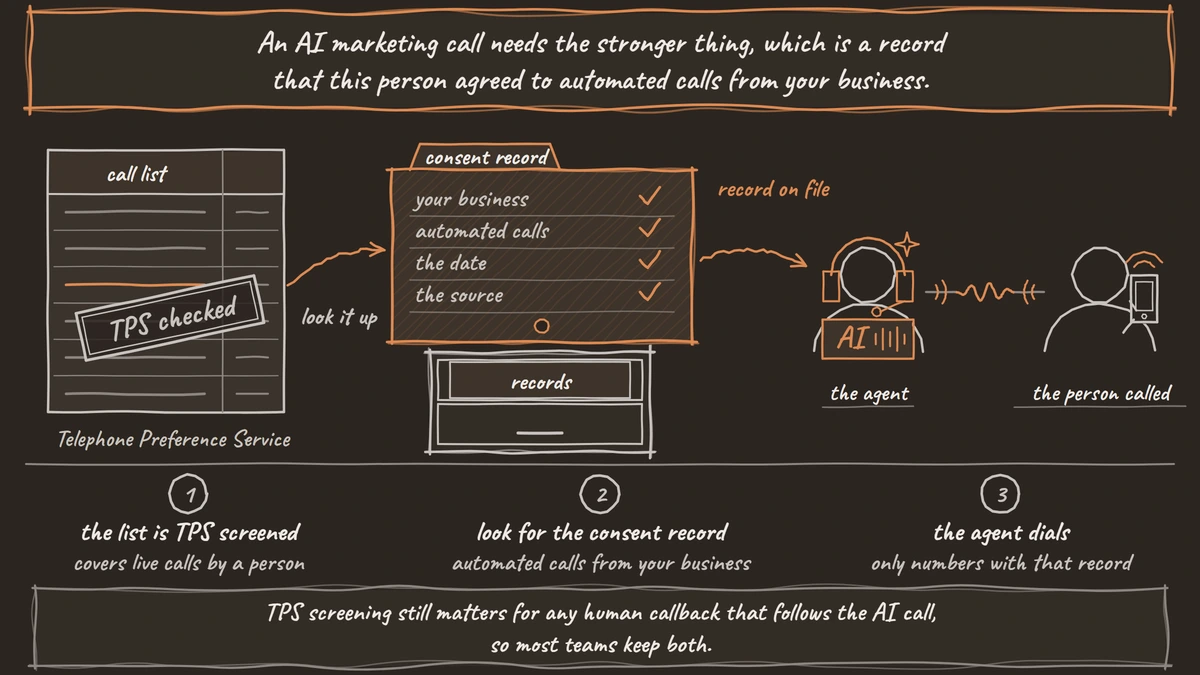
A usable consent record names your business and automated calls in the wording the person saw, and it keeps the date and the source. Consent a lead seller collected for unnamed partners rarely names you, so treat a bought list as unconsented for AI calls. When someone withdraws, the record should show that too, so the next list leaves them out.
Business numbers get no exemption from the automated-call rule. It covers every subscriber, so a sole trader and a company both need to have agreed before an AI agent rings them. For live calls by a person, the Corporate TPS does for companies what the TPS does for households.
The cost of getting it wrong has gone up. From 5 February 2026, under the Data (Use and Access) Act 2025, the ICO can fine a PECR breach up to £17.5 million or 4% of worldwide turnover. Before that the ceiling was £500,000, so a list that was a small risk before is a large one now.

Open Source Alternative to Vapi / Retell
Self-hosted voice agent platform — no per-minute fees
dograh-hq/dograh
Star on GitHub
Ofcom's two-second rule for automated dialers
Ofcom regulates the phone network side, and its rules on silent and abandoned calls apply to any automated dialer, AI or not. Ofcom's persistent misuse policy caps abandoned calls at 3% of live calls on each campaign over 24 hours. When nobody is ready to speak, a short information message must play no later than two seconds after pickup, or two seconds after the person starts talking.
Two more points follow. A number that got an abandoned call should not be called again for 72 hours unless a person is sure to be on the line. Outbound calls should also carry calling line identification (CLI), a number people can call back. Ofcom takes these steps into account when it decides whether a caller has misused the network.
An AI agent speaks the moment the call connects, so in our reading it is the agent Ofcom has in mind and the call is not abandoned. That holds only if the first words arrive within those two seconds and name the business. Measure it on a real phone line, since the carrier's connect time and any listening delay before the greeting both count. Our post on AI voice agents for UK debt collection applies the same rule to collections calls.
Calls you place and calls you answer
Two splits decide which rules a call meets. The first is service versus marketing. A call about an existing account or an appointment that promotes nothing sits outside PECR's marketing rules. Once the same call adds an offer, it becomes a marketing call. In practice the script decides it. If the agent may mention an upgrade or a renewal price, plan the call as marketing from the start. Our post on AI voice agents for UK insurance works through that split for renewals.
The second split is who dialed. PECR's calling rules govern calls a business makes. An AI receptionist answering calls people place is not making marketing calls, so PECR consent generally does not arise for it. The UK General Data Protection Regulation (UK GDPR) still covers the recording and the transcript whichever side dialed, so you need a lawful basis and a retention period for both. The inbound point is our reading of the statute, so confirm with counsel how these rules apply to your calls, your lists and your sector before launch.
Checklist before any outbound AI call in the UK
Work through these nine points before a UK campaign places its first call. Each one maps to a rule above, and the last section shows where it lives in the agent.
- Sort the call as service or marketing, and write down why.
- For an AI marketing call, hold each person's prior consent to automated calls from your business, with when and how they gave it.
- Screen the numbers against the TPS and Corporate TPS for any live callback by a person.
- Remove everyone who asked you to stop, on any channel.
- Put your business name and a contact address or freephone number in the opening line.
- Show a number people can call back.
- Make sure the first words land within two seconds of pickup.
- Pick your own calling hours, since PECR sets none, and run them in UK time.
- Set a retention period for recordings and transcripts under UK GDPR.
Join the Dograh Community
Dograh is an OSS alternative to Vapi. Join our Slack community for queries, releases, best practices & community interactions.
Setting up UK calls in Dograh
The opening line carries most of the checklist, so it should never be left to the model. In Dograh, write the business name and the freephone number into the Greeting Text on the Start Call node, which is spoken exactly as written once the call connects. A line saying the person is talking to an automated assistant goes there too, whether you add it by choice or because a law asks for it. Switch off Allow Greeting Interruption so the line plays in full, and if you turn on Delayed Start, keep Delay Duration (seconds) under two.
Calling hours live on the campaign. A campaign's Call Schedule takes one Timezone, Europe/London here, and Time Slots by weekday, so the UK needs only one campaign. Retries follow Max Retries and Retry Delay, and you can switch off retries on voicemail. Upload only the numbers that hold the right consent, since your list and your CRM carry that record.
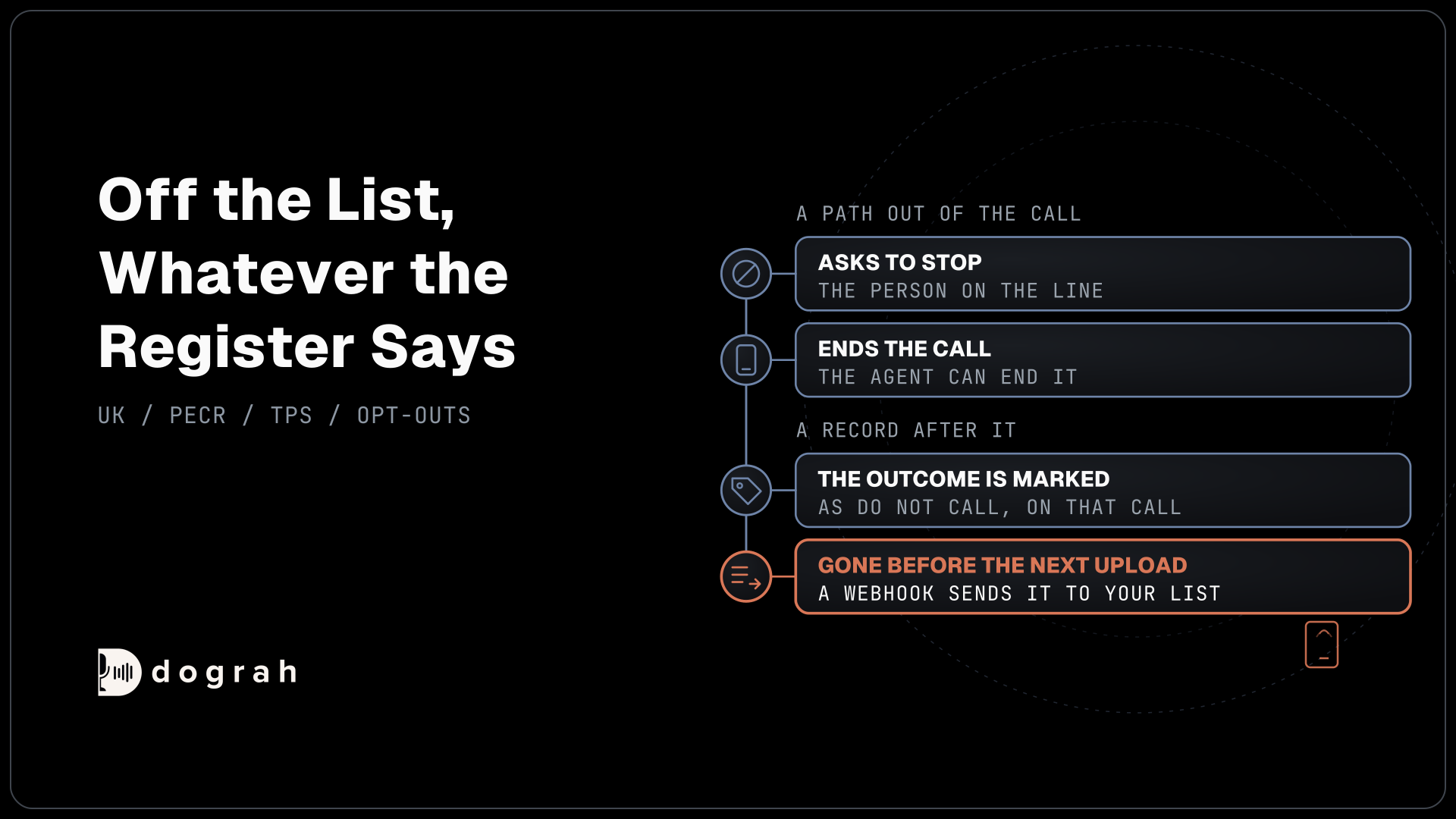
Opt-outs need a path out of the call and a record after it. The agent can end the call when someone asks to stop, and the call disposition do_not_call marks that outcome on the call. A Webhook node then sends it to your own list, so the number is gone before the next upload. If the person on the line asks for a human, Dograh calls the destination first and connects the caller only when someone answers, on Twilio, Telnyx, Plivo, Cloudonix and Asterisk ARI.
Recordings sit wherever the calls run. To keep UK call data in the UK, self-host in a UK data center and run the speech and language models there as well. Running Dograh yourself means no per-minute platform fee. You still pay for servers, model keys and phone minutes, and your team looks after the database and upgrades. Support comes from the open-source community, and Enterprise adds custom SLAs. If you would rather not host it, Dograh Cloud runs it for a 1 cent a minute platform fee. For calls into Germany and France as well, see our post on outbound AI calling laws in the UK, Germany and France.
Glossary
- Automated calling system
- Equipment or software that places calls and speaks without a person on the line. PECR requires prior consent before one makes a marketing call, and the safe reading includes AI agents.
- Telephone Preference Service (TPS)
- The UK register of people who do not want live sales calls. The Corporate TPS does the same for companies. Screening it does not replace consent for automated calls.
- Abandoned call
- A call a dialer connects with nobody ready to speak. Ofcom caps them at 3% of live calls per campaign over 24 hours, with a message within two seconds.
- Calling line identification (CLI)
- The number shown to the person you call. UK rules expect it on marketing calls so the person can call back or object.