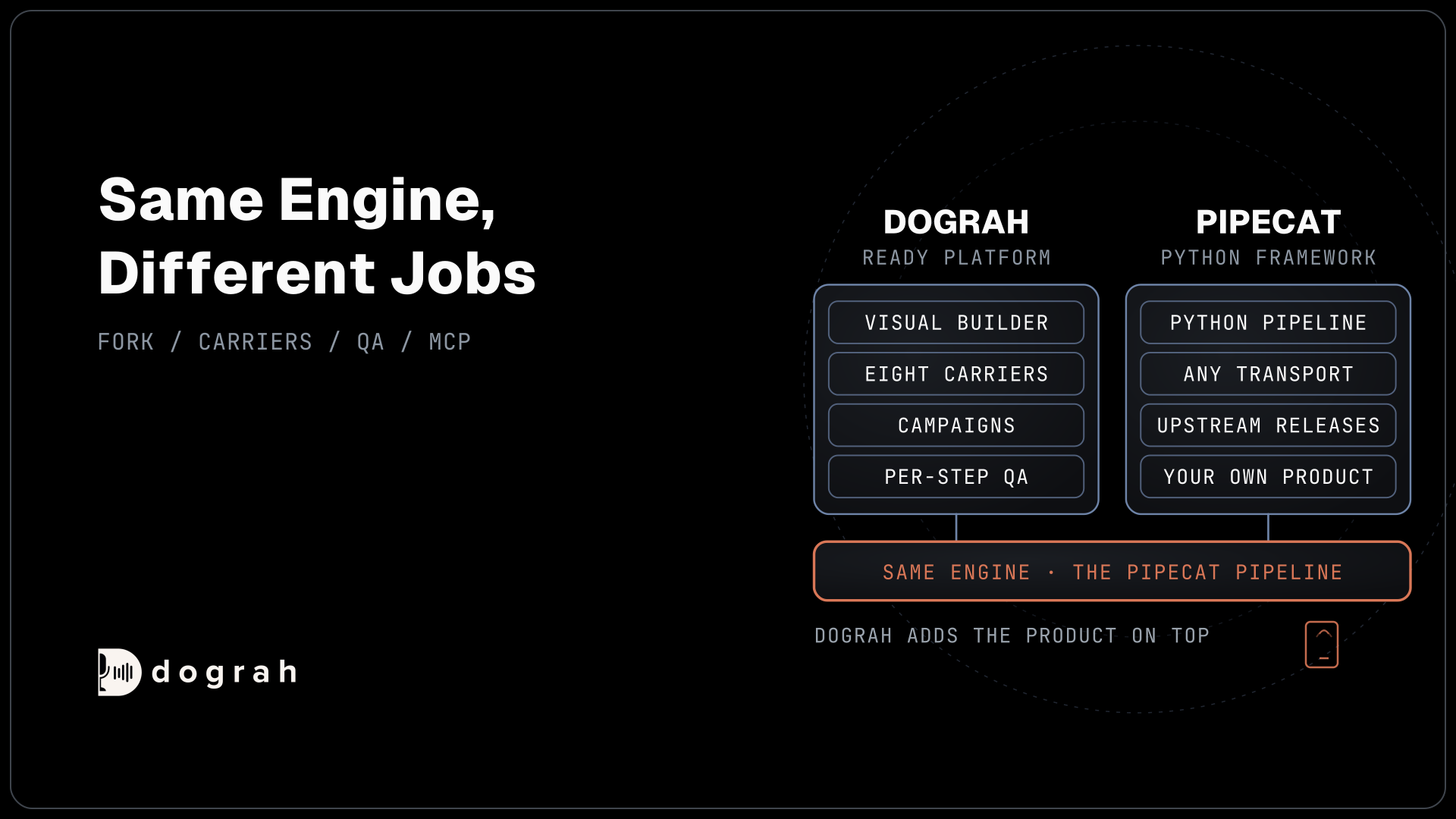

Choosing Dograh vs Smallest AI comes down to who runs the platform. Smallest AI's Atoms is a closed, hosted agent platform built around Smallest's own speech models. Dograh, an open-source, self-hostable AI voice agent platform, runs on your own servers or in its hosted cloud with any supported model, and Smallest's Lightning voices and Pulse speech-to-text run inside it.
Key Takeaways
- Smallest's Lightning voices and Pulse transcription run inside Dograh with your own key.
- Smallest builds in keypad input, PII removal and Salesforce. Dograh has none of these.
- Dograh's code is open source. Smallest's on-premise option is licensed from Smallest.
This post is part of our guide to Smallest AI alternatives, which makes one point about Dograh. If you like Smallest's voices, keep them and own the platform. Here we compare the two row by row, show how they work together, and say who should stay on Smallest AI.
The two platforms, row by row
Smallest AI rents a hosted platform around its own models, while Dograh is open-source software you can run anywhere.
| Row | Smallest AI (Atoms) | Dograh |
|---|---|---|
| License | Closed-source platform with public SDKs, examples and an MCP server | Open source under BSD-2-Clause, with the whole platform on GitHub |
| Where it runs | Smallest's cloud; on-premise deployment on Enterprise; its speech models self-host under a Smallest license key | Your own servers with Docker Compose, Dograh Cloud, or on-prem and private cloud on Enterprise. But self-hosting puts the servers on your team |
| Models | Smallest's Pulse and Lightning in the agent, GPT models at cost, ChatGPT Realtime for speech to speech, your own LLM through a public OpenAI-compatible endpoint | Dograh's models, any supported provider with your own keys (Smallest included), or open-weight models on your own network |
| Builder | Single Prompt, Conversational Flow (a visual builder) or the Agent Crews Python SDK | A visual workflow builder of nodes and pathways, plus an MCP server that lets an AI assistant create and edit agents |
| Phone | Rent numbers from Smallest or bring your own over SIP | Your own carrier: Twilio, Vonage, Plivo, Telnyx, Cloudonix, Exotel, Vobiz or Asterisk ARI, or Dograh SIP |
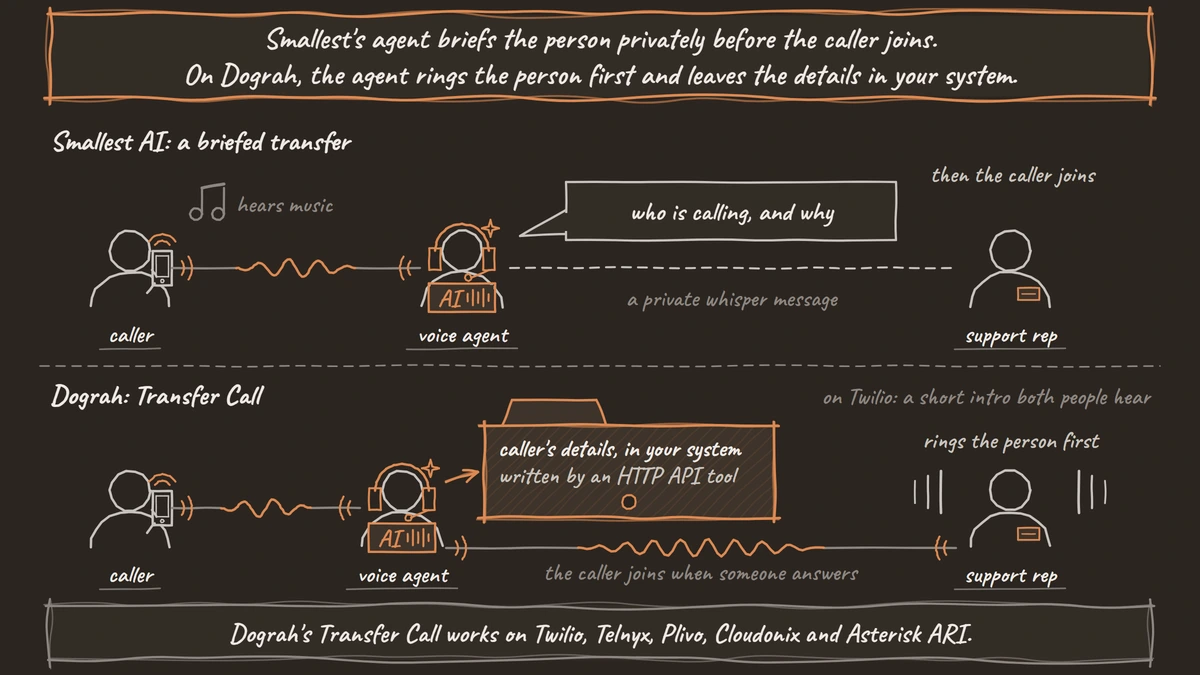
| Transfer to a person | Direct, or briefed first with a private whisper message | Transfer Call on Twilio, Telnyx, Plivo, Cloudonix and Asterisk ARI, with the details written to your system first |
| Keypad input | Yes, it detects keypad presses | No keypad (DTMF) tool; callers answer by voice |
| Calls at once | 20 on Pay as you go, with no add-on; custom on Enterprise | Dograh Cloud includes 10, more on request; self-hosted runs 10 by default, a limit you can raise |
| HIPAA and certificates | SOC 2 Type II and ISO 27001; a BAA on Enterprise with zero data retention | Self-host inside your own compliance perimeter, with no BAA with Dograh |
| Integrations | Salesforce available; HubSpot listed as coming soon | HTTP API tools, MCP tools, a Webhook node and Pre-Call Data Fetch connect your own systems |
| Sensitive data | PII removal as a paid add-on | No redaction; keep sensitive numbers out of the call design |
Smallest's own per-minute prices are covered in our Smallest AI pricing breakdown.
Using both: Smallest's voices inside Dograh
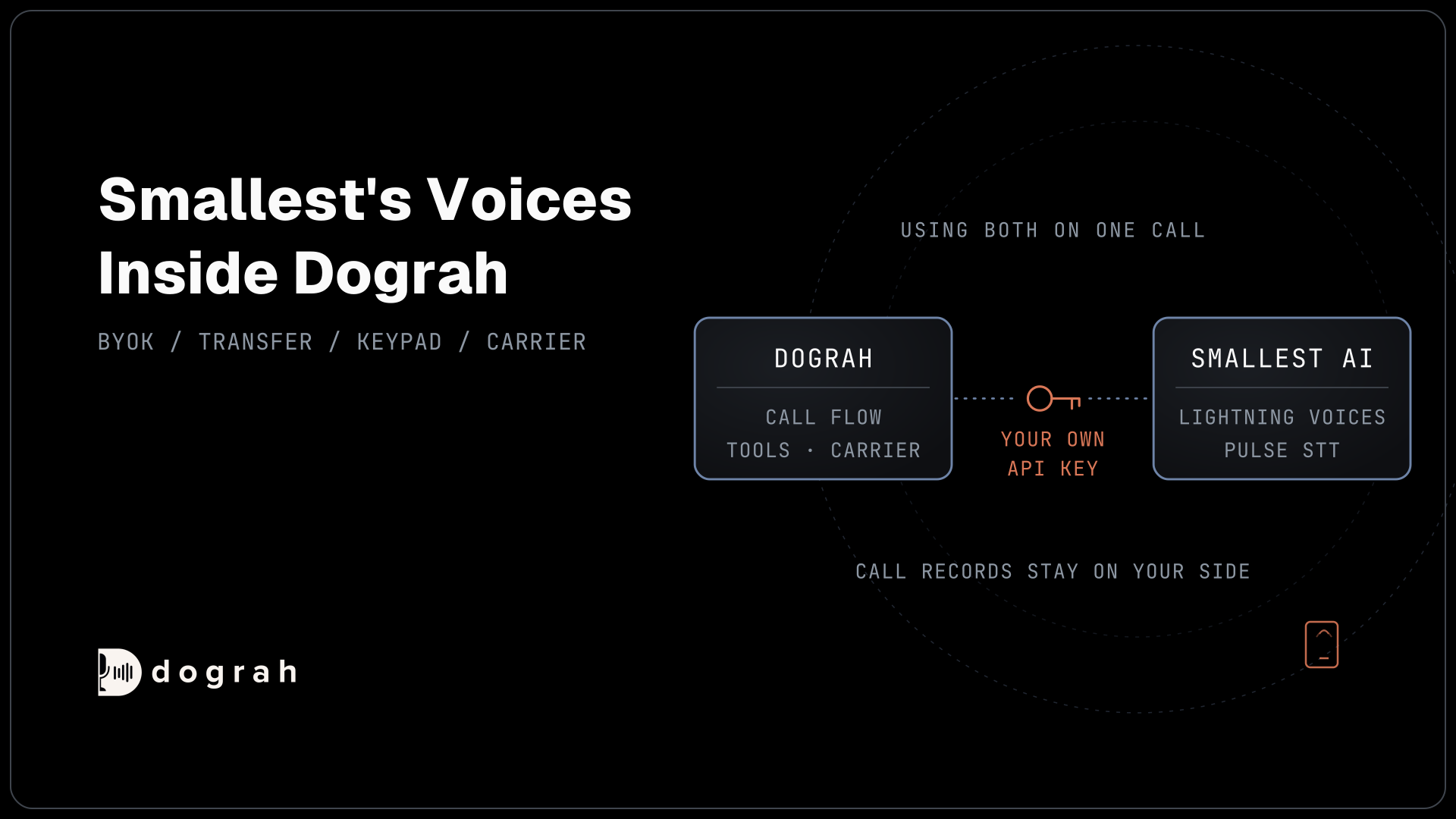
The two products also work together, which is the most useful fact in this comparison. Smallest AI is a built-in provider in Dograh, for both the voice and the transcription.
On the Models page, open the BYOK tab. On the Voice tab, choose Smallest AI as the provider and pick lightning_v3.1, the standard pool, or lightning_v3.1_pro, the premium pool with American, British and Indian voices. Then pick a voice and language. On the Transcriber tab, choose Smallest AI, which uses Pulse, and enter your Smallest API key. The voice settings cover each field.
Smallest documents the same setup in its own guide to using its models in Dograh, where it calls Dograh an open-source platform for building and deploying voice agents.
The billing for those models stays between you and Smallest, on your own account. You get Smallest's voices with your own carrier and workflow around them, and the call records stay on your side.
Models and where the call audio goes
Smallest picks the speech models inside an Atoms agent, while Dograh treats every model as your choice. In an Atoms agent, transcription and voice come from Smallest's Pulse and Lightning. You can bring your own language model, but Smallest's FAQ says the OpenAI-compatible endpoint must be publicly reachable, so localhost or private-network URLs will not work. Electron, Smallest's own small language model, is a proprietary hosted API on Enterprise only.
Because Dograh is the orchestration layer that runs the call flow, tools and telephony, the speech and language models are a separate layer you choose. Its OpenAI-compatible setting can point at a model on the same machine or network, such as one served by Ollama or vLLM.
Your own keys move the contract, not the audio. With Smallest's models in Dograh, the caller's voice still reaches Smallest's API, the same as with any provider. The audio stays in-house only when the models run on your own servers too, which our post on the open-source alternative to Smallest AI walks through.

Open Source Alternative to Vapi / Retell
Self-hosted voice agent platform — no per-minute fees
dograh-hq/dograh
Star on GitHub
Phone, transfer and keypad input
Smallest's call controls go further in two places, and both matter for support lines. For transfers, Smallest's transfer docs describe a direct connect and a briefed one. In the briefed transfer, the agent first tells the person privately who is calling and why, with a whisper message, and the caller hears music before being connected. Atoms also detects keypad presses.
Dograh's Transfer Call works on Twilio, Telnyx, Plivo, Cloudonix and Asterisk ARI. Dograh calls the destination first and connects the caller only when someone answers. On Twilio, it can play a short spoken introduction to both people before connecting them. No summary goes across by default, so an HTTP API tool writes the caller's details to your system before the transfer. There is no keypad (DTMF) tool, so callers answer by voice, and a payment link comes from your own system by text or email.
On phone lines, Smallest rents numbers or connects your SIP trunk. Dograh connects to the carrier you already use, and numbers stay in your carrier account.
Who should stay on Smallest AI
Smallest AI is the better fit for some teams, and the reasons are concrete. Stay if you want one vendor for the models and the platform on one bill, with 20 calls at once from the first day. Stay if your flow needs keypad input, a briefed transfer with a whisper message, or a PII removal add-on, or if Salesforce is your CRM and you want its integration built in.
Stay too if your buyers need reports on the vendor itself. Smallest lists SOC 2 Type II and ISO 27001, and it signs a BAA on Enterprise plans with zero data retention turned on. Dograh covers that need another way. Self-hosted inside your own compliance perimeter, it needs no BAA with Dograh. Your model providers may need their own, and the phone carrier may too, depending on what it stores. Our guide to HIPAA-compliant voice AI covers the full setup.
When Dograh is the stronger fit
Dograh is the stronger fit for teams that want to own the platform and choose every model. Its code is open, so your security team can read what it approves, and you can change it or keep running your version whatever happens upstream. You can pick every model, from Smallest's own voices to local open-weight models. QA runs on test and live calls and scores each step of the call, and agents can be built from an AI assistant through Dograh's MCP server.
Self-hosting runs on Docker Compose and puts updates and uptime in your team's hands. Self-hosted Dograh has no per-minute platform fee (servers, model keys and phone minutes still cost). Dograh Cloud has a 1¢-a-minute platform fee.
Run your real call script on both over a phone line, since most phone calls still reach the agent as 8 kHz audio while a browser demo runs at 16 kHz. To try Dograh, self-host it from GitHub, or start on Dograh Cloud.
Join the Dograh Community
Dograh is an OSS alternative to Vapi. Join our Slack community for queries, releases, best practices & community interactions.
Glossary
- Conversational Flow
- Smallest AI's visual workflow builder in Atoms, for structured, step-by-step calls. The other way to build there is a Single Prompt, one prompt that runs the whole call.
- Whisper message
- In Smallest's briefed transfer, the private line the agent speaks to the person taking the call, saying who is calling and why, before the caller is connected.
- Concurrency
- How many calls a platform runs at the same time. Smallest's Pay as you go includes 20 with no add-on. Dograh Cloud includes 10, and self-hosted Dograh runs 10 by default, a limit you can raise.
- Bring your own key (BYOK)
- Using your own account with a model provider, such as Smallest, inside another platform. You hold the contract and the bill, but the call audio still goes to that provider.