
A full open-source alternative to Smallest AI is Dograh, an AI voice agent platform under the BSD-2-Clause license that anyone can run on their own servers or use on Dograh Cloud. Smallest's on-premise option is licensed software from Smallest. LiveKit Agents and Pipecat are open-source frameworks, and call audio stays in-house only with self-hosted models.
Key Takeaways
- Smallest's self-hosting covers its speech models, run under a Smallest license key.
- Dograh ships the builder, telephony and QA as one open-source platform.
- Self-host the models too, or call audio still reaches a provider.
This post is part of our guide to Smallest AI alternatives, which points out that Smallest's on-premise option is licensed software, while open source needs no license key. Here we look at what each gives you and what running it takes, using Dograh as the worked example.
What Smallest AI lets you run yourself
Smallest AI runs agents on its own cloud, and what you can run yourself is mostly its speech models. Smallest's on-premise page offers to deploy its speech models on your hardware. To do that you need a license key, container registry credentials and model URLs, all from Smallest's support team, and its Kubernetes setup covers speech to text only. The Atoms agent platform lists on-premise deployment on its Enterprise plan. The platform code is not public. Smallest's GitHub holds SDKs, examples, an MCP server and Helm charts.
The models follow the same pattern. Electron, Smallest's small language model, is a proprietary hosted API on Enterprise only. Your own language model must sit behind a public endpoint, since private-network URLs will not work. Data handling sits on Smallest's side too. Atoms keeps call content unless zero data retention is turned on, and that is an Enterprise feature.
What open source gives you that a license does not
Open source changes who controls the platform, and a license key does not. Dograh's code is on GitHub under BSD-2-Clause, one of the BSD licenses, which lets you use, change and redistribute it, commercially too, as long as the copyright notice stays.
In practice that gives you four things a licensed install keeps with the vendor. You can install it today, with no sales call. Your security team can read the code it is asked to approve. You can change it, or pay someone to, when a feature is missing. And you can keep running the version you have if the vendor's pricing or direction changes.
That last point carries weight. In a Zapier survey of US enterprise executives published in April 2026, only 6% said they could stop using their main AI vendor without any disruption.
A full platform or a framework
Three open-source options come up for a Smallest AI team, and only one arrives as a finished platform.
| Option | License | Where it runs | What your team builds |
|---|---|---|---|
| Smallest AI, Atoms (baseline) | Closed platform; speech models licensed for self-hosting | Smallest's cloud; on-premise deployment on Enterprise | The agents, as a Single Prompt, in Conversational Flow or with the Agent Crews SDK |
| Dograh | BSD-2-Clause | Your servers, Dograh Cloud, or on-prem and private cloud on Enterprise | The agents, in a visual builder; telephony, campaigns, call history and QA ship with it |
| LiveKit Agents | Apache-2.0 | Your servers with the LiveKit media server, or LiveKit Cloud | The agent in code, plus any builder, call history and QA you want |
| Pipecat | BSD-2-Clause | Your servers, or Pipecat Cloud | The agent in Python, plus phone wiring, call history, QA on live calls and the call lifecycle |
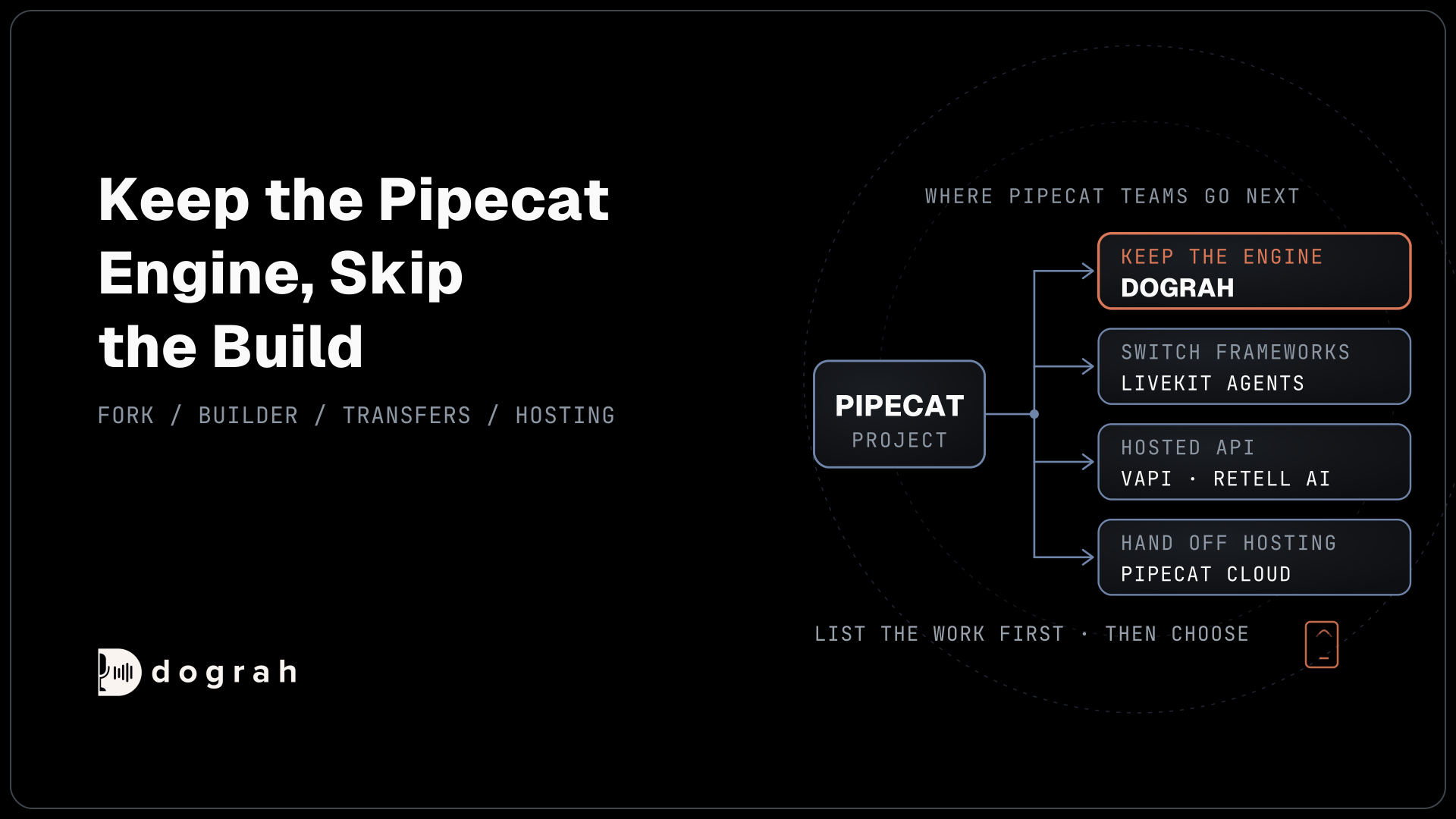
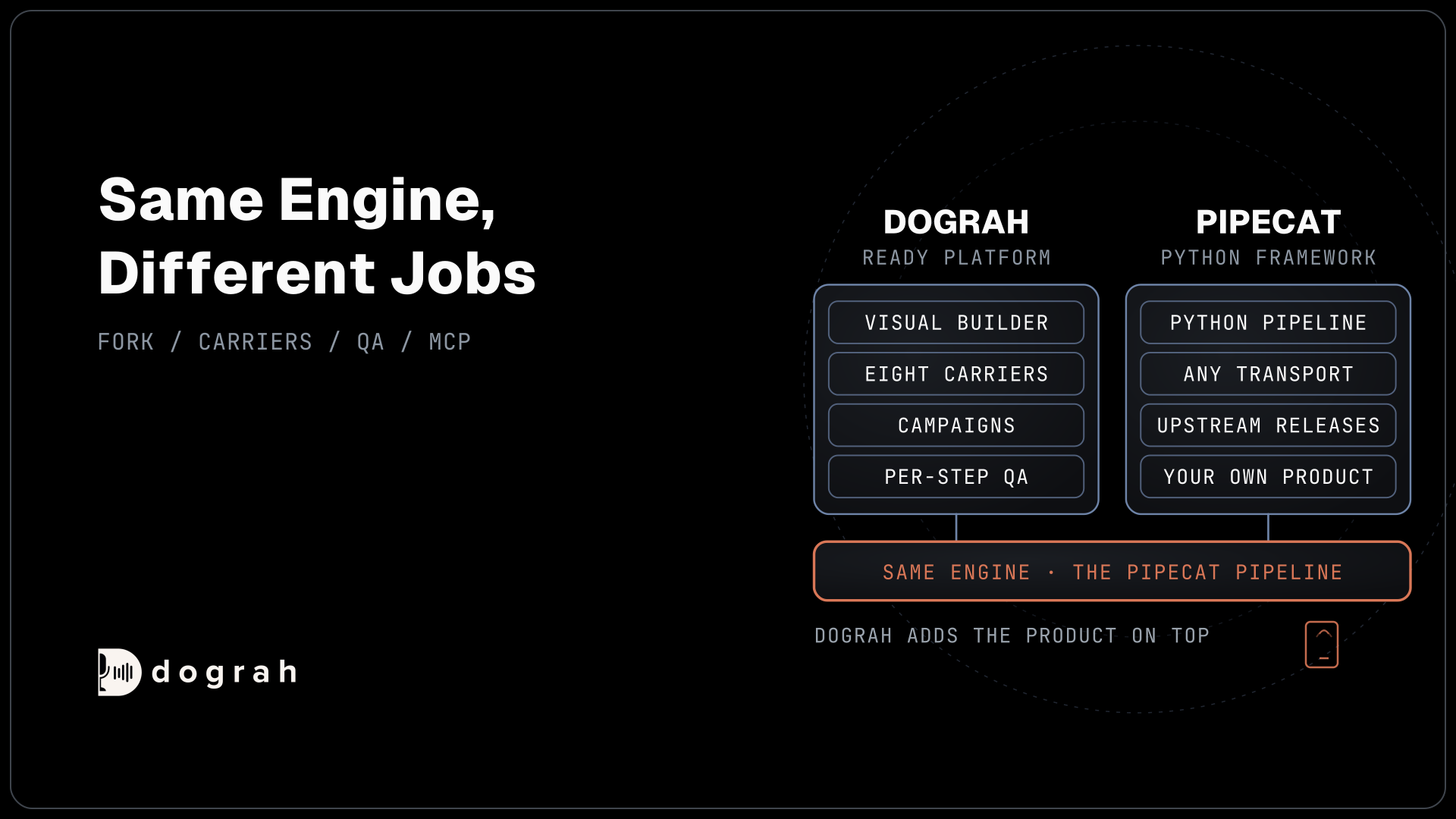
Pipecat is a Python framework from Daily, and Dograh itself is built on a fork of it. In our experience Pipecat is an excellent base, but production needs a lot of extra plumbing, which is the part Dograh adds. LiveKit Agents runs on the LiveKit media server. Both suit teams that want to write the agent in code, and our comparison of the best open-source voice AI platforms goes deeper on each.

Open Source Alternative to Vapi / Retell
Self-hosted voice agent platform — no per-minute fees
dograh-hq/dograh
Star on GitHub
Builder, telephony and QA, ready to use
The parts a framework leaves to your developers come with Dograh on day one. A team used to Smallest's Conversational Flow will find the visual workflow builder familiar, with nodes joined by pathways, each with a written condition the AI reads. Agents can also be built from an AI assistant through Dograh's MCP server, which helps when you rebuild many Atoms agents.
Telephony connects to the carrier you already use, such as Twilio, Vonage, Plivo, Telnyx, Cloudonix, Exotel, Vobiz or Asterisk ARI, or Dograh SIP. Campaigns run outbound lists, and Transfer Call hands a call to a person on Twilio, Telnyx, Plivo, Cloudonix and Asterisk ARI. Dograh calls the destination first and connects the caller only when someone answers.
QA runs on editor test calls and on live calls of the published agent. It scores each step of the call separately, with its own tags, a 1-10 score, sentiment and a summary, and a Sample Rate setting picks a share of calls at random. Our Dograh vs Smallest AI comparison sets the two platforms side by side.
Keeping call audio in-house
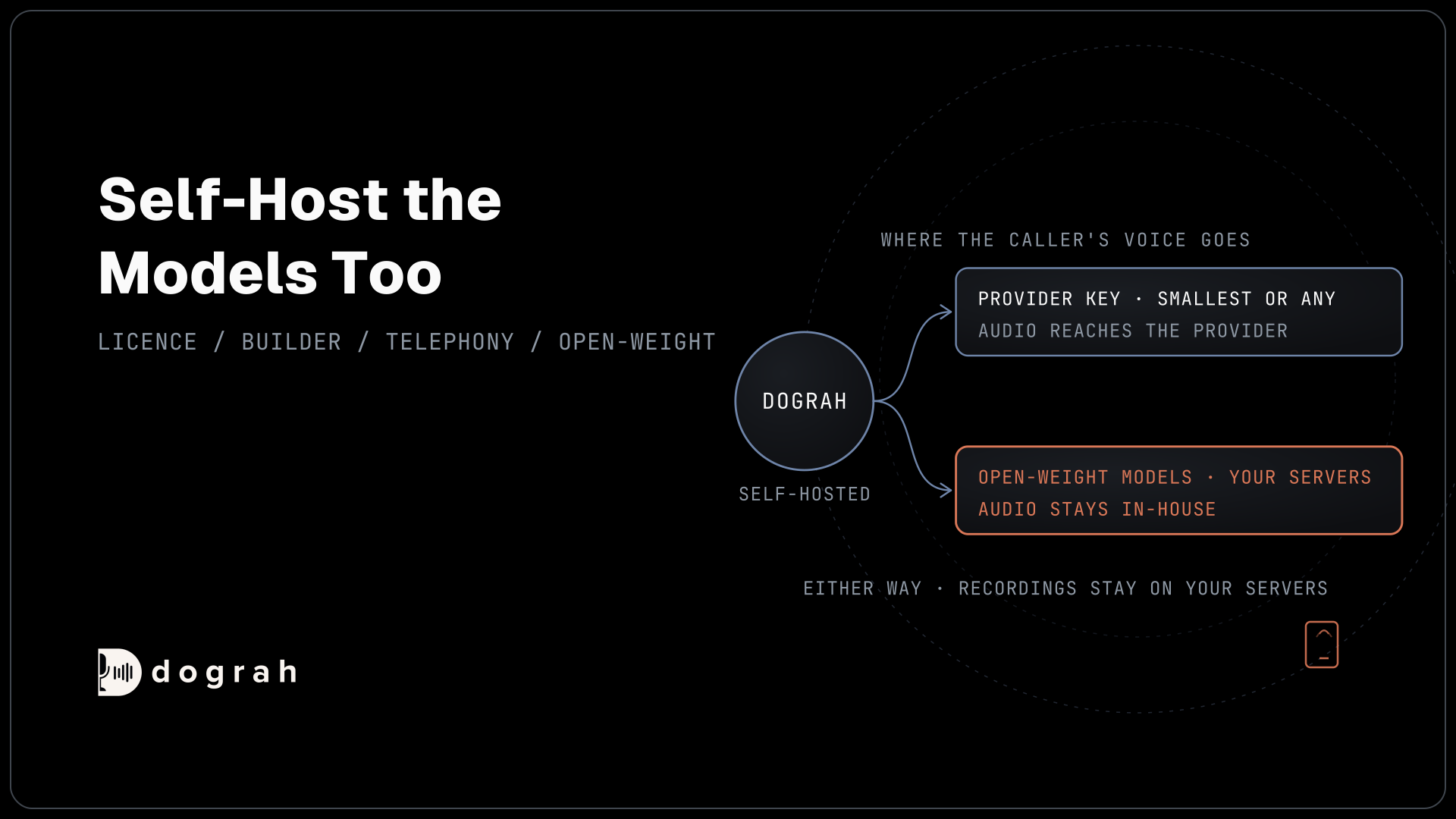
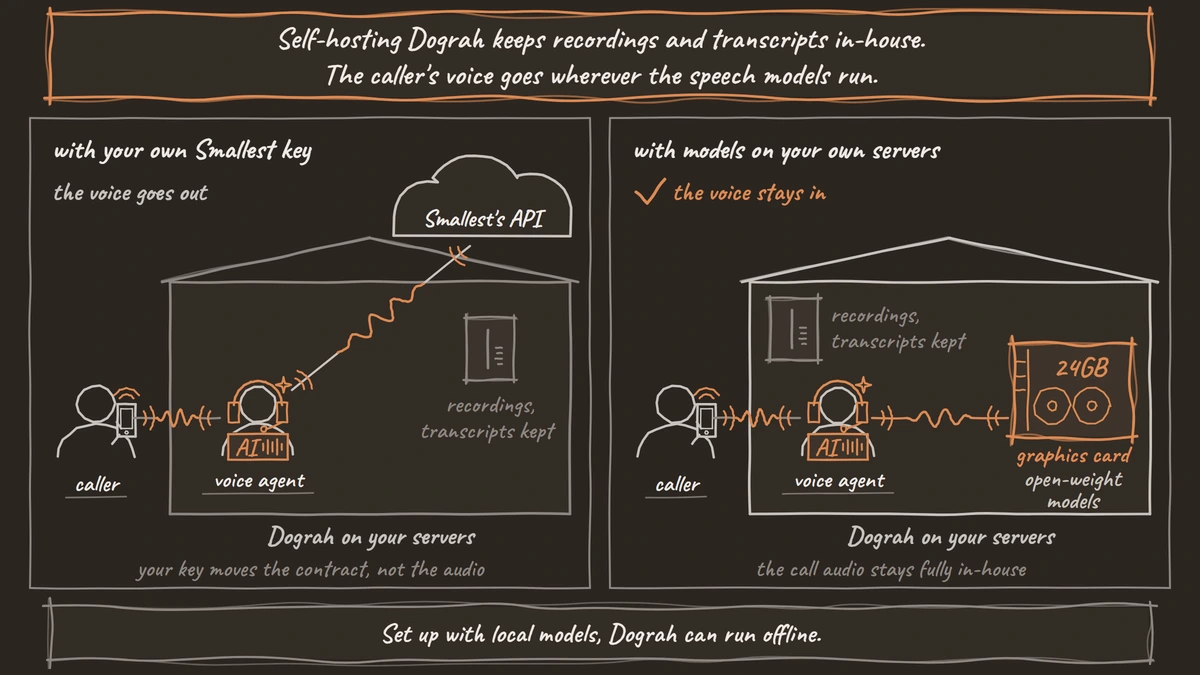
Self-hosting the platform keeps recordings and transcripts on your servers. The caller's voice is the part that can still go out during a call. Because Dograh is the orchestration layer that runs the call flow, tools and telephony, the speech and language models that hear the caller are a separate layer you pick, and the voice goes wherever those models run. If you like Smallest's voices, you can keep them, since Lightning and Pulse are built-in providers in Dograh, used with your own Smallest key. Bringing your own key moves only the contract, so the audio still reaches Smallest's API, as it would with any provider.
The call audio stays fully in-house only when the speech and language models run on your own servers too. One stack that fits a single 24GB graphics card is Qwen3.8 27B at 4-bit for the language model with Parakeet TDT 0.6B v2 for speech-to-text, at roughly 2GB. For the voice, Magpie TTS ships fixed voices as open weights under NVIDIA's own license, and Chatterbox (MIT) can clone a voice. You point Dograh at them in its model configuration, and set up this way it can run offline. Our guide to running voice AI on local, self-hosted models explains the trade-offs.
What you take on, and which route fits
Owning the platform moves the work a hosted vendor does onto your own team. Self-hosting uses Docker Compose, and you run the servers and their updates, plus the security around them. A self-hosted install runs 10 calls at once by default. You can raise that limit, though your servers and phone carrier set the real ceiling. Telemetry is on by default, so set ENABLE_TELEMETRY=false and remove POSTHOG_API_KEY from the api service in docker-compose.yaml. Self-hosted Dograh has no per-minute platform fee (servers, model keys and phone minutes still cost). Dograh Cloud has a 1¢-a-minute platform fee.
Two Smallest features have no match in Dograh. It has no keypad (DTMF) tool and no transcript redaction, so design the call never to ask for a full card or account number. A short check such as the last four digits is enough.
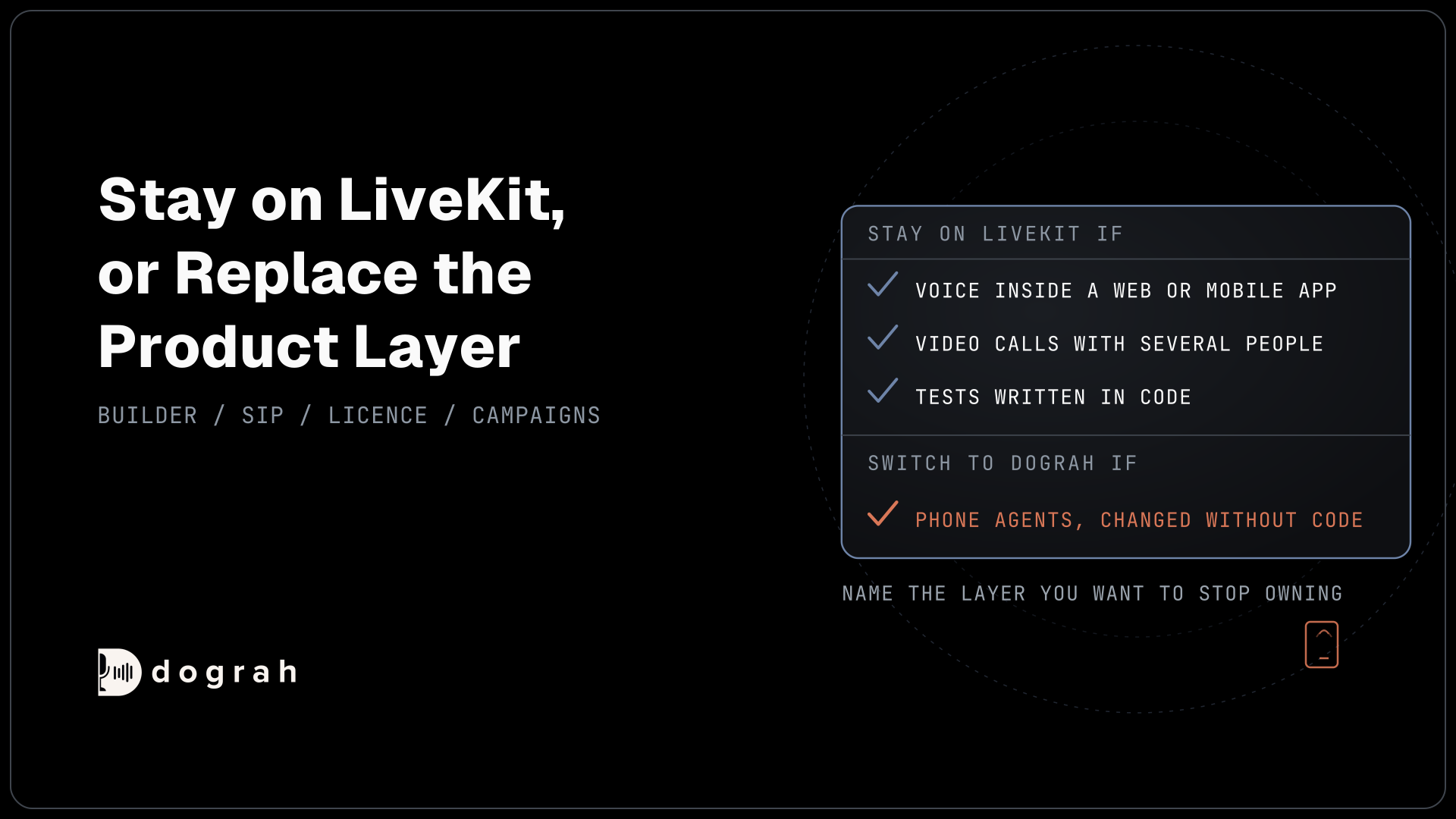
Choose Dograh if you want a full platform on your own servers, with every model your choice. Choose LiveKit Agents or Pipecat if your developers would rather write the agent in code. Stay on Smallest AI if licensed models from one vendor, on its cloud or on-premise through Enterprise, are what you need. To start, run Dograh from GitHub with Docker Compose.
Join the Dograh Community
Dograh is an OSS alternative to Vapi. Join our Slack community for queries, releases, best practices & community interactions.
Glossary
- License key
- A key from the vendor that lets its software run on your hardware. Smallest's self-hosted speech models need one, plus registry credentials, so the vendor still controls whether the software runs.
- Open-weight model
- A model whose weights you can download and run on your own servers. Some, like Magpie TTS, come under the maker's own license rather than an open-source one, so read the terms.
- Orchestration layer
- The part of a voice agent that runs the call flow, tools, telephony and call lifecycle. Dograh is this layer. The speech and language models are a separate layer you choose.
- Framework
- Open-source building blocks, such as LiveKit Agents or Pipecat, that your developers assemble into an agent in code. The builder, call history and QA around it are theirs to build.