
Decagon suits large support teams that want one managed agent across chat, email and voice, written as procedures their support leads can edit. Its voice side is moving fastest, built on its own speech models. For teams that want to own the platform, Dograh, the open-source AI voice agent platform, runs self-hosted or on Dograh Cloud.
Key Takeaways
- Decagon runs one agent across chat, email and voice, written as plain-language AOPs.
- Decagon says its new Alto voice model lifted resolution by more than 5 points.
- Pricing is per conversation or per resolution, and most customers pick per conversation.
Decagon shipped two voice models and a feature for long-running tasks in two months, so this review asks how it does on the phone. We cover the agent, its voice models, Missions, what reviewers say, pricing and data, demo questions, fit and where open-source Dograh fits for on-prem buyers.
One agent across chat, email and voice
Decagon sells one AI customer-service agent that answers chat, email and voice from the same logic. Support teams write its behavior as Agent Operating Procedures (AOPs), workflows in plain language that support leads can edit and engineers can version. Simulations, live experiments and always-on quality monitoring sit around it, and the agent works inside help desks such as Zendesk, Salesforce and Intercom.
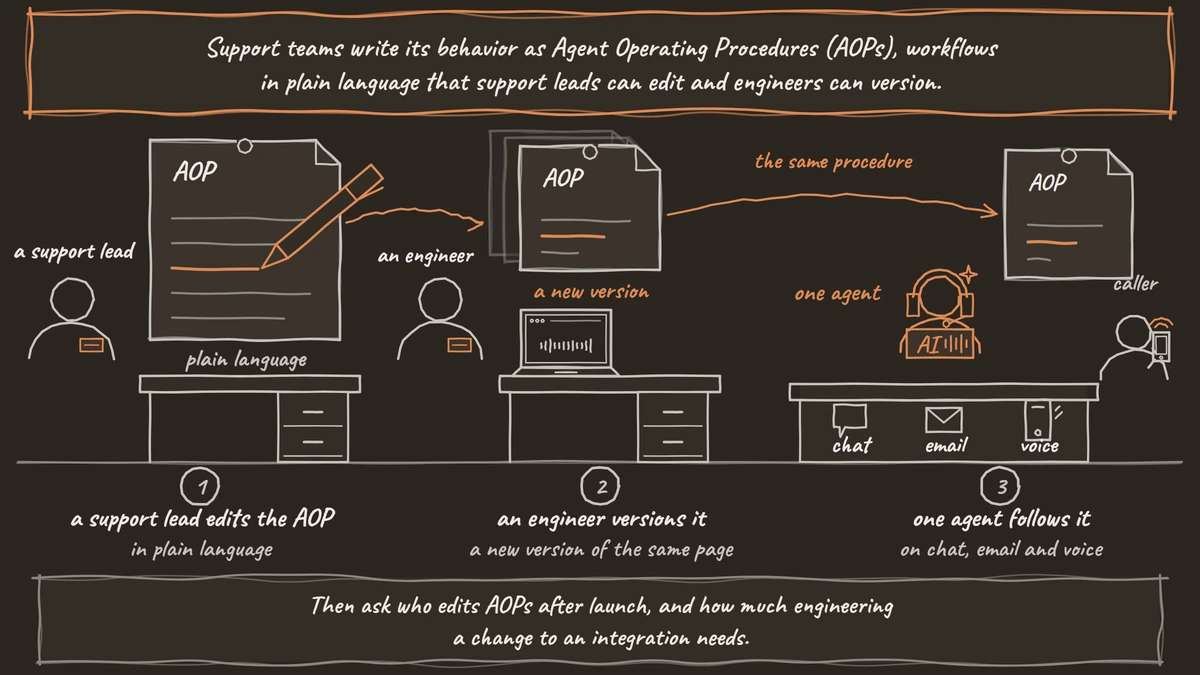
For many support teams chat and email still carry most of the volume, which is why Decagon is often called chat-led. That is fair as history, but its recent launches have mostly been about voice. Our guide to Decagon alternatives covers the full product and the reasons teams look elsewhere.
Decagon on the phone: Voice 3, Chord and Alto
On calls, Decagon now does most of what a phone team asks for. Decagon's voice page lists more than 70 languages with automatic detection and switching, outbound calls for sales, support and customer updates, and transfers to human agents with a concise summary. The voice agent runs on Chord, Decagon's own speech model, which lets teams shape tone, terminology and style, and Voice 3 is what Decagon calls its most advanced voice agent yet.
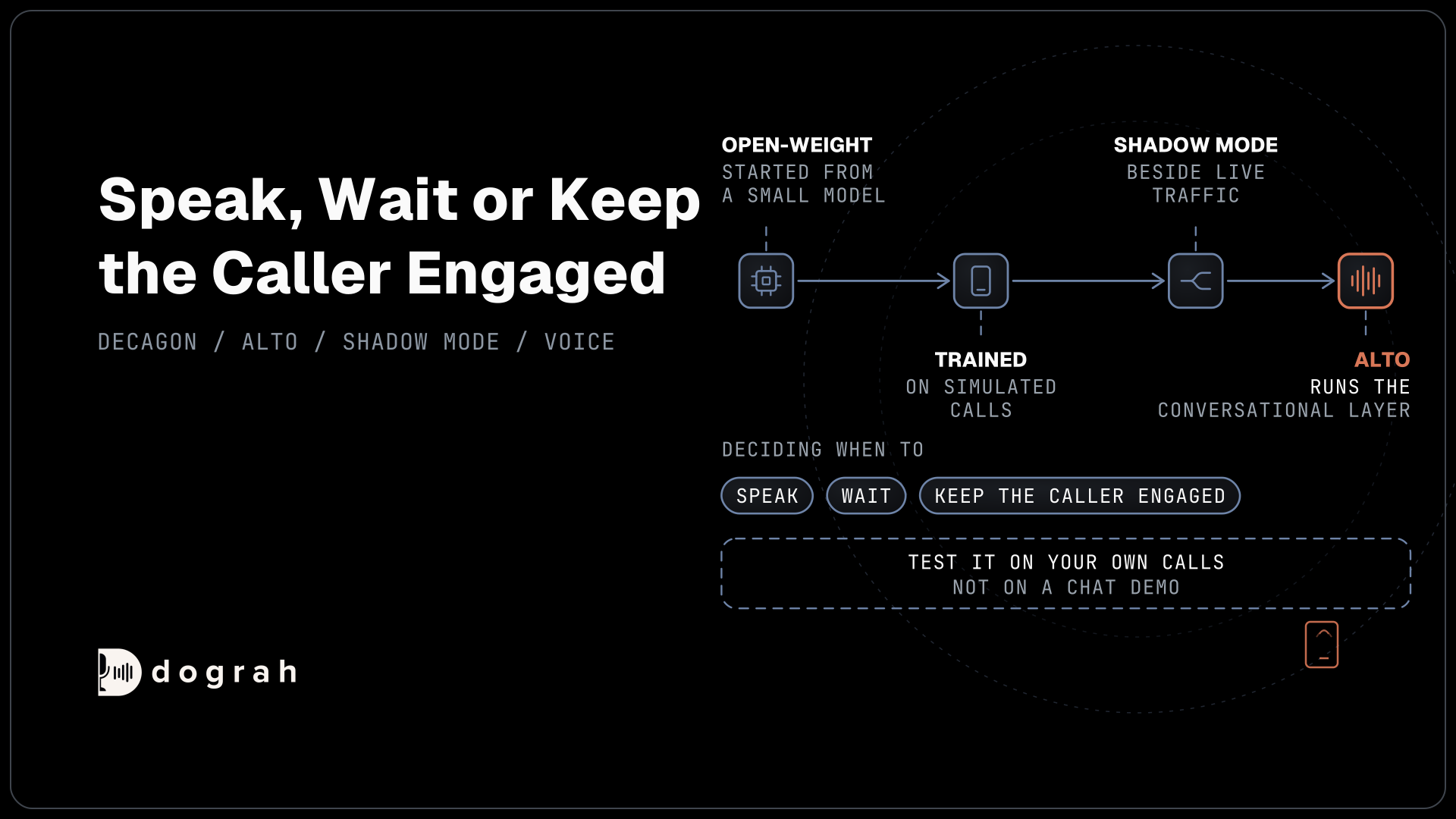
The newest piece is Alto. In Decagon's Alto post, Alto is a model from Decagon Labs that runs the conversational layer of its duplex agent, deciding when to speak, wait or keep the caller engaged while an action runs. Decagon says it started from a small open-weight model, trained it on more than 90 million simulated calls and ran it in shadow mode beside live traffic before launch.
Decagon reports that Alto raised resolution rates by more than 5 percentage points and answers in about 700 milliseconds on average, and that Chord alone lifted resolution by up to 7 points. Those are Decagon's own figures, so test them on your calls. Customers speak well of the switch too. Duolingo's operations manager says that with its previous vendor, at least half his week went on maintaining the system.
Missions and the October launches
Decagon is also stretching the agent beyond single conversations. Decagon's Missions post describes long-horizon tasks that run for days, weeks or months toward a business goal, coordinating across systems and people, and each Mission is built as an AOP that the team writes and edits. October brought an Experiment Hub and Agent Modules as well. For a support team the direction is plain, with more of the workflow moving inside Decagon's platform, written in its procedure format.

Open Source Alternative to Vapi / Retell
Self-hosted voice agent platform — no per-minute fees
dograh-hq/dograh
Star on GitHub
What reviewers praise and criticize
Public user reviews of Decagon are few, so treat the themes as a signal. Reviewers praise fast deflection after launch, one agent across channels, AOPs that read like plain instructions and a responsive implementation team. They criticize enterprise-only buying with no self-serve way to try it, changes that need engineering help when integrations or guardrails move, and usage-based costs that are hard to forecast.
Most of those reviews came before Alto and Voice 3, so they say little about the phone. That gap is the reason to run your own call tests before you sign.
Pricing, models and where data goes
Decagon charges per conversation or per resolution, and it says the vast majority of its customers choose per conversation. Amounts are set with sales, and our post on Decagon pricing works through which meter fits which volume.
The platform is closed and runs on Decagon's own multi-region infrastructure. Decagon's security page names OpenAI and Anthropic among its AI providers, with zero data retention agreed with them, and says personal data is redacted from logs and transcripts after each conversation using Google's data loss prevention service. It lists SOC 2 Type II, HIPAA, GDPR, ISO 27001 and PCI DSS, among others. Those are solid controls, and the audio still passes through Decagon's cloud and its model providers, with no code a customer can inspect.
Join the Dograh Community
Dograh is an OSS alternative to Vapi. Join our Slack community for queries, releases, best practices & community interactions.
Questions to ask in a Decagon voice demo
A phone team should test Decagon on its own calls, not on a chat demo. Ask how a call counts under your meter, including transfers and callers who ring back the same day. Ask which phone systems and contact center platforms connect for your setup. Ask where call audio is processed and stored, and which providers hear it. Ask how Alto's 5-point lift and 700-millisecond figure were measured, and on which call types. Then ask who edits AOPs after launch, and how much engineering a change to an integration needs.
Who Decagon fits
Decagon fits a large support organization with real volume across chat, email and voice that wants one managed agent and procedures its support leads can write. It suits teams already on Zendesk, Salesforce or Intercom, teams that value built-in experiments and simulations, and buyers who want redaction and certifications handled by the vendor.
It fits less well a team whose work is mostly on the phone and wants to choose its carrier, models and voices, a team that needs the code or on-prem hosting, and a small team with low volume. For a row-by-row view of the trade-offs, see Dograh vs Decagon.
Where Dograh fits
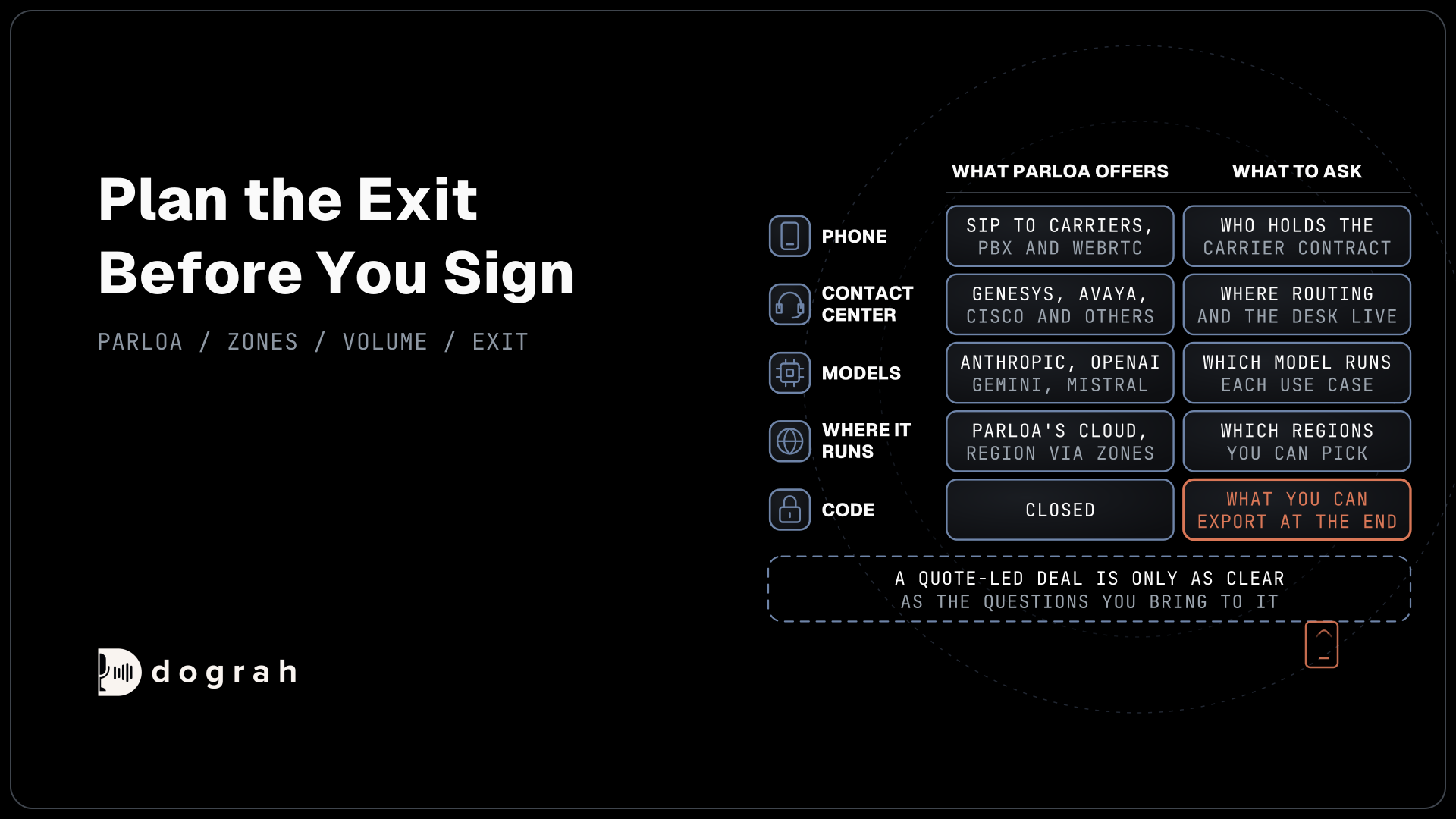
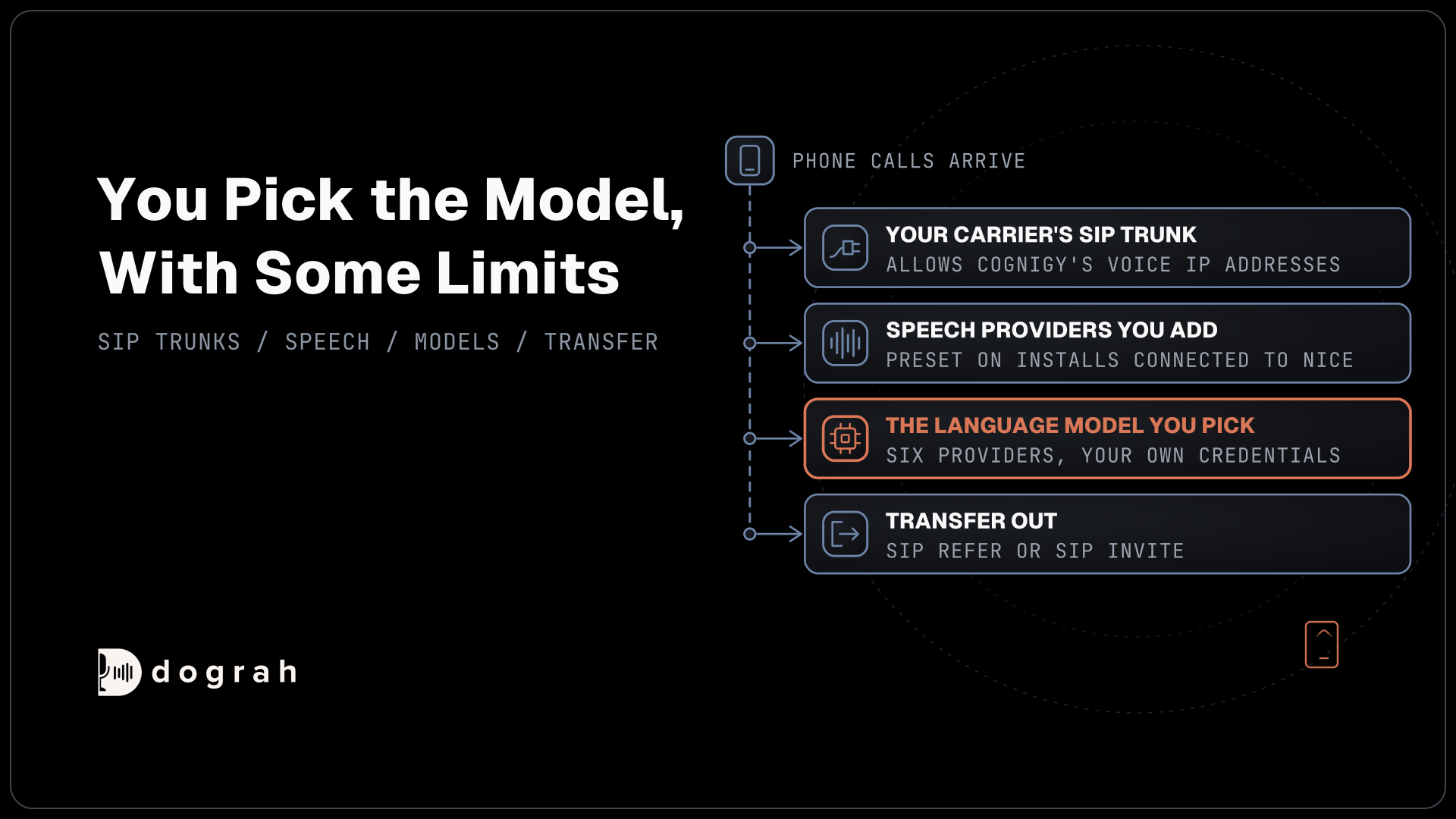
Dograh, the open-source AI voice agent platform, fits buyers who want the phone agent on their own terms. Its code is public under the BSD 2-Clause license, and you can self-host it with Docker Compose, run it on Dograh Cloud, or deploy on-prem on the Enterprise plan. You pick the speech-to-text, language model and voice for each agent, including open-weight models on your own servers, which is the only way the audio stays inside your network end to end.
The platform is built for calls and the website widget. It connects to Twilio, Telnyx, Plivo, Vonage, Exotel, Vobiz, Cloudonix and Asterisk ARI, and answers inbound WhatsApp calls. Transfer Call on Twilio, Telnyx, Plivo, Cloudonix and Asterisk ARI rings the support rep first and connects the caller only when someone answers, and if the line goes unanswered, is busy or fails, the caller stays with the agent. Before the handover, an HTTP API tool can write the caller's details to your help desk so the rep sees them.
Testing stays in your hands. The QA step scores every step of test and live calls, simulated callers run through Tuner, and View Trace shows the speech-to-text, AI and voice time for each turn, so you can check a turn-taking claim against your own calls.
Running it yourself changes both the bill and the paperwork. Self-hosted, it has no per-minute platform fee, but servers, model keys and phone minutes still cost money. Dograh Cloud charges a 1¢-a-minute platform fee. A self-hosted install needs no business associate agreement with Dograh for patient calls, though model providers and your cloud host may need one. Confirm this with counsel. The server, the database and each upgrade fall to your team, with community support for the open-source version and custom SLAs on Enterprise.
Glossary
- Agent Operating Procedures (AOPs)
- Decagon's format for an agent's behavior, written in plain language that support leads can edit and engineers can version. Missions are built as AOPs too.
- Duplex agent
- A voice agent that can listen, speak and act at the same time instead of taking strict turns. Decagon's Alto model runs the conversational layer of its duplex agent.
- Shadow mode
- Running a new model beside live traffic without letting it answer customers, so its choices can be compared with the live system before launch.
- Zero data retention
- An agreement that a model provider will not store the prompts and outputs it processes. Decagon says it has this with providers such as OpenAI and Anthropic.