
Conversational AI for customer service handles calls and chats that need a document or a system lookup, such as order status, bookings and FAQs. Refunds, disputes, complaints and anyone who asks go to a person. Dograh, the open-source AI voice agent platform we build, runs the voice side, and you can self-host it or run it on Dograh Cloud.
Key Takeaways
- Automate jobs answered from a document or a live system lookup.
- Send refunds, disputes and judgment calls to a person, with notes written first.
- Voice needs faster replies than chat and hears muffled 8 kHz audio.
The useful question for a support team is which conversations to give an AI agent and which to keep. We sort support work by what each answer needs, look at who holds the conversation data, then cover documents, live lookups, handoffs and voice, with Dograh as the voice example.
Sort support work by what the answer needs
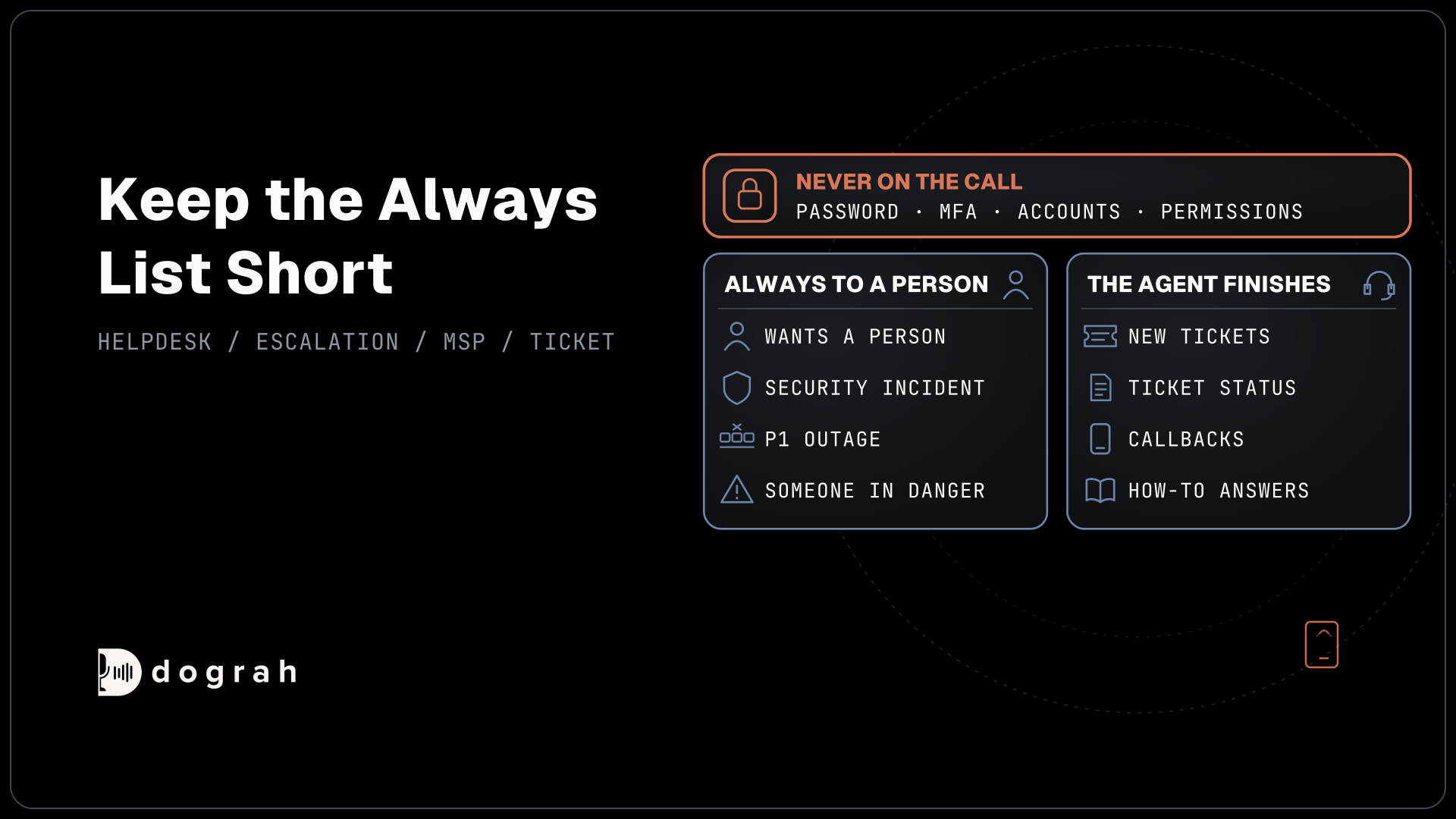
Every support question needs one of three things to answer it, a document, a lookup in a live system, or a person's judgment. The first two suit an AI agent, in chat or on the phone. The third belongs with your team, and the agent's job there is to get the customer to the right person quickly.
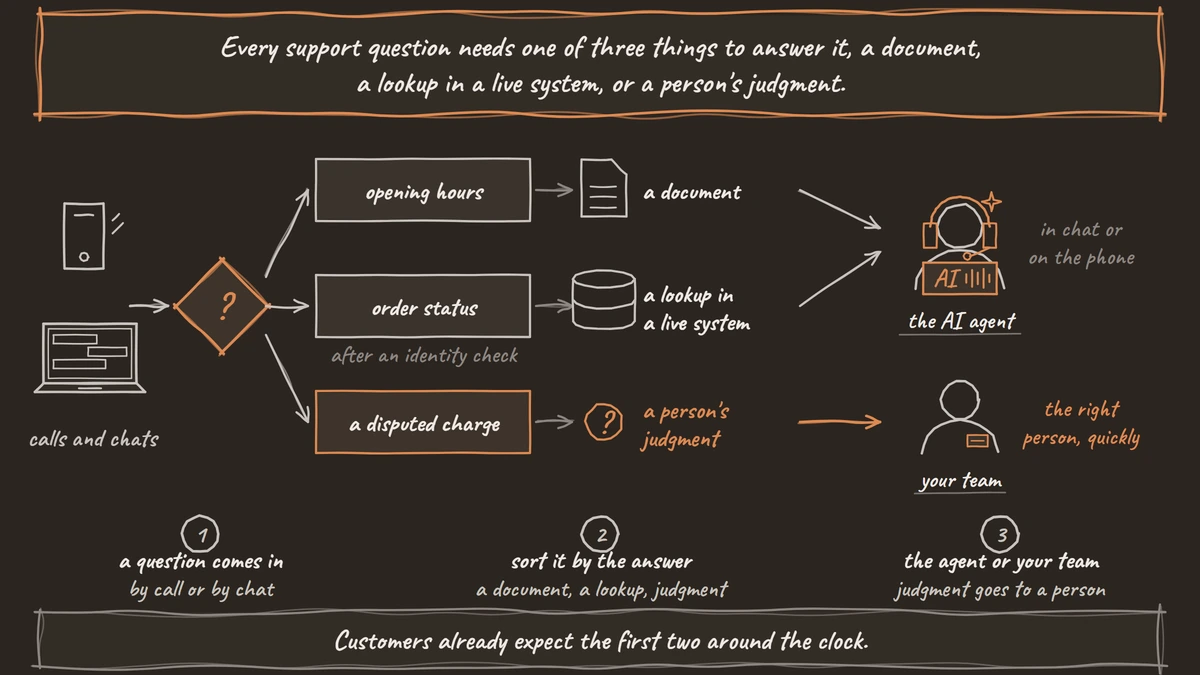
Customers already expect the first two around the clock. In Zendesk's CX Trends 2026, 74% of consumers say that due to AI they now expect customer service to be available 24/7. A sort like the one below tells you which of those hours an agent can cover alone.
| Support job | What the answer needs | Who handles it |
|---|---|---|
| Opening hours, policies, how-to questions | A document | AI agent, chat or voice |
| Order status and delivery dates | A lookup in the order system, after an identity check | AI agent |
| Booking, rescheduling or canceling | A lookup and a write to the booking system | AI agent |
| Address or contact change | An identity check, then a write to the customer record | AI agent, with the check enforced |
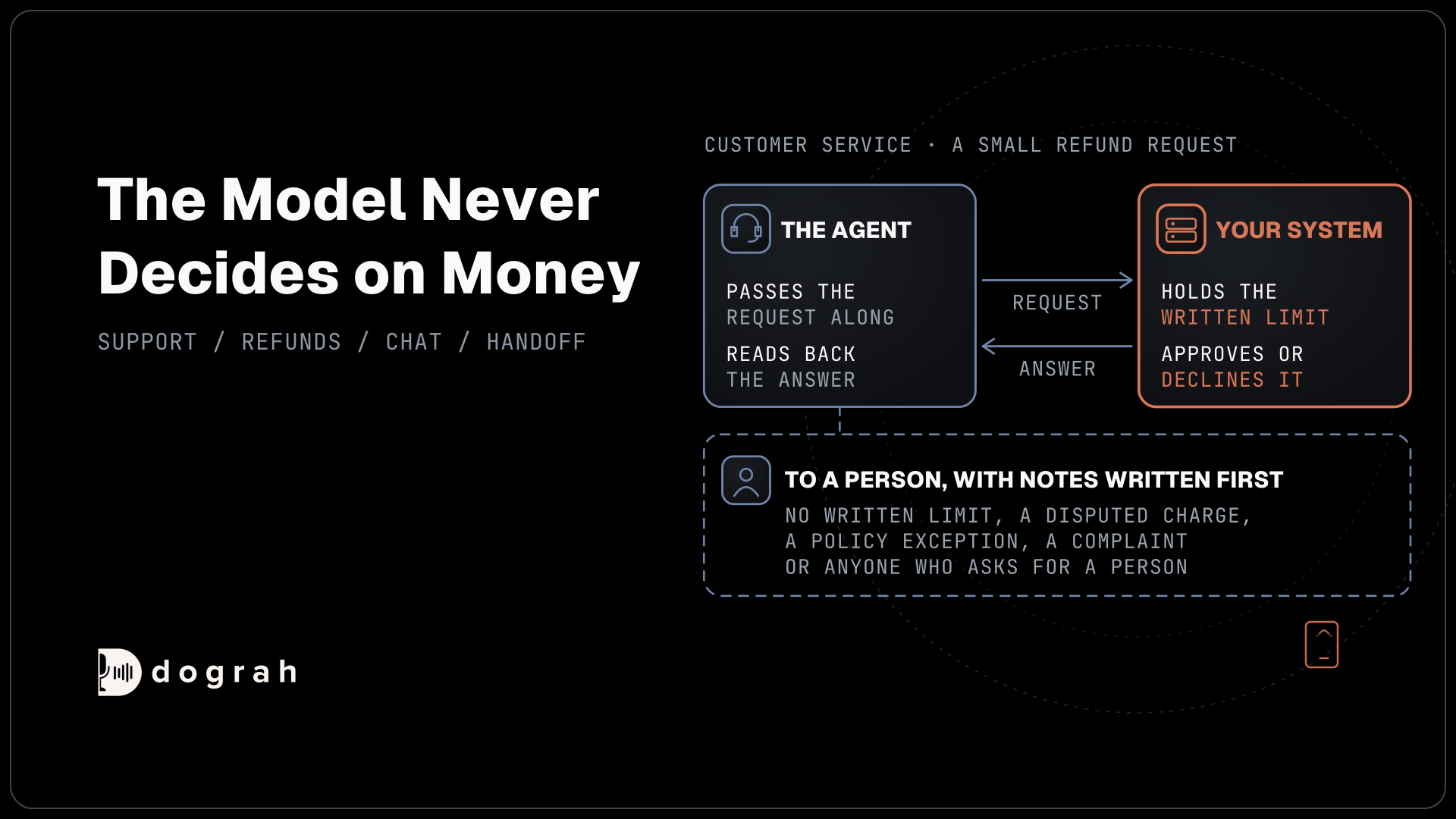
| Refund, disputed charge or policy exception | A decision, unless your own system holds a written limit | A person |
| Complaint or a clearly upset customer | Judgment and care | A person |
| Failed identity check | A different way to verify | A person |
| Anyone who asks for a person | Nothing more | A person, straight away |
Refunds sit on the line between the two. Some teams let the agent handle small ones, and that works only when the limit lives in your own system, which approves or declines the request. The model passes the request along and reads back the answer, so it never decides on money itself.
Who holds the conversation data
Support conversations carry names, addresses, order histories and sometimes account or health details. That makes the question of where transcripts and recordings live as important as which jobs you automate. On a hosted platform they sit on the vendor's servers, under the vendor's terms.
Self-hosting changes that. In healthcare and finance, sending call data to a third-party service is often blocked by compliance, so those teams run the voice agent on their own servers or not at all. Dograh's code is open, so the platform can run in your data center or private cloud, and on-prem deployment comes with the Enterprise plan.
The models need the same check. Bringing your own key for a hosted speech or language model moves the contract, but the audio still reaches that provider. Full control over the data comes only when open-weight models run on your own hardware as well, next to the platform.
Fixed answers from your documents
Fixed answers, such as opening hours, returns policies and how-to steps, come from documents the agent reads. In Dograh, you upload them under Files and attach them to an agent step under Knowledge Base Documents. The Knowledge Base takes PDF, DOCX, DOC, TXT and JSON files of up to 5 MB each.
You choose how the agent reads them. Chunked Search finds the most relevant passages and needs an embedding key, while Full Document hands the whole file to the model, which suits a short policy. Either way, the agent repeats what the document says, so an out-of-date returns policy becomes an out-of-date answer on every call.
Write documents for listening, too. Short sentences and one fact per line come out better when spoken than a dense page written for a screen.

Open Source Alternative to Vapi / Retell
Self-hosted voice agent platform — no per-minute fees
dograh-hq/dograh
Star on GitHub
Live answers from your systems
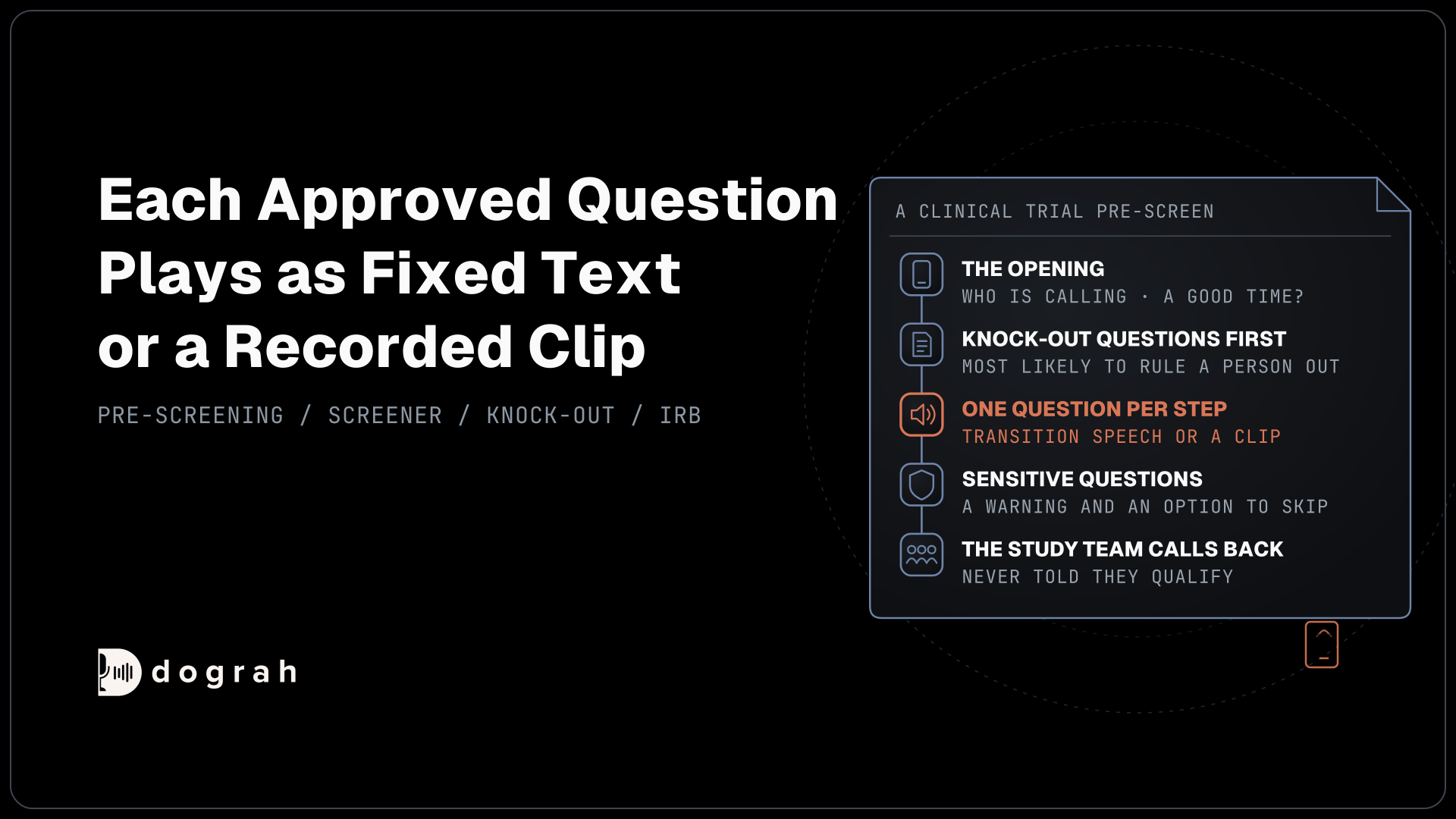
Order status, bookings and account changes need a live system, and they need an identity check first. A safe call follows greet, verify, disclose. A phone number can find the customer's record, but it does not prove who is calling, so the agent confirms identity with an approved check, such as a date of birth or the last digits of an account number, before it shares any order or account detail.
During the call, an HTTP API tool asks your order or booking system for the answer and can write changes back. Pre-Call Data Fetch can load the customer's record before the greeting, using the caller's number, so the agent already knows which order to talk about once the caller passes the check. For a booking, pass the call's workflow_run_id to your system with the request, so a retried request is not booked twice.
Lookups take a moment, so give the tool a short spoken line, such as "Let me pull that up", to cover the gap. Our guide to AI voice agents for inbound customer support walks through these two answer sources step by step.
What goes to a person, and why
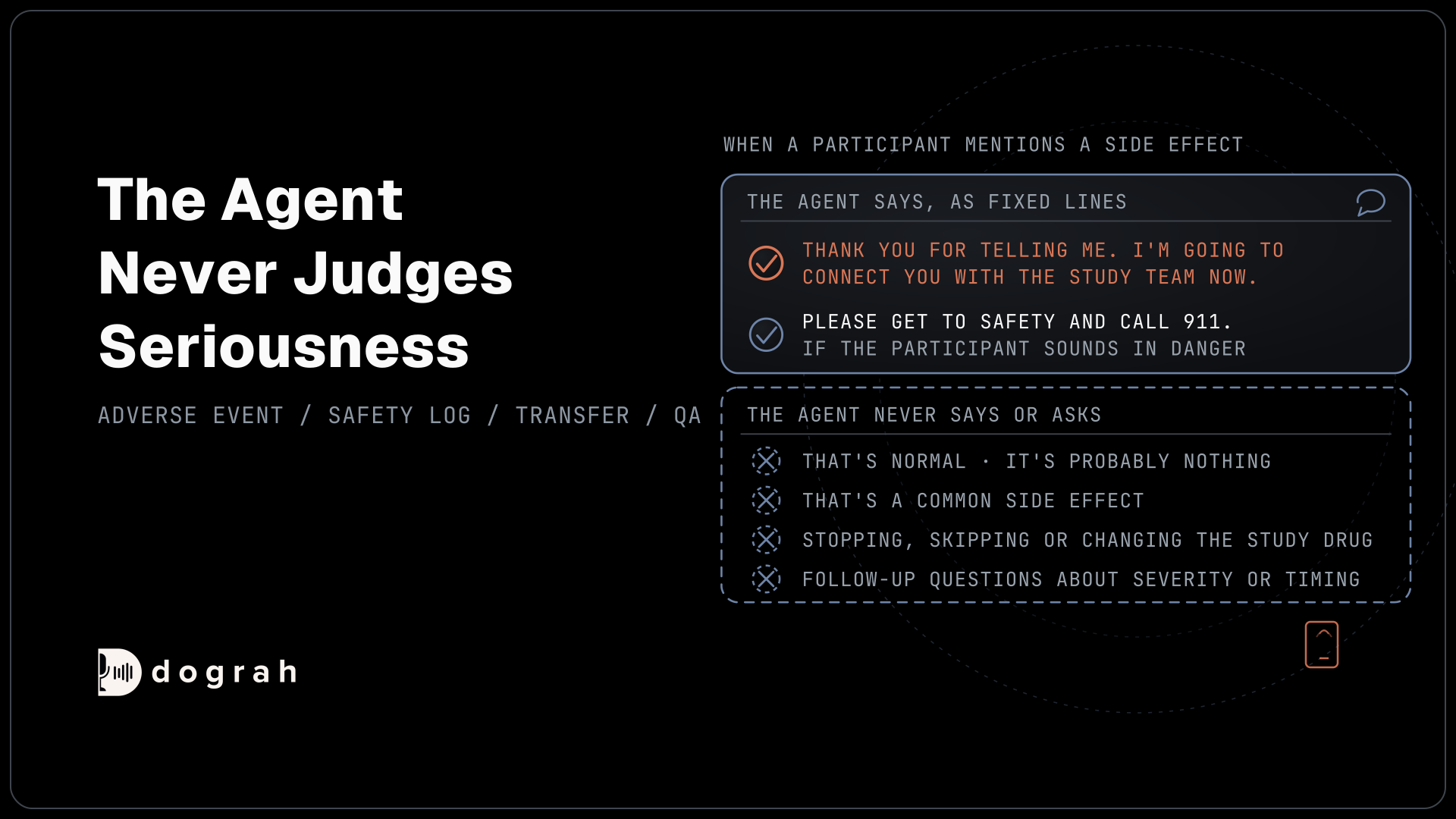
Some jobs go to a person because customers want a reason they can argue with. In the same Zendesk research, 95% of consumers expect an explanation for decisions made by AI, while only 37% of companies offer any reasoning behind them. A refund denial or a policy exception is exactly that kind of decision, so a person makes it.
In Spain, part of this is the law. Spain's customer service law, Ley 10/2025, covers utilities, transport, postal, telecom and financial services, plus other consumer-facing companies with 250 or more employees, or over 50 million euros in turnover, or over 43 million euros on the balance sheet. Those companies cannot use automated answering as the only way to reach customer service. A customer can ask for a person at any point, and 95% of calls must be answered within three minutes on average. Companies have twelve months from the law's entry into force on 28 December 2025 to adapt, and your counsel can confirm how it applies to your own lines.
Outside those rules, the list is the same. Disputes, complaints, exceptions, failed identity checks and anyone who asks go to your team. Our guide to call transfer and human handoff covers how the call moves, and the escalation rules for a helpdesk voice agent show a full list for IT support.
In Dograh, Transfer Call works on Twilio, Telnyx, Plivo, Cloudonix and Asterisk ARI. Dograh calls the destination first and connects the customer only when someone answers. Before the transfer, an HTTP API tool writes the details to your helpdesk, so the person who picks up does not ask the customer to start again.
How voice differs from chat
Voice is harder than chat because the agent hears less and has less time. Most phone calls still reach the agent as 8 kHz audio, while a browser test runs at 16 kHz, so names and order numbers are easier to mishear. In our experience, a spoken reply feels natural when the round trip stays under about 800 milliseconds, and speech-to-text is usually the slowest part.
There is also no screen. A chat answer can show a list of five options, and a spoken answer has to offer two and ask. So write the voice agent's prompt for short turns, confirm numbers by reading them back, and test every flow on a real phone line. Our guide to conversational AI on a phone call covers interruptions and short answers in more depth.
The same agent can still serve both channels. In Dograh, you can test an agent in a text chat as well as by voice, and embed it on your website, so the documents and tools you set up once serve the phone line and the site.
Join the Dograh Community
Dograh is an OSS alternative to Vapi. Join our Slack community for queries, releases, best practices & community interactions.
Running the voice side in Dograh
You build a support agent in Dograh's Agent Builder by describing it on the "Create an agent" page. It may ask a few questions, shows a "Your agent requirements" card with "Approve & build", then builds the agent for review, and "Test agent" publishes version 1. Later edits in the Builder tab save as a draft until you publish.
Once calls are live, the QA step scores each step of a call separately, with tags, a score, sentiment and a summary, on the share of calls you choose to sample. Read the transcripts of calls that ended in a transfer as well. They show which questions your documents do not answer yet, and each gap is a new paragraph in a Knowledge Base file.
On cost, Dograh on your own servers has no per-minute platform fee, while servers, model keys and phone minutes are still a cost. Teams on Dograh Cloud pay a 1¢-a-minute platform fee instead of running the servers. When you self-host, the server, the database and the upgrades become your team's job, with help from the community in Dograh's Slack on the open-source edition and a dedicated account manager and custom SLAs on the Enterprise plan.
Glossary
- Greet, verify, disclose
- The order a support call follows. The agent confirms identity with an approved check before it shares any order, account or booking detail.
- Pre-Call Data Fetch
- A Dograh setting on the Start Call node that loads data from your system once the call connects, using the caller's and the called number, so the agent knows the record before the greeting.
- Chunked Search
- A Knowledge Base mode that finds the most relevant passages of a document for each question and needs an embedding key. Full Document mode hands the whole file to the model instead.
- Automated answering
- Customer service answered by an automated system with no person on the line. Spain's Ley 10/2025 rules it out as the only way to reach the companies it covers, which must offer a person on request.