
Pre-screening calls for clinical trial recruitment ask a possible participant a few IRB-approved questions before formal screening, record the answers for the study team and book a visit when they fit. The site decides eligibility. Dograh, the open-source AI voice agent platform we build, plays each question as fixed wording and can run self-hosted on the site's servers.
Key Takeaways
- Each approved question plays as fixed text or a recorded clip.
- Your IRB will ask what happens to partial screens and non-qualifiers.
- Self-hosting keeps pre-screen recordings and transcripts on the site's own servers.
A pre-screen call is the first conversation a participant has with your study, and the IRB reads every word. Below, we cover what the call may ask before consent, how to build the screener, what the IRB asks about unfinished calls, and where the data sits in Dograh.
What a pre-screen may ask before consent
A pre-screen sits inside recruitment, so the institutional review board (IRB) oversees it before the first call goes out. The Food and Drug Administration (FDA) explains in its information sheet on screening before study enrollment that screening for eligibility is part of selecting and recruiting subjects. An investigator may talk with a person about available studies and whether they might enter one before consent. A test or procedure done only to check eligibility is different, and it needs consent first.
Research funded by the US government follows the Federal Policy for the Protection of Human Subjects, known as the Common Rule. Its consent rules let an IRB approve collecting information for screening or eligibility without consent when that information comes from talking with the person or their legally authorized representative. FDA-regulated trials follow FDA's own rules and guidance. In both cases your IRB decides what the call may ask before consent, so settle that boundary for each study with your IRB and counsel before the agent dials anyone.
Keep the call short. A full medical history is intake work for the site visit, and a phone screen that drifts into it asks more than the IRB approved. The wording rules for recruitment material, such as never calling an investigational product new or safe, are covered in our guide to AI voice agents for clinical trial recruitment and retention.
Build the screener one question at a time
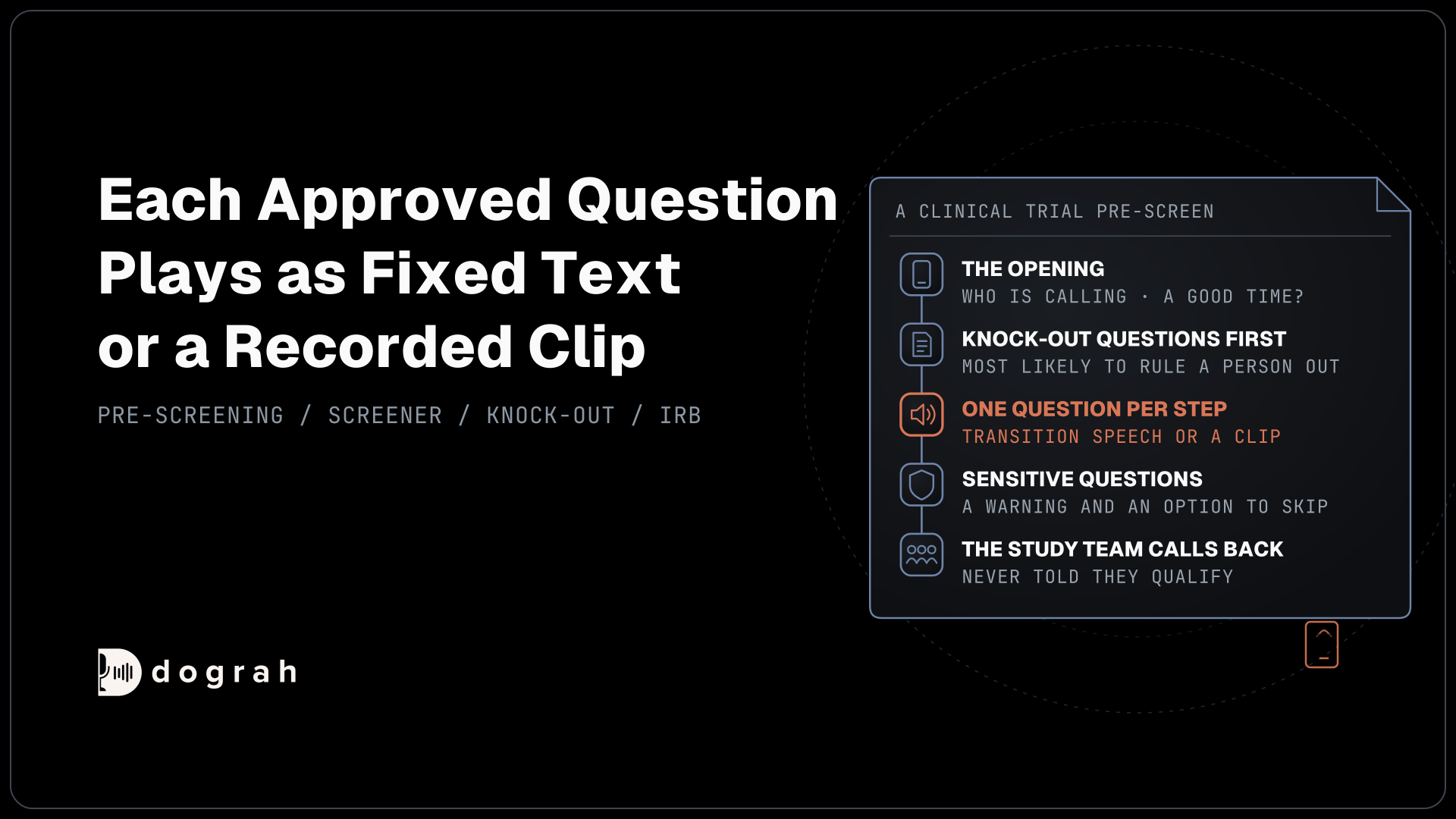
A good screener respects the caller's time by ruling people out early. Knock-out questions, the ones most likely to rule a person out, come first, so nobody answers eight questions to learn on the last one that the study is closed to them. Write each inclusion and exclusion criterion in plain words a caller can answer with a number or a yes or no.
Sensitive questions, such as pregnancy or a mental health diagnosis, get a short warning and a clear option to skip. The opening says who is calling and roughly how long the questions take, then asks whether now is a good time. Put that opening in the Greeting Text on the Start Call node, and switch off Allow Greeting Interruption, which is on by default, so the whole approved opening plays.
Inside an agent step the language model writes its own words, so a question placed in a node prompt can come out reworded. Exact wording only holds where Dograh speaks fixed text. Put each question in the Transition Speech of the pathway that leads into its step. Better still, record it in the coordinator's own voice as a pre-recorded clip, because the IRB can then listen to the exact audio file every caller hears.
Transition Speech cannot carry per-caller variables, which suits a script that must sound the same for everyone. Here is an example screener for a made-up asthma study, in the order the agent asks it. Your IRB-approved wording replaces every line.
- "Are you 18 or older?"
- "Has a doctor ever told you that you have asthma?"
- "In the past 12 months, how many times did your asthma send you to urgent care or an emergency room?"
- "The next question is personal, and you can skip it. Are you pregnant, or planning a pregnancy in the next year?"
Questions 1 and 2 are the knock-out questions. Each line plays as the Transition Speech into its own step, and each step records one answer.

Open Source Alternative to Vapi / Retell
Self-hosted voice agent platform — no per-minute fees
dograh-hq/dograh
Star on GitHub
Record each answer for the study coordinator
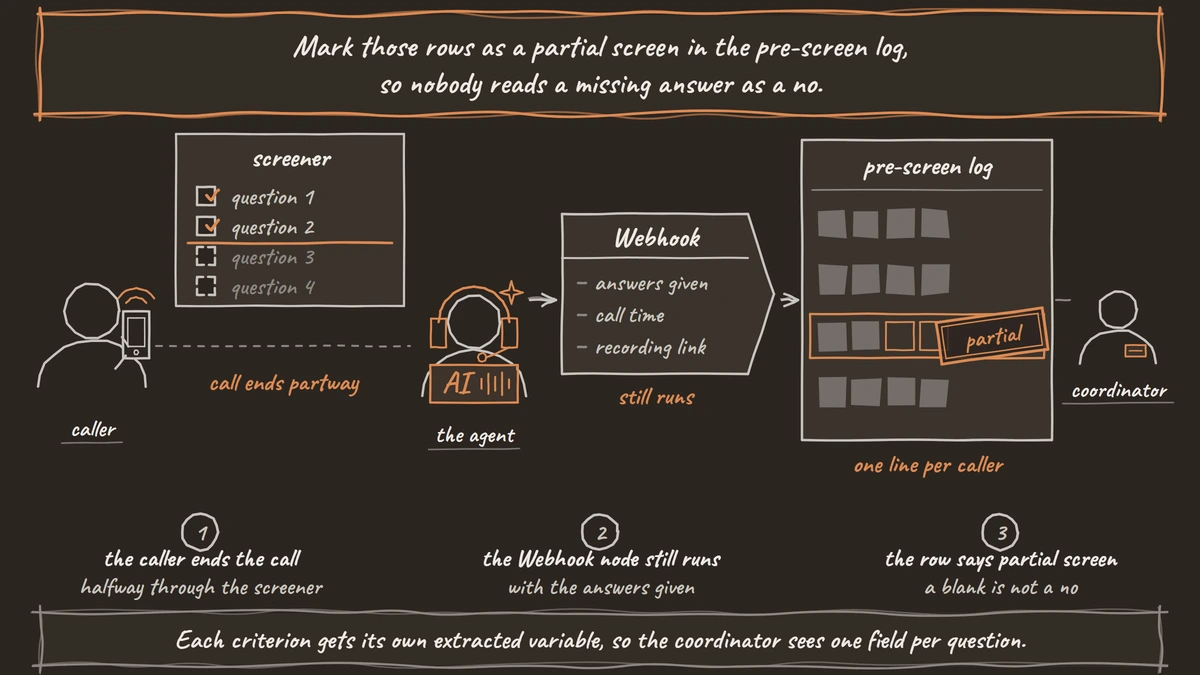
Each criterion gets its own extracted variable, so the coordinator sees one field per question. Variable extraction on a step offers String, Number and Boolean types, each with an Extraction Hint that tells the model what to capture, such as "number of urgent care or emergency room visits in the past 12 months". Extraction is an AI step, so the agent records each answer as the caller stated it, and the transcript and recording stay as the exact record.
The agent never tells a caller they qualify. It thanks them and says the study team will review the answers and call back. After the call, a Webhook node sends the answers to the site's recruitment database or clinical trial management system (CTMS) as fields such as {{gathered_context.asthma_diagnosis}}. If the receiving system has a temporary failure, the webhook is retried automatically, up to 5 attempts.
Those rows become the pre-screen log the coordinator reads each morning, one line per caller with the answers, the call time and a link to the recording. When the answers fit and the protocol allows it, the agent can also book the screening visit during the call with an HTTP API tool against the site's scheduler.
What the IRB asks about hang-ups and non-qualifiers
Your IRB wants real procedures for the information callers give, and a general promise of confidentiality is not enough. FDA's guidance on recruiting study subjects says the IRB may ask what happens to a caller's personal information if they end the interview partway through, and whether the names of people who do not qualify are kept for other studies.
Have an answer for both before the first call. When a caller ends the call halfway through the screener, the run still ends normally and the Webhook node still runs, carrying whatever answers were extracted before the call ended. Mark those rows as a partial screen in the pre-screen log, so nobody reads a missing answer as a no.
Recordings and transcripts stay until the site removes them, so the site's own retention policy decides how long partial screens and non-qualifier records are kept. Tell your IRB what happens to them, then delete them from your own storage on the schedule you described. If a caller agrees to hear about future studies, record that as its own Boolean answer, so a kept name always has a yes behind it. On a self-hosted install, the ENABLE_CALL_RECORDING_UPLOAD setting switches recording off for the whole server, and transcripts are still saved.
Join the Dograh Community
Dograh is an OSS alternative to Vapi. Join our Slack community for queries, releases, best practices & community interactions.
When a symptom comes up during screening
Some callers mention a health problem while answering, and that can matter to the study before anyone is enrolled. The good clinical practice guideline from the International Council for Harmonization, ICH E6(R3), says unfavorable medical events during screening should be considered and reported to the sponsor if the protocol requires it.
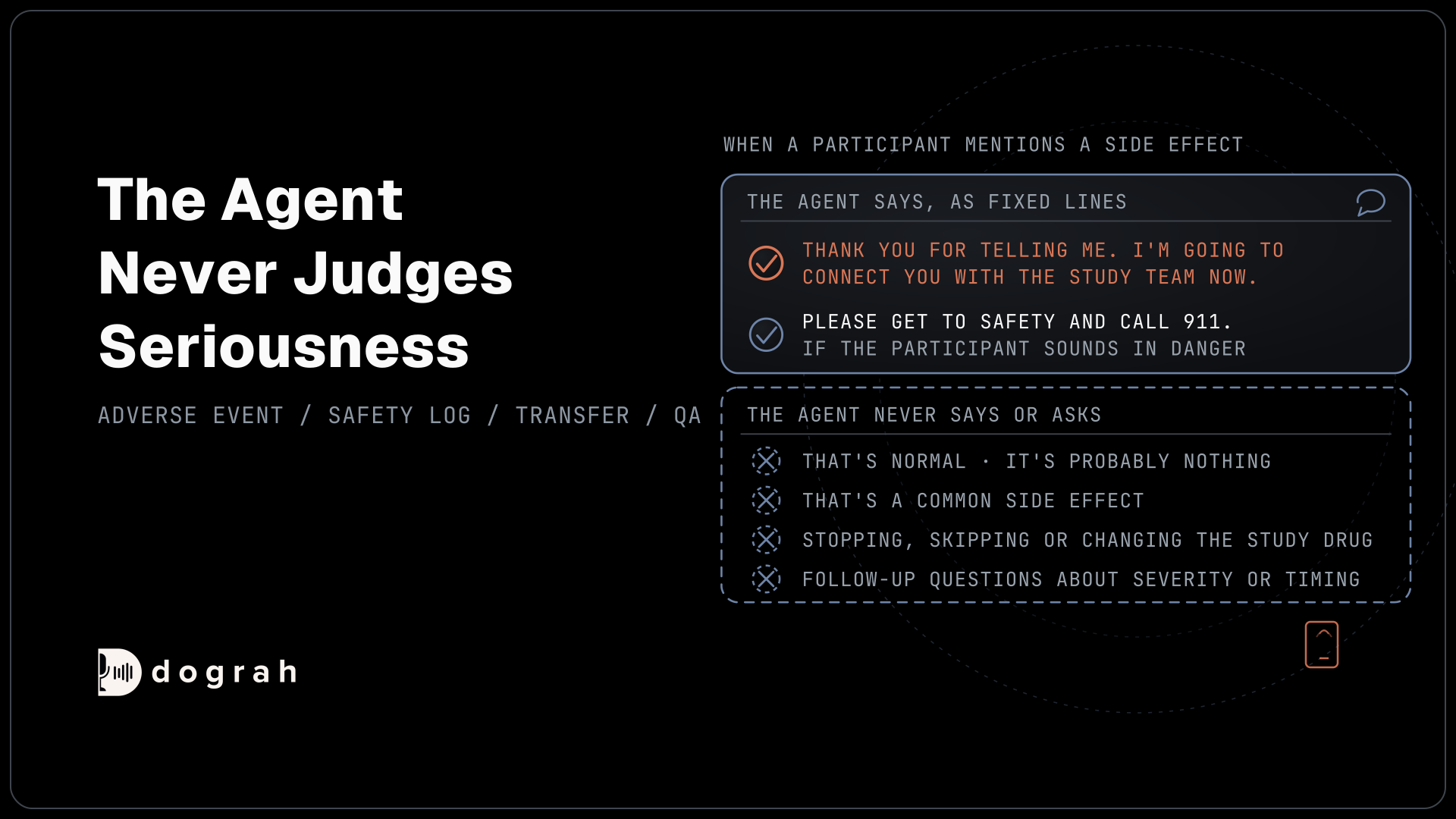
The agent judges none of this. A pathway into a handoff step plays a fixed line, and Transfer Call dials the coordinator and connects the caller only when someone answers. Anyone in danger is told to get to safety and call 911. Our post on handling adverse event mentions on AI calls covers what the agent says and who is told.
Running pre-screens on the site's own servers
A pre-screen recording holds health information about a named person, often someone who never enrolls. Under the research rules of the Health Insurance Portability and Accountability Act (HIPAA), reviews preparatory to research are allowed only when no protected health information leaves the covered entity. Where a site relies on that route, recordings and transcripts of these calls belong on its own servers.
Self-hosted Dograh runs inside the site's network, so no business associate agreement (BAA) with Dograh is needed. A model provider that hears the call needs its own BAA, a cloud host needs one if the servers run in its account, and the phone carrier may need one depending on what it stores. A BAA hands over obligations, and the site keeps its own liability. Our post on which parts of a voice AI stack need a BAA goes layer by layer.
Dograh is the orchestration layer that runs the call flow, tools and telephony, and the speech and language models are a separate layer you choose. Open-weight models on the site's servers keep participant audio inside. Your own keys for a hosted model change who holds the contract, while the audio still reaches that provider.
On cost, a self-hosted install pays no per-minute platform fee to Dograh, though the servers, model keys and phone minutes still cost money. Dograh Cloud adds a 1¢-a-minute platform fee to each call minute. Self-hosting also makes the site the operator. Your team runs the server and its database and applies each upgrade. On the open-source version, help comes from the community on Slack and GitHub, and the Enterprise plan adds custom SLAs.
Prove the script held with a QA check
Before adding a second study, check that the agent asked every question as approved. Add tags to the QA node's prompt, such as QUESTION_SKIPPED and QUESTION_REWORDED, and set its Sample Rate to 100% while the study is new. QA scores each step on its own, so a flag points at the exact question that went wrong.
QA runs after the call, so it finds a miss and never stops one. Read each flagged call with its trace, fix the pathway or the clip, and test again over a real phone line. Choosing a pathway is the language model reading its written condition, so this check is how you show the IRB that every caller heard the same questions in the same order.
Start with one study that has a steady flow of referrals and run its pre-screen alone for a few weeks with the tags on. A site that can play the IRB the exact audio behind every question has its answer ready when the next protocol comes up for review.
Glossary
- Knock-out question
- A pre-screen question whose answer alone rules a caller out, such as age or diagnosis. Asking these first keeps calls short for people the study cannot take.
- Partial screen
- A pre-screen call that ends before every question is answered. The answers given so far still reach the site, so the log marks the row as partial and the IRB should know what happens to it.
- Pre-screen log
- The site's list of everyone who took a pre-screen call, with their answers, the call time and a link to the recording. The coordinator reviews it before anyone is booked for screening.
- Extraction Hint
- A short instruction on a Dograh extraction variable that tells the model exactly what to capture from the caller's answer. It is an AI step, so the transcript and recording stay as the exact record.