
AI voice agents for clinical trial recruitment and retention call people who showed interest in a study, ask the pre-screen questions its institutional review board (IRB) approved, book screening visits and place reminders and check-ins. The study team decides eligibility and the investigator takes consent. Dograh, the open-source AI voice agent platform we build, can run self-hosted at the site.
Key Takeaways
- Approved pre-screen questions play as fixed text, never as model-written wording.
- The agent records answers as stated, and the site decides who qualifies.
- A symptom mentioned on a check-in call goes straight to the coordinator.
Research coordinators lose hours to phone calls that could go to participants in the clinic. Below, we cover where calls slow a study down, how to keep IRB-approved wording fixed, who decides on pre-screen answers, reminders and check-ins, and where participant data sits, each set up in Dograh.
Where the phone slows a study down
Most of a site's recruitment work happens on the phone, and most of it is repetitive. A 2026 myTomorrows survey of 100 US site professionals, run by a patient-referral company, found that 55% of sites report delayed timelines or missed enrollment targets. In the same survey, 52% said at least one in five referrals is rejected before formal screening even begins.
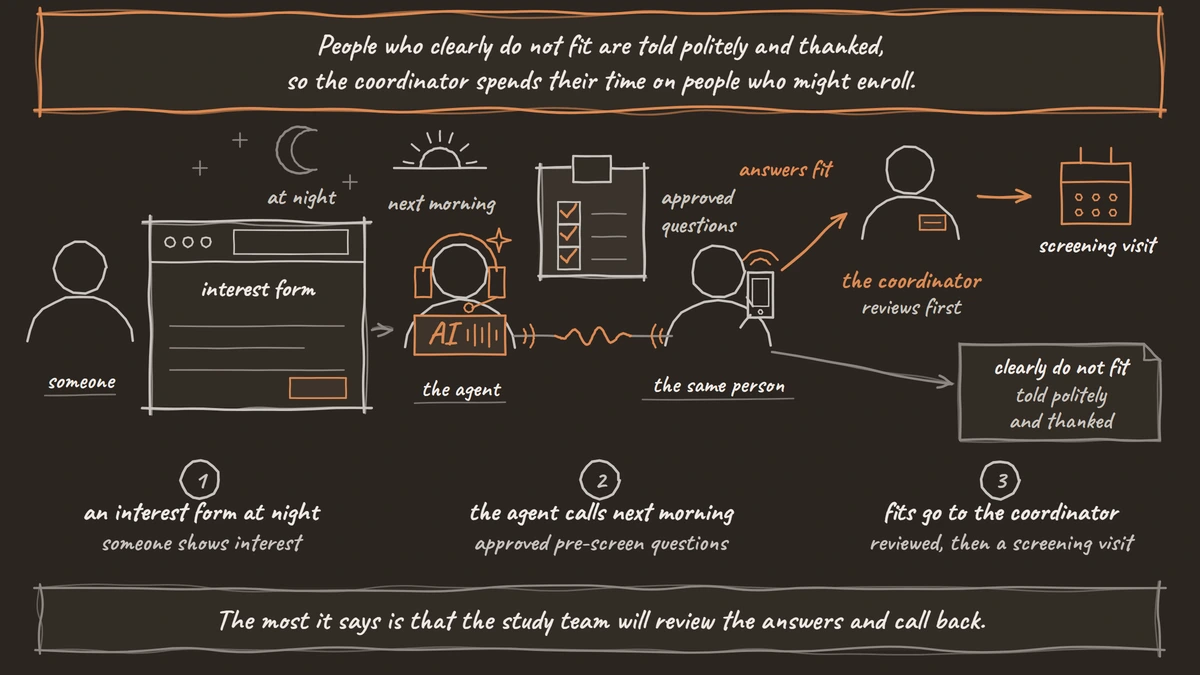
That second number is where a voice agent helps first. Someone fills in a study's interest form at night, and the agent calls them the next morning, asks the approved pre-screen questions and books a screening visit if the answers fit. People who clearly do not fit are told politely and thanked, so the coordinator spends their time on people who might enroll.
The same agent covers the other end of the study. Visit reminders and short check-ins between visits keep participants in the study, and they follow a fixed pattern from one participant to the next. In every one of these calls the site keeps the decisions, while the agent does the asking and the booking.
Keep the IRB-approved wording fixed
The words an agent says to a possible participant are recruitment material, and the IRB reviews them before the first call. The Food and Drug Administration (FDA), in its guidance on recruiting study subjects, expects the IRB to review the script used at first contact, along with ads and other materials. That wording may not claim the product is safe or effective, promise free medical treatment, stress payment, or call an investigational product "new" without saying it is investigational.
A language model writing its own sentences cannot promise any of that. Inside an agent step, the model chooses the words, so put the approved wording where Dograh speaks fixed text. The opening goes in the Greeting Text on the Start Call node. Each pre-screen question goes in the Transition Speech of the pathway that leads into its step, so the agent asks it word for word, and longer approved passages can play as pre-recorded clips in a real voice.
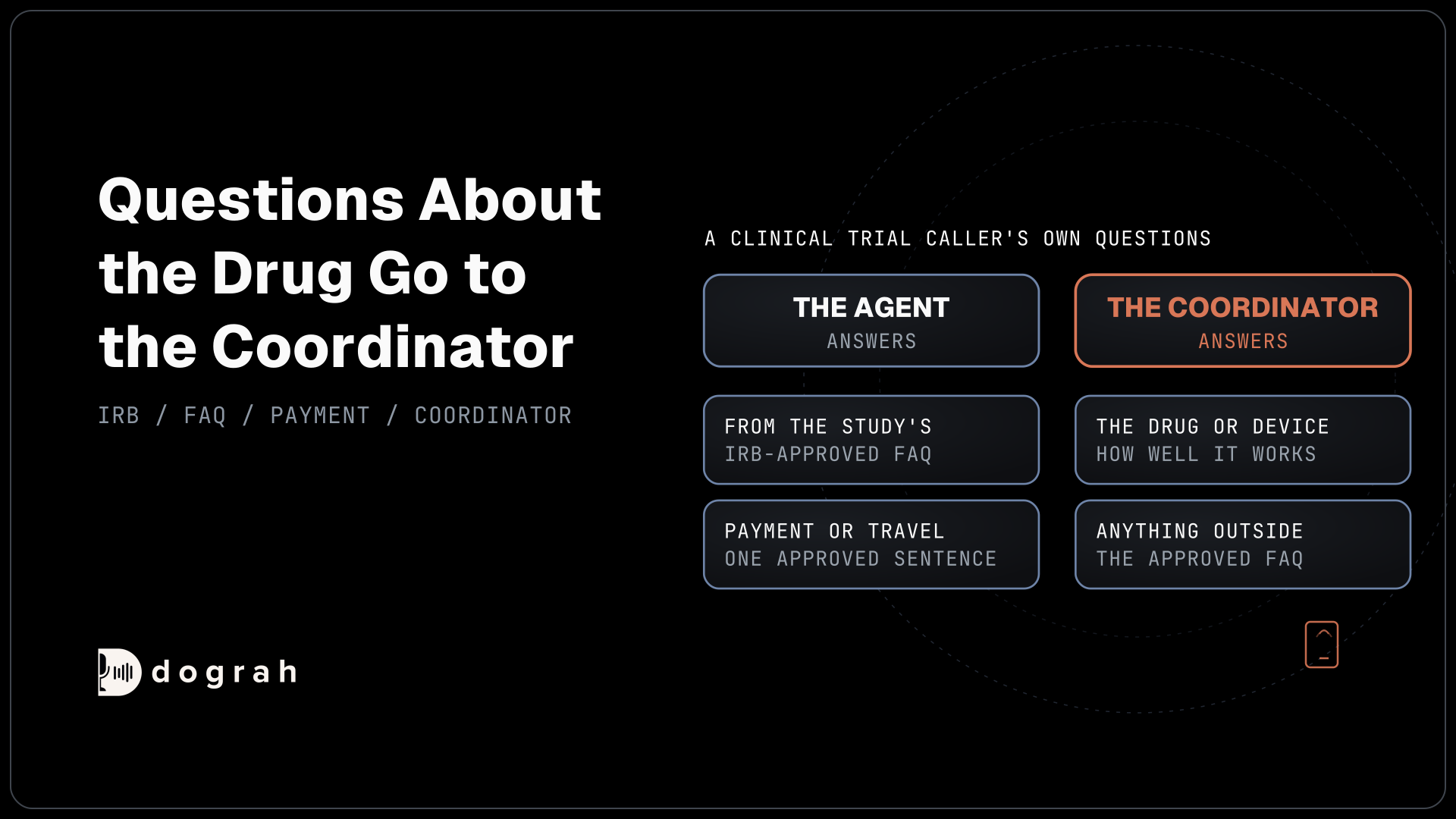
Answers to the caller's own questions come from the IRB-approved FAQ for the study, loaded into the agent's Knowledge Base, and the prompt tells the agent to offer a coordinator for anything outside it. Open with the site's name and, as we argue in why a voice agent should say it is an AI, say it is an automated assistant. Allow Greeting Interruption is on by default, so switch it off on the Start Call node and the whole approved opening plays.

Open Source Alternative to Vapi / Retell
Self-hosted voice agent platform — no per-minute fees
dograh-hq/dograh
Star on GitHub
The site decides, the agent records
Eligibility and consent stay with people at the site. Under the FDA's informed consent rule, an investigator obtains consent, gives the person time to consider it and avoids any coercion. So the agent never takes consent and never tells a caller they qualify. The most it says is that the study team will review the answers and call back.
Variable extraction records each answer as the caller stated it, and the transcript and recording stay as the exact record. A Webhook node sends those answers to the site's recruitment database or clinical trial management system (CTMS) after the call, and the coordinator reviews them before anyone is scheduled for screening. Ask questions in a way that does not reveal which answer qualifies, the same discipline our post on market research panel screening describes.
When answers fit, the agent can book the screening visit during the call with an HTTP API tool against the site's scheduler. Add a Preset Parameter named workflow_run_id with the value {{initial_context.workflow_run_id}}, so the scheduler can ignore a duplicate request for the same call.
Callers often ask about payment or travel costs before anything else. The FDA guidance allows recruitment material to mention payment but not to stress it, so give the agent one approved sentence about compensation and have it say only that. Questions about the drug or device itself, such as how well it works, go to the coordinator, because any answer the agent writes on its own can stray from what the IRB approved.
Visit reminders and check-ins between visits
Retention calls are short and frequent, and they suit a campaign. Upload the week's visits as a campaign, or let the CTMS start each call through the API Trigger. You set the retries (0 to 10) and the calling hours by weekday, in one time zone per campaign. Our guide to appointment reminders and confirmations covers the confirm, reschedule and cancel loop these calls share.
Study visits carry instructions that ordinary appointments lack, such as fasting before a blood draw or bringing a medication diary. Once the participant confirms who they are with the date of birth on file, the agent reads the instructions for their own visit, supplied by Pre-Call Data Fetch or the campaign's contact columns. Nothing about the visit is said before that check. Keep each instruction short and in the study's approved wording, and tell the prompt to read it as written.
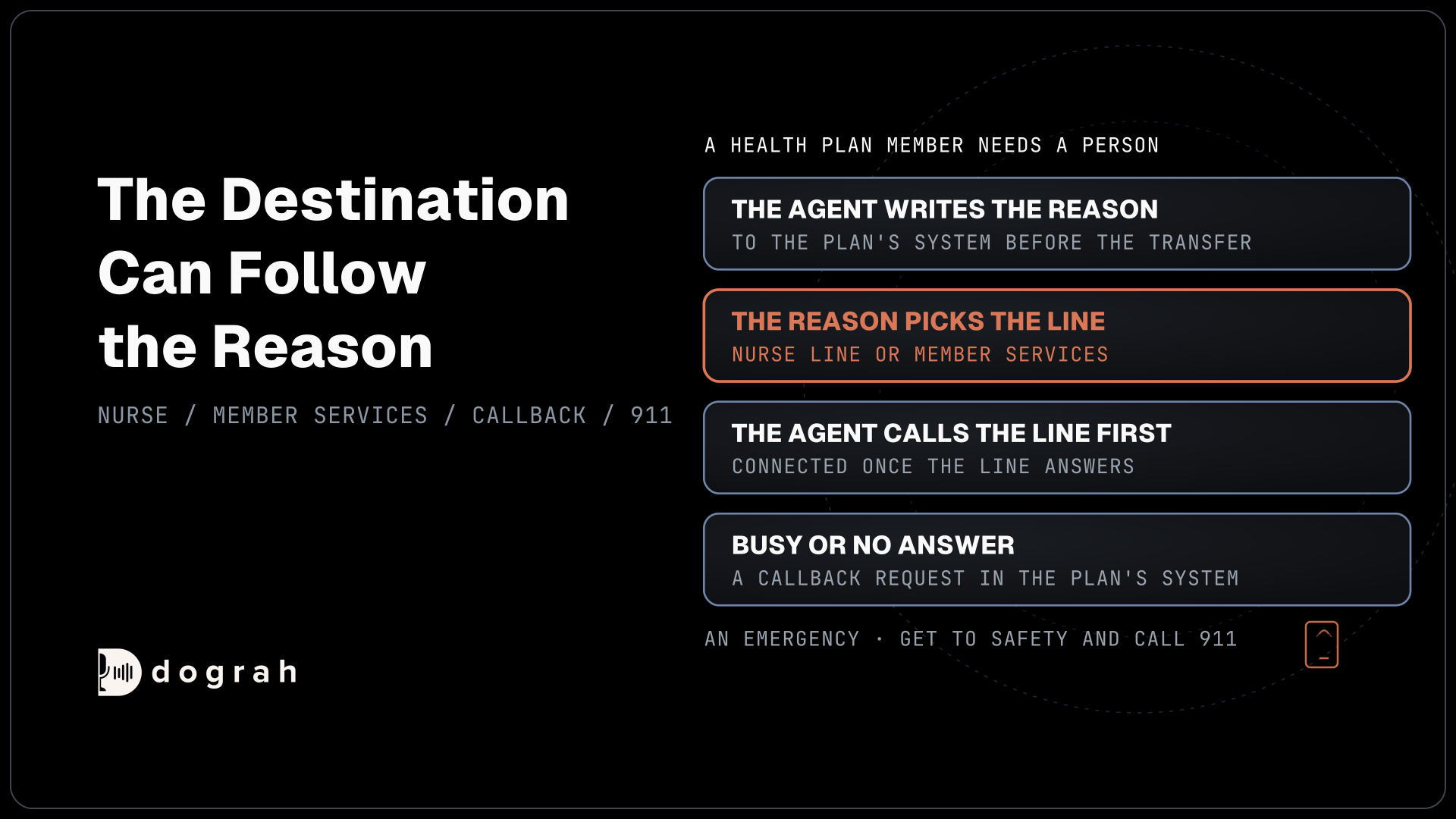
A check-in asks the protocol's approved questions, and the agent never judges the answers. Any mention of a side effect or new symptom goes to the study coordinator through Transfer Call, which works on Twilio, Telnyx, Plivo, Cloudonix and Asterisk ARI. Dograh dials the coordinator while the participant hears hold music and connects them once the coordinator answers. If nobody answers, the agent hears transfer_failed, stays on the call and records an urgent callback request. Anyone in danger is told to get to safety and call 911.
Voicemail handling is off by default. If you turn it on and choose Leave a message, keep the message to the site's name and a callback number, with no study name or condition, because anyone in the household may hear it.
Consent applies to the outbound side. Under the Telephone Consumer Protection Act (TCPA) rules, the FCC treats an AI voice as an artificial voice, so reminder and check-in calls to mobiles generally need the participant's prior express consent, collected on the consent form or intake. The rules have a healthcare exemption with conditions, and whether a research visit reminder fits it is a question to confirm with counsel and your IRB.
Join the Dograh Community
Dograh is an OSS alternative to Vapi. Join our Slack community for queries, releases, best practices & community interactions.
Where participant data sits
Recordings and transcripts of these calls hold health information about named people. Under the research rules of the Health Insurance Portability and Accountability Act (HIPAA), a covered entity may use or disclose that information for research with an IRB or privacy board waiver of authorization. Reviews to prepare a protocol do not allow the information to leave the covered entity, so recruitment calls generally belong under the study's approved plan.
Self-hosted Dograh runs on the site's own servers, so no BAA with Dograh is needed. A business associate agreement delegates obligations and never transfers the site's liability, and a model provider that hears the call or a cloud host running the servers needs its own. Our post on which parts of a voice AI stack need a BAA walks through each layer, including the phone carrier.
Dograh is the orchestration layer that runs the call flow, tools and telephony, and the speech and language models are a separate layer you choose. Open-weight models on the site's servers keep participant audio inside, while your own keys for hosted models move only the contract. Recording can be switched off server-wide with ENABLE_CALL_RECORDING_UPLOAD, and the study's retention rules decide when stored calls are deleted.
Start with one study
Pick one study with a steady flow of referrals and automate only the pre-screen call for the first few weeks. Self-hosted Dograh has no per-minute platform fee, but servers, model keys and phone minutes still cost money. Dograh Cloud charges a 1¢-a-minute platform fee.
Add a check to QA that flags any call where the agent implied a caller qualifies, or called the product safe, effective or new. Read every flagged call with its call trace and fix the wording or the prompt before you add reminders. A site that can show the IRB exactly what each caller heard has an easier time getting the next study's script approved.
Glossary
- Pre-screen call
- A short call that asks a possible participant the study's approved questions before formal screening at the site. It records answers for the study team and never decides eligibility.
- Investigational product
- A drug, device or biologic still under study. Recruitment wording must say it is investigational and may not call it a new treatment or claim it is safe or effective.
- Waiver of authorization
- Approval from an IRB or privacy board that lets a covered entity use or disclose health information for research without each person's written authorization.
- Transition Speech
- A fixed line, typed text or a recording, that Dograh plays when the agent moves to another step. It plays the same words on every call, which suits IRB-approved questions.