
AI voice agents for market research panels handle the phone work around a study: recruiting new panelists, screening them against quota cells that are still open, reminding them about sessions and calling lapsed members back. The panel system decides who gets called and how often, so quotas fill without calling the same people again and again.
Key Takeaways
- The panel system sets contact frequency, and the agent places the calls.
- Check the quota cell during the call, before anyone is booked.
- Research calls to mobiles still need prior express consent from sign-up.
Below, we follow a panelist from the first recruitment call through screening, quota checks, reminders and re-engagement, cover consent and panel data, and show how each part works in Dograh, the open-source AI voice agent platform we build. You can self-host it or run it on Dograh Cloud.
What a panel phone line does
A panel phone line exists to get people into studies and keep them on the panel. That means four jobs: recruiting new members, screening them for a study, reminding them about sessions and open surveys, and calling back the ones who drifted away. None of these calls is the research itself.
The hard part is getting people in and keeping them. In one recent wave of Pew Research Center's American Trends Panel, 8,937 of 9,531 sampled panelists answered, a 94% response rate. Once nonresponse to recruitment and attrition over the years are counted, the cumulative response rate is 3%. People on a panel answer. Most people never get onto one, or leave.
Some AI tools now run the interview itself and bring their own rented panel. We think that is a separate decision. The interview method belongs to the research team, whether it is a human moderator, an online survey or a phone survey. The voice agent works on the calls around it, where volume is high and the questions repeat.
That split also keeps the agent's job measurable, because each call has a clear end. A recruitment call ends with a new member or without one, and a reminder ends with a session that is confirmed or moved.
Quotas: fill the cells you still need
A quota fills cell by cell, so the agent should only spend calls on cells that still need people. A cell is a slice of the sample, such as women aged 35 to 44 in the Midwest who bought a car this year. When a cell is full, every extra call into it costs the panel goodwill and gains nothing.
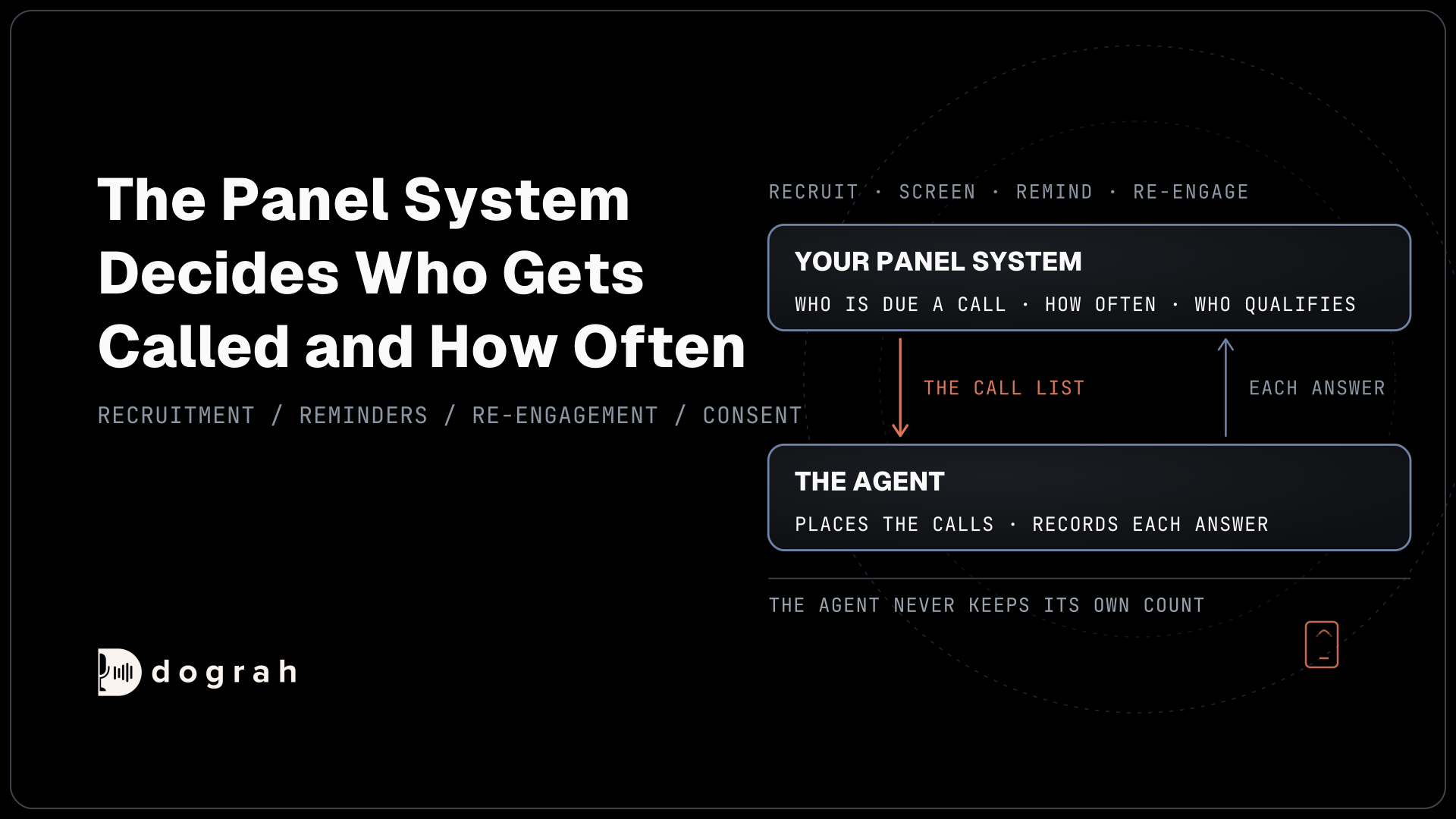
Start with the call list. Your panel system exports only members who could fit an open cell, and a full cell drops off the next export. The voice agent never keeps its own count.
Cells can close while a campaign runs, so check again during the call. An HTTP API tool sends the person's answers to your panel or quota system mid-call, and the system replies whether they qualify and whether their cell still has room. While the request runs, a message plays as the tool starts, either a typed line or a recorded clip, and a later update can be added if the lookup takes a few seconds.
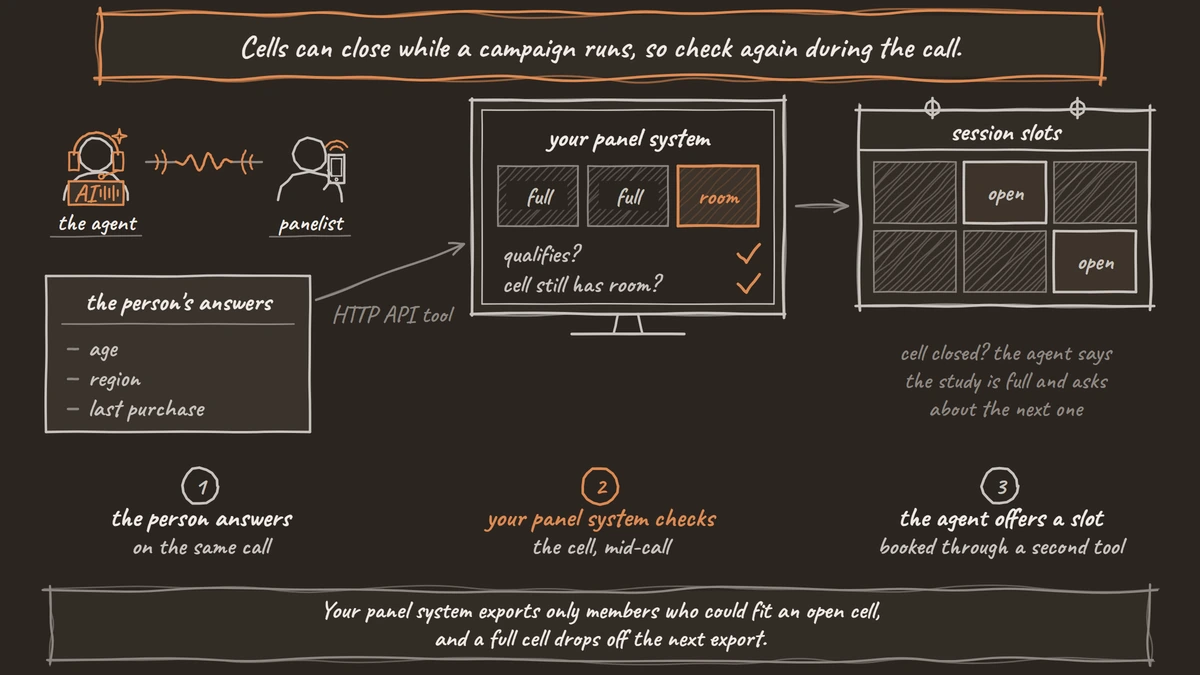
If the cell is open, the agent offers a session slot from the same system and books it through a second tool. Add a Preset Parameter named workflow_run_id with the value {{initial_context.workflow_run_id}}, so your system can ignore a duplicate booking for the same call. If the cell closed a minute ago, the agent thanks the person, says the study is full and asks whether they would like to hear about the next one.

Open Source Alternative to Vapi / Retell
Self-hosted voice agent platform — no per-minute fees
dograh-hq/dograh
Star on GitHub
Recruiting new panelists by phone
Recruitment calls come two ways, from people who call a number in an ad and from people who left their number on a sign-up form. Both can reach the same agent.
For inbound recruitment, give each ad its own phone number and point every number at one agent through the number's Inbound workflow setting. The dialled number reaches Pre-Call Data Fetch as to_number, so your system can tell the agent which study the ad was for. The greeting waits for that fetch, and the caller hears ringing in the meantime.
For outbound recruitment, call only people whose sign-up form collected consent for these calls (more on that below). The Greeting Text on the Start Call node is fixed text spoken word for word, so it carries the research company's name and a callback number, for example "Hi, this is Northfield Research calling about the panel you signed up for. You can reach us at +1415555XXXX." Switch off Allow Greeting Interruption, which is on by default, so the full opening plays.
After the opening, the agent asks the profile questions your panel needs, records the answers and writes the new member to your panel system.
Screening without giving away the answer
A spoken screener has one problem a written one does not: the question can tell the person what you want to hear. "Are you between 25 and 34?" invites a yes from anyone who wants the incentive. "How old are you?" does not.
So the agent asks open questions, records each answer as the person said it, and sends them to the panel system, which applies the criteria. The agent never decides who qualifies and never says which answer did not fit. Someone who does not qualify hears a polite thank-you and nothing about the reason.
Recorded answers come from an AI step, so treat the transcript and recording as the exact record. Our deep dive on AI phone surveys for recruitment and screening calls covers screener design for voice, the quota check and sending qualified people on.
Reminders for sessions and open studies
Reminders protect the sessions you already booked, so they are often the first call worth automating. A focus group seat that sits empty on the day costs the incentive budget and the recruiter's time.
Run reminders as a campaign from your panel system's daily export. Extra columns in the file, such as the session time and location, become variables the agent can read. Calling hours are set by weekday in one time zone per campaign, so split a national list by time zone. The retries (0 to 10) and the gap between them are both yours to set.
The reminder asks one thing, whether the person can still make the session. A yes is recorded. A no or a "maybe" leads to a reschedule offer from open slots, booked through an HTTP API tool, or a release of the seat so your recruiters can fill it.
Voicemail handling is off by default. Once you turn it on, "Disconnect the call" is preselected, and "Leave a message" plays one fixed message. Keep that message to the company name, the study and a callback number. A Webhook node after the call sends each outcome to your panel system, retrying on its own if your endpoint has a temporary failure.
Join the Dograh Community
Dograh is an OSS alternative to Vapi. Join our Slack community for queries, releases, best practices & community interactions.
Re-engaging lapsed panelists
A panel wears out from how often it is asked, more than from which channel asks. Ipsos reports in its KnowledgePanel report that monthly panel attrition fell to 2.5%, down from 4.8% four years earlier, and completion rose to 70% from 55%. Ipsos credits controlling survey frequency, limiting demands on members and fair rewards.
That puts contact frequency in your panel system, never in the voice agent. A Dograh campaign makes one answered call per contact and does not track contacts across campaigns, so your system decides who is due a call and leaves everyone else off the list.
The re-engagement call itself is short. The agent says who is calling, asks whether the member still wants studies, checks the profile fields that go stale, such as job and household, and asks how often they would like to be invited. Each answer goes back to the panel record.
Listen for one phrase in particular. "Stop calling me" does not always mean "remove me from the panel". The agent asks which one the person means and records the answer, so a member who only wants email invitations stays a member.
Some re-engagement calls start from an event, such as a member who skipped three invitations in a row. Your panel system can start that call through the API Trigger, which places the call as soon as your system sends the request. It has no calling-hours setting of its own, so hold evening events in your system until morning. The setup is covered in our guide to starting a voice agent call from any system.
Consent and contact limits
Research calls sit outside telemarketing, and AI calls to mobiles still need consent. The FCC's ruling on AI-generated voices places them in the artificial-voice category of the Telephone Consumer Protection Act (TCPA). Under the FCC's calling rules, an artificial-voice call to a mobile number needs the prior express consent of the person called, unless it is an emergency.
A call that only recruits, screens or reminds for a study, and does not encourage anyone to buy anything, is not telemarketing. So the stricter written consent that sales calls need does not apply for that reason. Get consent to these calls on the panel sign-up or recruitment form where the person gives their phone number, in wording they agree to.
The call must say who is calling at the start and give a callback number, which is why both sit in the fixed greeting. A person can revoke consent by any reasonable method that makes clear they want no more calls, and the request must be honoured within 10 business days. The agent writes a revocation to your system during the call, and your system removes the number from later lists. If your call names a paid incentive, have counsel check that wording, and confirm your consent language with them before the first campaign.
Retries count toward how often you contact someone. Our post on AI voice agents for NPS and CSAT surveys walks through retries and call limits on survey campaigns.
Where panel data goes
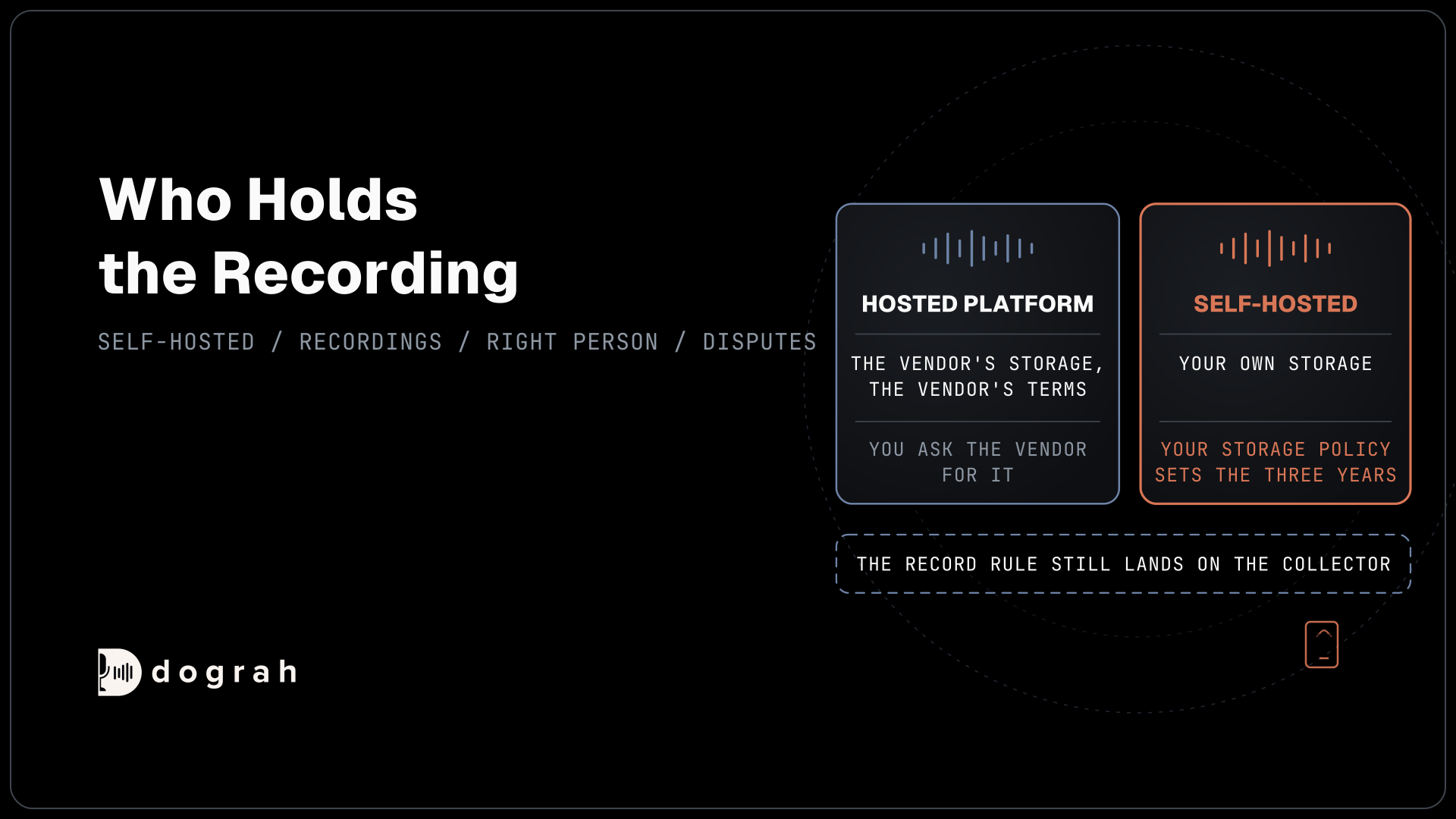
Panel profiles carry sensitive answers, such as health conditions and household income, so where the calls run matters. Dograh is open-source, so you can self-host it and keep recordings, transcripts and answers on your own servers. We built a page on a self-hosted voice agent for research panel recruitment that keeps screening, quota checks and panelist recordings in your environment.
For full control, run open-weight speech and language models on those servers too. Bringing your own keys for hosted models changes whose contract covers the data, while the audio still reaches that provider. You can start in the cloud and move the most sensitive studies in-house later. Self-hosted Dograh has no per-minute platform fee, but servers, model keys and phone minutes still cost money. Dograh Cloud charges a 1¢-a-minute platform fee.
The fixed parts of a panel call, the opening and the consent lines, can be pre-recorded clips in a real recruiter's voice, with the model's voice covering everything else. Each call's View Trace button opens the full trace, so you can see what the agent heard and why it took each step. Our page on open-source voice AI for survey calls covers the survey side of that setup.
Built-in QA reviews calls after they end, scoring each step on its own. Write its prompt to flag leading screener questions, a criterion read aloud, or a missed opt-out, and set a Sample Rate if you only want to review a share of calls.
Where to start
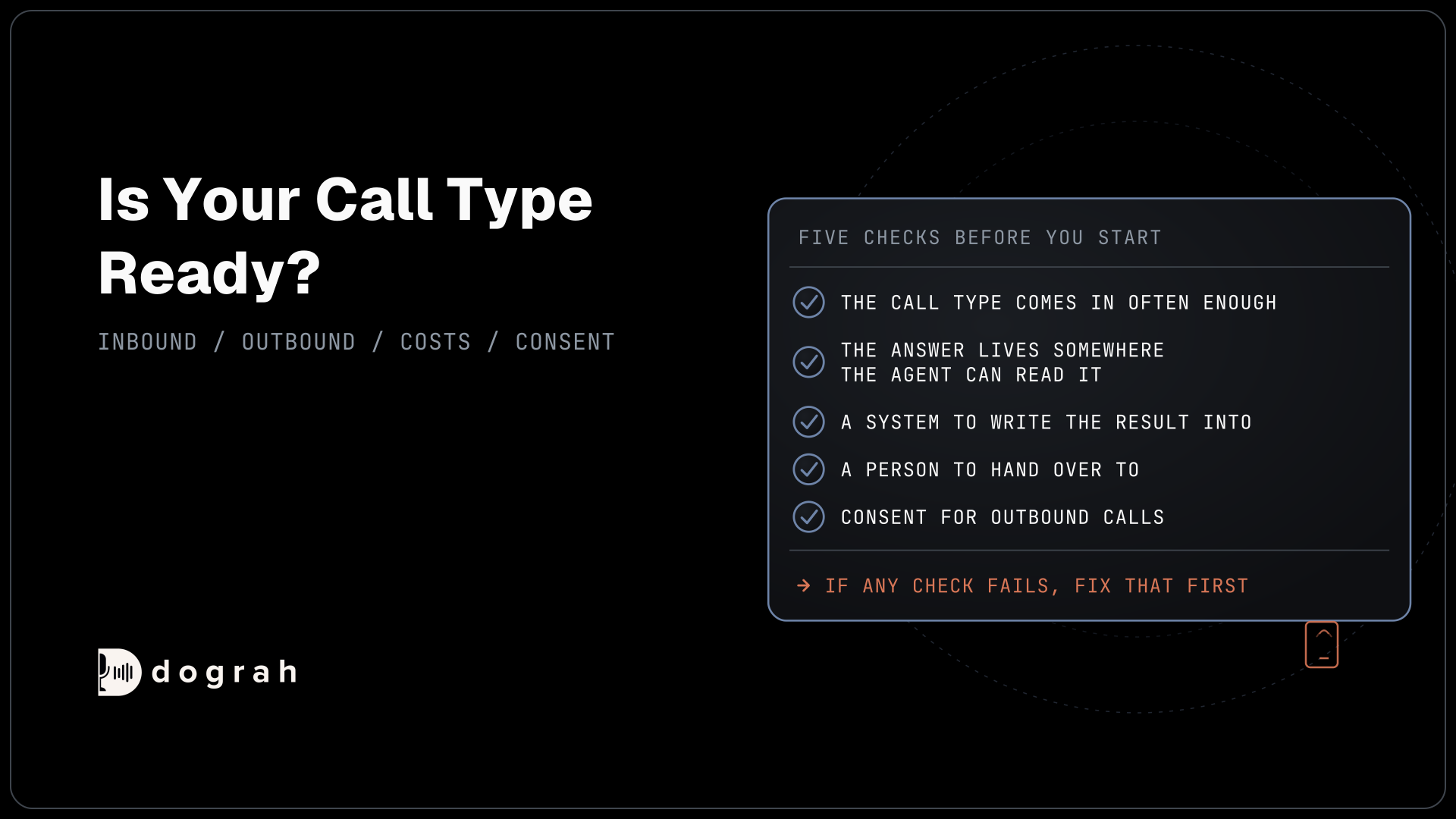
Start with session reminders, because the list already exists and a no-show has a clear cost. Re-engagement comes next, once your panel system holds a contact-frequency rule the agent can follow. Recruitment and screening come last, because they need the quota check and the consent wording in place.
Test every call over a real phone line before launch. Most phone calls still reach the agent as 8 kHz audio, while a browser test runs at 16 kHz, so product names and brand names can sound different to the speech model.
Screening has its own deep dive:
Glossary
- Quota cell
- One slice of a study's sample, defined by a mix of traits such as age band, region and purchase history. A cell closes once it has enough people, and calls into it stop.
- Screener
- The short set of questions that decides whether a person fits a study. During a call, the agent asks the questions and records the answers, while the panel system applies the criteria.
- Panel attrition
- The share of panel members who stop taking part over a period. Ipsos links lower attrition to controlling how often members are asked.
- Prior express consent
- Permission given before the call to be contacted at a number. Under the TCPA, an artificial-voice call to a mobile needs it, research calls included.