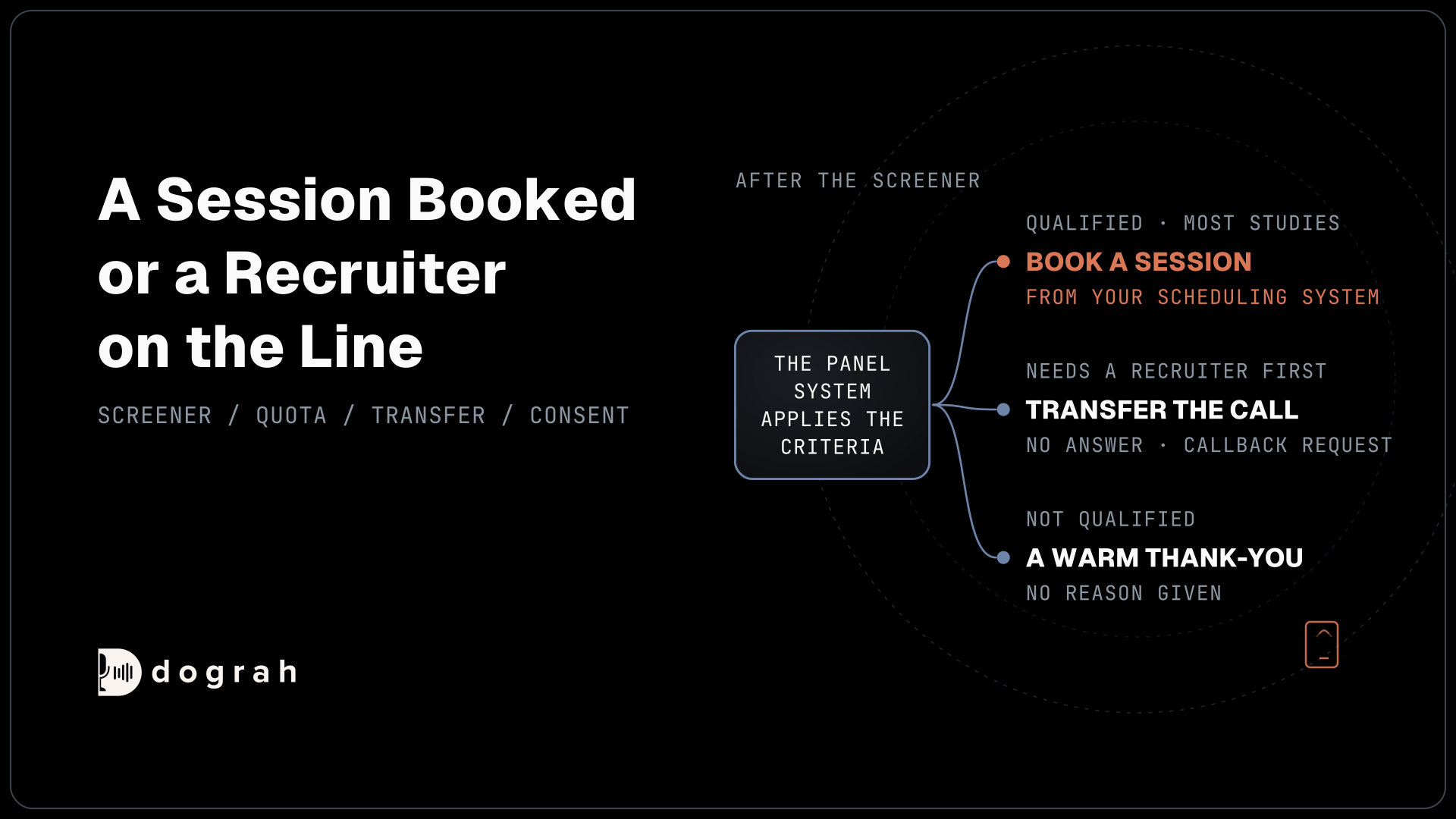

AI phone surveys for recruitment and screening ask candidates open questions in a normal conversation and record each answer as said. The panel system applies the criteria and checks the quota cell during the call. Qualified people are booked into a session or put through to a recruiter. Calls to mobiles need the person's prior express consent.
Key Takeaways
- Ask open questions so the qualifying answer stays hidden from the candidate.
- The panel system applies the criteria and checks the cell mid-call.
- Screening calls to mobiles need prior express consent from the sign-up form.
This post is part of our guide to AI voice agents for market research panels, where the panel system decides who qualifies. Below, we cover spoken screener questions and the quota check. Throughout, we show how the screening call runs in Dograh, the open-source AI voice agent platform we build.
Write the screener as a conversation
A screener on a call works when it sounds like a chat and gives nothing away. The structure is the same as a written one. Koji's guide to screener questions puts a typical screener at 5 to 11 questions, warns that more than 10 causes significant drop-off, and suggests piloting with 10 to 15 candidates. If more than 80% qualify, the screener is too broad. Under 5% usually means the criteria are unrealistic.
Voice changes how you ask. On a form, a person sees every option at once. On a call, they hear them one by one and can steer toward the one that sounds wanted. So the agent asks open questions and lets the person describe their own behaviour. "Which of these brands have you bought in the last three months?" becomes "Tell me about the last time you bought coffee for home."
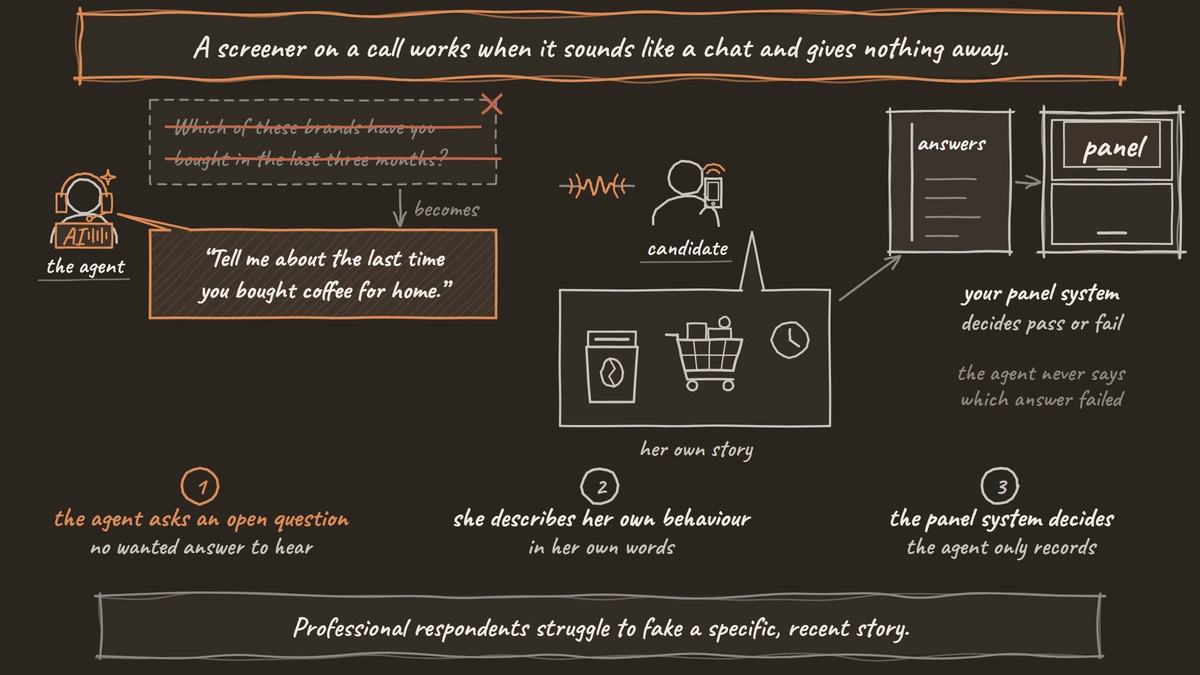
Put behaviour first and demographics later, and keep an exclusion question for people who work in research or marketing. Add one articulation question, such as "Describe the last time a website frustrated you." Professional respondents struggle to fake a specific, recent story.
Build each block of questions as its own Agent node with a short prompt. Moving between nodes is the model reading a written condition, so it is a judgement, never a hard rule. The pass or fail decision belongs somewhere else.
Record answers, let the panel system decide
The agent records what the person said, and your panel system applies the criteria. Turn on Enable Variable Extraction on the Agent node and list the fields you need, such as age, region, last purchase and job. Extraction is an AI step, so a field holds the answer as the person stated it, and the transcript and recording remain the exact record.
When the screener is done, an HTTP API tool sends those fields to your panel system during the call. The system checks them against the study's rules and replies with qualified or not. The agent never says which answer failed. A person who does not qualify hears a warm thank-you and an offer to hear about future studies, nothing more.
Hiring teams use the same pattern for job applicants. Our post on AI voice agents for candidate screening covers that version, where a recruiter makes the decision.

Open Source Alternative to Vapi / Retell
Self-hosted voice agent platform — no per-minute fees
dograh-hq/dograh
Star on GitHub
Check the quota before you book
A qualified person is only useful if their cell still has room. Quotas fill while a campaign runs, so the same panel system reply can include whether the cell is open, checked at that moment.
The lookup takes a second or two. You can have the tool play a typed line or a recorded clip as it starts, plus a later update if the lookup runs long. "Let me check which sessions we still have" covers the gap naturally.
If the cell is full, the agent thanks the person, says this study has filled and asks whether they would like to be contacted for the next one. Their answers still go to the panel system, so a later study can use them without a second screener.
Send qualified people on
A qualified person leaves the call with a session booked or a recruiter on the line. Most studies book. The agent reads open slots from your scheduling system and books the chosen one through a second HTTP API tool. Add a Preset Parameter named workflow_run_id with the value {{initial_context.workflow_run_id}}, so your system can ignore a duplicate booking from the same call.
Some studies need a recruiter to confirm details first, such as a home visit or a medical history. The Transfer Call tool handles that. Dograh calls the recruiter first and connects the candidate only when someone answers. With Twilio, it can first play a short spoken introduction that both the candidate and the recruiter hear, and then connect them. If nobody answers within the timeout, 30 seconds by default, the candidate stays with the agent, which writes a callback request to your system.
After the call, a Webhook node sends the outcome, the recorded answers and links to the recording and transcript to your panel system.
Join the Dograh Community
Dograh is an OSS alternative to Vapi. Join our Slack community for queries, releases, best practices & community interactions.
Consent for screening calls to mobiles
A screening call that sells nothing is not telemarketing, yet an AI call to a mobile still needs consent. The FCC's ruling on AI-generated voices treats them as artificial voices under the Telephone Consumer Protection Act (TCPA). The FCC's calling rules require the prior express consent of the person called for an artificial-voice call to a mobile, unless it is an emergency.
Because a screening call only asks about a study, the stricter written consent that sales calls need does not apply for that reason. Add a product pitch or an offer to the call and that changes. Collect consent to these calls on the sign-up or recruitment form that takes the phone number, in words the person agrees to. Sales qualification sits on the other side of that line, as our post on AI voice agents for lead qualification explains.
The call must say who is calling at the start and give a callback number. Put both in the Greeting Text on the Start Call node, which plays word for word, and switch off Allow Greeting Interruption, which is on by default, so the full opening plays. A person can revoke consent by any reasonable method, and the request must be honoured within 10 business days. The agent writes "stop calling me" to your system during the call. If the call names a paid incentive, have counsel check that wording, and confirm your consent language with them before the first campaign.
Checking every screening call
Screening calls drift in small ways, so review them after they end. Write the QA prompt to flag a criterion read aloud, a closed question that hints at the right answer, or a reason given to someone who did not qualify. QA scores each step separately, so you can see which block of the screener slipped.
Screener answers often include health and income details. Self-hosting keeps those answers, recordings and transcripts on the research company's own servers, and open-weight models running there keep the audio in-house too. Self-hosted Dograh has no per-minute platform fee, but servers, model keys and phone minutes still cost money. Dograh Cloud charges a 1¢-a-minute platform fee.
Pilot with a small batch before the full list. If the qualification rate lands above 80% or under 5%, read the transcripts and adjust the questions before the cells start filling.
Glossary
- Screener
- The short set of questions that decides whether a person fits a study. On a call, the agent asks and records, and the panel system applies the criteria.
- Articulation question
- An open question that asks for a specific, recent example in the person's own words. It catches professional respondents who know which boxes to tick.
- Variable extraction
- The AI step on an Agent node that turns what the person said into named fields. It records the answer as stated, and the transcript stays the exact record.
- Quota cell
- One slice of a study's sample, such as an age band in one region. A screening call checks that the cell still has room before booking anyone into it.