
A prior authorization status call tells a member where their request for a treatment stands. The voice agent verifies the member, reads the status and any denial reason from the plan's own system and hands clinical or appeal questions to a person. Dograh, the open-source AI voice agent platform we build, can run it self-hosted on the plan's servers.
Key Takeaways
- Verify the member before naming any request, service or status.
- Read the status and denial reason exactly as the plan's system returns them.
- From 2026, impacted payers decide standard requests within 7 calendar days.
Members call about a prior authorization because a treatment is waiting on the answer. Below, we cover the federal rules behind those calls, the verify step, what the agent says for each status, how denials reach a person, and where call data sits when the plan runs Dograh itself.
Why members call about prior authorizations
A pending request is a treatment on pause, and members feel that. In the AMA's 2025 prior authorization physician survey, published in 2026 by the physician advocacy body, 95% of physicians said prior authorization delays access to necessary care. A member waiting on an MRI or a course of physical therapy calls the plan to ask where things stand, and often calls again a few days later.
Most of these calls end in a fact the plan already holds. The request is pending, approved, denied or waiting on more information from the doctor's office. That makes the status call a lookup, and our guide to AI voice agents for health plans and payers puts it among the first member calls worth automating.
Speed and tone still matter. In a high-stakes wait, a line that answers at once and gives a clear status builds trust, even when the answer is "still pending". The agent's job is to give that answer quickly, in plain words, and to say what happens next.
The 2026 rules behind the status call
Federal rules now set how long many plans may take, and members increasingly know it. The CMS Interoperability and Prior Authorization Final Rule, known as CMS-0057-F, applies to impacted payers. These are Medicare Advantage organizations, state Medicaid and CHIP fee-for-service programs, Medicaid managed care plans, CHIP managed care entities and qualified health plan issuers on the federally facilitated exchanges.
Beginning in 2026, impacted payers other than those exchange plans must decide expedited requests within 72 hours and standard requests within 7 calendar days, with an extension of up to 14 days in some cases. The timeframes do not cover drugs. Every denial must come with a specific reason, and each payer must publish its prior authorization metrics on its website. For Medicare Advantage, the same 7-day standard is written into the rules on decision timeframes. How these rules apply to your plan's products is a question to confirm with your compliance team and counsel.
The rule also moves status into software. From 2027, payers must offer a Prior Authorization API and show prior authorization status through their Patient Access and Provider Access APIs. CMS names basic statuses such as pending, active, denied, expired and authorization not required. A phone agent that reads the plan's utilization management system reads the same record those APIs will expose, so members who never open an app still get the same answer.
Verify the member before any status
Every status call runs in the same order of greet, verify, then disclose. Even the fact that a request exists for a named service is protected health information. Our post on verifying identity before a voice agent shares PHI covers the rule and the failed-check paths.
A caller's number finds a likely member, and it proves nothing about who is speaking. Pre-Call Data Fetch on the Start Call node sends the caller's number to the plan's member system as the call connects, and the caller hears ringing until it returns. The agent then asks for the member ID and date of birth, and an HTTP API tool checks both against the plan's system. Only after the plan's system confirms a match does the agent say which requests are on file. It never reads a stored value aloud for the member to confirm.
A spouse or adult child calling for a member needs to be an authorized representative already on file, and the plan's system answers that, never the agent. Provider offices calling for status need a different check, built on the plan's own provider verification, and they are outside this post.

Open Source Alternative to Vapi / Retell
Self-hosted voice agent platform — no per-minute fees
dograh-hq/dograh
Star on GitHub
Read the status from the plan's system
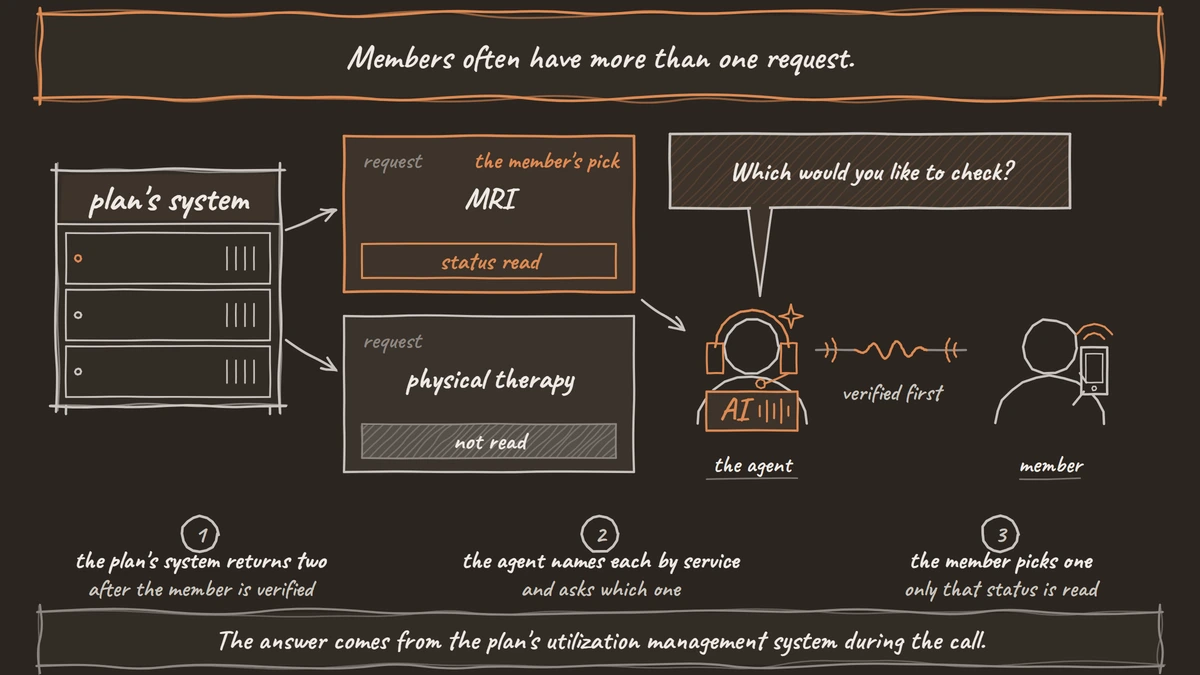
The answer comes from the plan's utilization management system during the call. An HTTP API tool sends a GET request with the verified member ID as a Preset Parameter, so the model cannot swap in a different ID. The system returns the member's open requests with their service, dates, status and any reason on file.
Members often have more than one request. When the system returns several, the agent names each by service and date and asks which one the member means before reading any status. "I see a request for an MRI from March and one for physical therapy from April. Which would you like to check?" keeps the agent from reading the wrong decision.
An HTTP API tool waits 5 seconds by default and tries once. If the lookup fails, the agent says it cannot read the record right now and offers a person or a callback, and it never guesses a status. For a slow system, the tool's Messages can play a start line such as "Let me check that authorization" and a delayed line such as "Still checking" after a set number of milliseconds. Text lines do not play on speech-to-speech models, so use recordings there.
What the agent says for each status
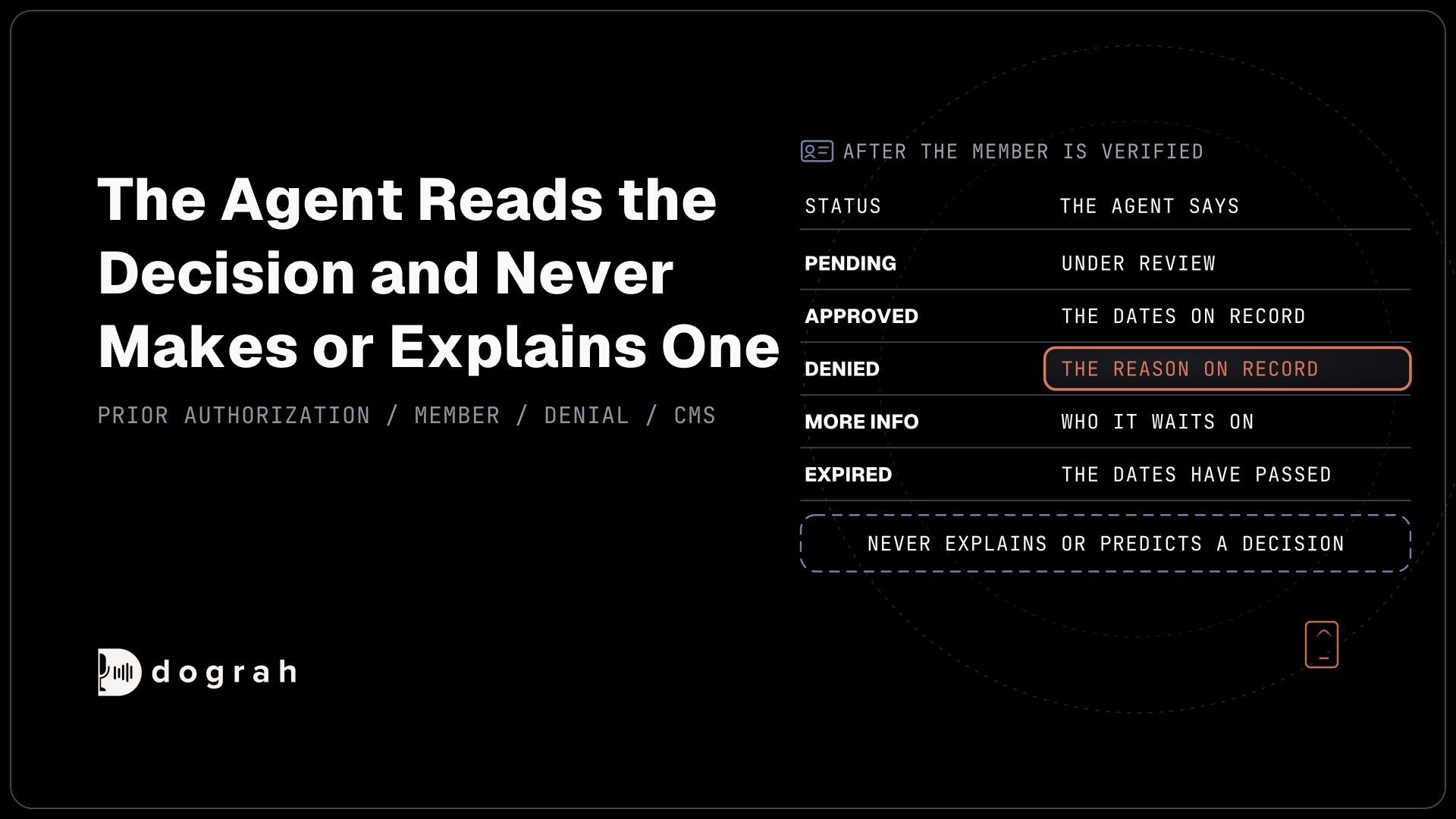
The agent reads the decision and never makes or explains one. Status names differ from plan to plan, since CMS does not fix the terms, so map your system's values to plain sentences before launch. Here is an example mapping for a typical plan:
| Status in the plan's system | What the agent says | Next step |
|---|---|---|
| Pending | The request was received on its date and is under review | Gives the decision date only if the system returns one |
| Approved | The service is approved, with the dates or visits on the record | Offers a person for questions about the care itself |
| Denied | The service was not approved, and reads the reason as the system holds it | Offers member services for an appeal |
| More information needed | The plan is waiting on information, and from whom | Suggests the member contact the doctor's office |
| Expired | The approval's dates have passed | Explains a new request comes from the doctor |
| Not required | This service does not need prior authorization | None |
Two lines stay off limits. The agent never explains why a service was or was not medically necessary, and it never predicts whether an appeal will succeed. Both belong to plan staff, and the rows above send those calls to a person.
Join the Dograh Community
Dograh is an OSS alternative to Vapi. Join our Slack community for queries, releases, best practices & community interactions.
Denials and handoffs to a person
A denial is where most members want a person, and the agent should get them there fast. Before the transfer, an HTTP API tool writes the request, the reason read out and what the member asked for into the plan's system, so the person who answers can see it. The transfer carries no summary of its own.
Transfer Call works on Twilio, Telnyx, Plivo, Cloudonix and Asterisk ARI. Dograh calls the destination first and connects the member only when someone answers. Context Mapping picks the number from what the member asked, so a clinical question goes to the nurse line and an appeal goes to member services. If the line is busy or nobody answers, the agent hears so and the call continues, and it records a callback request in the plan's system.
Running status calls on the plan's own servers
Each recording and transcript of a verified status call holds protected health information. Self-hosted Dograh runs on the plan's own servers, so no business associate agreement (BAA) with Dograh is needed. The plan still needs a BAA from any model provider that hears the call and from a cloud host whose account runs the servers, and the phone carrier may need one depending on what it stores. Our post on which parts of a voice AI stack need a BAA walks through each one.
Dograh is the orchestration layer, running the call flow, tools and telephony, while the speech and language models are a separate layer the plan chooses. Open-weight models on the plan's servers keep member audio inside its walls, while your own keys for hosted models move the contract and send the audio to that provider. Recording can be switched off server-wide with ENABLE_CALL_RECORDING_UPLOAD, transcripts are still saved, and the plan's retention policy decides when both are deleted.
For a plan's budget, self-hosted Dograh comes with no per-minute platform fee, but the servers, model keys and phone minutes are still real costs. Dograh Cloud bills a 1¢-a-minute platform fee instead. Running it in-house puts the server, the database and the upgrade schedule with the plan's own engineers. The open-source edition gets help from the community on Slack and GitHub, and Enterprise contracts come with custom SLAs.
Check every status the agent states
Before adding claim status or benefits calls, add a QA check that flags any call where the agent stated a status the tool never returned, with a tag such as STATUS_NOT_FROM_SYSTEM. QA scores each step on its own, so the flag lands on the exact turn. Start with pending requests, the calls with the least to get wrong, and widen once the flags stay at zero.
Glossary
- Impacted payer
- A plan covered by CMS-0057-F, such as a Medicare Advantage organization, a state Medicaid or CHIP program, a Medicaid or CHIP managed care plan, or a qualified health plan issuer on the federally facilitated exchanges.
- Expedited request
- A prior authorization request where the standard wait could seriously harm the member's health. Since 2026, impacted payers must decide most of these within 72 hours.
- Utilization management system
- The plan's system that records prior authorization requests, their status and the reason for each decision. The voice agent reads it during the call and never changes it.
- Authorized representative
- A person the plan has on file as allowed to act for a member, such as a spouse or caregiver. The plan's system confirms this before the agent discusses the member's requests.