
When a participant mentions a side effect on an AI call, the agent says a fixed line, writes the mention in their own words to the site's safety log and transfers the call to the study coordinator. It never judges seriousness. Dograh, the open-source AI voice agent platform we build, can run this self-hosted at the research site.
Key Takeaways
- The agent never judges seriousness. The investigator or sponsor makes that call.
- Write the mention to the safety log before transferring the call.
- Treat the call time as the time the site heard it.
A visit reminder can become a safety report in one sentence. Below, we cover what counts as a mention, who is told and how fast, the lines the agent says, the note it writes before transferring, what happens when nobody answers, and how Dograh shows nothing slipped through.
What counts as an adverse event mention
Make the trigger broad on purpose. Any new symptom, side effect, injury, fall, hospital or emergency room visit, or new medicine counts, and so does a vague "I haven't felt right since the last dose". The agent is not the one who sorts a real event from a passing complaint.
Under FDA's investigational new drug (IND) safety reporting rules, an adverse event is any untoward medical occurrence linked to using a drug in people, whether or not anyone thinks the drug caused it. Whether it is serious, for example because it led to a hospital stay or was life-threatening, is decided in the view of the investigator or the sponsor. A voice agent holds neither role, so it treats every mention the same way.
Detection is the language model following the prompt, so the trigger list belongs in plain words where every step can read it. Add the study drug's name and common symptom words to the agent's Dictionary, so speech-to-text hears them correctly. These rules are for clinical trials. A patient support line for a marketed drug follows different reporting rules.
Who is told, and how fast
The site's reporting chain starts the moment a person hears the mention. Under FDA's investigator reporting rule, the investigator must immediately report any serious adverse event to the sponsor, with a view on whether the drug could reasonably have caused it. Events that are not serious are recorded and reported on the protocol's timetable. Unanticipated problems involving risk to participants go to the IRB promptly.
The good clinical practice guideline ICH E6(R3), which FDA adopted as final guidance, says serious adverse events should be reported immediately after the investigator reasonably becomes aware of them. The investigator may delegate safety reporting tasks to qualified site staff and keeps the overall responsibility. A voice agent is not qualified site staff, so its job is to hand the mention to a person who is.
Device trials have their own clock. An investigator reports any unanticipated adverse device effect to the sponsor and the reviewing IRB as soon as possible and no later than 10 working days after first learning of it, under FDA's rules for device investigators.
So the order on the day is the agent to the study coordinator, the coordinator to the investigator, and the investigator to the sponsor. Whether a symptom heard by an agent the site runs counts as the site becoming aware is a question the rules leave open. The safe reading is to treat the call time as the time the site heard it, and to confirm that reading with your sponsor, your IRB and counsel. Our guide to AI voice agents for clinical trial recruitment and retention covers the reminder and check-in calls where these mentions usually come up.
What the agent says when it hears one
The agent's words at this moment should be fixed and short. Write the rule once in the Global Node, whose prompt is added to every step with Add Global Prompt switched on. For example, "If the participant mentions any new symptom, side effect, injury, hospital visit or new medicine, stop and take the escalation pathway." Each step then needs a pathway into the escalation step.
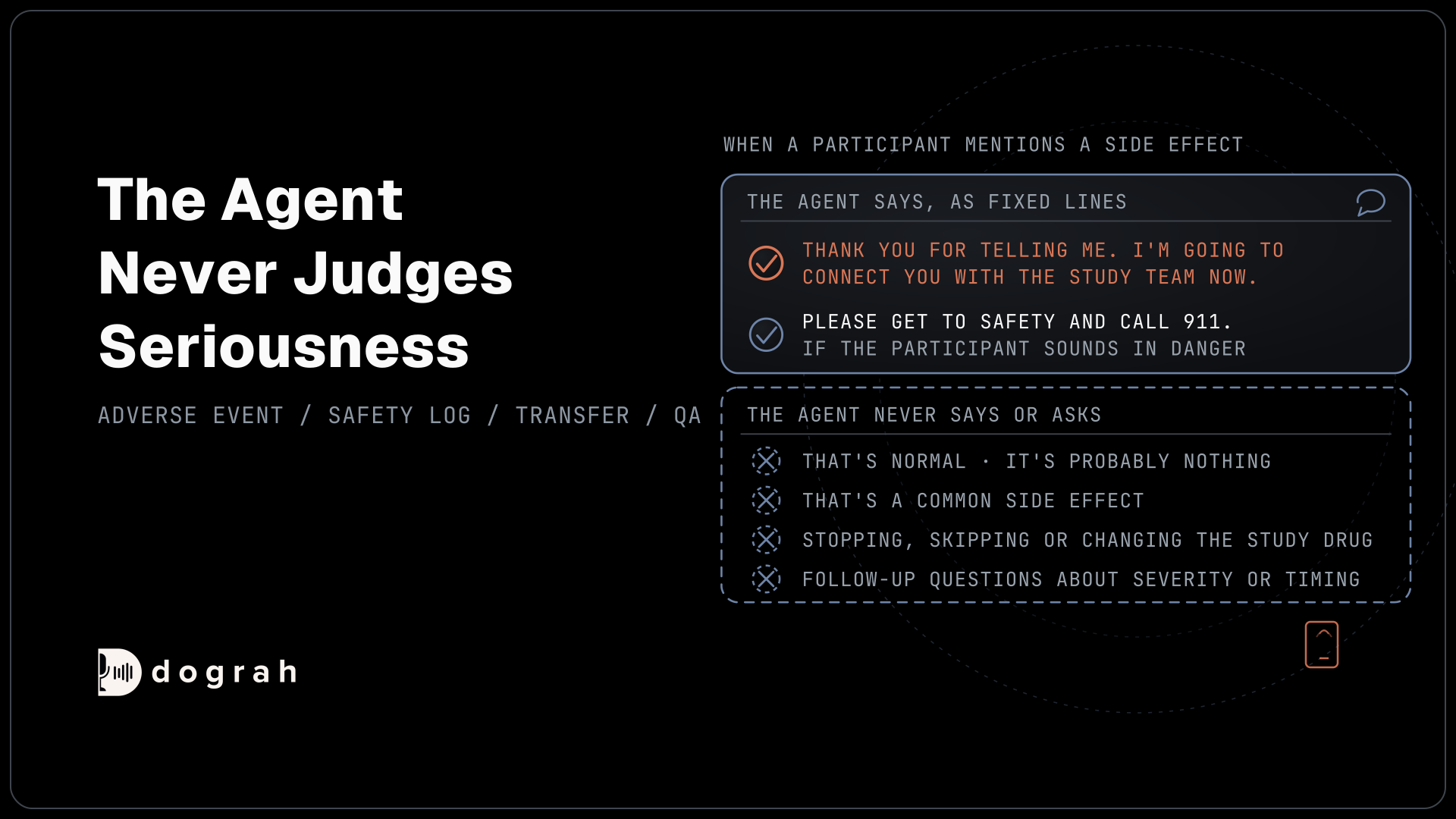
The pathway's Transition Speech plays the same words every time, as text or a recording. Inside a step the model chooses its own sentences, so the line that matters belongs in the transition. Here is an example set of lines for a made-up study:
- Says, on the transition: "Thank you for telling me. I'm going to connect you with the study team now."
- Says, if the participant sounds in danger: "Please get to safety and call 911."
- Never says: "That's normal", "That's a common side effect" or "It's probably nothing".
- Never says: anything about stopping, skipping or changing the study drug.
The agent asks no follow-up questions about severity or timing. The coordinator does that with clinical judgment. Choosing a pathway is still the language model reading its written condition, so the rule can miss on an odd phrasing, and the QA check at the end of this post catches that.

Open Source Alternative to Vapi / Retell
Self-hosted voice agent platform — no per-minute fees
dograh-hq/dograh
Star on GitHub
Write it down before the transfer
The note reaches the study team only when something writes it. On the way into the escalation step, an HTTP API tool posts the mention to the site's safety log or clinical trial management system (CTMS), with the participant ID, what they said in their own words and the time of the call. Transfer Call sends no summary with the call by default, so this record is what the coordinator sees on screen.
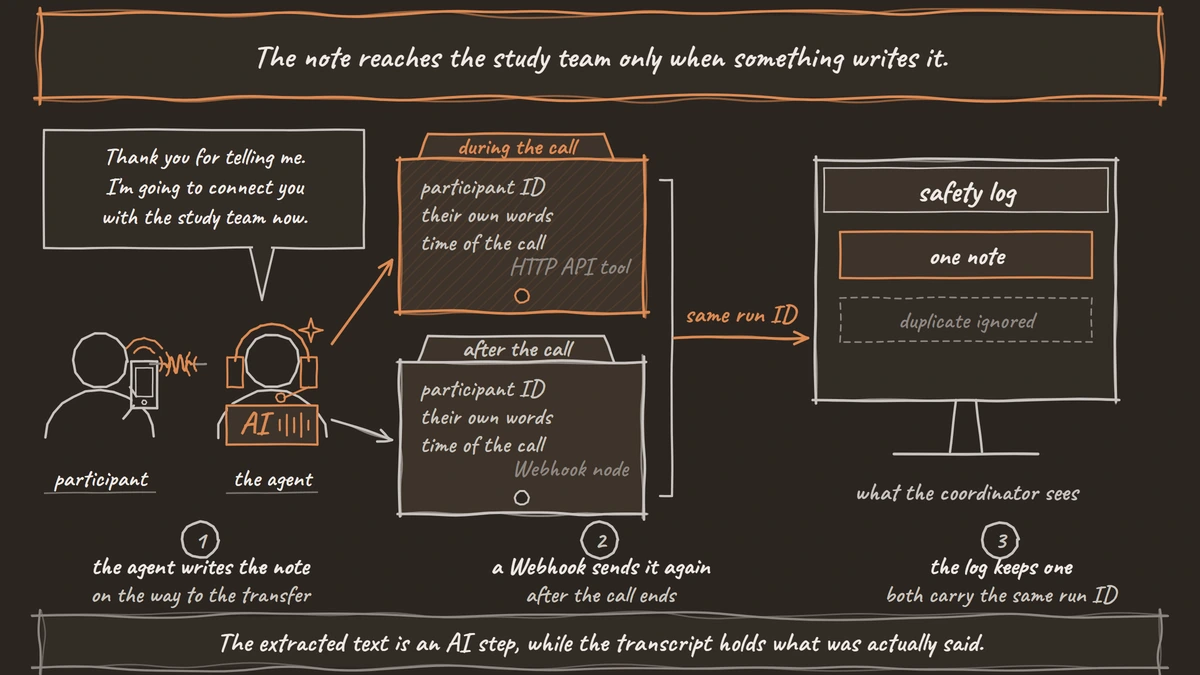
An HTTP API tool makes a single attempt and waits 5 seconds by default before the agent gets an error. So send the same record again after the call through a Webhook node, which retries a temporary failure automatically, up to 5 attempts. Include the run's workflow_run_id in both, and the receiving system can ignore the duplicate when both arrive.
Write the participant's words as close to what they said as the model allows, and point the coordinator to the transcript and recording as the exact record. The extracted text is an AI step, while the transcript holds what was actually said.
Get the participant to a person
With the note written, the agent hands the call over with Transfer Call, which works on Twilio, Telnyx, Plivo, Cloudonix and Asterisk ARI. Dograh calls the coordinator first and connects the participant only when someone answers. The participant hears hold music during the transfer.
The destination can depend on the call. Context Mapping picks the number from a value the agent gathered, such as the study site, with a fallback number. A Dynamic HTTP Resolver can ask the site's own on-call system who is covering right now. On Twilio, an optional spoken introduction that both people hear can play before they are connected. It is off by default and holds at most 25 words, so keep it to the participant's name and the word "symptom".
The transfer timeout defaults to 30 seconds and can be set from 5 to 120. Our guide to call transfer and human handoff covers the transfer settings in more depth.
Join the Dograh Community
Dograh is an OSS alternative to Vapi. Join our Slack community for queries, releases, best practices & community interactions.
When nobody answers the transfer
A busy line, no answer or a failed transfer comes back to the agent, and the call continues. The agent tells the participant, in a fixed line, that the study team will call them back, and an HTTP API tool writes an urgent callback request to the site's system. The safety note from the earlier step is already there, so the person who calls back starts with the participant's own words.
Agree with the site who watches that callback queue, especially for evening and weekend calls. If the protocol gives participants a 24-hour study phone number, have the agent read it out in the same fixed line.
Voicemail handling is off by default. If an outbound reminder campaign turns it on and sets it to Leave a message, keep the message to the site's name and a callback number, with no study name or symptom, because anyone in the household may hear it.
Prove no mention slipped through
Add a tag such as SAFETY_MENTION_NOT_ESCALATED to the QA node's prompt, and set its Sample Rate to 100% for every call in a study. QA scores each step separately, so the flag shows the step where the participant spoke and the agent carried on. QA runs after the call, so it finds a missed mention and never prevents one. Read every flagged call with its trace on the same day, and treat it as a mention the site heard at the call time.
Mentions can come up before anyone is enrolled, too. Our post on pre-screening calls for clinical trial recruitment covers what to do when a symptom comes up during screening.
Where the safety records are kept
When the site self-hosts, the transcripts, recordings and safety notes sit on its own servers, so no business associate agreement (BAA) with Dograh is needed. Any model provider that hears the calls signs its own BAA, so does a cloud host whose account runs the servers, and the phone carrier may need one depending on what it stores.
Self-hosted Dograh has no per-minute platform fee, but the site still pays for servers, model keys and phone minutes. On Dograh Cloud the platform fee is 1¢ per minute. Hosting it yourself means the site's IT team owns the server and the database and plans every upgrade. Help for the open-source version comes from the community on Slack and GitHub, and Enterprise adds custom SLAs.
Start with one study's reminder calls, keep the QA tag at 100% and read every flag before adding more calls. A site that can show every mention was written down and reached a person has the record its sponsor's monitor will ask for.
Glossary
- Serious adverse event
- An adverse event that results in death, is life-threatening, leads to or prolongs a hospital stay, causes lasting incapacity or a birth defect, in the view of the investigator or the sponsor. The investigator reports it to the sponsor immediately.
- Unanticipated adverse device effect
- A serious effect on health or safety caused by or linked to an investigational device that was not identified beforehand. The investigator reports it to the sponsor and the IRB within 10 working days.
- Site awareness
- The moment the trial site learns of an event, which starts its reporting clock. For a symptom heard on an agent the site runs, the safe reading is the call time.
- Escalation step
- The step a voice agent moves to when a participant mentions a symptom. Its Transition Speech plays a fixed line, and it writes the mention down before transferring the call to a person.