
Call center outsourcing means paying an outside provider to run some or all of your phone calls, such as support, sales, collections or scheduling, against agreed service levels. Models range from a fully managed vendor team to contractors under your own managers. Judge each option by the cost of a resolved call, not the hourly seat rate.
Key Takeaways
- Compare the cost of a resolved call, never the advertised hourly rate.
- Write every metric definition into the contract before the first call.
- Keep complaints and regulated decisions with the people accountable for them.
Outside call capacity should be bought for an outcome, then sized to deliver it. We compare the models, turn a seat rate into a cost per resolution, and show where Dograh, the open-source AI voice agent platform we build, takes routine calls, self-hosted or on Dograh Cloud.
What call center outsourcing means
Say a dental group misses calls at lunch and after six, while a lender's collections line overflows at month-end. The dental group needs bookings that reach the calendar, and the lender needs controlled conversations with clear authority to escalate a dispute. Outsourcing hands those calls to an outside provider against agreed service levels, so decide which calls leave your business and which outcome proves the move worked.
Grand View Research values global call and contact center outsourcing at USD 102.9 billion in 2025, with voice holding the largest share of revenue at 33.7%. Phone reliability, recording controls and data location deserve as much procurement attention as headcount.
If your managers already handle scheduling, coaching and escalation well, a staffing agency can help you hire customer service representative roles for your own team, and that option is worth pricing too. If they can't, decide who owns the queue and who fixes a failed handoff before you talk about headcount.
Outsourcing models and when each fits
The common models differ in who runs the agents, how you pay and what control you keep.
| Model | Who runs the agents | Typical use | Pricing pattern | Relative cost | Control you keep |
|---|---|---|---|---|---|
| Full managed BPO | Vendor hires, trains and manages | Support, sales and collections at scale | Per seat-hour or transaction | Staffing and management bundled | Medium, via the service agreement |
| Dedicated offshore team | Vendor team in hubs such as the Philippines or India | High-volume frontline and back-office calls | Per hour or monthly seat | Lower labor cost, check the loaded quote | Medium, via scripts and quality reviews |
| Nearshore team | Vendor team with overlapping hours | Calls needing language and hours overlap | Per hour | Premium for overlap and skills | Medium to high |
| Onshore specialist agency | Domestic vendor with industry experience | Insurance claims, healthcare scheduling, finance | Hourly or per engagement | Specialist premium | High over policy, less over staffing |
| Overflow and after-hours | Vendor takes spillover or off-hours calls | Peaks, nights and weekends | Per minute or answered call | Small commitment, watch usage charges | High for core lines |
| Staff augmentation | Contractors under your managers | Capacity gaps, management stays with you | Per contractor hour | Labor fee plus your tools and management | High |
| AI voice automation with human fallback | Software for routine calls, people for exceptions | Confirmations, reminders and triage | Usage-based, plus model and infrastructure | Low only when calls get resolved | High if you control the stack |
Geography says where the work happens, and who supervises the agents is a separate choice. A managed service hands supervision to the vendor while policy and accountability stay with you, so write down what agents may do and when they escalate.
The billing unit decides what you buy. Seat-hours buy availability, idle time included, per-call pricing buys an answered call that may not be resolved, and transaction pricing needs a written definition of a completed transaction. For technical products, a guide on offloading tickets from your engineering team frames the split well, with repeatable troubleshooting going to support staff and product defects staying with engineers.

Open Source Alternative to Vapi / Retell
Self-hosted voice agent platform — no per-minute fees
dograh-hq/dograh
Star on GitHub
What an outsourced call center seat really costs
A Philippines benchmarking report from Magellan Solutions puts one seat at US$18,086 a year, US$4.83 per seat-hour and US$0.40 per transaction, assuming a seat staffed 12 hours a day, six days a week, at 12 contacts an hour and 80% occupancy.
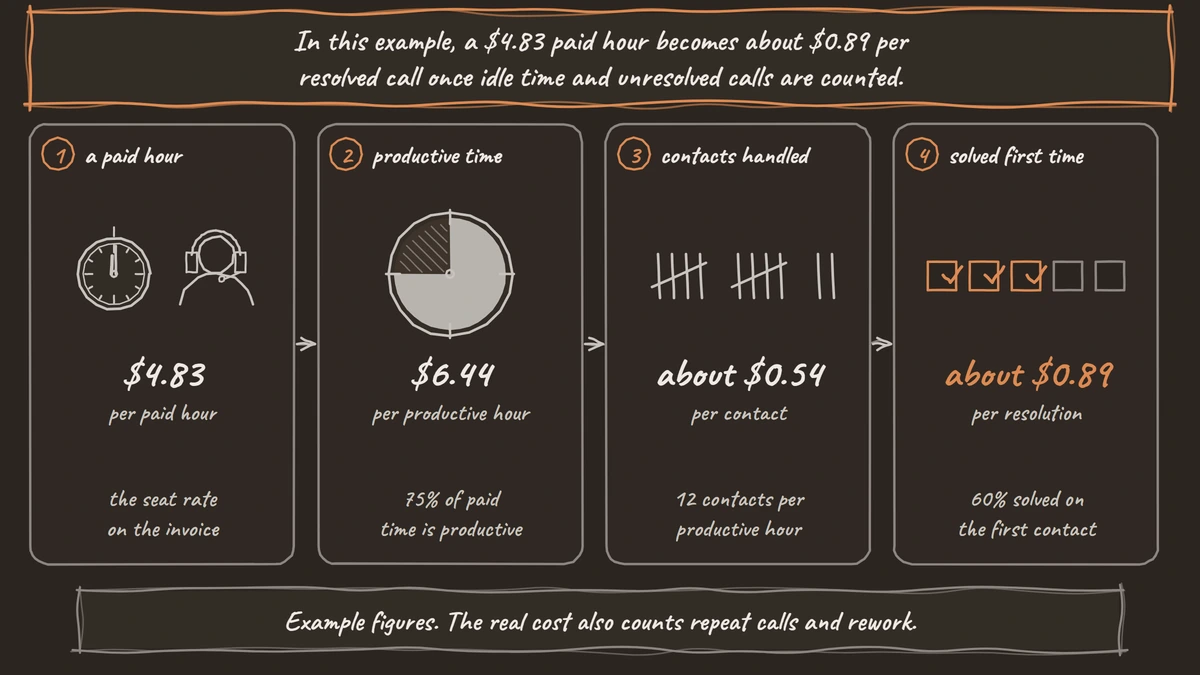
In the hypothetical example below, productive time is 75% of paid time, agents handle 12 contacts per productive hour and 60% of contacts are resolved on the first contact.
| Hypothetical calculation | Result |
|---|---|
| Benchmark hourly rate divided by productive share, $4.83 / 0.75 | $6.44 per productive hour |
| Productive-hour cost divided by contacts handled, $6.44 / 12 | About $0.54 per contact |
| Unrounded contact cost divided by resolution share, 0.60 | About $0.89 per first-contact resolution |
Losing a quarter of paid time raises the productive-hour cost by about a third. For procurement, divide all program costs by the distinct issues actually resolved, counting repeat calls and rework, and ask for the invoice and resolution assumptions together.
Supervision may carry a separate management fee, and phone minutes and recording storage are often billed as usage, so ask which charges are included, excluded or passed through. High occupancy isn't free either, because one surge leaves callers queuing longer when agents have no spare time.
Trade-offs between cost, control and experience
A lower labor rate doesn't make a business case on its own. Deloitte's Global Outsourcing Survey found that cost reduction is no longer the central reason organizations outsource, and that the benefits executives report from AI-powered outsourcing are still modest. A higher bill can still be worth it to cover missed calls or add a language, as long as the outcome is measured.
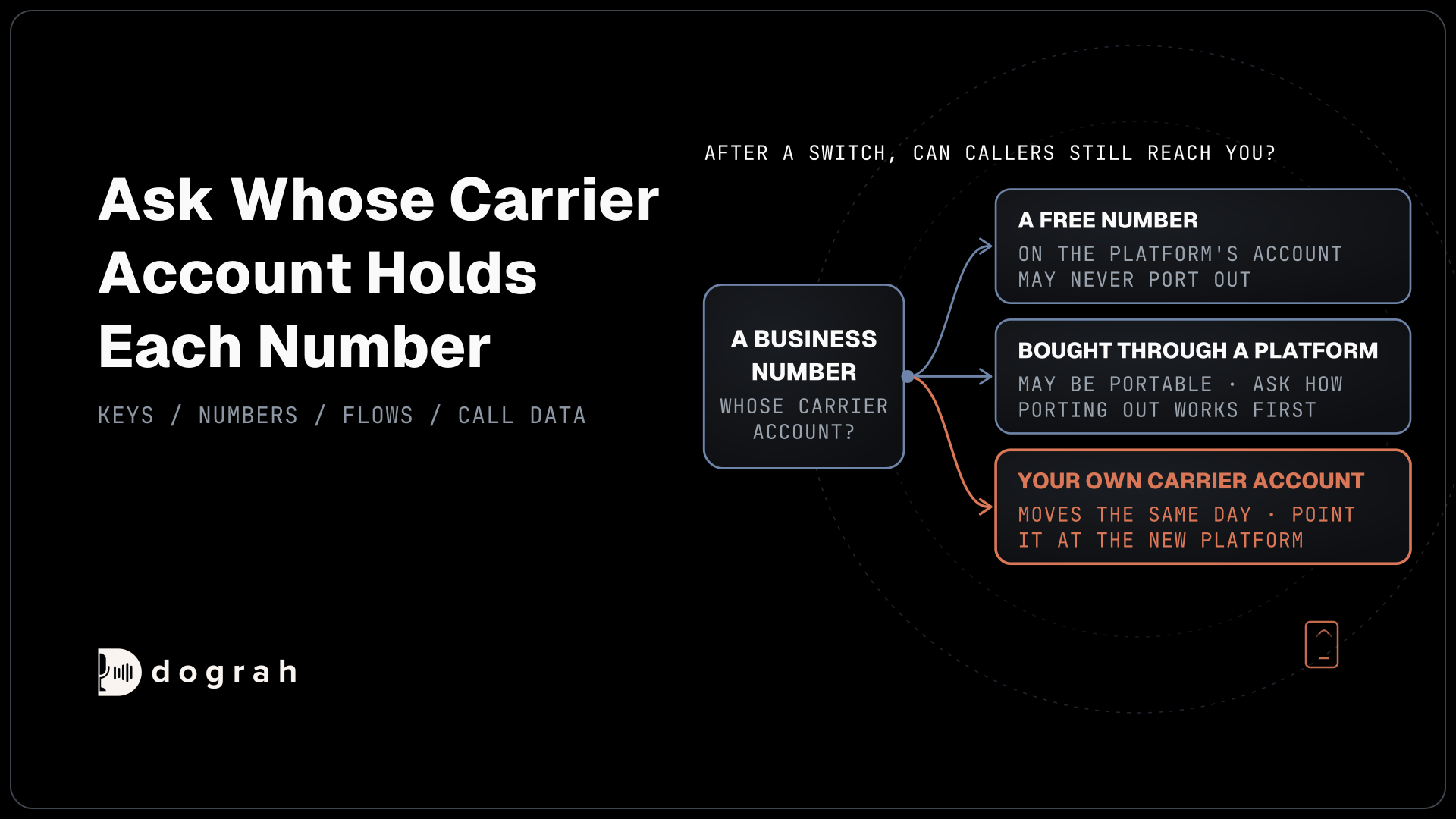
The quieter risk is knowledge leaving the business, so require categorized contact reasons and access to call evidence. Number ownership and recording exports decide whether you can change providers without rebuilding.
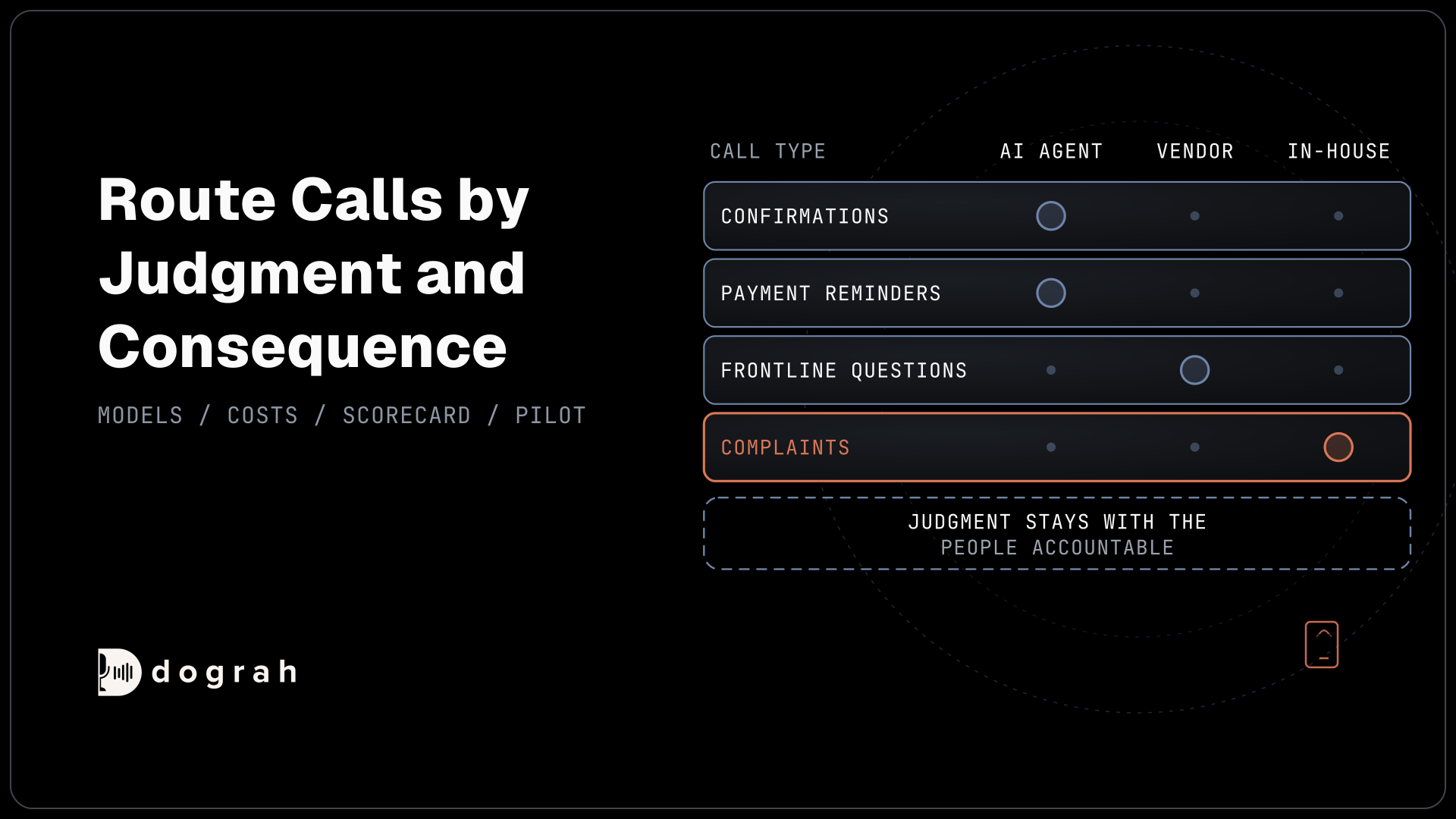
Say a clinic outsources appointment overflow and keeps billing disputes with its own team. That boundary only works if the handoff carries the caller's identity and request. Keep the calls where judgment changes the outcome close to the people accountable for it.
How to choose a vendor and measure it
Listen to sample calls from the proposed delivery team, including failed handoffs, and read the terms for minimums, ramp charges and export fees. A COPC global benchmarking study found that organizations holding monthly formal business reviews with their BPOs were more satisfied than those reviewing less often, so treat vendor reviews as part of running the queue.
For every metric, write down the data source and sampling method, and agree whether hang-ups and repeat calls stay in the denominator. For any automated part of the service, our voice AI vendor procurement guide covers the extra technical checks.
| Metric | What it measures | How it misleads when read alone |
|---|---|---|
| Service level | Calls answered within the agreed time | Overstaffing can meet it at excessive cost |
| Abandonment rate | Callers leaving before an agent answers | Low abandonment says nothing about resolution |
| First-contact resolution | Issues solved without another contact | A loose definition inflates it |
| Transfer rate | Calls moved to another agent or queue | Agents may avoid transfers they should make |
| Quality score | Monitored calls scored against a checklist | Weak sampling misses important failures |
| Compliance accuracy | Calls meeting required process controls | Narrow samples can hide serious exceptions |
| Cost per resolved contact | Total cost divided by resolved issues | Missing costs or duplicate cases distort it |
Price the transition before signing, including knowledge transfer, call-listening calibration and a parallel run, with checkpoints at 30, 60 and 90 days.
Join the Dograh Community
Dograh is an OSS alternative to Vapi. Join our Slack community for queries, releases, best practices & community interactions.
Where AI voice automation fits
AI changes which calls need purchased human capacity. The 2025 SupportNinja CX Outsourcing Report found that 87% of businesses are implementing, testing or strategizing AI to improve operational efficiency, and 77% of leaders consider AI a critical factor in choosing an outsourcing vendor. It also warns that many traditional outsourcers apply AI to cut their own costs and raise margins, with little regard for the customer experience.
So test whether callers can finish the task and reach a person. A demo that can't recover from a fully booked day is not ready for live calls.
| Call type | Best handled by | Why | Measure |
|---|---|---|---|
| Appointment confirmations and reminders | AI voice automation | Scripted work with little emotional load | Completion and reschedule rates |
| Payment reminders | AI with human escalation | Predictable flow, while disputes need people | Promise-to-pay and complaint rates |
| After-hours intake | AI or an overflow vendor | Uneven demand makes dedicated staffing hard | Answer rate and handoff quality |
| Frontline product or service questions | Outsourced team with a knowledge base | Repeatable answers suit trained staff | First-contact resolution and transfers |
| Complaints and high-emotion calls | In-house team | Trust, discretion and authority shape the outcome | Satisfaction and retention |
| Regulated decisions such as claim denials or credit changes | In-house with human review | Accountability and audit trails come first | Compliance accuracy and appeals |
Containment has to mean the caller finished what they came for, never a caller who gave up. Our guide to AI voice agents in BPO contact centers covers how to divide work between software and outsourced agents.
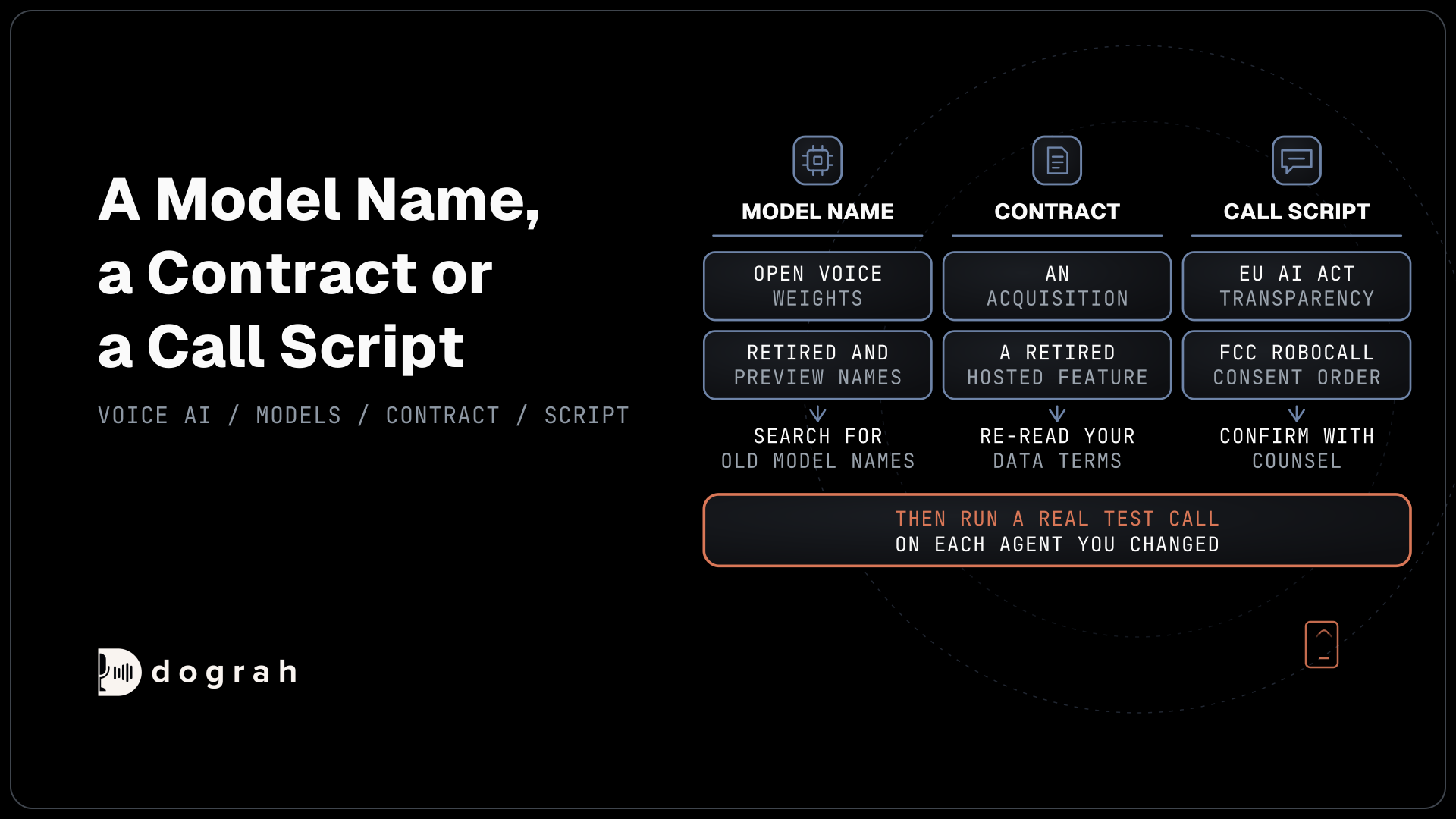
A sensitive call may pass through an outsourcer, the carrier, a speech service and a model provider, so settle who owns recordings and which subprocessors see customer data. Recording rules depend on where callers are and what the call is for, and our post on call-recording consent laws for voice agents shows how they turn into agent settings. Have counsel confirm the lawful basis and retention rules rather than accept a blanket promise of compliance.
Pilot one queue before you commit
Start with a bounded queue where mistakes are easy to catch, such as appointment confirmations. Run the current setup, a vendor option and an AI agent with a human fallback against the same scorecard, counting implementation work and internal cleanup. A voice AI pilot plan helps you write down the acceptance criteria and stop conditions before the first call. We'd keep a clear route to a person and make cost per completed confirmation the main measure, with complaints and failed handoffs as guardrails.
Running the automated queue in Dograh
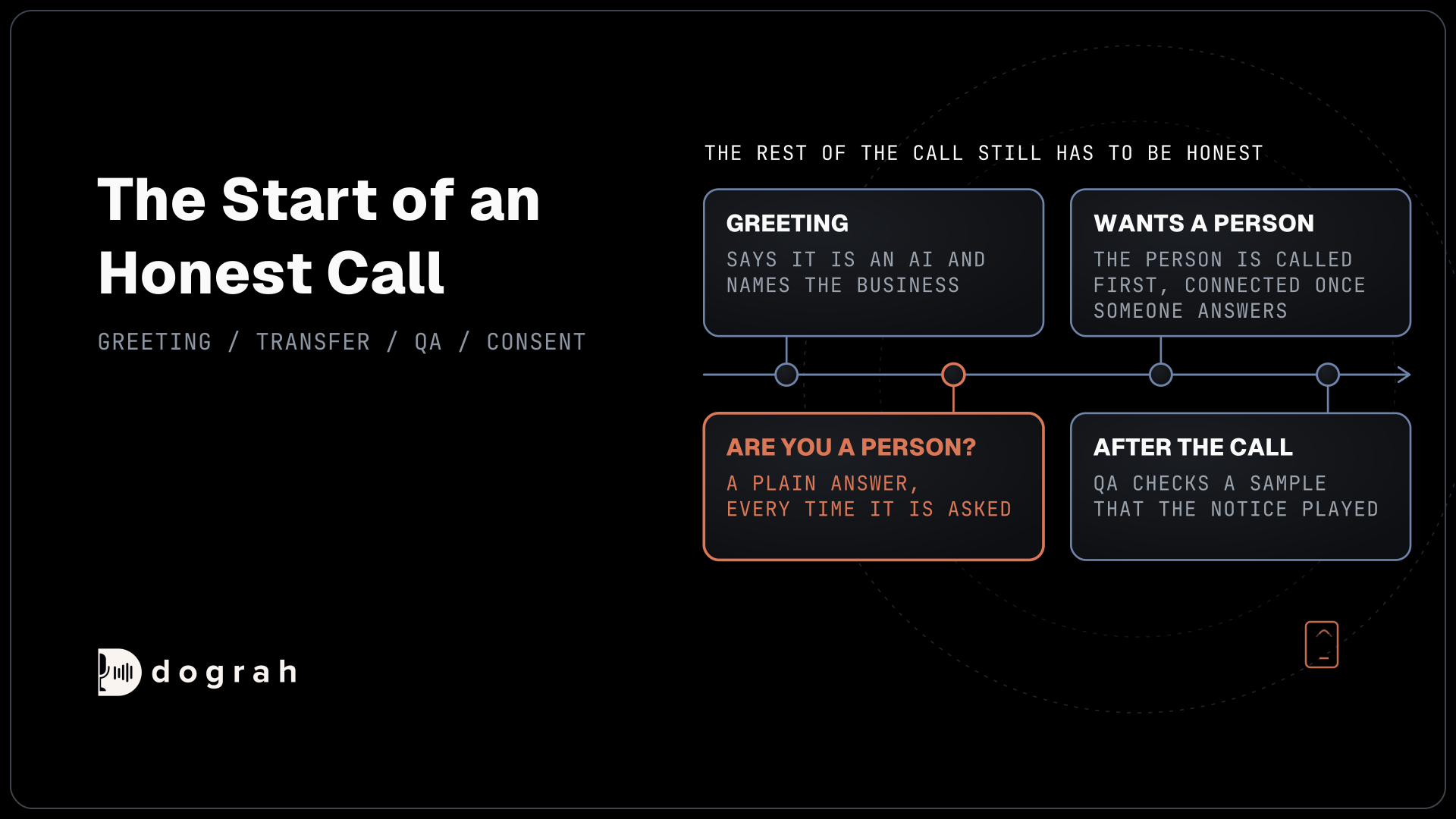
For the confirmation queue, you describe the agent to Dograh's Agent Builder in plain words, approve the requirements it lists and test the agent it builds, with the canvas still there for hand edits. The agent then works through your contact list as a campaign, with set retries and calling hours. When a caller disputes a time, Transfer Call dials your team first and connects the caller only when someone answers, and an HTTP API tool can write the request to your system beforehand so staff see it when they pick up.
A QA node reviews completed calls and scores each step separately, with its own tags, a 1 to 10 score, sentiment and a summary, and its sample rate lets it check a share of live calls at random. Transcripts and recordings sit beside each run, so a failed handoff can be traced to the exact turn, which is the call evidence the vendor checklist asks for.
Cost per completed confirmation is the number to set against the vendor quote. Running the platform on your own servers carries no per-minute platform fee, though servers, model keys and phone minutes still cost money, and your team looks after the database and upgrades. Support comes from the open-source community, and Enterprise adds custom SLAs. Teams that would rather not host it can use Dograh Cloud, which hosts the platform for a 1¢-a-minute fee, with model and phone costs on top.
The platform itself is the orchestration layer that runs the call flow, tools and telephony, and the speech and language models are a separate layer you choose. Because the code is open, your security team can read how calls are handled before one goes out. Self-hosted with the models running on your servers as well, recordings, transcripts and model inference stay inside your boundary, though the phone call itself still passes through the carrier and third-party model keys still send audio to those providers. None of this certifies compliance on its own, and Dograh lets you hold an automated queue to the same resolution, quality and full-cost tests as any human vendor.
Glossary
- Seat-hour
- One hour of a staffed agent position that you pay for, whether or not calls arrive during it.
- Occupancy
- The share of logged-in agent time spent on calls or after-call work, rather than waiting for the next call.
- First-contact resolution
- The share of issues solved on the first call, with no repeat contact, transfer or callback needed.
- Containment
- Calls an automated agent completes without a person. It should count finished tasks only, never callers who gave up.
Frequently Asked Questions
Built with Outrank tool