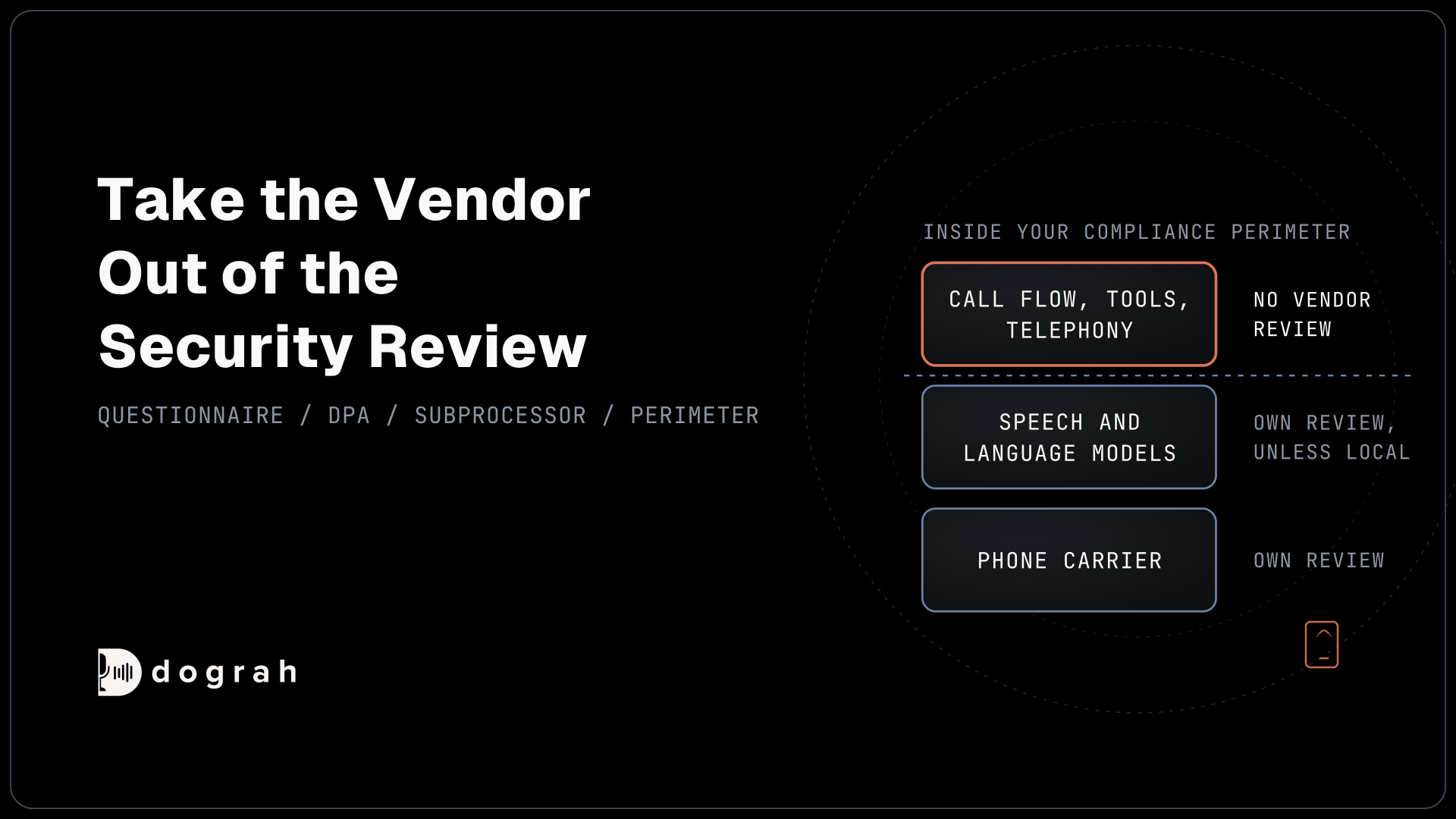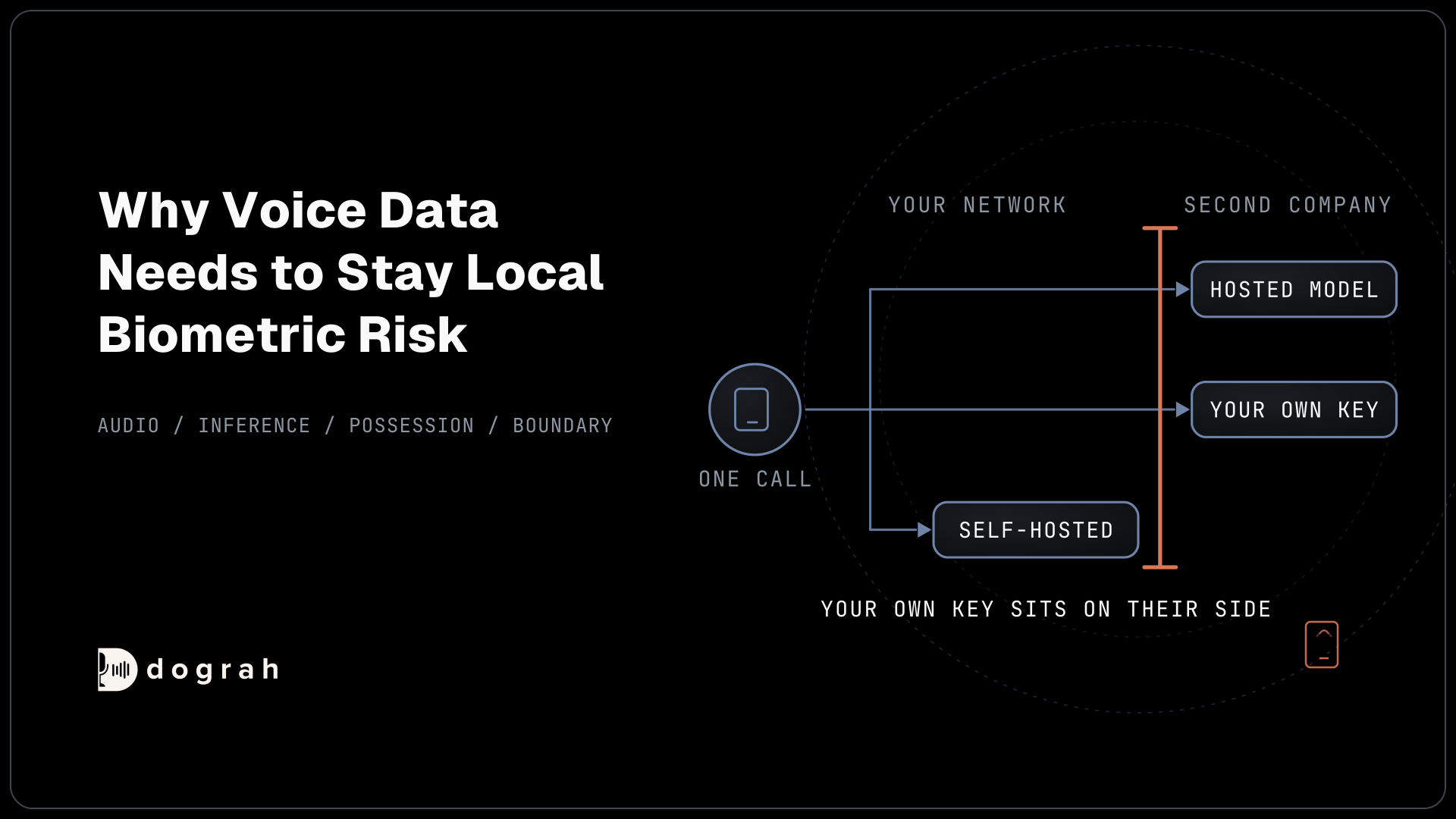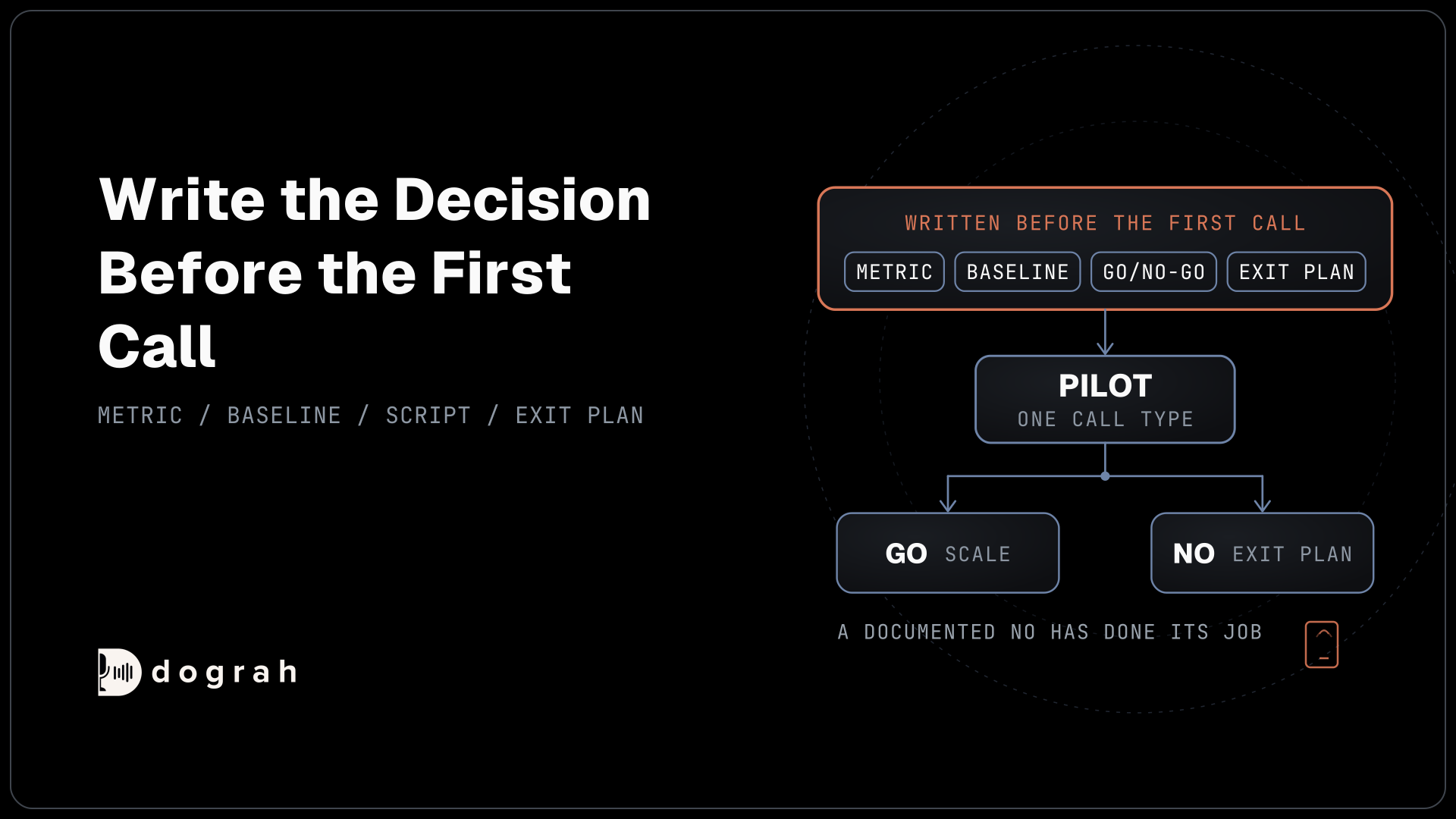

A voice AI pilot survives procurement when the decision is written before the first call, with one metric, a baseline from your human team, a go/no-go line and an exit plan. Outbound pilots work best with a script your best callers already use and fresh, consented leads. Inbound pilots stay narrow and send everything else to a person or callback.
Key Takeaways
- Write the metric, baseline and go/no-go line before the first call.
- Reuse the script your best human callers already use, on fresh leads.
- Inbound pilots stay narrow, and anything else goes to a person or a callback.
This post is part of our guide to The Business Case for AI Voice Agents: ROI and Payback, which covers how to measure a pilot. Here we cover the decision, script, leads, scope and exit, run in Dograh, the open-source AI voice agent platform we build.
Write the decision before the first call
A pilot that cannot change a decision is a demo, so write the decision down before any call goes out. Most proofs of concept never reach production. In Omdia's 2025 AI Market Maturity Survey, reported by The Register, the largest group of enterprises, 31%, saw fewer than 5% of their proofs of concept succeed. A pilot built around a written decision gives procurement something to sign, whichever way it goes.
The written decision has four parts. One metric, such as the share of calls resolved or payments per 100 accounts. A baseline for that metric from your human team's recent calls. A go/no-go line, the result that means you scale. And an exit plan that says what you keep and how you leave if the answer is no.
A pilot that ends in a documented no has still done its job. It saved the cost of a full rollout, and the next proposal starts with real numbers.
Procurement will also ask how the pilot handled risk. The NIST AI Risk Management Framework gives a shared vocabulary for that conversation, and naming who owns each risk in the pilot plan answers most of it.
Outbound: start from a script that works
For outbound pilots, the call script and the quality of the leads decide most of the result. Start from the script your best human callers already use. It holds the opening that keeps people on the line and the objections that actually come up, with the answers that work in the order they arrive. Turn it into the agent's prompt, and put the lines that must be word for word, such as the company name, into the Greeting Text, which Dograh speaks exactly as written.
Then pick warm, fresh leads, such as people who asked for information in the last few days, over an old list. In our experience they convert better, and a pilot run on stale leads tests the list more than the agent. Use the same kind of leads your human team gets, so the baseline is fair.
Upload the leads as a CSV to Campaigns. The file needs a phone_number column, and every other column becomes a variable the agent can use on that call. Calling hours run in one time zone per campaign, and retries default to 2.
Consent comes before the first dial. Under the Telephone Consumer Protection Act (TCPA), the Federal Communications Commission ruled in February 2024 that AI-generated voices count as artificial voices, so the consent rules for those calls apply to calls to mobiles, so confirm your position with counsel before the campaign starts.

Open Source Alternative to Vapi / Retell
Self-hosted voice agent platform — no per-minute fees
dograh-hq/dograh
Star on GitHub
Inbound: keep the scope narrow
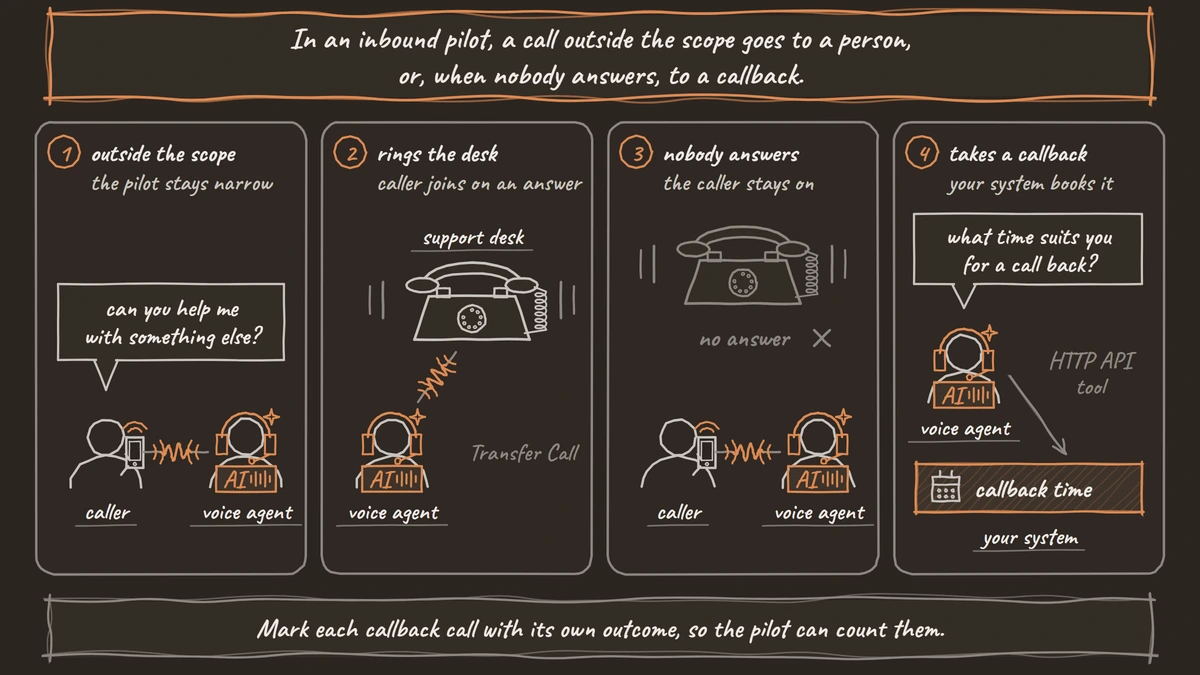
For inbound pilots, keep the scope to a few call types with strict guardrails, and send everything outside it to a person or a callback.
A narrow scope is easier to test and easier to defend. Pick the two or three call types with the most volume and the clearest answers, and write down what the agent must never do. Exact wording only holds where Dograh speaks fixed text, meaning the Greeting Text, a pathway's Transition Speech or a recorded clip. Inside a node the model writes its own words, so test those parts with off-topic and awkward calls.
When a caller makes an out-of-scope request, Transfer Call hands them to a person on Twilio, Telnyx, Plivo, Cloudonix or Asterisk ARI. Dograh calls the destination first and connects the caller only when someone answers. On Twilio, it can play a short spoken introduction to both people before connecting them. No summary goes with the call by default, so have the agent write the details to your system first.
If nobody answers within the timeout, 30 seconds by default, the caller stays with the agent. Dograh has no built-in callback scheduler, so the agent takes a callback request. It asks for the caller's preferred time, and an HTTP API tool sends it to your system, which books the callback. Mark those calls with the callback_requested outcome so you can count them.
Browser test calls cannot run a transfer, so test every transfer over a real phone call. Our post on testing voice agents before you go live sets out the full order of tests.
Measure what procurement will ask for
Procurement will ask for numbers it can check, so collect them from the first call. Turn on Call Dispositions in the agent's Settings before launch, since they are off by default. Each call then ends with one outcome code, such as callback_requested or a code you add. The Report card on the same page downloads a CSV of completed calls with the disposition, the duration, extracted values and links to each transcript and recording. Multiply the durations by your per-minute cost to get the pilot's running cost.
Then check quality, beyond the totals. In production, run QA on a random 5 to 10% of calls. Dograh's QA scores each step of a call separately, and our post on automated QA for voice agents explains how to read those scores. When a call goes wrong, its View Trace button opens the trace in Langfuse, so you can see which step failed.
Compare the pilot's metric with the human baseline at the end, using the same definition on both sides.
Join the Dograh Community
Dograh is an OSS alternative to Vapi. Join our Slack community for queries, releases, best practices & community interactions.
Answer the exit and security questions early
Procurement asks how you leave before it lets you start, so bring the answers to the first meeting. Lock-in is the norm. In a Zapier survey of 542 US enterprise executives, only 6% said they could stop using their primary AI vendor without any disruption. Dograh can be self-hosted, and its code is BSD-2 licensed, so a security team can read it and the pilot can run on your own servers.
Self-hosted Dograh has no per-minute platform fee (servers, model keys and phone minutes still cost). Dograh Cloud has a 1¢-a-minute platform fee. The cloud plan includes 10 concurrent calls, with more on request, and self-hosted installs run 10 by default, a limit you can raise.
The security review has its own traps, which our post on why procurement stalls on closed voice AI covers. For the full list of questions to put to any vendor, use our Voice AI Platform Buyer's Checklist, With RFP Questions.
Glossary
- Go/no-go line
- The result, written before the pilot starts, that means you scale the agent. Anything below it means you stop or redesign, and that documented decision is what procurement signs.
- Human baseline
- The pilot metric measured on your human team's recent calls of the same type. The agent's result means something only against it.
- Out-of-scope request
- Anything a caller asks that the inbound pilot was not built to handle. It goes to a person through Transfer Call, or to a callback request when nobody answers.
- Callback request
- The caller's preferred time, collected by the agent and sent to your system through an HTTP API tool. Your system books the callback. Dograh has no built-in callback scheduler.