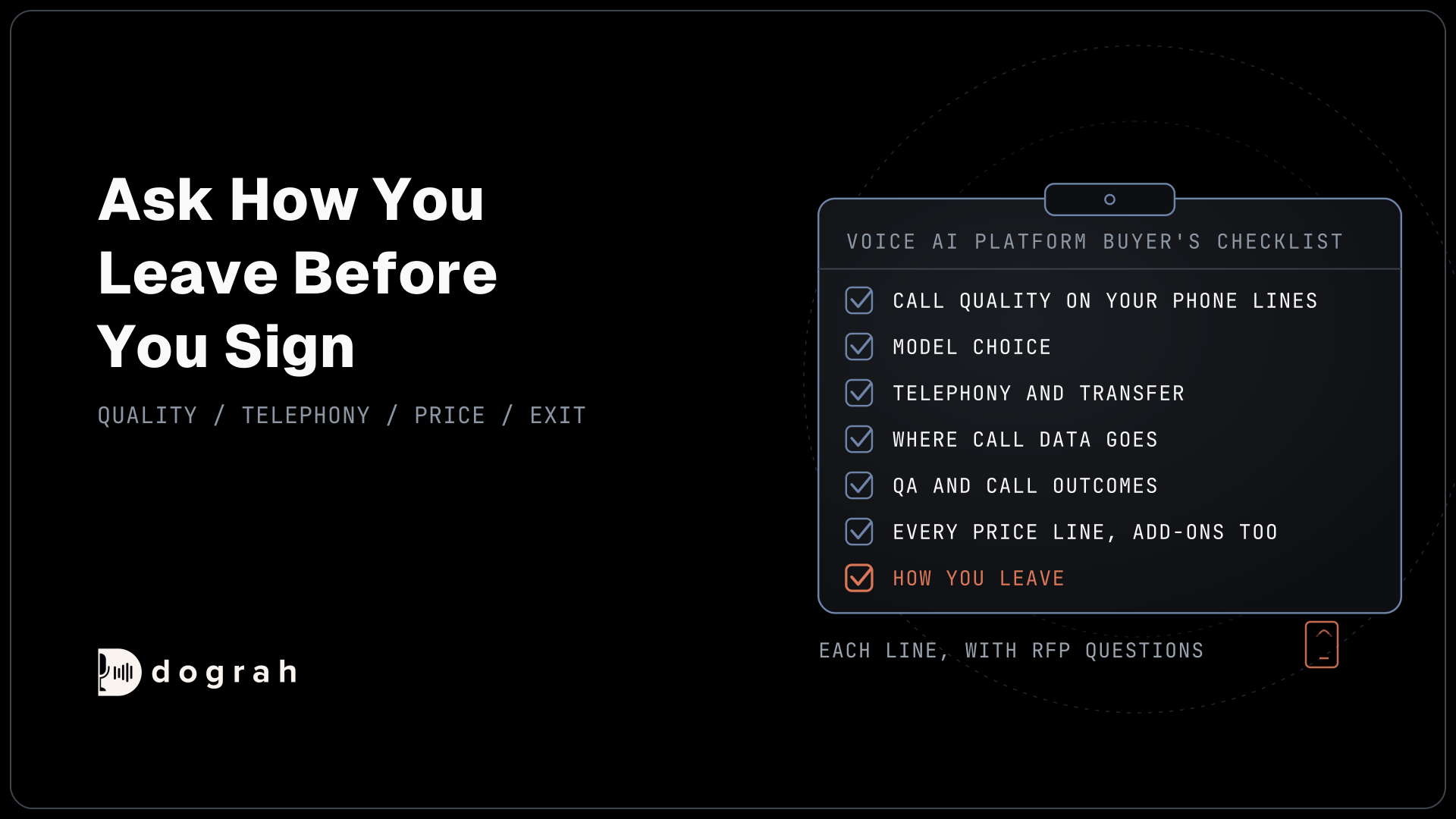

Evaluate a voice AI platform on your own calls. Check call quality over real phone lines first, then model choice, telephony and transfer, how it reads and writes your systems, where call data goes, QA and outcome reporting, concurrency, every price line with add-ons, and finally how you leave. Turn each line into an RFP question that asks for evidence.
Key Takeaways
- Test every platform on your own calls over real phone lines first.
- Ask for every price line, including add-ons, phone and extra concurrency.
- Ask how agents and call history come out before you sign.
This post is part of our guide to The Business Case for AI Voice Agents: ROI and Payback, which starts the list under choosing a platform you can leave. Here are the checklist and RFP questions, with how Dograh, the open-source AI voice agent platform we build, answers each line.
Test on your own calls first
Judge a platform on your own calls over real phone lines before you compare features or prices. A sales demo usually runs in a browser. Most phone calls still reach the agent as 8 kHz audio, while a browser demo runs at 16 kHz, so speech recognition that looks perfect in the demo can slip on a real call. How much it slips depends on the speech-to-text model and the phone path, so only a test on your own lines tells you.
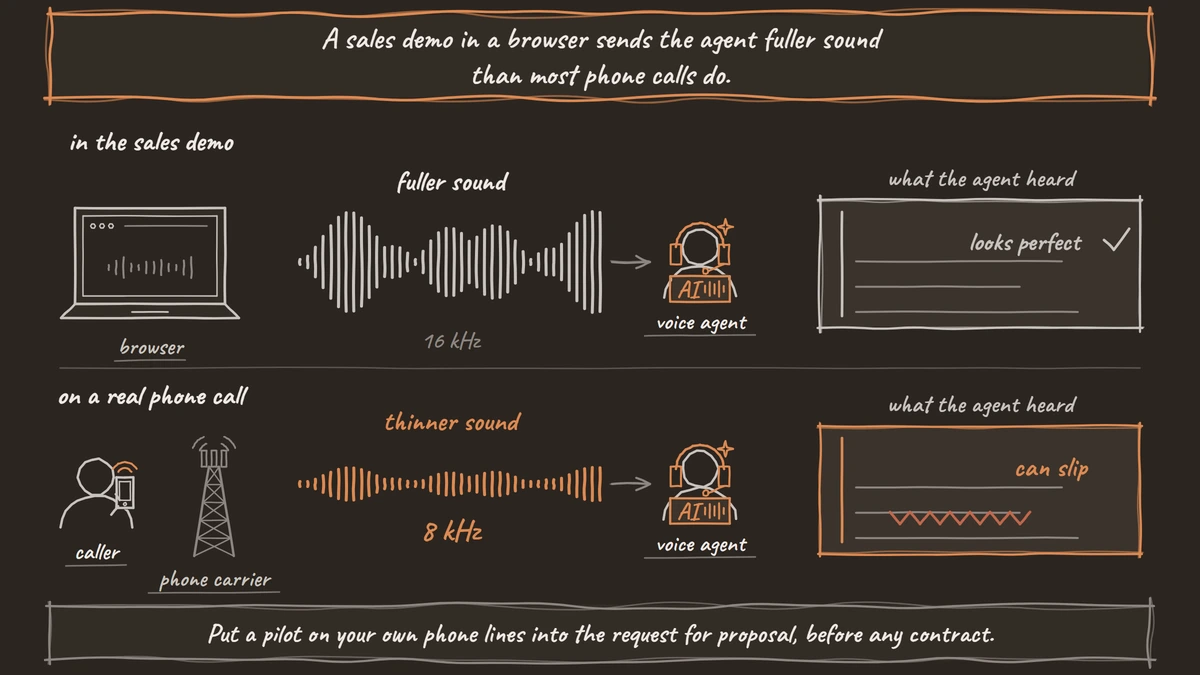
So put a pilot on your own calls into the request for proposal (RFP), scored against your human team's baseline, before any contract. How to Run a Voice AI Pilot That Survives Procurement covers the design. Pilots fail more often than buyers expect. In Omdia's 2025 AI Market Maturity Survey, reported by The Register, only 9% of enterprises moved more than half of their AI proofs of concept into production.
The checklist, line by line
Each line below is a question to ask every vendor, the evidence that answers it, and how Dograh answers it.
| Area | What to ask | Evidence to ask for | How Dograh answers |
|---|---|---|---|
| Call quality | Does it hold up on our calls over our phone lines? | Recordings and transcripts from a pilot on your numbers | Browser test calls first, then real calls on your own carrier, with a recording and transcript for each |
| Models | Which speech, language and voice models can we use? Can we bring our own keys or our own models? | The provider list, and a model swapped during the pilot | Dograh's own models, your keys for supported providers, or open-weight models behind an OpenAI-compatible endpoint; speech-to-speech models too |
| Telephony and transfer | Which carriers work, and can a call go to a person? | The carrier list, and a transfer tested on a real call | Twilio, Telnyx, Plivo, Vonage, Cloudonix, Exotel, Vobiz and Asterisk ARI; transfer to a person on Twilio, Telnyx, Plivo, Cloudonix and Asterisk ARI |
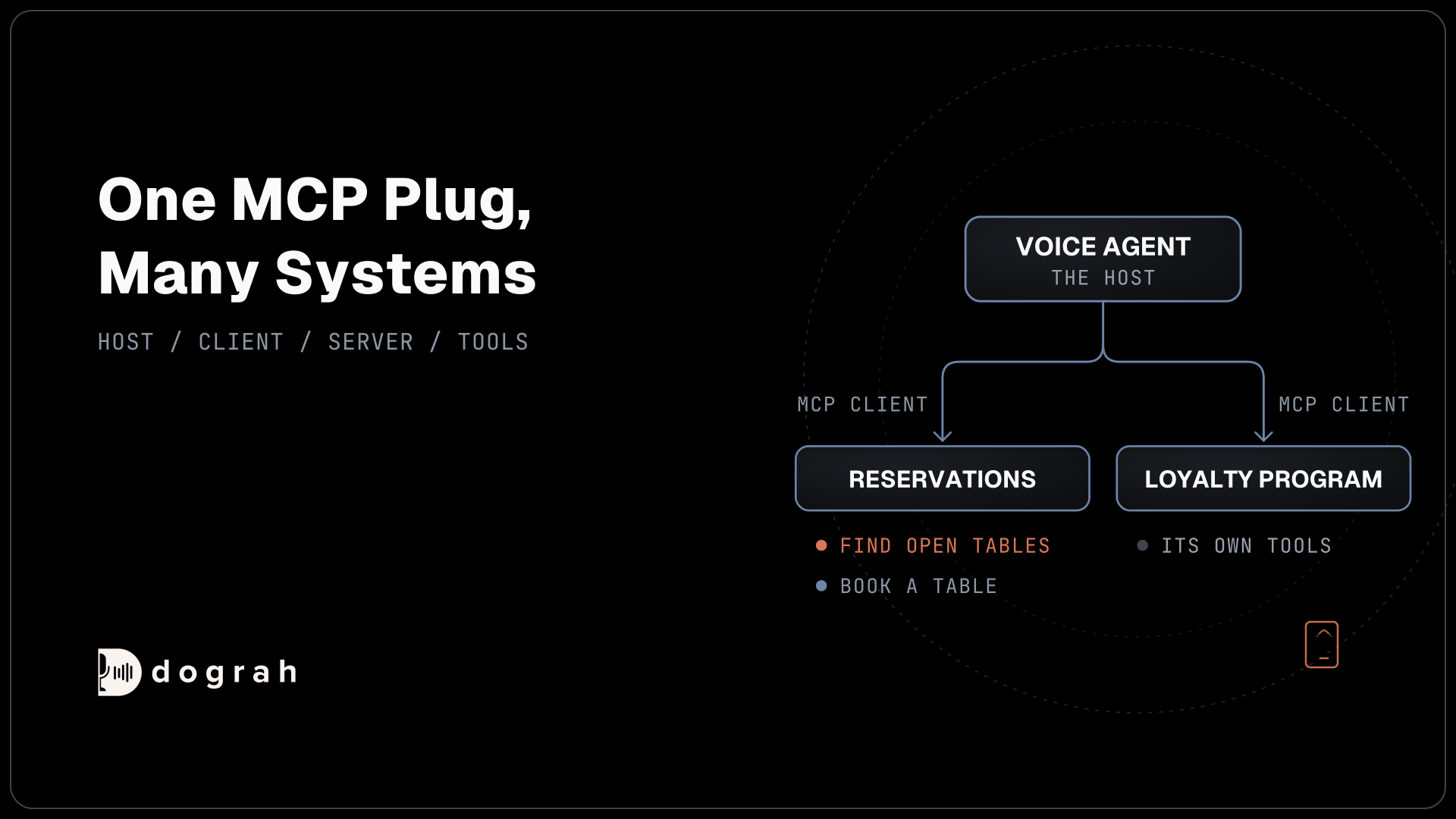
| Your systems | How does the agent read and write our CRM or booking system during and after the call? | A working tool call against your test endpoint | HTTP API tools, MCP tools, Pre-Call Data Fetch, the Webhook node and the API Trigger connect any system with an API |
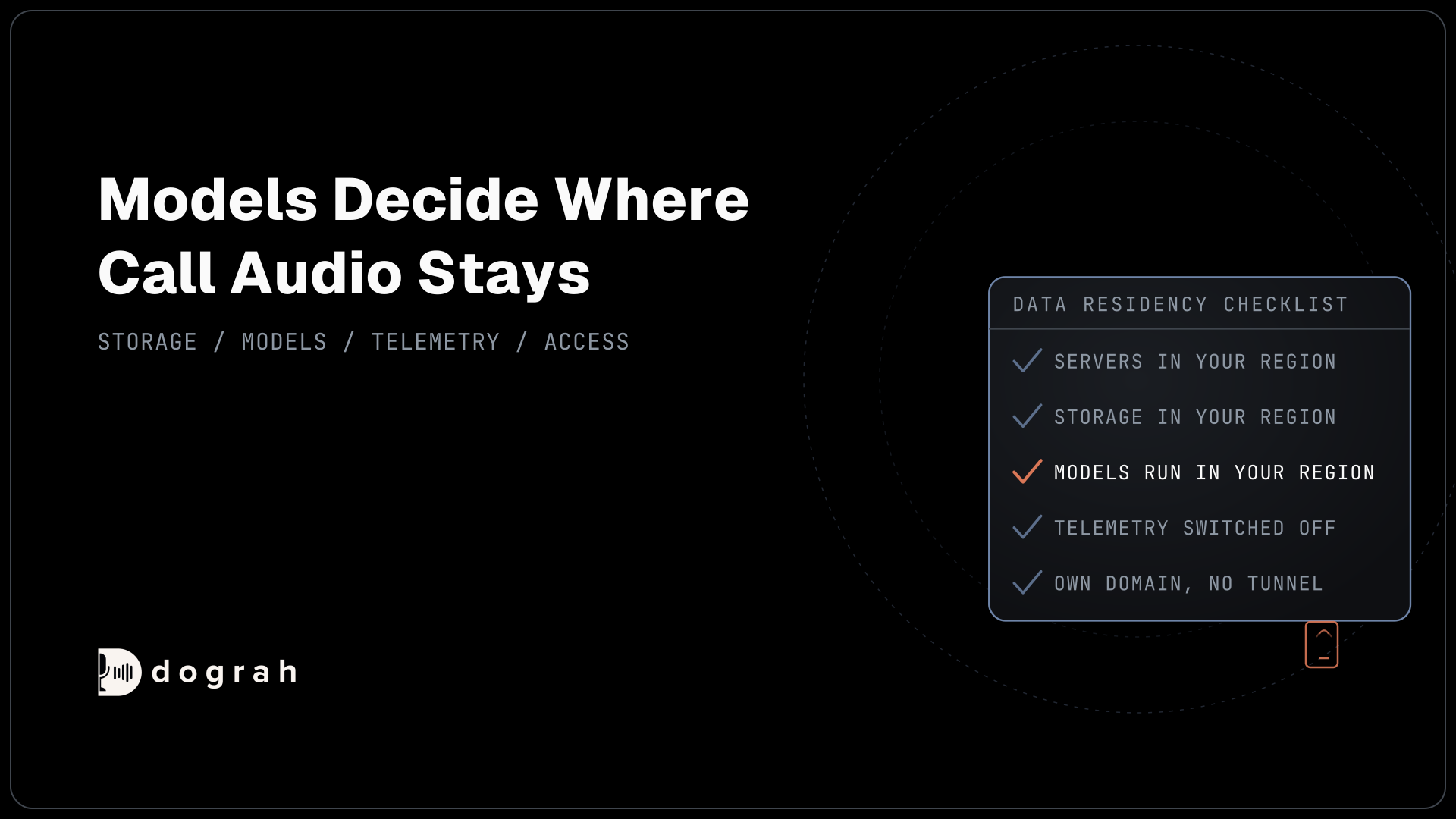
| Data location | Where do audio, transcripts and recordings sit, and which companies hear the call? | Every subprocessor and region, in writing | Self-hosted with local models, call data stays on your servers, apart from the carrier's leg; recordings and transcripts sit in your own storage |
| QA and outcomes | Can we see why a call failed, and count outcomes? | A trace of one failed call and an outcome export | QA that scores each step of a call, View Trace in Langfuse, Call Dispositions and a CSV report of every call |
| Concurrency | How many calls can run at once, and what does more cost? | The included number and the price of each extra line | Self-hosted, 10 by default and adjustable; Dograh Cloud includes 10, with more on request |
| Price | What is every per-minute and monthly line at our volume? | A quote at your volume with every add-on named | No per-minute platform fee self-hosted; a per-minute fee on Dograh Cloud (next section) |
| Exit | How do our agents and call history come out? | One agent and a month of call data exported during the pilot | Each agent is a JSON workflow definition; call data comes out as CSV and through the API; the code is BSD-2 licensed |
Data location has more settings than one row can hold. Our data residency checklist for voice AI walks through each one, from the carrier to the model providers.
Score each line pass, partial or fail from the evidence, and weight the lines your use case depends on most.

Open Source Alternative to Vapi / Retell
Self-hosted voice agent platform — no per-minute fees
dograh-hq/dograh
Star on GitHub
Price every line, not the headline
Ask for every line of the bill at your volume, because the headline rate is usually one line of several. Start with the per-minute lines for the platform fee, the models and the phone line. Twilio's US voice pricing, for example, lists $0.0140 a minute for outbound calls and $0.0085 for inbound calls to a local number, on top of whatever the platform charges.
Then ask for the lines outside the minute. Phone numbers rent by the month. Extra concurrent calls are priced per line. Vapi charges $10 a line a month above the number included, and Retell $8 a month for each one past its first 20. Each add-on line has its own price too. Vapi's HIPAA add-on is $2,000 a month, and Retell charges $0.01 a minute for PII removal and $0.10 a minute for AI quality checks after 100 free minutes.
Add your own costs, such as servers if you self-host and the hours your team spends building and reviewing calls. Self-hosted Dograh has no per-minute platform fee (servers, model keys and phone minutes still cost). Dograh Cloud has a 1¢-a-minute platform fee.
Ask how you leave before you sign
Ask how your agents and your call history come out before you sign, because leaving is the cost a contract never shows.
Most buyers end up locked in. In a Zapier survey of 542 US enterprise executives, 74% said losing their primary AI vendor would disrupt daily operations or leave them unable to function. Only 6% could stop using it without any disruption.
Test the exit during the pilot. Export one agent and a month of call data, and check that the export holds the prompts, the tool settings and every call's outcome, transcript and recording.
In Dograh, each agent is a workflow definition in JSON, the same structure the builder reads and writes, and any Dograh install can load it. The code is BSD-2 licensed.
Each call's details, transcript and recording come out through the run details API. Our post on Build vs Buy: Should You Build Your Own Voice AI Stack? covers what owning the platform changes.
Join the Dograh Community
Dograh is an OSS alternative to Vapi. Join our Slack community for queries, releases, best practices & community interactions.
An RFP question list you can copy
Turn each checklist line into a question that asks for evidence, and send every vendor the same list.
- Call quality: will you run a pilot on our calls, over our phone numbers, scored against our human baseline?
- Models: which speech, language and voice providers are supported, can we use our own keys, and can we run our own models?
- Telephony: which carriers do you support, and can we bring our own numbers and SIP trunk?
- Transfer: on which carriers can a call go to a person, and what does the person receive before they answer?
- Systems: how does the agent read and write our systems during the call and after it? Show a working example.
- Data: list every company that receives call audio or transcripts, with the region for each.
- Retention: where are recordings and transcripts stored, for how long, and who can delete them?
- QA: how do we find out why a call failed, and how are calls scored?
- Outcomes: how do we export each call's outcome, duration and extracted values?
- Concurrency: how many calls run at once on the quoted plan, and what does each extra line cost?
- Price: fill in our price sheet at our monthly minutes, with every add-on named.
- Exit: show us an exported agent and a month of exported call data. Under what license is the code?
For governance questions, the NIST AI Risk Management Framework gives you and the vendor the same vocabulary for who owns each risk. The security review has its own pattern of delays, covered in our post on why procurement stalls on closed voice AI.
Glossary
- Request for proposal (RFP)
- A written list of requirements and questions sent to several vendors so their answers can be compared line by line. For voice AI, it should ask for evidence from your own calls, beyond written answers.
- Concurrent calls
- How many calls a platform runs at the same moment. Plans include a set number and price extra lines separately, so a quote should state both.
- Add-on line
- A charge outside the headline per-minute rate, such as a HIPAA add-on, extra concurrent calls, PII removal or AI quality checks. An RFP price sheet should name each one.
- Workflow definition
- In Dograh, the JSON that describes an agent's nodes, prompts and pathways. The builder reads and writes it, so an agent can be kept in version control and loaded into another install.