
The best voice AI for a startup changes by stage. Free credits from Vapi, Retell, LiveKit and Deepgram get a prototype calling in days, and included concurrency decides the first-customer pick. Dograh, the open-source AI voice agent platform, fits all three stages, starting on Dograh Cloud and moving the same agent to your own servers later.
Key Takeaways
- Pick for your current stage, and check the lock-in each pick creates.
- Vapi's free number cannot port out, and Retell-managed numbers are US and Canada only.
- Dograh runs the same open code on Dograh Cloud and your own servers.
A startup's first voice agent has to take calls within days, survive the first paying customers and still make sense at scale. We pick the best option per stage and name the lock-in each creates, then talk about how Dograh lets you start hosted and move to your own servers.
What changes from prototype to scale
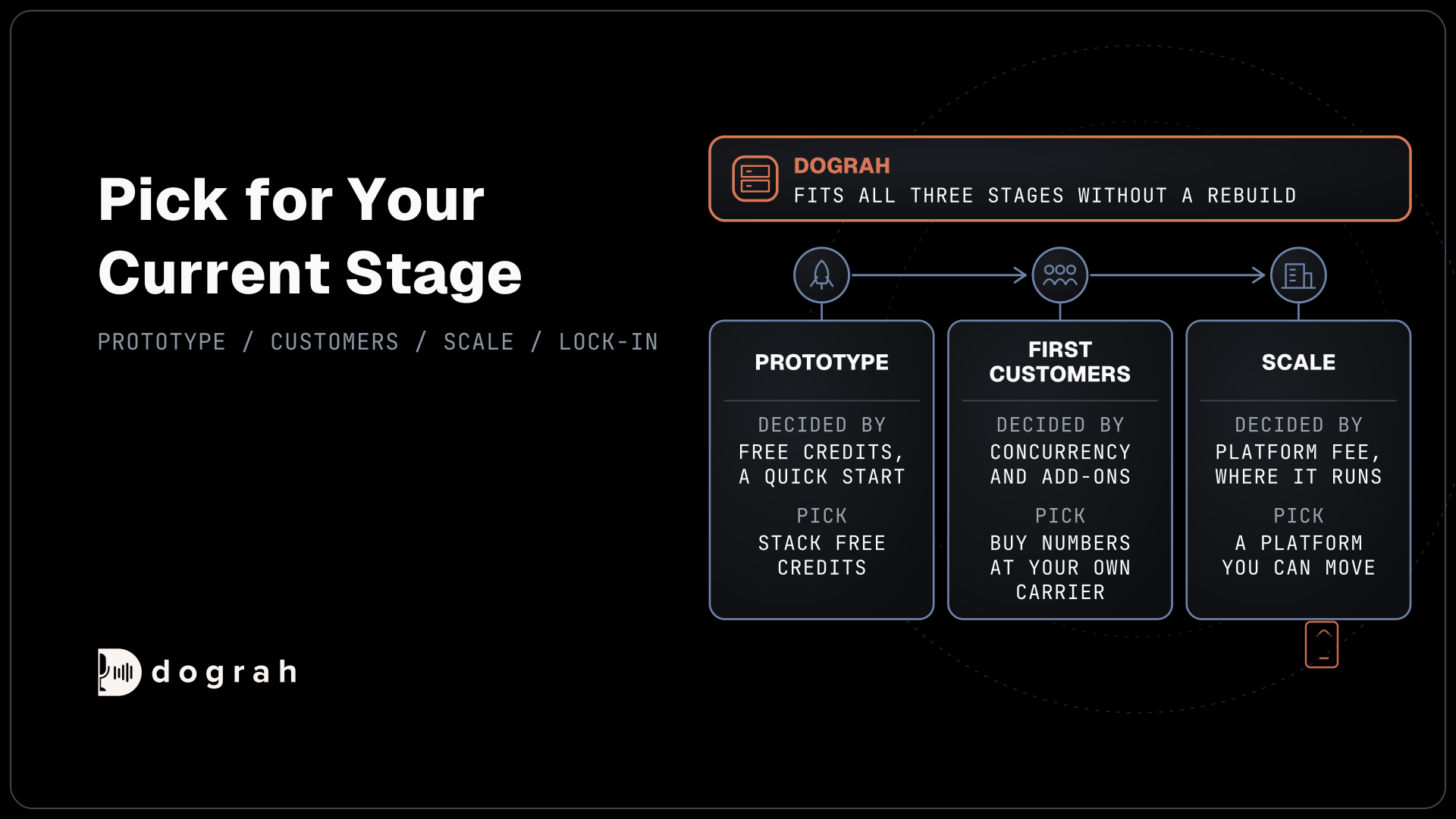
A prototype needs one working call as fast as possible, so free credits and a quick start decide it. Nobody needs ten calls at once yet, and a free test number is enough. The cost that matters is your own time.
First customers change the questions. Several calls arrive at once, so the number of concurrent calls a plan includes starts to matter, and a customer may ask about HIPAA, data location or a phone number in another country. Add-ons that looked small on day one now show up on every invoice.
At scale, the per-minute platform fee and where the agent runs decide the bill, and moving off a platform gets harder each month you stay. Our guide to voice AI for startups covers the platform fee at 10x growth and when to bring your own keys, so this list sticks to which option fits each stage.
Voice AI options for startups compared
The table puts each option against the same questions, using each vendor's published prices and limits. Model and phone costs come on top of every row.
| Option | Free start | First paid step | Concurrent calls included | Lock-in it creates |
|---|---|---|---|---|
| Dograh (open source) | Self-hosted Dograh has no per-minute platform fee, though servers, model keys and phone minutes still cost money. Dograh Cloud credits from $5 | Dograh Cloud 1¢-a-minute platform fee | 10 on Dograh Cloud, more on request. 10 by default self-hosted | Low. Same open code hosted or on your servers |
| Vapi | $5 in credits | $0.05 a minute hosting, Core $29 a month | 4, or 10 on Core | Free number has no port-out. Workflows retired |
| Retell AI | $10 in credits | $0.055 a minute voice infra | 20, then $8 a month each | Managed numbers US and Canada only |
| ElevenLabs Agents | Startup grant for eligible teams | $0.08 a minute | Set by plan | Closed platform, professional clones of your own voice only |
| LiveKit Cloud | Build plan with 1,000 agent minutes | Ship $50 a month with 5,000 minutes | 5 on Build, 20 on Ship | Open framework, but the product around it is yours to build |
| Bland | Start plan, no card | Start $0.14 a minute, Build $299 a month plus $0.12 | 10 on Start, 50 on Build | One bundled stack, no models of your own |
Dograh leads because it is the one option that fits all three stages without a rebuild. The others each win a stage, and the sections below say which.
Prototype: free credits that get you to a first call
For a prototype, free credits decide the pick. Vapi gives $5 and Retell $10, enough for a first round of test calls. LiveKit Cloud's Build plan includes 1,000 agent session minutes, 5 concurrent sessions and one free US phone number, the most room of the hosted platforms here, though you write the agent in code with the LiveKit Agents framework.
Model credits stretch further. Deepgram gives $200 of speech-to-text credit with no card and no expiry, and Cartesia's Free plan includes 20K credits and $1 of agent usage. If your startup has fewer than 25 employees, the ElevenLabs grant gives 33 million characters on the Scale plan for 12 months, which ElevenLabs puts at over 680 hours of Agents usage. Agencies, consulting firms and small and medium businesses do not qualify.
Self-hosted Dograh has no per-minute platform fee, though servers, model keys and phone minutes still cost money. Its Cloud edition starts from $5 of credits, with built-in models available so the first call needs no provider accounts. Stack the credits, and a prototype can run for weeks before anyone opens a card.
Use those weeks to test what a demo hides. Call the agent from a real phone, not only the browser, since most phone calls still reach the agent as 8 kHz audio, while a browser demo runs at 16 kHz. Interrupt it mid-sentence, give it a messy address, and time the gap before it answers. A prototype that passes those calls is ready for a first customer.
First customers: concurrency, add-ons and numbers
The first paying customers usually break the concurrency limit before they break the budget. Vapi runs 4 concurrent calls without a package and 10 on Core at $29 a month, with Pro at 10% of hosting and a $999 monthly minimum for 30, and HIPAA is a $2,000-a-month add-on. Retell includes 20 concurrent calls and charges $8 a month for each one after that.
LiveKit Cloud moves from 5 concurrent sessions on Build to 20 on Ship at $50 a month, which includes 5,000 agent minutes and then $0.01 a minute. Bland's Start plan allows 10 concurrent calls and 100 calls a day, and Build lifts that to 50 for $299 a month plus $0.12 a minute.
Dograh Cloud includes 10 concurrent calls, with more on request, and a self-hosted install runs 10 by default, raised with one setting while your servers and phone provider set the real ceiling. Model providers keep their own limits too, so check your speech-to-text and voice plans before a launch day.
Healthcare customers raise one more question early. Vapi sells HIPAA as an add-on, while a self-hosted Dograh install needs no BAA with Dograh, because the calls run on your servers. The model providers that handle patient data may need their own BAA, the phone carrier may need one depending on what it stores, and a cloud account that hosts your servers needs one too, so confirm the setup with counsel before the first patient call.

Open Source Alternative to Vapi / Retell
Self-hosted voice agent platform — no per-minute fees
dograh-hq/dograh
Star on GitHub
Scale: one startup at three volumes
Here is an example of one startup at 2,000, 20,000 and 200,000 minutes a month, counting the platform line only from each vendor's published rate. Models and phone minutes come on top of every figure.
| Option | 2,000 minutes | 20,000 minutes | 200,000 minutes |
|---|---|---|---|
| Vapi hosting at $0.05 | $100 | $1,000 | $10,000 |
| Retell voice infra at $0.055 | $110 | $1,100 | $11,000 |
| LiveKit Cloud agent minutes | $50 (Ship) | $200 (Ship) | $2,000 (Scale) |
| Dograh Cloud platform fee | $20 | $200 | $2,000 |
| Self-hosted Dograh | No platform fee | No platform fee | No platform fee |
Vapi adds a concurrency plan on top, from Core at $29 to Pro at a $999 minimum, and Retell's all-in rate with its own models runs from $0.07 to $0.31 a minute. LiveKit's figure covers hosting for an agent you build and run in code.
Volume also sets concurrency. 200,000 minutes a month is about 6,700 minutes a day, and if most calls land in a 10-hour window that averages about 11 calls at once, with peaks well above it. That is past Vapi's Core plan, and on Dograh Cloud it means asking for more than the included 10, so plan the concurrency step with the volume.
Running Dograh yourself means no per-minute platform fee. You still pay for servers, model keys and phone minutes, and your team looks after the database and upgrades. Support comes from the open-source community, and Enterprise adds custom SLAs. That work pays off when your volume or a customer's data rules justify it. If you would rather not host it, Dograh Cloud runs it for a 1 cent a minute platform fee.
The lock-in each choice creates
Every pick ties you to something, and the time to check is before the first customer. Vapi's free number lives on Vapi's own carrier account, so there is no port-out and moving that number means a new one. Vapi also retired its visual Workflows on 18 August 2026, and teams that built on them had to rebuild.
Retell-managed numbers cover only the US and Canada, at $2 a month each, and other countries need your own carrier through custom telephony, which Retell does not charge for. Buying numbers at your own carrier from the start avoids both problems.
ElevenLabs Agents runs on a closed platform, and its professional voice clones accept only your own voice, so a brand voice built there stays there. Bland bundles its own models into one stack, so switching to a different model later means leaving.
Plivo argues that building straight on carrier APIs avoids lock-in, and Dograh runs on Plivo or any carrier without replacing the phone line. A raw build moves the lock-in into your own code and your team's time instead, and the LiveKit Agents framework carries the same trade. Our list of voice AI frameworks compares that route in full.
Dograh: start on the cloud, move to your own servers
Dograh is the orchestration layer that runs the call flow, tools and telephony, and the models are a separate choice. You can start on Dograh's models and switch any agent to your own keys for an LLM, speech-to-text or voice from the inference provider settings, so provider deals stay in your company's name. Our list of platforms that take your own model keys compares that across vendors.
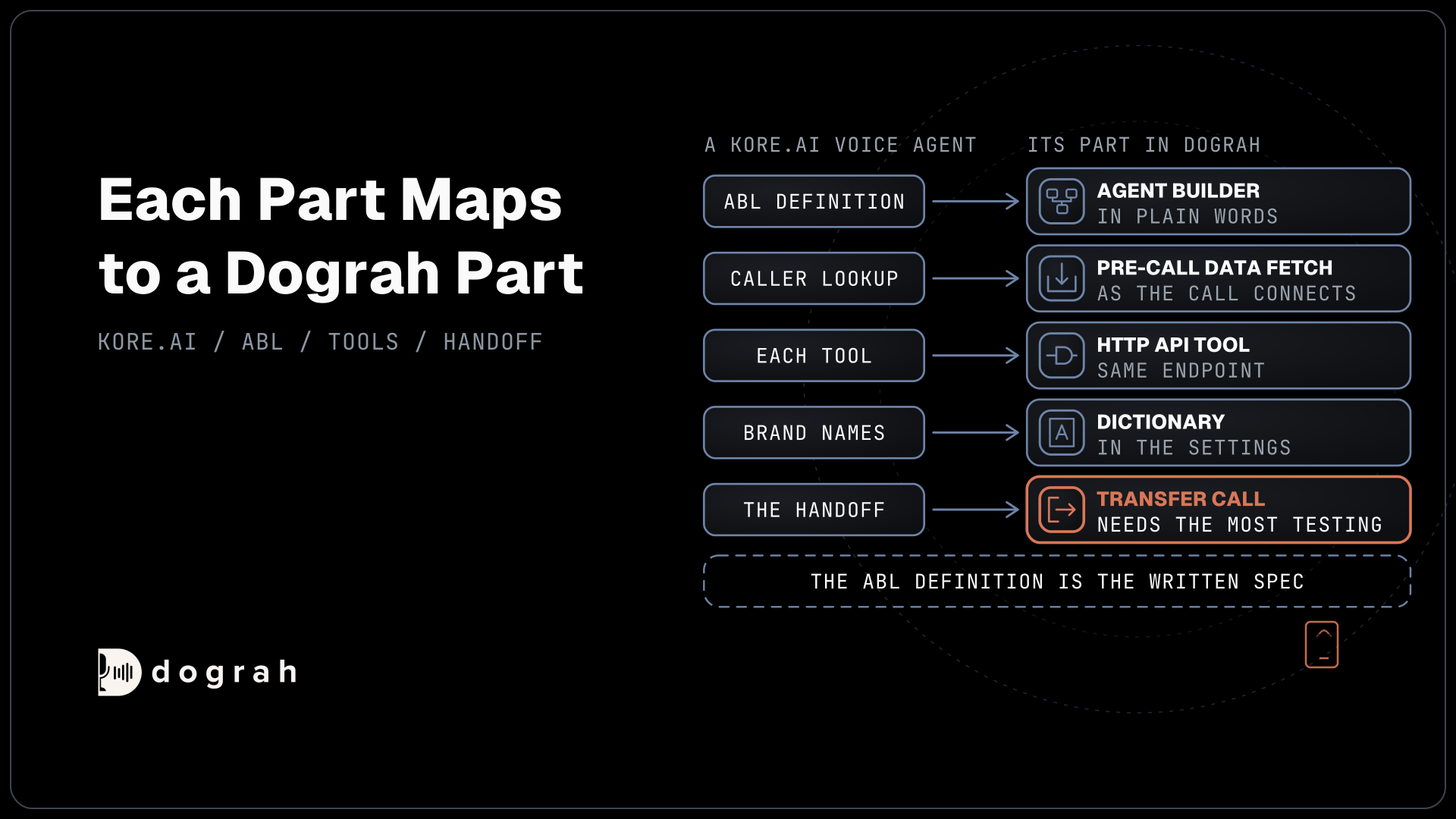
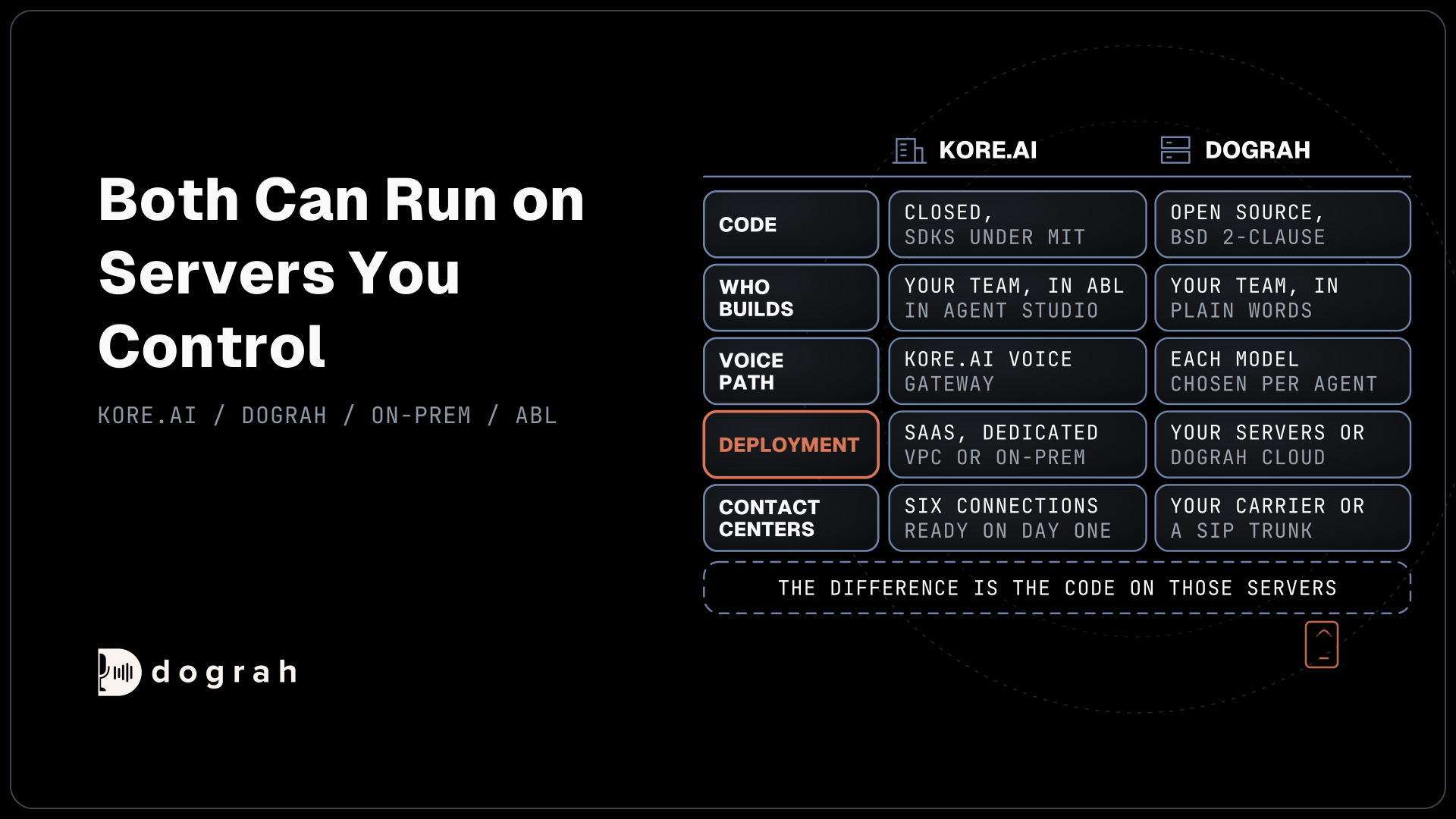
The same open code runs on Dograh Cloud and on your own servers. To move an agent, read the agent definition from one install and create it from that definition on the other through the API. Recordings, provider keys and phone numbers are set up again on the new install.
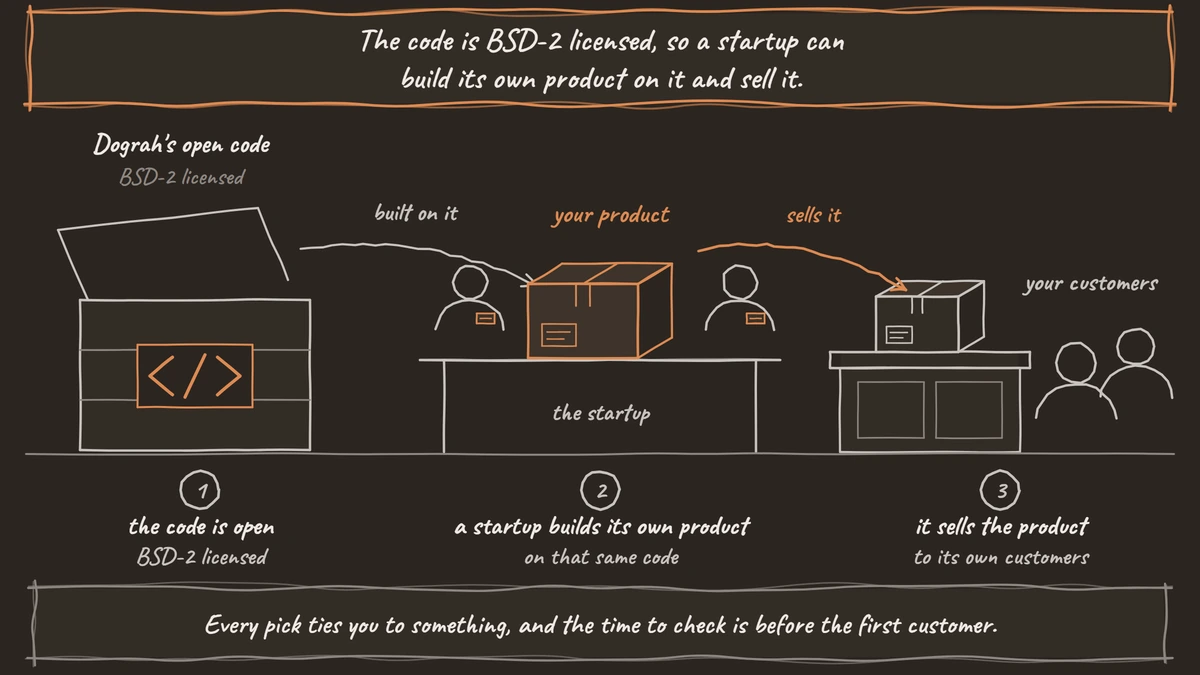
A self-hosted install runs with Docker on a server with at least 8 GB of RAM and 4 vCPUs. The code is BSD-2 licensed, so a startup can build its own product on it and sell it.
On Dograh Cloud, the Agent Builder drafts an agent from a plain description, and the MCP server lets a coding assistant create and edit agents, which keeps a small team's build time short at the prototype stage.
Join the Dograh Community
Dograh is an OSS alternative to Vapi. Join our Slack community for queries, releases, best practices & community interactions.
Picking by stage
For a prototype you want running this week, stack free credits on Vapi, Retell or LiveKit Cloud with Deepgram's $200, or start on Dograh Cloud with $5 of credits. If your team is under 25 people and wants ElevenLabs voices, apply for the grant first.
For first customers, pick on concurrency and the add-ons your customers will ask for, and buy your phone numbers at your own carrier. For scale, or when a customer asks where the calls run, pick a platform you can move, and Dograh is the open-source option that lets the same agent run on Dograh Cloud today and your own servers later.
Glossary
- Free credits
- Starting balance a vendor gives a new account, such as $5 on Vapi or $200 on Deepgram. Credits cover usage only and run out, so price the plan behind them too.
- Concurrent calls
- How many calls run at the same moment. Platforms include a set number and charge for more, and model providers set their own limits on top.
- Port-out
- Moving a phone number from one carrier to another. A number with no port-out, such as Vapi's free number, stays behind when you leave.
- Agent definition
- The saved description of an agent's call flow, prompts and tools. In Dograh you read it from one install and create the agent from it on another.