
Voice AI platforms with BYO models split into those taking your keys and endpoints on every layer, those taking only your own LLM, and bundled stacks running their own models. Teams that want to own the platform can use Dograh, the open-source AI voice agent platform, with your keys or local models on every layer, self-hosted or on Dograh Cloud.
Key Takeaways
- Dograh ranks first, taking your keys or local models on every layer.
- Vapi takes your keys everywhere but refuses localhost and private model addresses.
- Your own key moves the contract, while only local models keep audio in.
Plenty of voice AI platforms say bring your own model, but many mean only the language model, and few accept a model running on your own server. We set the criteria first, then rank seven options by which layers take your keys, starting with open-source Dograh and its local models.
How we ranked BYO model support
We scored each platform on five things. Which layers take your own key, out of speech-to-text, the LLM and the voice. Whether you can point the LLM at your own endpoint, and whether that endpoint may sit on localhost or a private network. Whether local speech-to-text and voice models are supported. Whether the platform is open source, and what it charges per minute on top of the models.
One distinction runs through the whole list. Your own key moves the contract and the bill to your account, while the audio and text still travel to that provider. Only an open model running on your own servers keeps the audio in. Our post on BYOK versus managed models covers the billing side, so this list stays on which models each platform will accept.
BYO model support across seven platforms
| Platform | Your keys (STT, LLM, voice) | Own LLM endpoint | Local speech models | Open source | Platform fee |
|---|---|---|---|---|---|
| Dograh | All three, plus realtime models | Any OpenAI-compatible URL, localhost and private network on a self-hosted install | Yes, through Speaches | Yes, BSD 2-Clause | None self-hosted, 1¢-a-minute on Dograh Cloud |
| Vapi | All three | Public https URL only, localhost and private addresses refused | Through a custom transcriber or voice server you host | No | $0.05 a minute hosting |
| LiveKit Agents | All three, in your code | Any, including Ollama on localhost | Yes, through plugins | Yes, Apache-2.0 | None for the framework |
| Pipecat | All three, in your code | Any, in your code | Yes, such as Moonshine on CPU | Yes, BSD-2-Clause | None for the framework |
| Retell AI | LLM only | Your server over a WebSocket per call | Not offered | No | $0.055 a minute voice infrastructure |
| ElevenLabs Agents | LLM only, ElevenLabs voices | Chat Completions or Responses server, not with Realtime models | Not offered | No | Per-minute plans |
| Bland | None, bundled stack | No | No | No | Bundled per-minute price |
1. Dograh, every layer on your keys or local models
Dograh is the open-source AI voice agent platform, and in it you pick the speech-to-text, LLM and voice provider for each agent, on your own keys or open models you host. A model configuration runs in one of three modes. Dograh runs the transcriber, LLM and voice for you, BYOK lets you pick your own provider for each of the three, and Realtime uses one speech-to-speech model. The provider connections each hold your keys, with several keys per connection used at random.
The local path is built in. The Local Models (Speaches) provider points the LLM at http://localhost:11434/v1, an OpenAI-compatible endpoint that Ollama or vLLM can serve, and runs speech-to-text on faster-whisper and the voice on Kokoro at http://localhost:8000/v1. The LLM settings also take any OpenAI-compatible base URL on the OpenAI provider, so a fine-tuned model on your private network works the same way. Our guide to local and self-hosted models covers which open models fit each layer and the GPU they need.
Hosted providers sit beside local ones. The BYOK lists include Deepgram, AssemblyAI, Soniox and Azure Speech for speech-to-text, OpenAI, Groq, Google and AWS Bedrock for the LLM, and ElevenLabs, Cartesia, Rime, Murf, MiniMax and Azure Speech for the voice. A fallback LLM on your own keys can take over when the first one is slow, and each agent's choice lives in its Model tab or in Settings under Model Configuration.
Self-hosting is real work. Self-hosted Dograh has no per-minute platform fee, but servers, model keys and phone minutes still cost money. Dograh Cloud charges a 1¢-a-minute platform fee. The server, the database and the upgrades belong to your team, starting from a Docker install that needs 8 GB of RAM and 4 vCPUs, plus a GPU for local models. Support is community-based on the open-source edition, with custom SLAs on Enterprise, and the AI agent builder on a self-hosted install uses a Service Key while the canvas works without one.

Open Source Alternative to Vapi / Retell
Self-hosted voice agent platform — no per-minute fees
dograh-hq/dograh
Star on GitHub
2. Vapi, your keys with a public model endpoint
Vapi takes your own keys for the transcriber, the model and the voice, and once a key is validated you are billed by that provider rather than by Vapi for its use. Hosting costs $0.05 a minute on top. For a model of your own, Vapi calls an OpenAI-compatible /chat/completions server, and a custom transcriber or voice can sit behind your own server too.
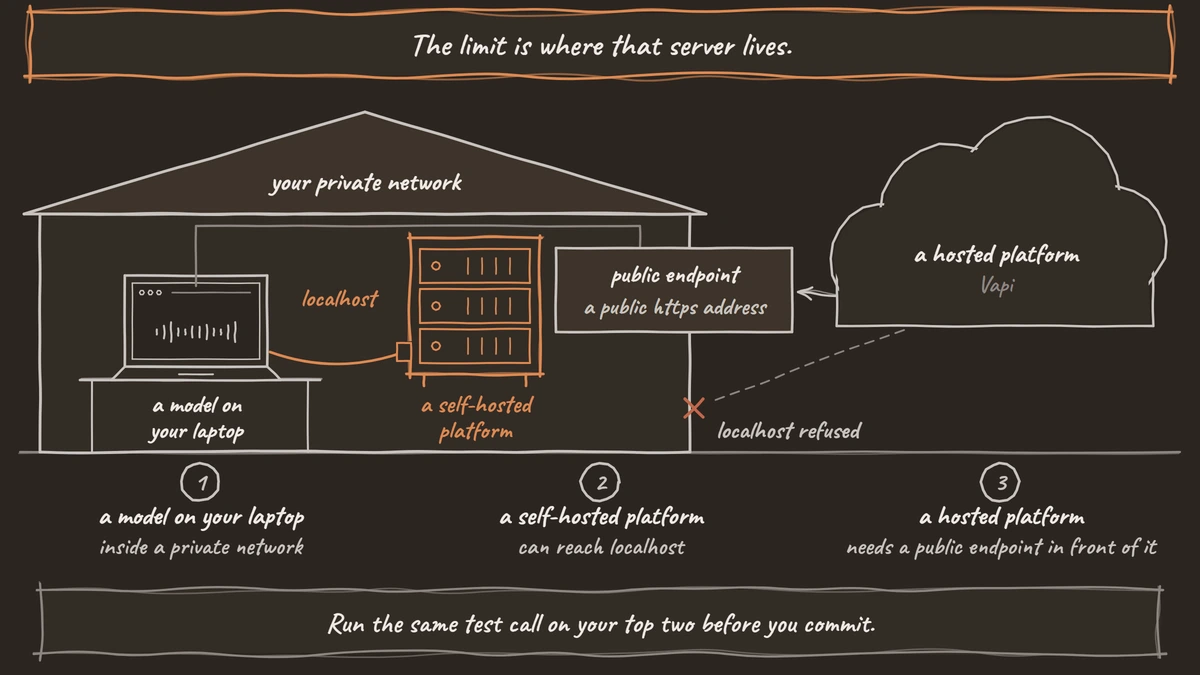
The limit is where that server lives. Vapi's custom LLM guide says the URL must use https and resolve to a public IP address, and that localhost, private network and link-local addresses are refused. A model on your laptop or inside a private network needs a public endpoint in front of it, and Vapi itself runs only as a hosted service.
3. LiveKit Agents, a framework with local plugins
LiveKit Agents is an Apache-2.0 framework, so every model is your choice because you write the agent. Plugins cover hosted speech-to-text, LLM and voice providers, any OpenAI-compatible LLM, and local options. The Ollama plugin points at http://localhost:11434/v1 by default, which makes a fully local model a few lines of code.
The trade is that LiveKit gives you parts, and the call flow, the dashboards and the phone setup are yours to build and run. It fits a team with Python developers who want full control and are happy to own the code that a platform would otherwise provide.
4. Pipecat, a framework with local speech services
Pipecat is a BSD-2-Clause Python framework with the same shape as LiveKit Agents. You pick every service in code, and its local speech options include Moonshine, which runs on a CPU through ONNX Runtime with no GPU or API key, and FunASR. Any OpenAI-compatible LLM, local or hosted, plugs in the same way.
As with LiveKit, the platform around the models is yours to build. Our comparison of open-source voice AI frameworks sets Pipecat and LiveKit Agents side by side and explains when a framework beats a ready platform.
Join the Dograh Community
Dograh is an OSS alternative to Vapi. Join our Slack community for queries, releases, best practices & community interactions.
5. Retell AI, your own LLM over a WebSocket
Retell AI accepts your own language model through its custom LLM option. Retell's custom LLM overview says Retell handles telephony, transcription, turn-taking and speech synthesis, and opens a WebSocket to your server for each call, which suits a fine-tuned or self-hosted open-weight model. Speech-to-text and voices come from Retell's own list.
There are testing trade-offs. Retell's LLM playground cannot test a custom LLM agent, and simulation and batch testing reject them, so web and phone calls are the only way to check one. Voice infrastructure costs $0.055 a minute, with the LLM billed by your provider.
6. ElevenLabs Agents, your own LLM with its voices
ElevenLabs Agents lets you bring your own OpenAI key or run an entirely custom LLM server. ElevenLabs' custom LLM guide accepts servers in the OpenAI Chat Completions or Responses format, streamed back as server-sent events. A custom LLM cannot be used with a Realtime model.
The voices are ElevenLabs' own, which is the main reason teams choose it. For a team that wants ElevenLabs voices and its own reasoning model behind them, that split works well, and the per-minute plans cover the rest.
7. Bland, one bundled stack with no BYO models
Bland owns the full voice stack, from telephony through speech-to-text, the language model and the voice to the call flow, and bills it as one per-minute price. Bland offers no option to bring your own model or key. Self-hosted and on-premises deployments are offered for regulated industries, and our list of the best on-prem voice AI platforms covers that side.
Bland belongs on this list as the clearest example of the opposite choice, one company tuning every layer together.
When a bundled stack is the better fit
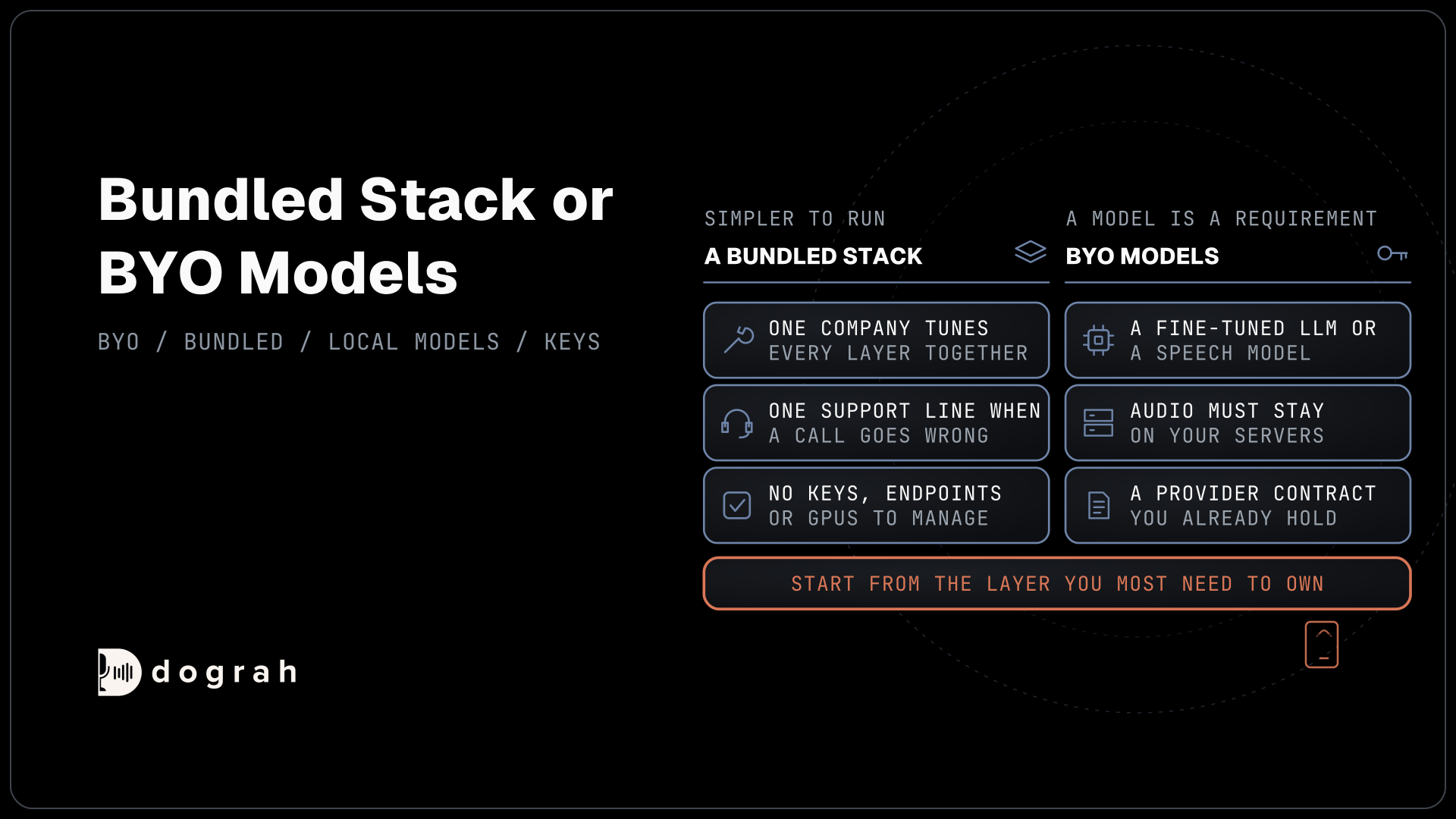
A bundled stack is simpler to run, and that is a fair reason to choose one. One company tunes speech-to-text, the model and the voice together, so latency, interruptions and billing come from one place, and there is one support line when a call goes wrong. A team with no engineers to manage keys, endpoints or GPUs gets a working agent sooner.
BYO models pay off when a specific model is a requirement. That includes a fine-tuned LLM, a speech model for a language the bundle handles poorly, a rule that audio must stay on your servers, or a provider contract you already hold.
Picking your BYO model voice AI platform
Start from the layer you most need to own. If audio must never leave your servers, you need open models on hardware you run, so pick Dograh self-hosted for a complete platform, or LiveKit Agents or Pipecat if you would rather build one. If you mainly want your own keys on hosted models, Dograh and Vapi take them on every layer, with Vapi requiring a public endpoint for your own LLM. If you want only your own LLM with a vendor's voices, Retell AI and ElevenLabs Agents fit.
Then check how hard it would be to move later. Our post on voice AI platform lock-in explains why models are the easiest layer to swap and which layers are not. Run the same test call on your top two before you commit.
Glossary
- BYOK
- Using your own account and API key with a model provider inside a voice platform. The provider bills you directly, while the audio and text still go to that provider.
- OpenAI-compatible endpoint
- A model server that answers the same request format as OpenAI's API, such as Ollama or vLLM. Platforms that accept one can run almost any open model.
- Custom LLM
- A platform option that sends each turn to a language model server you run. Some platforms require a public https address, while a self-hosted platform can reach localhost.
- Open-weight model
- A model whose weights you can download and run on your own hardware. It is the only way to keep a caller's audio and text inside your own servers.