
Voice AI for startups starts with the bill at ten times today's minutes. Every per-minute platform fee grows tenfold, so compare concurrency limits and add-ons, keep model keys and phone numbers in your own accounts, and pick a platform you could run yourself. Dograh, the open-source AI voice agent platform we build, runs self-hosted or on Dograh Cloud.
Key Takeaways
- At ten times the minutes, every per-minute platform fee is ten times larger.
- Concurrency included and add-on prices decide the bill more than the rate.
- Keep model keys and phone numbers in accounts you own from day one.
This post is part of our guide to AI voice agents, where every minute carries a platform fee, model usage and a phone line. Below, we price the fee at ten times today's volume, then cover concurrency, your own keys, hosting and switching later, with Dograh as the example.
The platform fee at today's volume and at 10x
A per-minute platform fee grows in a straight line, so ten times the minutes means ten times the fee. Price it at the volume you plan to reach, before you build on it. The table uses the published rates of Vapi and Retell AI:
| Platform fee per month | 1,000 minutes | 10,000 minutes | 100,000 minutes |
|---|---|---|---|
| Vapi ($0.05 a minute hosting) | $50 | $500 | $5,000 |
| Retell AI ($0.055 a minute voice infrastructure) | $55 | $550 | $5,500 |
| Dograh Cloud (1¢-a-minute platform fee) | $10 | $100 | $1,000 |
| Self-hosted Dograh | No per-minute platform fee | No per-minute platform fee | No per-minute platform fee, plus servers |
These rows are the platform fee only. Self-hosted Dograh has no per-minute platform fee, but servers, model keys and phone minutes still cost money. Dograh Cloud charges a 1¢-a-minute platform fee. On every row, speech-to-text, the language model, the voice and the phone line are billed on top, and they are usually the larger share.
An all-in monthly total depends on the models you pick, so build your own rather than borrowing anyone else's. For the full breakdown, our post on what an AI voice agent costs per minute totals a single minute line by line. For a sense of scale, our own sum puts Vapi's hosting fee alone at $18,250 a year for 1,000 minutes a day, before models, phone minutes or any add-on.
Concurrency and add-ons change the bill
At ten times the usage, every per-minute fee moves by the same factor, so the rate rarely decides it. Concurrency does, meaning how many calls can run at the same moment, and so do the add-ons you will need later.
Vapi includes 4 concurrent calls with no package, 10 on its $29-a-month Core package and 30 on Pro, which has a $999 monthly minimum. Extra lines cost $10 a month each, and its HIPAA add-on costs $2,000 a month. Retell AI includes the first 20 concurrent calls and charges $8 a month for each one after that.
Take a startup whose Monday-morning peak reaches 40 calls at once. On Vapi's Core package, that is 30 extra lines at $10 each, or $300 a month. On Retell AI, it is 20 extra at $8 each, or $160 a month. Both sit on top of the per-minute fees.
On Dograh Cloud, the pay-as-you-go plan includes 10 concurrent calls, and you contact the team for more. Self-hosted, the limit defaults to 10 and you raise it with one setting, DEFAULT_ORG_CONCURRENCY_LIMIT, while your servers and phone provider set the real ceiling.
Model providers have limits of their own, and one account's key can run out of parallel sessions first. Dograh can rotate across several API keys for the same provider. Our post on STT and TTS concurrency limits covers when several keys help.

Open Source Alternative to Vapi / Retell
Self-hosted voice agent platform — no per-minute fees
dograh-hq/dograh
Star on GitHub
Bring your own keys from day one
With your own keys, the model bills come straight from the providers, and you can switch a provider without asking the platform. That matters at ten times the minutes, because the model lines usually outgrow the platform fee.
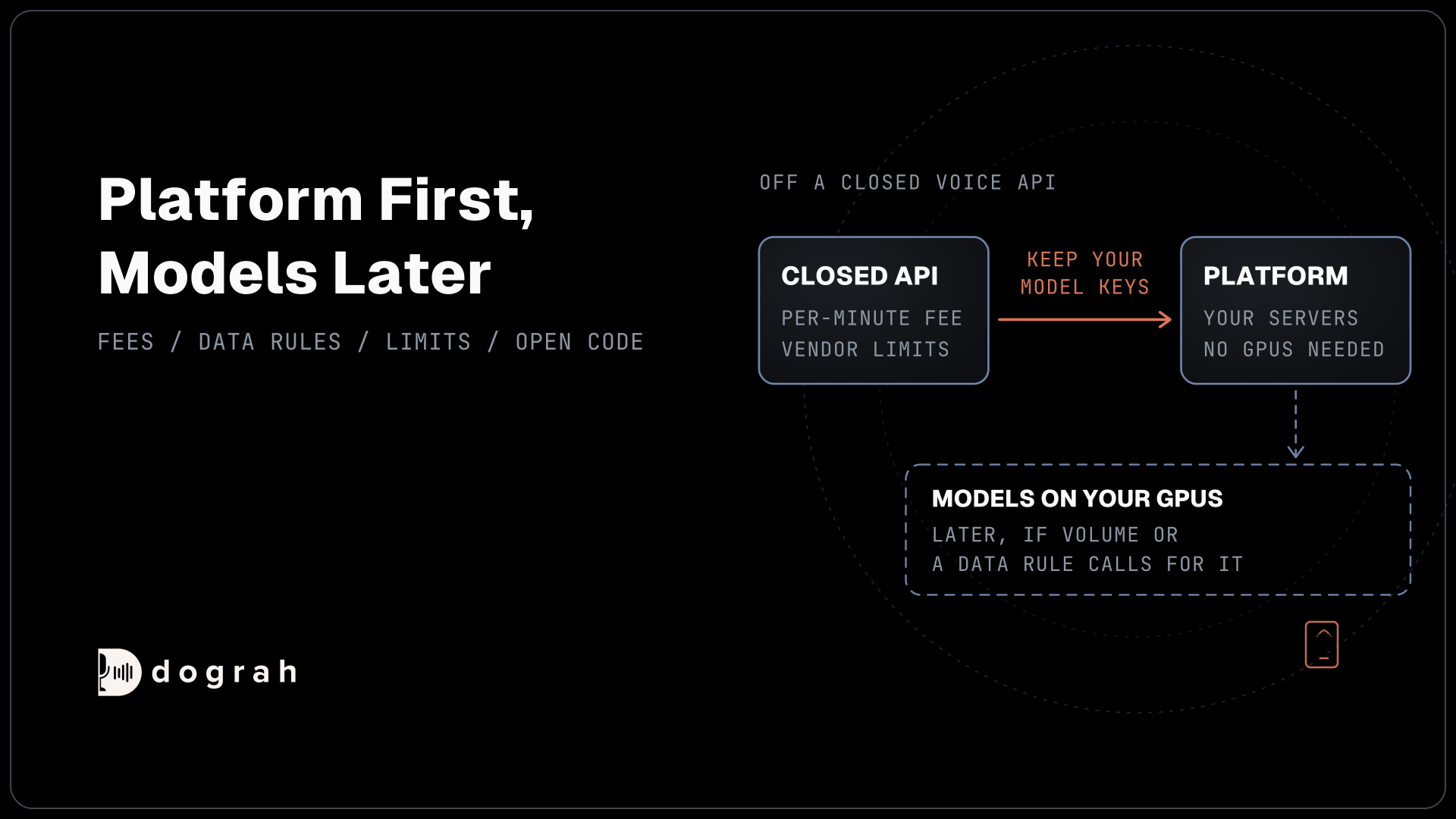
In Dograh, you can use Dograh's own models or set up your own provider keys for any LLM, speech-to-text and voice provider. Swapping a provider is a settings change. You can also point it at open models on your own servers.
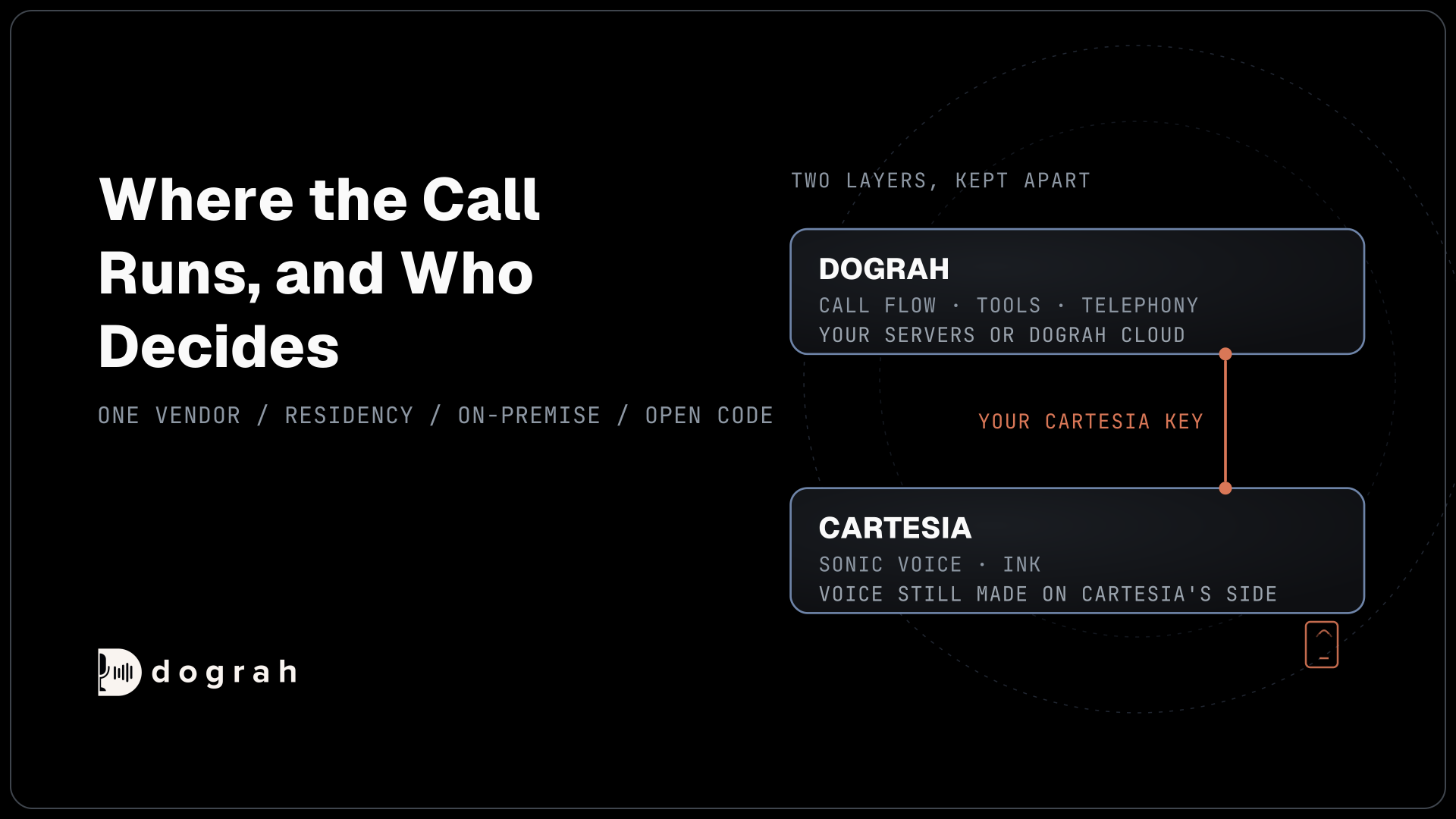
Your own keys move the contract to you. The audio still reaches whichever company runs the model. Data stays fully in-house only when the models run on your own servers too.
Pre-recorded clips also take pressure off the voice line. Recorded lines play without text-to-speech, and the agent falls back to a generated voice only when no clip fits.
Self-host or cloud, and when to move
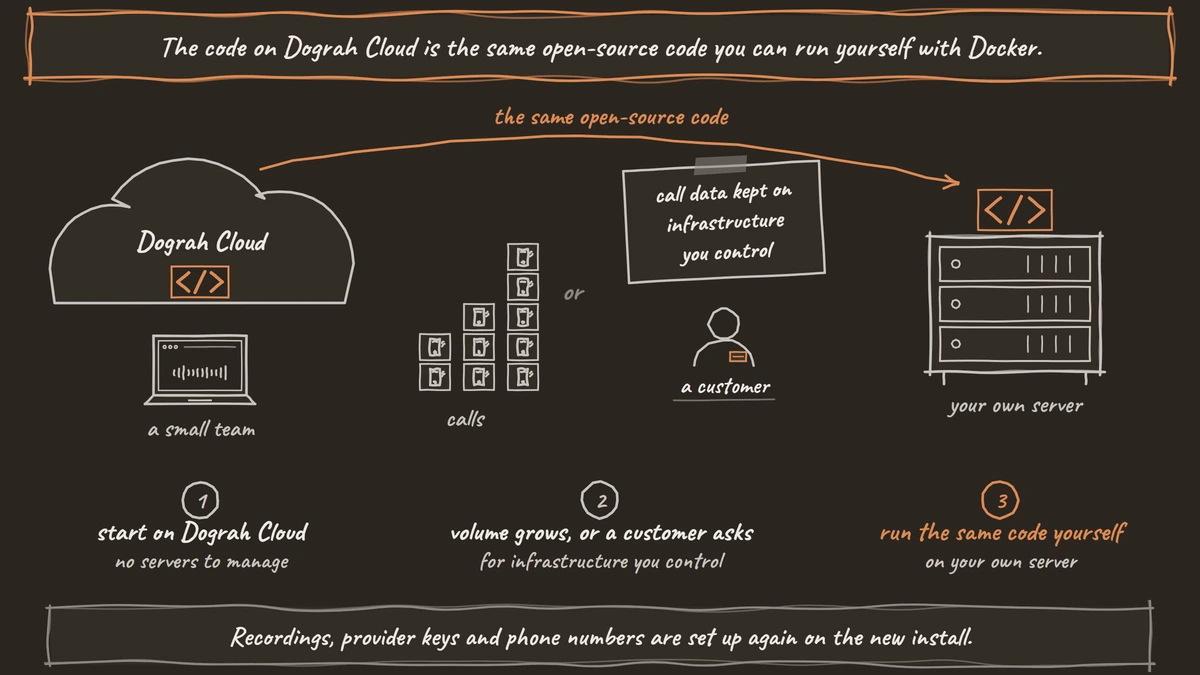
Start where you have the least to run. For most startups, that is Dograh Cloud, with no servers to manage while you find out which calls work.
The code on Dograh Cloud is the same open-source code you can run yourself with Docker. Teams usually move when volume makes the platform fee worth replacing with servers, or when a customer needs call data kept on infrastructure you control.
Self-hosting has its own costs. Someone has to run the servers, apply updates and watch the calls. Our post on self-hosted vs managed-cloud voice AI covers who runs what in each case.
Switching later without starting over
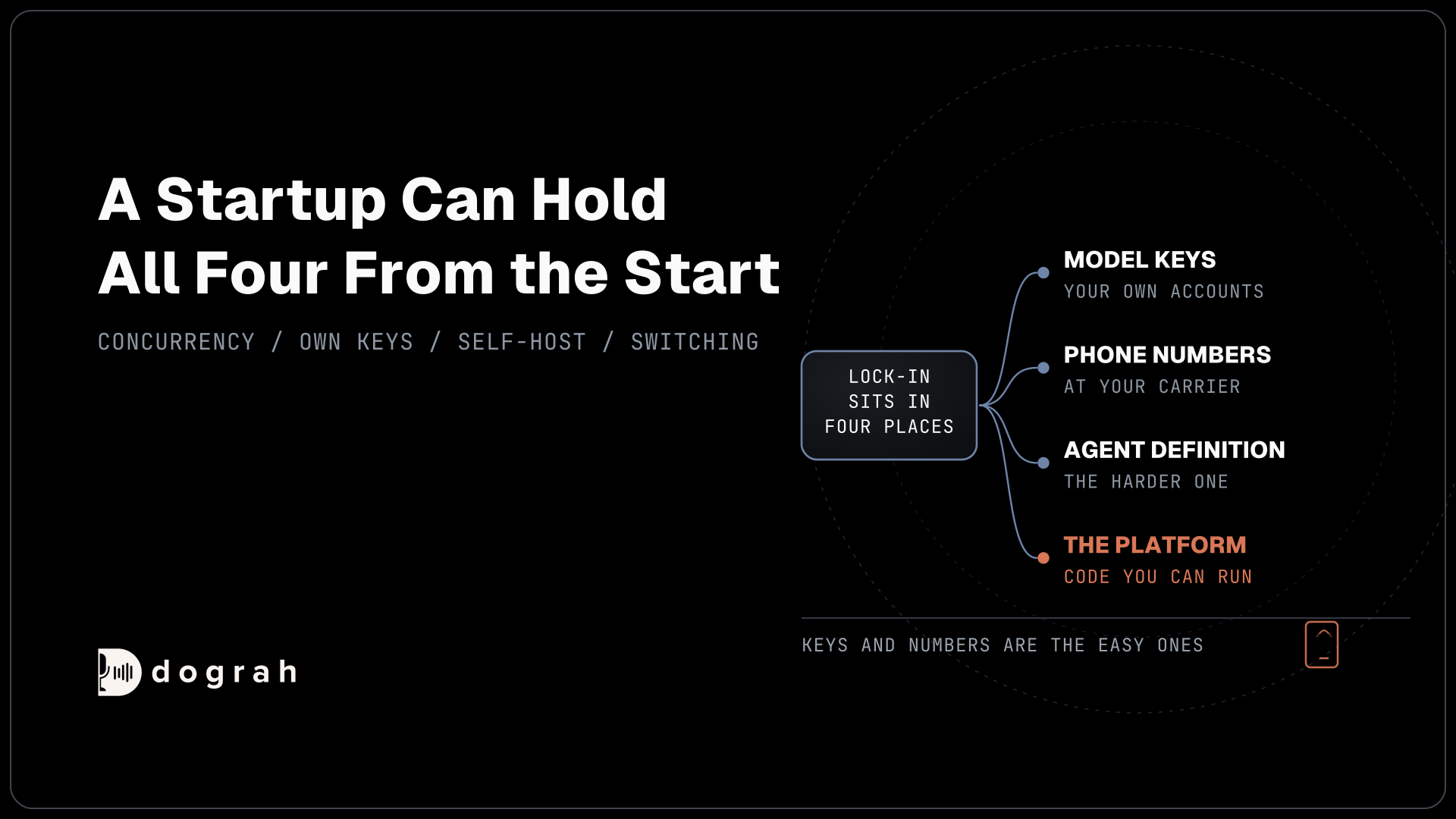
Lock-in in voice AI sits in four places: the model keys, the phone numbers, the agent definition and the platform itself. A startup can hold all four from the start.
Keys and numbers are the easy ones. Open provider accounts in your company's name, and keep your numbers at a carrier such as Twilio or Telnyx, where you can point them at a different agent any time.
The agent definition is harder. On a closed platform, an agent built in its visual editor only runs there. When Vapi retired its visual Workflows, teams that built on them had to rebuild, as our post on the hidden costs of closed voice AI platforms describes.
Dograh's code is on GitHub, and the same platform runs on Dograh Cloud and self-hosted. An agent's workflow can be moved through the API: read its definition from one install and create it from that definition in the other. You can also download the workflow file from the editor and upload it on the new install. Recordings, provider keys and phone numbers are set up again on the new install.
Join the Dograh Community
Dograh is an OSS alternative to Vapi. Join our Slack community for queries, releases, best practices & community interactions.
Glossary
- Platform fee
- What a voice agent platform charges per minute for running the call, separate from model usage and the phone line. Vapi charges $0.05 a minute, Retell AI $0.055, and Dograh Cloud 1¢.
- Concurrency limit
- How many calls can run at the same moment. Hosted platforms include a number and sell extra lines, and model providers set their own per-account limits.
- Bring your own keys (BYOK)
- Using your own accounts with model providers, so their bills come to you and you can switch providers. It moves the contract to you, while the audio still reaches the provider.
- Workflow definition
- The saved description of an agent's call flow, prompts and tools. In Dograh it can be read from one install and created in another through the API.