
The best self-hosted voice AI platforms run the call on servers you control and let the models run there too. For teams that want the full platform in-house, Dograh is the open-source AI voice agent platform to start with. LiveKit Agents and Pipecat are frameworks you build on, and Bland and Retell handle any private setup through enterprise sales.
Key Takeaways
- Self-hosting the platform keeps audio in only when the models run inside too.
- Dograh installs with Docker Compose and runs local models through Speaches.
- LiveKit and Pipecat self-host freely, but your team builds the phone product.
Self-hosting a voice agent sounds simple until you list what still leaves your network. We define what self-hosted covers, set out what running each platform takes, rank the open options led by open-source Dograh, then we talk about the closed vendors that self-host under contract.
What self-hosted means for a voice agent
A self-hosted voice platform runs the software that handles the call on servers you control. That covers the call flow, the hand-off to the phone network and the call records, in your own data center or in a cloud account that belongs to you. Your own AWS, Google Cloud or Azure account counts, because you hold the keys and decide where the data sits.
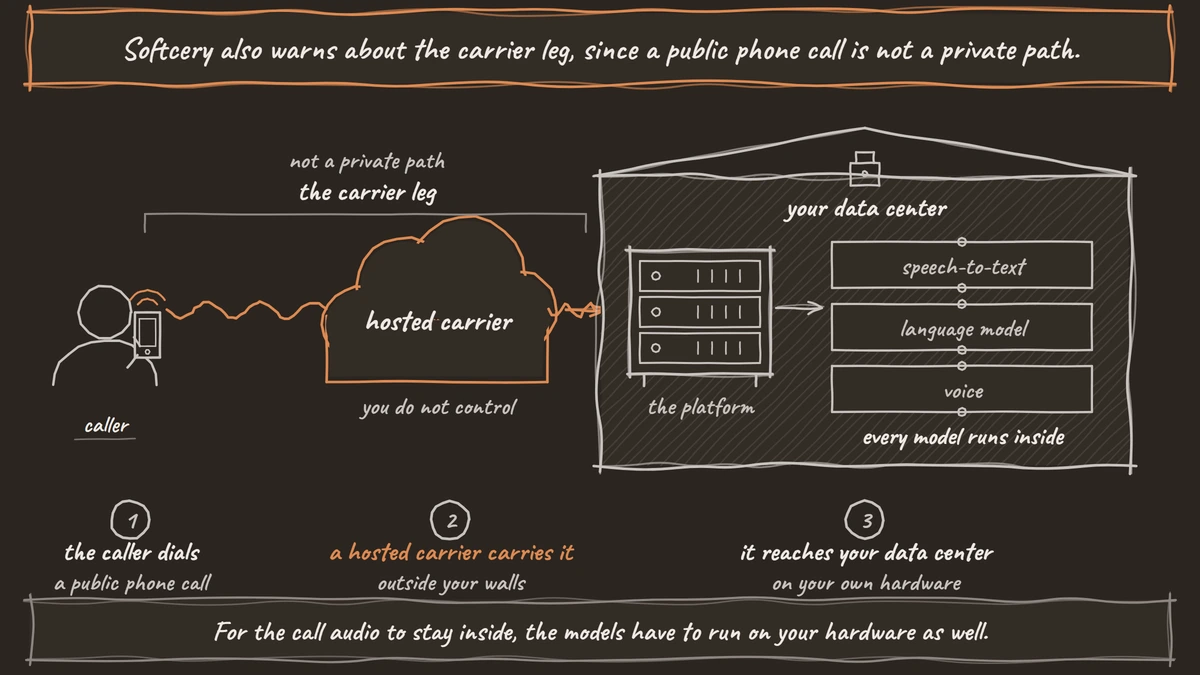
Self-hosting says nothing about the models. A self-hosted platform that calls hosted speech-to-text, a hosted language model and a hosted voice still sends audio or text to those providers on every call. Bringing your own keys moves the contract to you, not the data. For the call audio to stay inside, the models have to run on your hardware as well.
Dograh is the orchestration layer that runs the call flow, tools and telephony, and the speech and language models are a separate layer you choose. Every platform below splits along the same line, and the phone carrier is a third piece that usually sits outside. Our post on self-hosted vs managed-cloud voice AI covers how to choose between running the platform and buying it.
What running a platform yourself takes
Most buyers ask whether a platform can be self-hosted, when the better question is what running it will take. In Cloudian's survey of 203 IT leaders, a vendor survey from February 2026, 91% said they would choose on-premises, private cloud or hybrid over public cloud for AI that touches sensitive data. Plenty of teams want it, and far fewer have priced the work of running it.
So each option below is scored on the same columns. What you install covers whether you get a full platform or a framework, and on what kind of server. License and contract show whether you can install it today or need a sales deal. Local models show which speech, language and voice models can run on your hardware.
The phone route shows whether calls can end at your own phone system or must pass through a hosted carrier. Upgrades and support show who moves the install to a new version and who answers when it breaks. Together they tell you how much of the call you hold and how much work holding it takes.
Self-hosted voice AI platforms compared
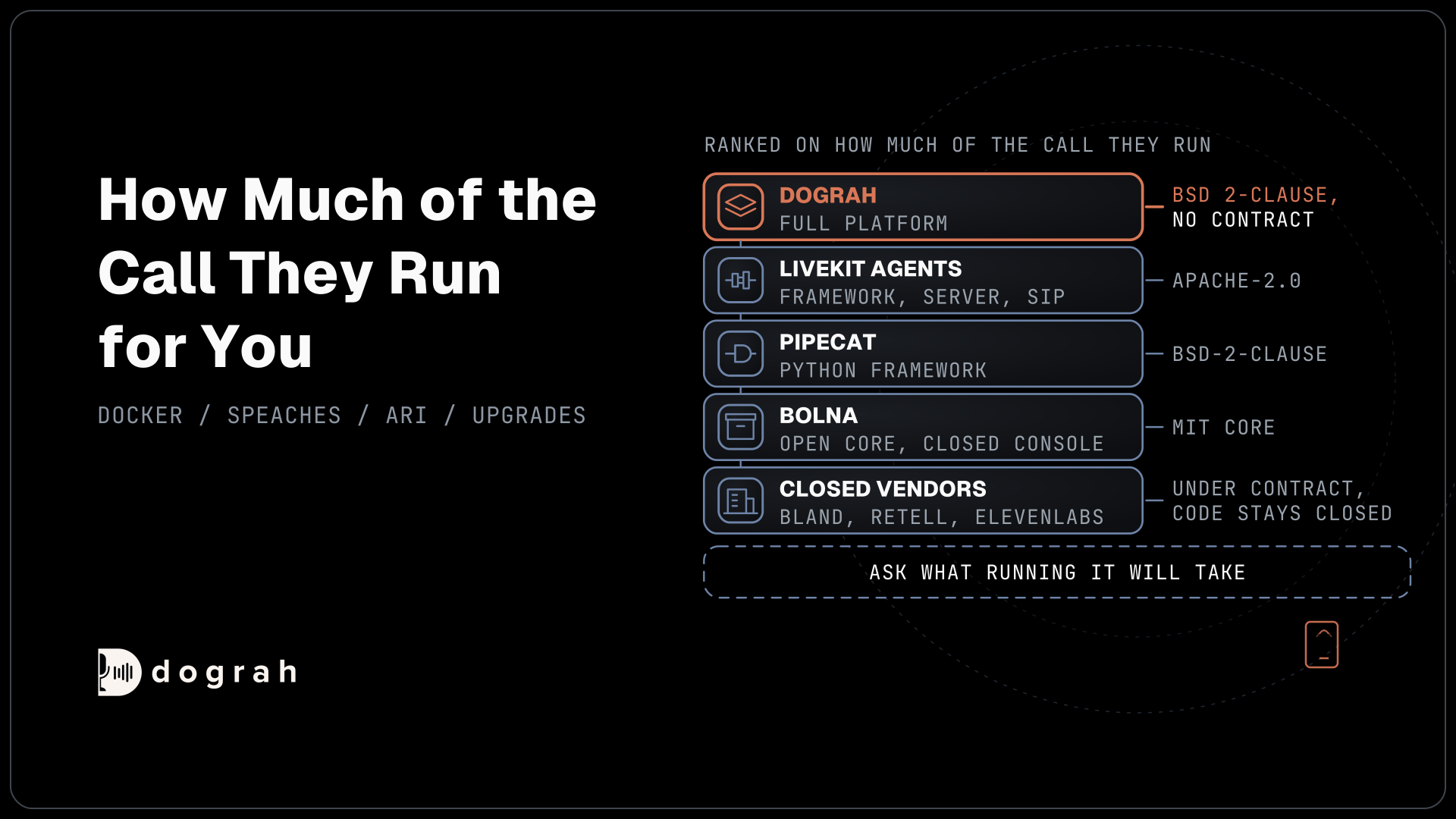
The open options come first, ranked on how much of the call they run for you, and the closed vendors follow as one group. Every row is closed code except the first four.
| Platform | What you install | License and contract | Local models | Phone route | Upgrades and support |
|---|---|---|---|---|---|
| Dograh | Full platform with Docker Compose, Helm chart in alpha | BSD 2-Clause, no contract | Local Models (Speaches) for speech and voice, any OpenAI-compatible LLM server | Asterisk ARI to your PBX, or hosted carriers | Update script, community support, custom SLAs on Enterprise |
| LiveKit Agents | Framework plus LiveKit server and LiveKit SIP | Apache-2.0, turn detector under its own model license | Any model you wire in | LiveKit SIP with a public IP and SIP trunk | Your team, community |
| Pipecat | Python framework | BSD-2-Clause, no contract | Any model you wire in | Twilio, Telnyx, Plivo, Exotel, Genesys, Vonage, SIP | Your team, community |
| Bolna | Orchestration core in Docker | MIT core, console and hosted APIs closed | Any model you wire in | Twilio and Plivo | Your team, community |
| Bland AI | Bland's platform, by enterprise arrangement | Closed, through sales | Bland's own models | Bland's telephony or your trunks | Bland |
| Retell AI | Retell's platform, by enterprise arrangement | Closed, through sales | Retell's model list | Through Retell | Retell |
| ElevenLabs Agents | VPC now, on-premise speech models in early access | Closed, Enterprise | ElevenLabs models | Through ElevenLabs | ElevenLabs |
Dograh, the full open platform on your servers
Dograh comes first because it is a full platform under an open license that you can install today without a contract. The whole product is BSD 2-Clause, from the Agent Builder and the canvas to campaigns, the QA step and call records. The Docker install runs two images, dograh-api and dograh-ui, with Postgres, Redis and MinIO under Docker Compose, on a server with at least 8 GB of RAM and 4 vCPUs. A Helm chart for Kubernetes exists but is still alpha, so Docker Compose is the install to run in production.
Models are set per agent, and each layer can run locally. The Local Models (Speaches) provider points speech-to-text and voices at a Speaches server on your network, with faster-whisper for listening and Kokoro for speaking, and the language model can point at any OpenAI-compatible server such as Ollama or vLLM. The speech-to-speech models in the list are hosted services, so a fully local agent uses separate speech, language and voice models.
Calls can stay on your own phone system. Asterisk ARI connects Dograh to your PBX on Asterisk 22.8 or later, and Transfer Call works on it, calling the destination first and connecting the caller only when someone answers. A few switches matter on a self-hosted install. Telemetry can be switched off with ENABLE_TELEMETRY=false, recording uploads switch on or off server-wide, and the Agent Builder needs a Dograh Service Key, so a closed network builds agents on the canvas. Our guide to deploying a voice agent on-prem walks through that install.
Running Dograh yourself means no per-minute platform fee. What you do pay for is the servers, any model keys and the phone minutes, and your team carries the database and every upgrade. Support comes from the open-source community, while Enterprise adds custom SLAs along with on-premise or private-cloud deployment help. For teams that later want it run for them, Dograh Cloud charges a 1¢-a-minute platform fee. A self-hosted install takes 10 calls at once by default, a limit you can raise, and your servers set the real ceiling.

Open Source Alternative to Vapi / Retell
Self-hosted voice agent platform — no per-minute fees
dograh-hq/dograh
Star on GitHub
LiveKit Agents and Pipecat, frameworks you assemble
LiveKit Agents is open under Apache-2.0 and says you can run the entire stack on your own servers. That stack is the agents framework, the LiveKit media server and LiveKit SIP for phone calls. The SIP service needs a public IP address for carriers to reach, SIP on port 5060 and a wide range of media ports, and its Docker container runs with host networking. The turn detection models ship under the separate LiveKit Model License, so read those terms before you rely on them.
Pipecat is a Python framework from Daily under BSD-2-Clause, with more than 100 ready integrations. It runs on any server you like and connects to Twilio, Telnyx, Plivo, Exotel, Genesys and Vonage. Its WebSocket phone routes carry no transfers, so a hand-off to a person needs a SIP route or Daily's phone service.
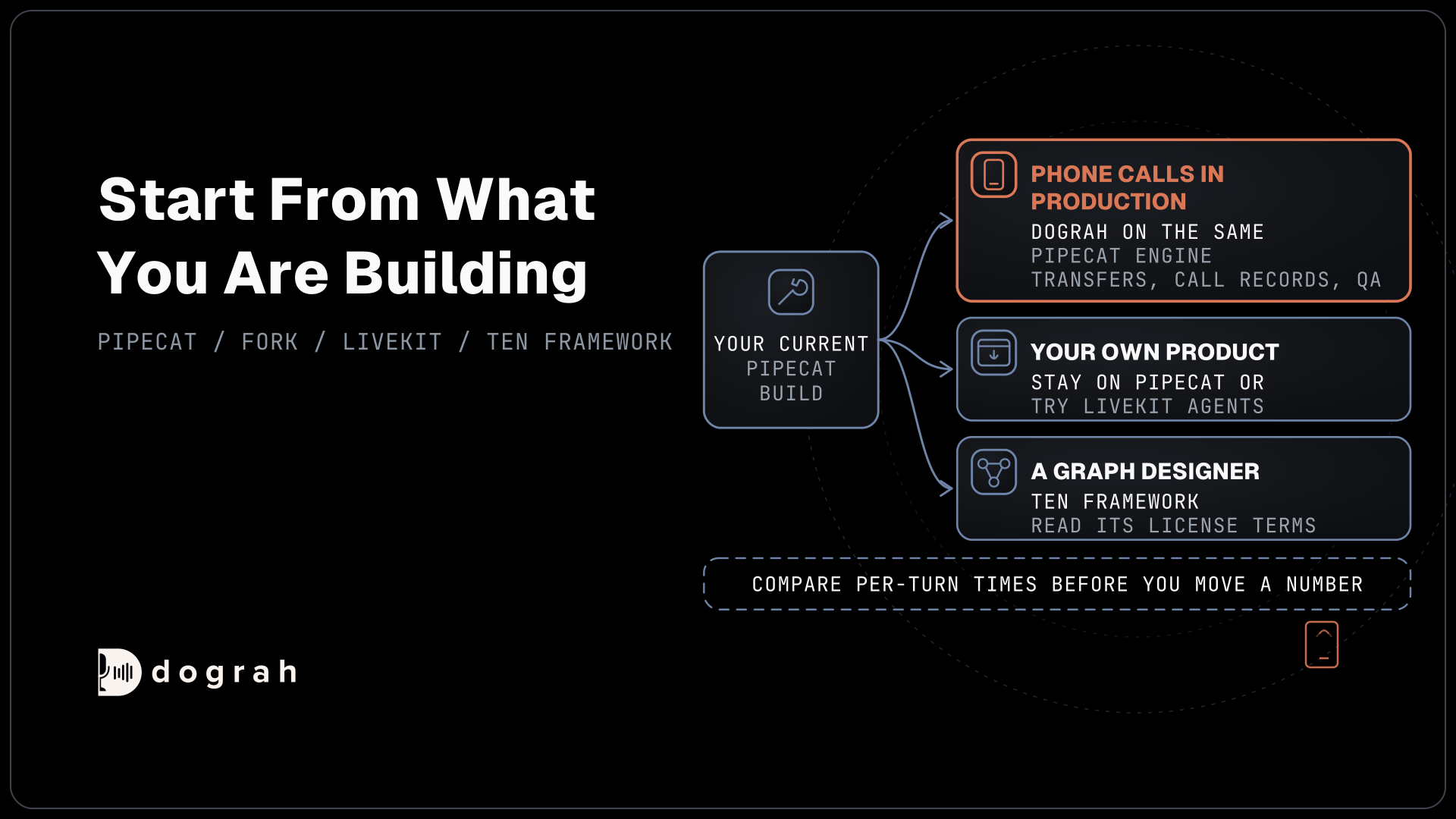
Both give you the engine and leave the phone product to you. Your team builds contact lists and calling hours, stored recordings, a place for non-developers to edit prompts and checks on live calls. Our list of the best open-source voice AI platforms covers that build list and the licenses in detail, so we do not repeat it here.
Bolna, an open core with a closed console
Bolna releases its orchestration platform under the MIT license, while its hosted APIs and no-code playground are closed source for now. The local setup runs four containers, a telephony server for Twilio or Plivo, the Bolna server, ngrok for a public tunnel and Redis for agent data. Exotel and Vonage are listed as coming soon.
That makes Bolna a reasonable base for a team that wants open code and will build its own screens. It is less complete than a full platform, and the ngrok tunnel in the local setup is one more outside connection to replace before production. Vocode and the TEN Framework are covered in our open-source list.
Join the Dograh Community
Dograh is an OSS alternative to Vapi. Join our Slack community for queries, releases, best practices & community interactions.
Closed vendors that self-host under contract
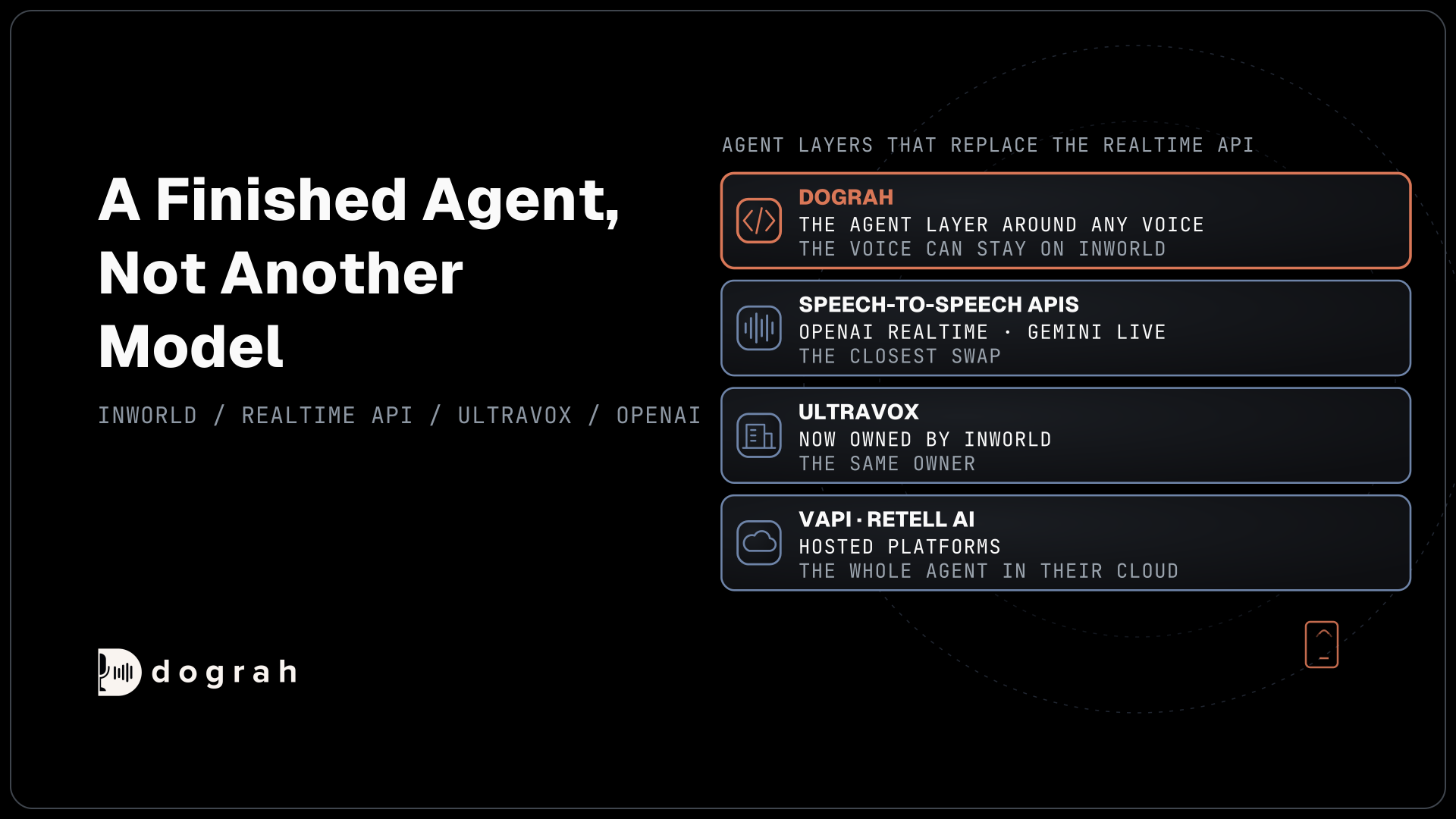
For a private-cloud or on-prem setup with Bland or Retell, talk to their enterprise sales teams, and expect the code to stay closed whatever the arrangement. ElevenLabs announced on-premise and on-device deployment of its speech models in April 2026, in early access at the time, while its VPC option on AWS SageMaker and GCP Vertex is available now. Rasa says it runs self-hosted, on-prem or hybrid and does not host customer data, with a free Developer Edition and Enterprise priced by quote.
Two well-known names fall outside this group. Cognigy keeps on-prem only for customers who already run it, and Vapi sells regions rather than installs on your servers. Our ranking of the best on-prem voice AI platforms covers those vendors and the speech engines you can run on-prem.
The work self-hosting takes, and when it pays
Self-hosting is not always the right first move, and the strongest case against it is worth reading. Softcery's cost analysis finds hosted options two to ten times cheaper below about 1M minutes a month, once you hire a team to run your own models. It names four reasons to self-host anyway, a hard data-boundary rule no vendor contract can meet, sustained volume of 1M to 2M minutes a month or more, voice as core product infrastructure, and a team that already runs GPUs.
Softcery's numbers price GPUs and a model team. Self-hosting only the platform, with hosted model APIs, needs an ordinary server and far less staff, though it also leaves the audio going to those providers. Decide which of the two you need before you size the budget.
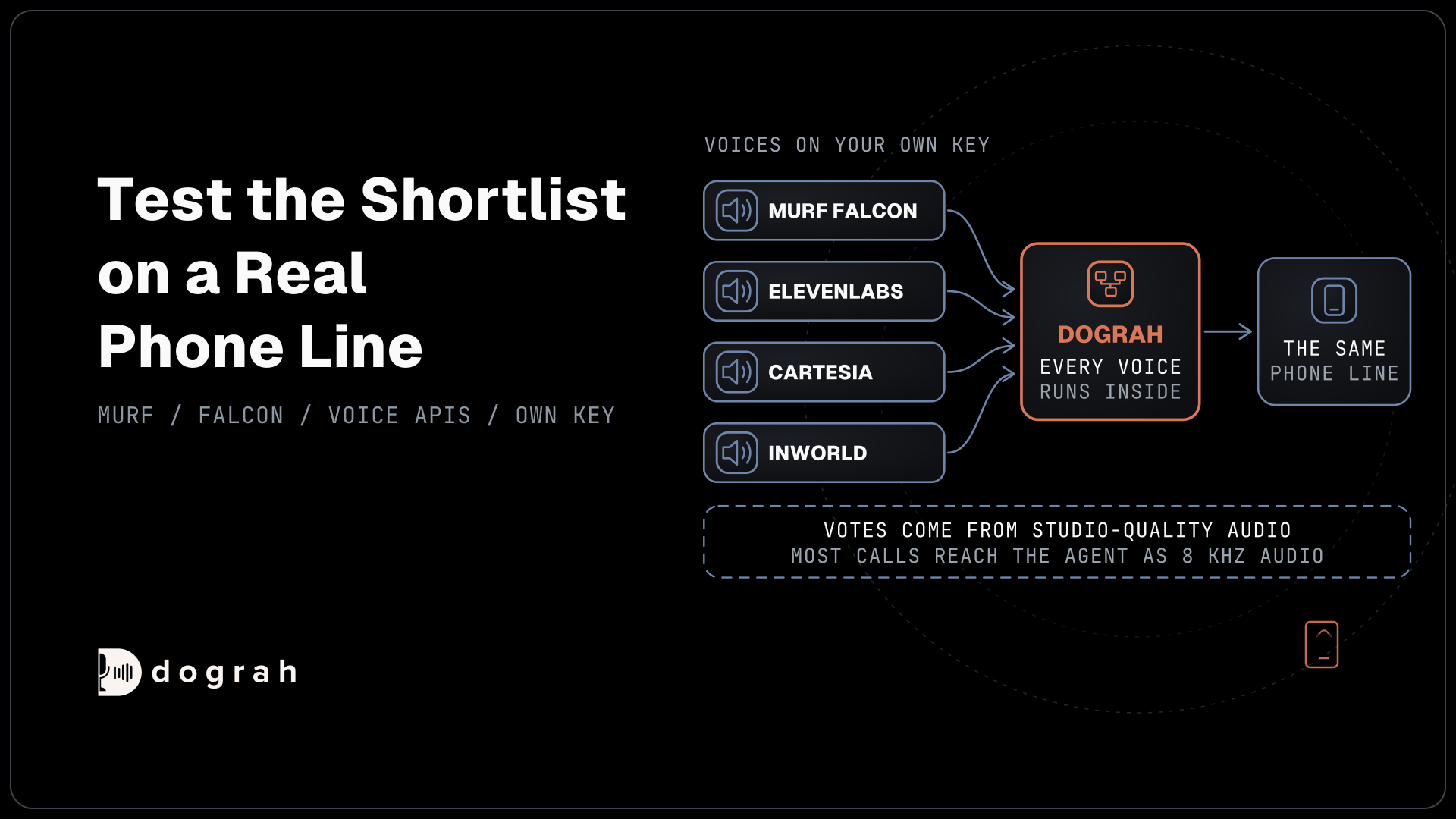
Softcery also warns about the carrier leg, since a public phone call is not a private path. It calls this the theater trap, where every model runs inside but the audio still arrives through a hosted carrier you do not control. Map each kind of call data against each part of the stack, from the carrier to the models, and self-host the parts your rules actually cover.
Glossary
- Self-hosted platform
- Voice agent software that runs the call flow, telephony hand-off and call records on servers you control. The models it calls may still run at a provider.
- Theater trap
- Softcery's name for paying to run models on-prem while call audio still leaves through a hosted carrier or speech service, so the privacy gain is smaller than it looks.
- Speaches
- An open-source, OpenAI-compatible server for local speech-to-text and voices, with faster-whisper and Kokoro. Dograh connects to it as Local Models (Speaches).
- Open core
- A project that releases its engine under an open license while keeping parts such as the console or hosted APIs closed, as Bolna does today.