
The best HIPAA-compliant voice AI platforms pass three tests, which plan carries the business associate agreement, where recordings live and whether you can self-host. Dograh, the open-source AI voice agent platform, ranks first for self-hosting, since a self-hosted install needs no BAA with Dograh. Retell AI self-signs a BAA at no fee, and Vapi charges $2,000 a month.
Key Takeaways
- Each company storing or processing patient data needs its own business associate agreement.
- Retell signs free, Vapi charges $2,000 a month, and Bland signs on Enterprise.
- Self-hosted Dograh needs no BAA with Dograh. Model providers may need their own.
A vendor calling itself HIPAA-compliant tells you little until you know which contract covers which copy of the call. We start with what the law asks, rank the platforms on their BAA terms and recordings, with open-source Dograh first, then show who else must sign.
What the law asks of a voice AI vendor
A voice agent that hears patient details is handling protected health information (PHI), so every company in the call path falls under the Health Insurance Portability and Accountability Act (HIPAA). A covered entity, such as a clinic or a health plan, may let a vendor handle PHI only with written assurances in a contract, the business associate agreement (BAA). A vendor may pass PHI on to its own subcontractors only with the same written assurances.
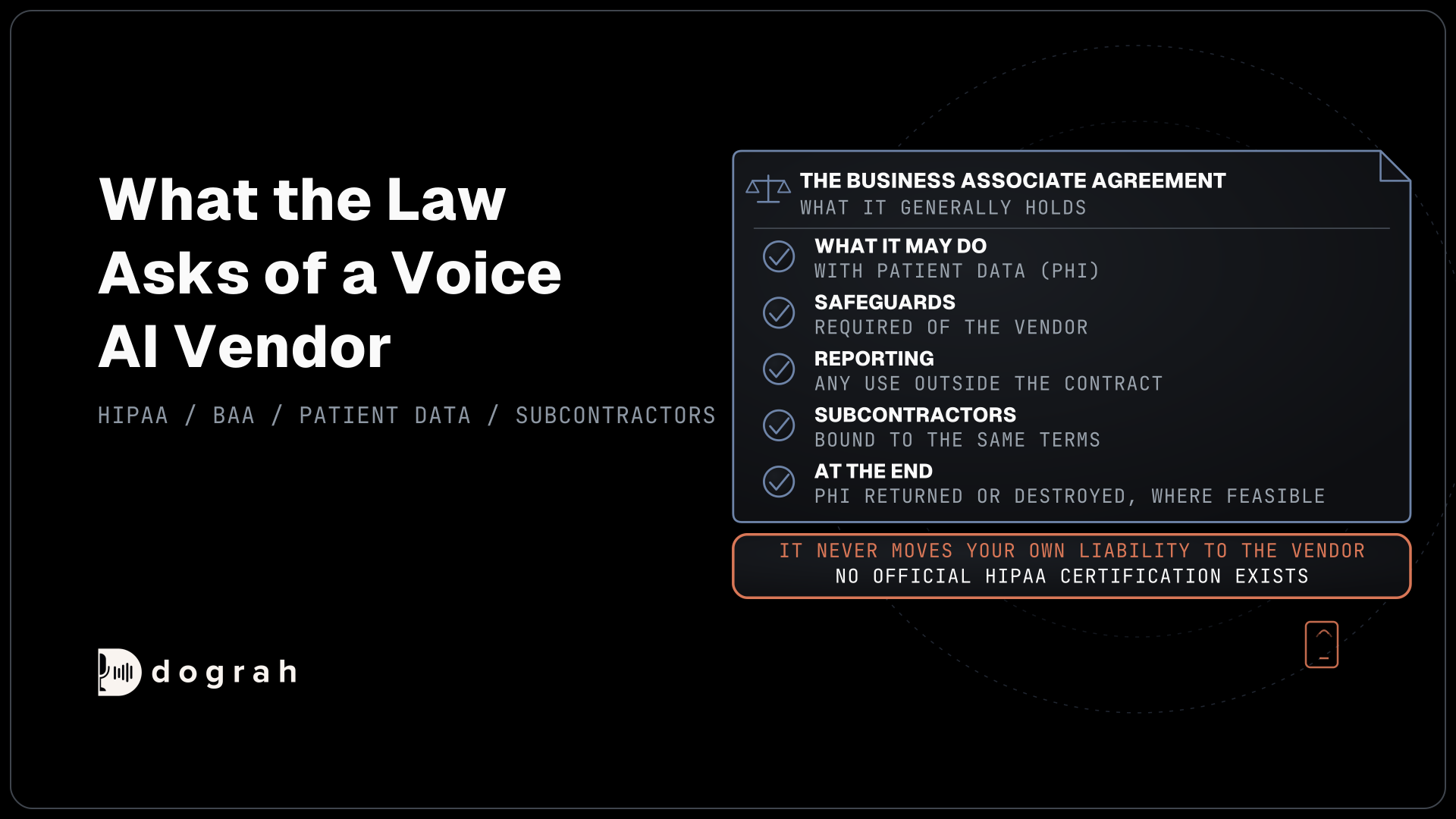
The rules for business associate contracts say what that contract must hold. It sets what the vendor may do with PHI, requires safeguards, requires the vendor to report any use outside the contract, binds subcontractors to the same terms and, where feasible, returns or destroys PHI at the end. A BAA delegates those duties and adds a duty for you to monitor them. It never moves your own liability to the vendor, and no official HIPAA certification exists, so "HIPAA-compliant" on a vendor's website is the vendor's own description.
The chain is where breaches happen. By HIPAA Journal's count of where each breach occurred, business associates were involved in 43% of large healthcare breaches in the first half of 2026. Every extra company on the call is one more contract and one more place the data can leak.
The Security Rule itself may change. A proposed update was published in January 2025 and is not final, and the federal regulatory agenda lists final action for July 2027. These are the rules as we read them, so confirm with counsel how they apply to your own call flows before you sign anything.
HIPAA voice AI platforms compared
The table scores each platform on the three tests, with self-hosting first and the hosted vendors after it. Every hosted row is closed code, so the contract terms are the part you can check.
| Platform | BAA terms | Where the calls run | What changes for PHI | Code |
|---|---|---|---|---|
| Dograh | No BAA with Dograh when self-hosted | Your own servers | Recordings and transcripts sit in your own storage | Open source, BSD 2-Clause |
| Retell AI | Self-signed, no extra fee | Retell's cloud | Retention set per agent, from 1 day to 2 years | Closed |
| Vapi | HIPAA add-on at $2,000 a month | Vapi's cloud, private bucket | Structured outputs not stored by default | Closed |
| Bland AI | Signed BAA on Enterprise | Bland's cloud, on-prem or VPC on Enterprise | Data residency on Enterprise | Closed |
| Synthflow | Signed with its HIPAA Setting on | Google Cloud, US or EU | PHI not logged, recorded or stored with the setting on | Closed |
| ElevenLabs Agents | Enterprise only | ElevenLabs' cloud | Zero Retention Mode, PHI not stored or logged | Closed |
| PolyAI | Offered for every PHI deployment | PolyAI's cloud on AWS | Data residency in the US, UK, EU or APAC | Closed |
Dograh, the self-hosted route with no BAA to sign
Dograh ranks first because self-hosting takes the platform vendor out of the BAA chain. A self-hosted install needs no platform BAA at all, since the calls run on your servers and never reach Dograh. Your model providers may need their own BAA when they handle PHI. The phone carrier may need one depending on what it stores, and many, such as Twilio, offer one. If your servers run in AWS, Google Cloud or Azure, that cloud provider needs a BAA too, while your own data center does not.
The models are where most teams still have a vendor to sign with. The platform is the orchestration layer that runs the call flow, tools and telephony, and the speech and language models are a separate layer you pick under Providers and Models. Open-weight models served from your own GPU through an OpenAI-compatible server such as Speaches take the model vendors off the list as well.
Recordings and transcripts land in storage you run. For production, point the platform at an S3-compatible bucket you control, using the S3 backend described in the environment variables, so the bucket stays private behind signed links. Recording can be switched off for the whole server with ENABLE_CALL_RECORDING_UPLOAD, and transcripts are still saved. Your own deletion job then enforces the retention schedule your policy sets.
Call traces stay private as well. Each organization's Langfuse tracing is private by default, and a self-hosted Langfuse keeps trace data on your servers too. Our post on HIPAA-compliant voice AI and what self-hosting changes walks through what stays and what leaves, including switching off usage telemetry before the first patient call.
On cost, a self-hosted install has no per-minute platform fee, but servers, model keys and phone minutes still cost money. Dograh Cloud charges a 1¢-a-minute platform fee. For patient calls, this ranking covers the self-hosted route.
Self-hosting also hands your team the work a vendor would otherwise do. The server, the database and the upgrades are yours to run and patch, and so is the access log a compliance officer will ask about. Help on the open-source version comes from the community Slack, and Enterprise adds custom SLAs.

Open Source Alternative to Vapi / Retell
Self-hosted voice agent platform — no per-minute fees
dograh-hq/dograh
Star on GitHub
Hosted platforms that sign a BAA
Six hosted platforms state BAA terms, and each one keeps your calls on its cloud under that contract. All six are closed code.
Retell AI's BAA is the easiest to get. Retell makes the BAA available for self-signing, states that "There is no additional fee to sign these agreements" and requires it before PHI goes through Retell. Retention is set per agent, from 1 day to 2 years for transcripts, recordings and logs, and Retell holds zero data retention agreements with its language, speech-to-text and voice subprocessors.
Vapi sells HIPAA as a paid add-on at $2,000 a month. With HIPAA turned on, call recordings and logs are stored in a private bucket, and structured outputs are not stored by default. HIPAA mode and zero data retention cannot both be on, and raw data is kept 14, 30 or 180 days depending on your support package.
Bland describes itself as HIPAA compliant with a signed BAA, and offers the BAA on Enterprise only, beside on-prem or VPC deployment and data residency. Synthflow signs a BAA for customers using its HIPAA Setting, sold as an annual enterprise agreement. With the setting on, Synthflow does not log, record or persistently store PHI, and one option deletes transcripts, recordings and caller IDs after 30 days.
ElevenLabs Agents offers a BAA only on Enterprise, and patient data needs Zero Retention Mode, under which PHI shared in a conversation is not stored or logged. PolyAI says a BAA is available for every deployment that handles PHI, on its AWS-hosted platform, with self-serve plans from $49 a month. Our guide to the best AI voice agents for healthcare compares health-system vendors with their prices side by side.
Who else on the call needs a BAA
A platform's BAA covers the platform, and each company under it that stores or processes PHI needs its own route. The carrier comes first. A carrier that only transmits the call can fall under HIPAA's conduit exception, and one that records or transcribes needs a BAA. Twilio signs one on its Security Edition or Enterprise Edition, for its HIPAA Eligible Products only.
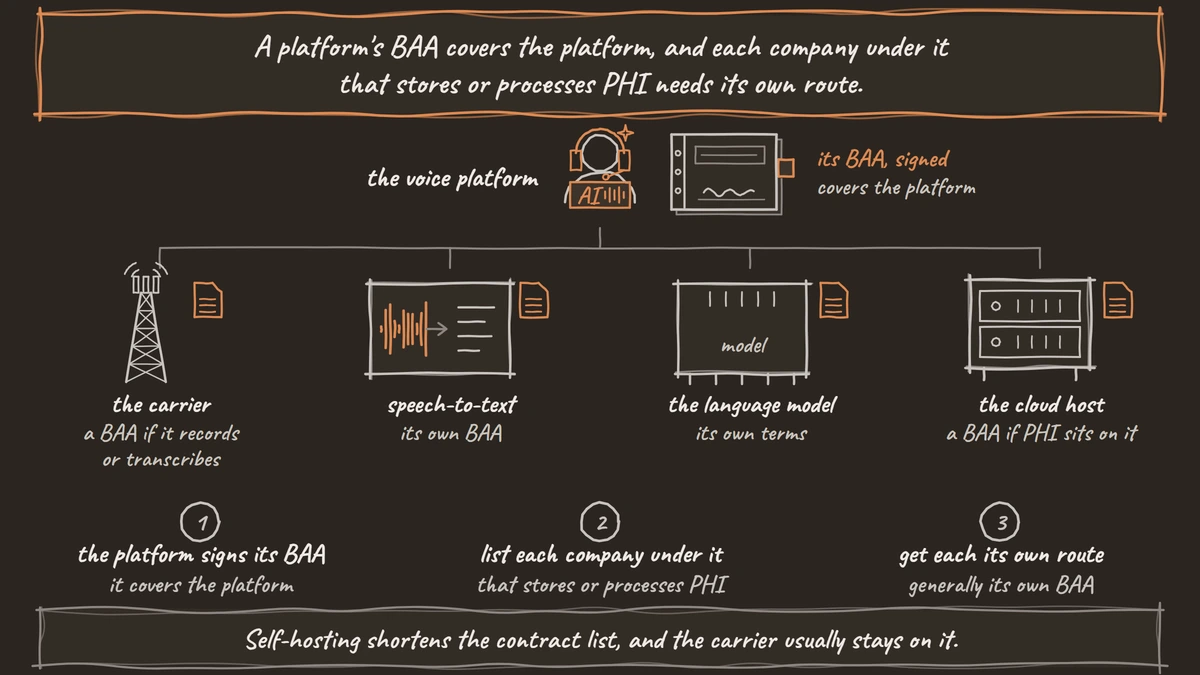
Speech-to-text comes next. Deepgram signs BAAs for Enterprise customers handling PHI. Google Cloud covers Speech-to-Text and Text-to-Speech under its BAA, as long as you do not opt in to Speech-to-Text data logging.
The language model has its own terms. OpenAI's API signs through a Business Associate and Healthcare Addendum, and its abuse monitoring logs are kept for up to 30 days unless zero data retention is approved. Microsoft Azure includes the BAA in its data protection addendum with no separate contract, and AWS lists Transcribe, Bedrock, Polly, Connect and S3 among its HIPAA-eligible services.
Then there is the cloud that hosts the servers, which needs a BAA whenever PHI sits on it. Our post on which parts of a voice AI stack need a BAA lays out every layer in one table.
Each layer you move onto your own servers takes one company off this list. Open-weight speech and language models remove the model vendors, and a data center you own removes the cloud host. Self-hosting shortens the contract list, and the carrier usually stays on it.
Join the Dograh Community
Dograh is an OSS alternative to Vapi. Join our Slack community for queries, releases, best practices & community interactions.
Picking a HIPAA voice AI platform
Pick by how many companies you are willing to sign with. If you want the shortest list, self-host Dograh with open-weight models in your own data center, and the carrier is the main contract left to check. Your team then runs the servers and the upgrades.
If you would rather a vendor runs everything and you can sign this week, Retell's self-signed BAA has no extra fee, and Vapi's add-on costs $2,000 a month on top of usage. If you are already negotiating an Enterprise contract, Bland, ElevenLabs Agents and Synthflow put the BAA inside it, and PolyAI offers one per deployment.
Budget the review time as well. Each BAA is a contract your compliance team reads, files and monitors, so a stack with six signers costs more hours every year than one with two.
Whichever you choose, get the list of subcontractors that hear the audio in writing, along with where recordings and transcripts are kept and how long each copy stays. Our guide to voice AI data security maps where every copy of a call goes in each setup, which makes those answers easier to check.
Glossary
- Business associate agreement (BAA)
- The written contract HIPAA requires before a vendor handles protected health information for a covered entity. It sets permitted uses and safeguards and binds subcontractors, and it delegates duties without moving the covered entity's liability.
- Subcontractor
- A company that handles PHI for a business associate, such as the speech-to-text or language model provider behind a hosted voice platform. It needs the same written assurances, so one platform BAA does not cover it.
- Conduit exception
- HIPAA's treatment of a company that only transmits data, such as a phone carrier passing a call through. A carrier that records or transcribes calls is no longer a conduit and needs a BAA.
- Zero Retention Mode
- A setting on some hosted platforms that deletes conversation data once each request completes. ElevenLabs Agents requires it for PHI on its Enterprise plan.