
The best AI voice agents for e-commerce come down to who holds the order data and the call. Dograh, an open-source voice agent platform, can run on your own servers and read and write your order system during the call, with no per-minute platform fee when self-hosted. The rest are Shopify apps, helpdesk add-ons, phone systems and voice platforms.
Key Takeaways
- Judge each tool on whether it reads and writes your order system during the call.
- If you want call data on your own servers, Dograh can run there with no per-minute platform fee.
- Price your busiest sale week, including what callers hear when every line is busy.
This post is part of our guide to AI voice agents for e-commerce and retail. The guide's section on building the agent and choosing a platform names the four questions this roundup uses. Here are eleven products, starting with Dograh and then grouped by kind, judged on those four questions.
Four questions to ask before you buy
Every tool below is judged on the same four questions, in this order.
The first is whether it reads and writes the order system during the call. An agent that can say "your parcel left on Tuesday" because it read the order a second ago is useful; one that takes a message for staff to look up later saves little.
The second is outbound: whether it can place calls, and what that means for consent. A cart or reorder call generally needs prior express written consent under US rules, and the store, not the vendor, answers for it. This is general information, not legal advice; confirm your position with counsel.
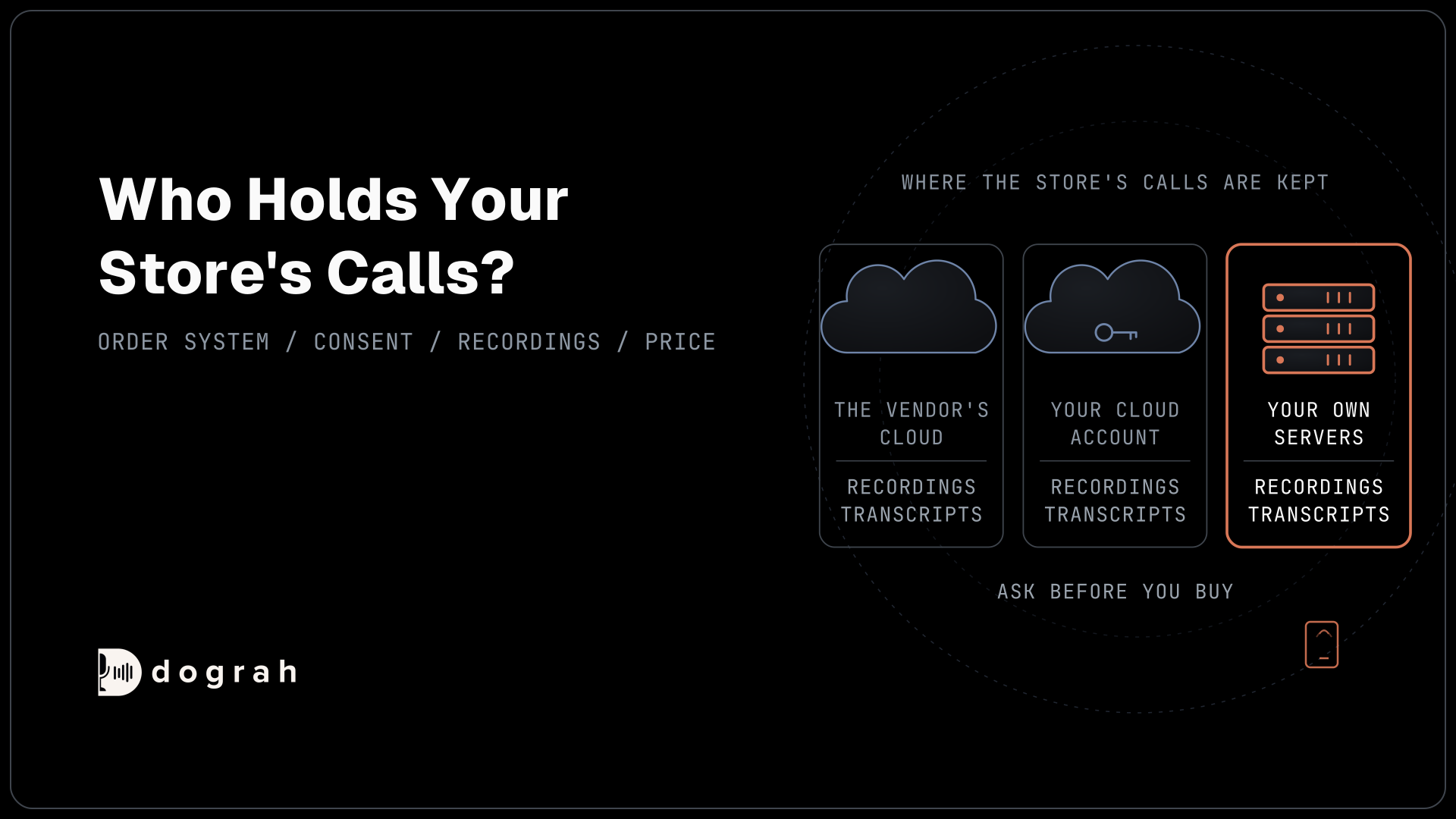
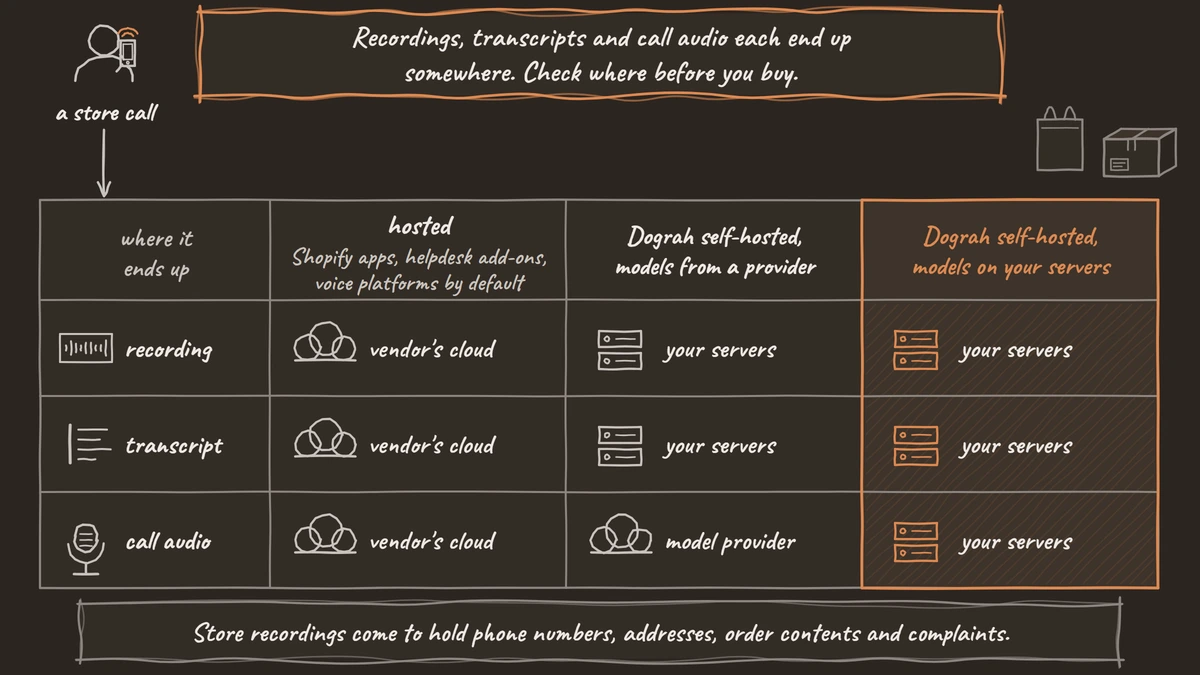
The third is who holds the recordings, transcripts and customer data: the vendor's cloud, your cloud account or your own servers.
The fourth is price and capacity in a peak week: what a minute or a seat costs at your volume, and what sits on top of it, plus how many calls run at once and what the next caller hears. Adobe Analytics counted 25 days above $4 billion in US online spending between 1 November and 31 December 2025, and support calls rise with sales.
Inbound comes before outbound for most stores. Invoca, which sells call-tracking software, found in its DTC eCommerce Lead Conversion Benchmarks Report 2026 that only 53% of calls to direct-to-consumer brands were answered by a person, and that 34% of answered calls were leads. Answering the phone well is the first job.
How the eleven products compare
The table groups the products by kind, then shows where each runs, how it reaches store data and its list price.
| Product | Kind | Where calls run | Store data during the call | Price on its own site |
|---|---|---|---|---|
| Dograh | Open source (BSD 2-Clause), self-hostable | Your own servers, or Dograh Cloud; your Twilio, Vonage, Plivo or Telnyx account, or your SIP trunk through Dograh Managed SIP | Shopify or your own APIs, read and written through HTTP API tools; no built-in Shopify connector | Self-hosted: no per-minute platform fee. Dograh Cloud: 1¢/min platform fee, 10 concurrent calls included |
| Consio | Shopify app | Vendor-hosted | Live order, product and stock context, per its Shopify listing | $30/month for 100 minutes, $60 for 400, $120 for 1,000; $0.10 per extra minute |
| Gorgias Voice | Helpdesk add-on | Vendor-hosted | Inside a Shopify-focused helpdesk | Voice priced by call and text volume; AI Agent $0.90 per interaction (annual) or $1.00 (monthly) |
| JustCall | Phone system with AI agent | Vendor-hosted | 100+ CRM and data integrations, such as HubSpot, Salesforce and Zendesk | From $29 per user per month (annual, two users minimum); AI voice down to $0.15/min at volume |
| CloudTalk | Phone system with AI add-on | Vendor-hosted | Integrations include Salesforce, HubSpot and Zendesk | From €19 per user per month (annual); AI Voice Agent add-on from €99 a month for 200 minutes |
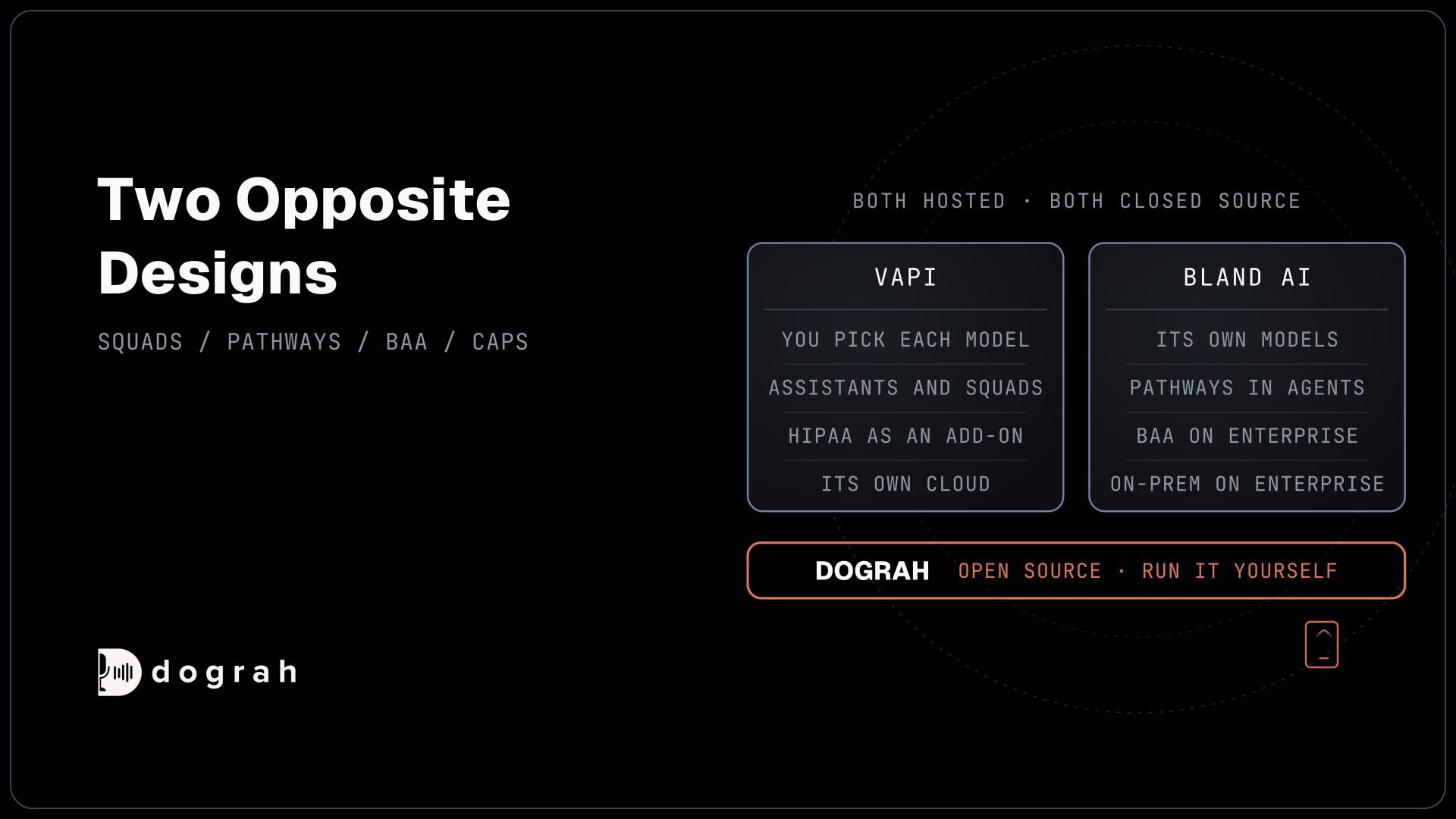
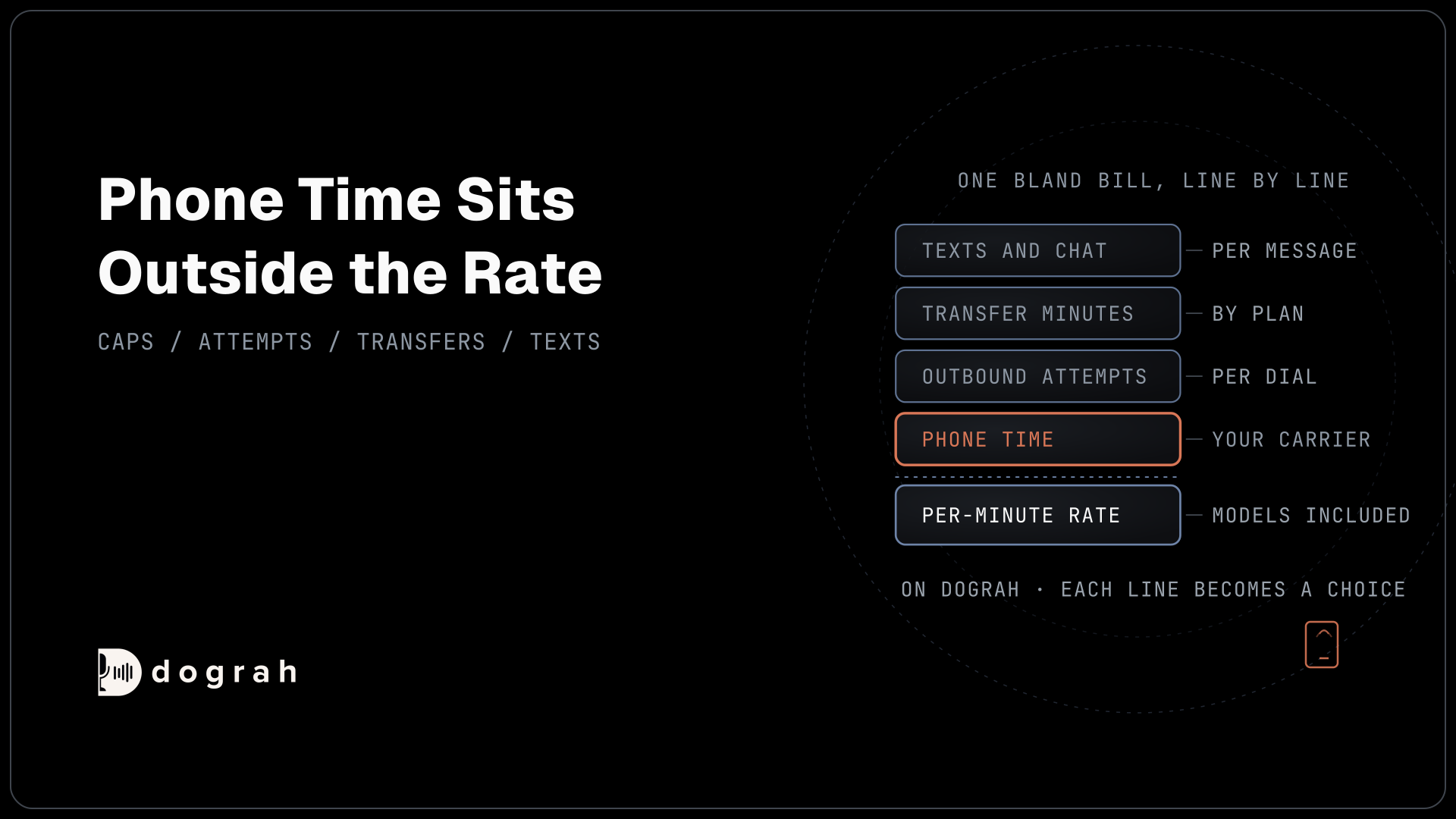
| Vapi | Voice platform | Vendor's platform | Your APIs, through tools you configure | $0.05/min hosting, before models and phone; 4, 10 or 30 concurrent calls by plan |
| Retell AI | Voice platform | Vendor cloud; dedicated server as an Enterprise add-on | Your APIs, through functions you configure | $0.07 to $0.31/min for AI voice agents; 20 concurrent calls free, then $8 each a month |
| Bland AI | Voice platform | Vendor's infrastructure; on-prem or VPC on Enterprise | Your APIs, through tools you configure | Start: $0.14/min, 10 concurrent calls. Build: $299/month plus $0.12/min, 50 concurrent calls |
| Synthflow | Voice platform | Synthflow Native Telephony, SIP trunking or approved enterprise telephony | Integrations scoped into the Enterprise contract | Enterprise contracts from $30,000 a year |
| Voiceflow | Voice and chat agent builder | Hosted on Voiceflow | Shopify and HubSpot among its listed integrations | Ask Voiceflow for a quote |
| PolyAI | Enterprise voice platform and a model-only API | Vendor-hosted; your own carrier over SIP at no charge | Through its Agentic Dialog Platform; the API plan excludes telephony and orchestration | API: 2¢ per connected minute; 10 concurrent calls once a card is added |
Dograh, the open-source option
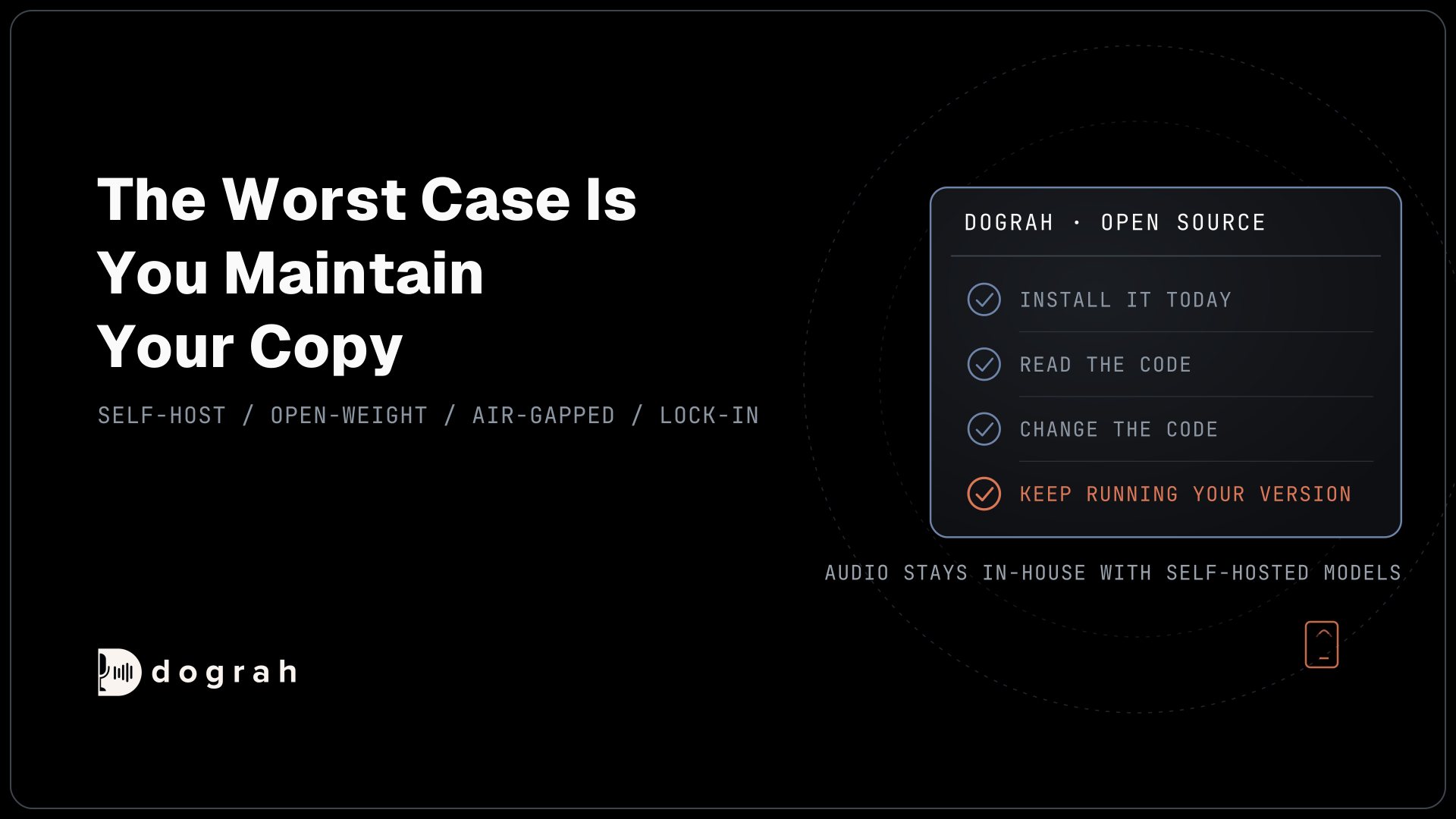
Against the four questions above, Dograh's case is plain. It reads and writes your order system during the call through HTTP API tools, starts outbound calls from your own system so consent stays in your records, keeps recordings and transcripts on your own servers when self-hosted, and publishes both its price and its concurrency limit. None of that needs a sales contract.
Dograh is released under the BSD 2-Clause licence on GitHub. It is the orchestration layer: it runs the call flow, tools and telephony, and the speech and language models are a separate layer you choose, whether Dograh's own models, any provider with your own key, or open-weight models on your own servers. It runs on the phone setup a store already has: Twilio, Vonage, Plivo, Telnyx and more, or your own SIP trunk or PBX on Dograh Cloud through Dograh Managed SIP.
For the order, Pre-Call Data Fetch sends the caller's number to your endpoint as the call connects; have it return a short order summary rather than the full order list. An HTTP API tool calls Shopify's API, directly or through n8n, to read an order or log a return during the call, and the flow puts the verification step in its own node before the agent reads out any address or order detail. Outbound calls start from your system through the API Trigger or from a campaign.
The words that must not vary are fixed. Greeting Text speaks the store's name and a recording notice word for word as the call connects, and a Pre-Transfer Message or Transition Speech tells the caller what happens next before a transfer to your team. With self-hosting, recordings and transcripts sit on your servers, and the audio stays there too when the models also run on them.
Capacity is stated in plain terms. Self-hosted Dograh runs 10 concurrent calls by default, raised with DEFAULT_ORG_CONCURRENCY_LIMIT, and your servers and carrier set the real ceiling. Dograh Cloud Pay as you go includes 10, with more by contacting Dograh. Once the limit is full, the next inbound call is rejected at once, with no queue, so set the limit for your sale-week peak and add an overflow at your carrier. Self-hosted Dograh has no per-minute platform fee (servers, model keys and phone minutes still cost); Dograh Cloud has a 1¢-a-minute platform fee.
The limits are worth stating. There is no built-in Shopify or helpdesk connector, so someone has to point HTTP API tools at your store; our tutorial on how to build a voice agent for e-commerce shows that work for a returns agent. Dograh keeps no do-not-call list, so opt-outs live in your own system. Transfer Call works on Twilio only and passes no summary, so write the order details to your helpdesk before the transfer. A Shopify app is live in an afternoon; a Dograh agent takes a build.
Join the Dograh Community
Dograh is an OSS alternative to Vapi. Join our Slack community for queries, releases, best practices & community interactions.
Shopify apps and helpdesk add-ons
These are the quickest to switch on for a store that already runs on Shopify. Consio installs from the Shopify App Store, answers with live order, product and stock context according to its listing, and has an outbound agent that calls Shopify and Klaviyo segments and texts a checkout link during the call. That outbound agent is a sales caller, so the store needs its own written-consent records before the first cart call; AI voice agents for abandoned-cart recovery explains what those records hold.
Gorgias is a helpdesk built around Shopify brands, and Voice is an add-on to any plan. Its pricing page prices Voice by call and text volume and lists AI Agent interactions at $0.90 each on annual plans. Both products keep calls and transcripts in the vendor's cloud. For a small store, that trade is often fine.
Phone systems with an AI agent
JustCall and CloudTalk sell a business phone system first, priced per user, with an AI agent on top. That suits a store with a support team already on the phones, because the AI agent and the people share one system and one set of numbers.
The cost shape changes in peak weeks. Per-seat pricing stays flat while the AI minutes climb: JustCall's AI voice falls to $0.15 a minute at volume, with the first 100 minutes free, and CloudTalk's AI Voice Agent add-on starts at €99 a month for 200 minutes. A shared phone system makes the handover from the AI agent to a person simple, and that is often the best reason to choose one.

Open Source Alternative to Vapi / Retell
Self-hosted voice agent platform — no per-minute fees
dograh-hq/dograh
Star on GitHub
Voice platforms you build on
Vapi, Retell AI, Bland AI, Synthflow and Voiceflow are platforms where the store, or its developer, builds the agent and connects it to the order system. Vapi, Retell AI and Bland AI price by the minute.
Vapi charges $0.05 a minute for hosting before any model or phone cost, with 4, 10 or 30 concurrent calls depending on the plan and extra lines at $10 a month each; our breakdown of Vapi pricing covers the rest of the bill. Retell AI lists $0.07 to $0.31 a minute for its voice agents and includes 20 concurrent calls free. Bland AI charges $0.14 a minute with 10 concurrent calls on Start, or $299 a month plus $0.12 a minute with 50 on Build, and offers on-prem or VPC deployment on Enterprise; Bland AI alternatives compares the options around it.
Synthflow sells one plan, Enterprise, with contracts from $30,000 a year scoped around call volume, concurrency, telephony setup and integrations. Voiceflow builds voice and chat agents hosted on Voiceflow, and quotes its business plan through sales. PolyAI sells a managed enterprise platform and a model-only API at 2¢ per connected minute; telephony and orchestration come with the platform, not the API.
These platforms run the call in the vendor's cloud by default. For a store, that holds until the recordings start holding phone numbers, addresses, order contents and complaints, and the legal team asks where they live.
Questions to ask in every demo
A demo call on a quiet line tells you little. Ask each vendor to show these on your own order data, whichever kind of product it is.
Ask the agent to find an order from a caller's number, then try to get it to read out the address before you have given the order number or postcode. A phone number finds an order; it does not prove who is calling, and a good setup refuses until the caller passes a check.
Ask how a card payment is handled. The right answer is that it never happens on the call: the store's own system sends a secure payment or checkout link by text or email. A spoken card number ends up in the recording and the transcript.
Ask to see a transfer to a person, and what that person sees when they pick up. If nothing is written to your helpdesk before the transfer, your team starts the conversation from zero.
Ask what happens on your busiest day: how many calls run at once on your plan, and what a caller hears when every line is busy. Then ask where recordings and transcripts are stored.
Which one fits your store
A store that wants its call data and its cost per minute under its own control should start with Dograh. It is the strongest fit for a store with a developer and high call volume, because it reads and writes the order system through HTTP API tools, runs on the store's own phone account, states its concurrency limit, and has no per-minute platform fee when self-hosted.
A small Shopify store that wants answers this month will get there fastest with a Shopify app or its helpdesk's voice add-on. A store with a phone team already in place may prefer a phone system with an AI agent, with the peak-week minutes priced in. A larger store that wants launch support under an enterprise contract will look at Synthflow or PolyAI's platform.
Whatever you choose, keep two rules out of the vendor's hands: no card numbers taken by voice, and no outbound sales call without a consent record in your own system.
To try Dograh, self-host it from GitHub with Docker Compose, or start on Dograh Cloud at a 1¢-a-minute platform fee, and point one test number at an agent that looks up a real order.
Glossary
- Concurrent calls
- How many calls an account can run at the same moment. Several vendors include a set number, such as 10 on Dograh Cloud or 20 free on Retell AI, and charge or require contact for more.
- Per-seat pricing
- A price per user per month, common for business phone systems. It stays flat in a busy week, while any per-minute AI charge on top rises with call volume.
- Self-hosting
- Running the voice agent platform on servers the store controls. With Dograh, recordings and transcripts then stay on those servers, and the audio does too when the speech and language models run there.
- HTTP API tool
- A Dograh tool that calls an outside API during the call, such as Shopify's or a store's own service, and returns the answer to the agent. It is how Dograh reads and writes the order system.