
AI voice agents for reference-check calls phone a candidate's referees only after the applicant tracking system records the candidate's written authorisation. The agent names the agency, says the call is automated and recorded, asks the recruiter's fixed questions and records each answer as the referee stated it. It never rates the reference; a recruiter reads the answers.
Key Takeaways
- The candidate's written authorisation in the ATS is what starts the call.
- The referee agrees to an automated call before the agent dials them.
- Answers are recorded as stated. The agent never rates a reference.
This post is part of our guide to AI voice agents for staffing and recruitment. The guide's section on calls after the interview sets the ground rules: a different person is on the line, and the candidate's written authorisation must be on file first. Here is how to build that call with Dograh, an open-source, self-hostable voice agent platform, from the trigger to the record it leaves in your applicant tracking system (ATS).
Start the call only when the authorisation is on file
A reference call the agent cannot place by mistake is the safest kind, so the permission check sits in your ATS before Dograh is involved at all.
Most of the work is the references that slip through. Bright Horizons asks for two to four professional references for each caregiver it hires, and about 15% were not completed through its background-check vendor, according to figures its voice agent vendor Phenom published in April 2026. An agent can work that remainder at hours when referees pick up.
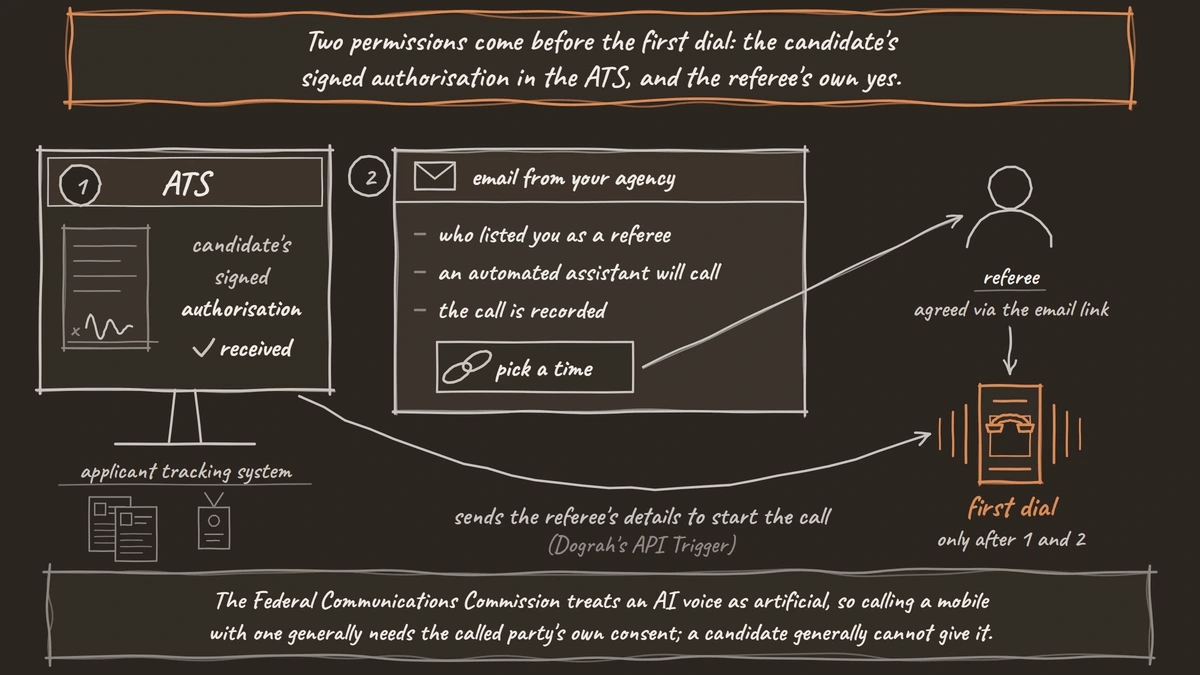
Make the candidate's signed authorisation the trigger. When the ATS marks the authorisation received, it sends each referee to Dograh's API Trigger with the referee's name, the relationship the candidate gave, the candidate's name and the agency name. No authorisation means no request, so the agent never decides whether it may call. API Triggers: Start a Voice Agent Call From Any System shows the request.
The referee must agree too, because the candidate's signature does not cover them. Under 47 CFR 64.1200, a call to a mobile number using "an artificial or prerecorded voice" generally needs "the prior express consent of the called party", and the Federal Communications Commission treats an AI voice as artificial. A candidate generally cannot give that consent for someone else. So the first contact comes from your own system as an email: who listed them, that an automated assistant will call, that the call is recorded, and a link to pick a time or a number to call. The agent calls only referees who said yes. An inbound reference line avoids the question entirely, because the referee dials you. Confirm your own consent wording with counsel.
What the referee hears, in order
The opening is fixed text, and the candidate's name waits until the right person is on the line.
If you want to tell referees they're speaking with an automated assistant, or your location requires it by law, write it in the Greeting Text along with the agency's name in the Start Call node, which is spoken word for word: "Hello, this is an automated assistant calling from Northside Staffing. This call is recorded." It names the agency and never the client employer, whose name is part of the candidate's application. Only fixed text guarantees wording, as Prompt and Flow Design Patterns for Reliable Voice Agents explains.
Next, the agent asks for the referee by name. That finds the right person, but it does not prove who answered, so the agent says nothing about the candidate until the person confirms they are the one named. The check is lighter than on a candidate screening call, because the referee hears only one personal detail: that the candidate listed them. Then it names the candidate and asks how the two worked together, in the referee's own words. If that does not match the relationship on file, the agent records both versions and carries on. What the mismatch means is the recruiter's call.
Before the first question, the agent checks the time suits and offers a callback from a person. Some US states require every party's consent to record a confidential call, which is why the recording notice comes first. Dograh can switch recording off only server-wide, not per agent, so a referee who objects to recording gets a callback request written to the ATS through an HTTP API tool. A wrong person ends the call with nothing said.

Open Source Alternative to Vapi / Retell
Self-hosted voice agent platform — no per-minute fees
dograh-hq/dograh
Star on GitHub
Fixed questions, recorded as the referee said them
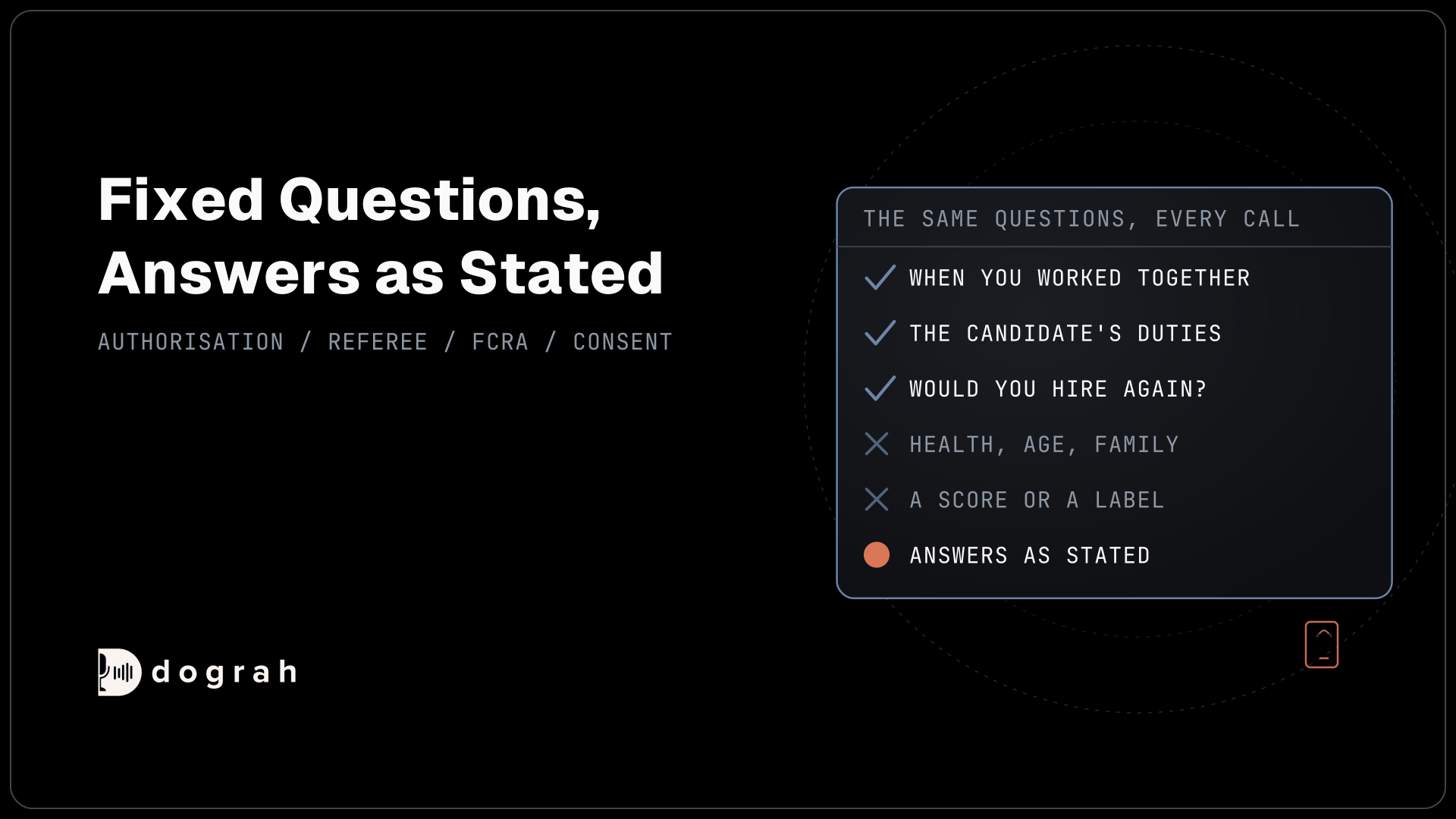
The recruiter writes the questions, and the agent asks the same ones in the same order on every call.
A typical set covers when the referee and the candidate worked together and in which roles, the candidate's main duties, whether the referee would hire or work with them again, and one example of reliability, such as how a missed shift was handled. When an answer is very short, the agent may ask one follow-up: "Can you give me an example?" A referee who declines a question is not pushed. "Declined to answer" is recorded as the answer.
The agent never asks about health, disability, age, family plans, religion or any other protected characteristic. If a referee volunteers such details, the agent moves on without a follow-up. The agency reviews the question set.
Each answer lands in its own extraction variable. Extraction is an AI step, so the variable holds the answer as the referee stated it, and the transcript and recording stay the exact record. "I would not rehire her" is stored in those words. The agent adds no score and no label of any kind. A recruiter reads the answers and decides what they mean.
For a quality signal, a QA node samples calls and tags each step, for example whether the agent stayed on its questions or asked something off the list. Automated QA for Voice Agents covers how to read those tags. They grade the agent, never the referee.
When the Fair Credit Reporting Act applies
Who places the reference call can change the legal duties, so settle this before the first call. This section is general information, not legal advice.
The Fair Credit Reporting Act (FCRA) names reference interviews directly. Under 15 U.S.C. 1681a, an investigative consumer report is a consumer report "in which information on a consumer's character, general reputation, personal characteristics, or mode of living is obtained through personal interviews with neighbors, friends, or associates of the consumer reported on or with others with whom he is acquainted". Consumer reports come from a consumer reporting agency, defined as a person that "regularly engages in whole or in part in the practice of assembling or evaluating consumer credit information or other information on consumers for the purpose of furnishing consumer reports to third parties".
So the question is who is asking, and for whom. An employer calling its own applicant's referees is generally not furnishing a report to anyone. A screening company that interviews references for an employer generally is. A staffing agency that interviews referees and sends the results to a client employer can sit closer to the second case, so check your agency's position with counsel.
Where the FCRA applies, the paperwork comes before the call. The FTC's guidance for employers says the disclosure "must be in writing and in a stand-alone format", and the employer must "Get written permission from the applicant or employee." For an investigative report, 15 U.S.C. 1681d adds a written disclosure "not later than three days after the date on which the report was first requested", which also tells the candidate they may ask about the scope of the investigation. Before any adverse action, the candidate gets "a notice that includes a copy of the consumer report you relied on to make your decision".
Generally, these steps belong in the trigger logic: the ATS holds the disclosure and authorisation before it sends any referee to Dograh. State laws can add their own rules, so confirm your own position with counsel.
Join the Dograh Community
Dograh is an OSS alternative to Vapi. Join our Slack community for queries, releases, best practices & community interactions.
What the call leaves in the ATS
Each call ends with the referee's answers and two links in the candidate's record, and nothing more.
A webhook after the call sends the answers, the recording and transcript links, the relationship as the referee described it and the outcome, such as completed, declined, wrong person or callback requested. A temporary failure is retried automatically, up to five attempts. A referee who asks to speak with a recruiter can be put through with Transfer Call, which works on Twilio only and passes no summary, so the agent writes the details to the ATS first.
Campaigns retry unanswered calls (up to 10 retries, 2 by default), or the ATS sends the referee again. Campaigns have no per-person call cap, so set the limit in your list; two attempts is plenty for someone doing a favour. A referee who asks not to be called again is written back at once.
Self-hosting Dograh keeps recordings and transcripts on the agency's own servers, and the audio stays inside your infrastructure only when the speech and language models run there too. Dograh has no retention setting, so your own policy decides how long records are kept. Self-hosted Dograh has no per-minute platform fee (servers, model keys and phone minutes still cost); Dograh Cloud has a 1¢-a-minute platform fee.
Start with an inbound reference line that referees call after the email, and read the first week of transcripts with your recruiters before the agent dials anyone.
Glossary
- Investigative consumer report
- Under 15 U.S.C. 1681a(e), a consumer report built from personal interviews with people who know the person, about their character, reputation or way of life. Reference interviews gathered by a third party for an employer can fall here.
- Consumer reporting agency
- Under the FCRA, a person that regularly assembles or evaluates information on consumers to furnish consumer reports to third parties. Whether a staffing agency counts depends on what it does with referee answers, so check with counsel.
- Trigger logic
- The rule in your own system that decides when a call starts. For reference calls, the ATS sends a referee to Dograh only after the candidate's written authorisation is recorded.
- Extraction variable
- A field the agent fills from the conversation, such as the answer to one reference question. Extraction is an AI step, so the transcript and recording remain the exact record.