
In AI call screening, software reads signals from an incoming call, such as caller ID, number reputation and the caller's first words, and decides what happens before anyone answers. It can block it, send it to voicemail, ask its purpose, put it through, or pass a routine request to a voice agent that finishes it or transfers to a person.
Key Takeaways
- Screening is a routing choice, so count the real callers it turns away.
- A synthetic-voice score should trigger a verification step, never end the call.
- Detectors that look reliable on clean audio slip on real phone lines.
You let an unknown number ring out, and later learn it was the pharmacy. We follow a screened call from signals to routing choice, then cover privacy and piloting, ending with how Dograh, the open-source AI voice agent platform we build, meets screeners on its own outbound calls.
What AI call screening decides on every call
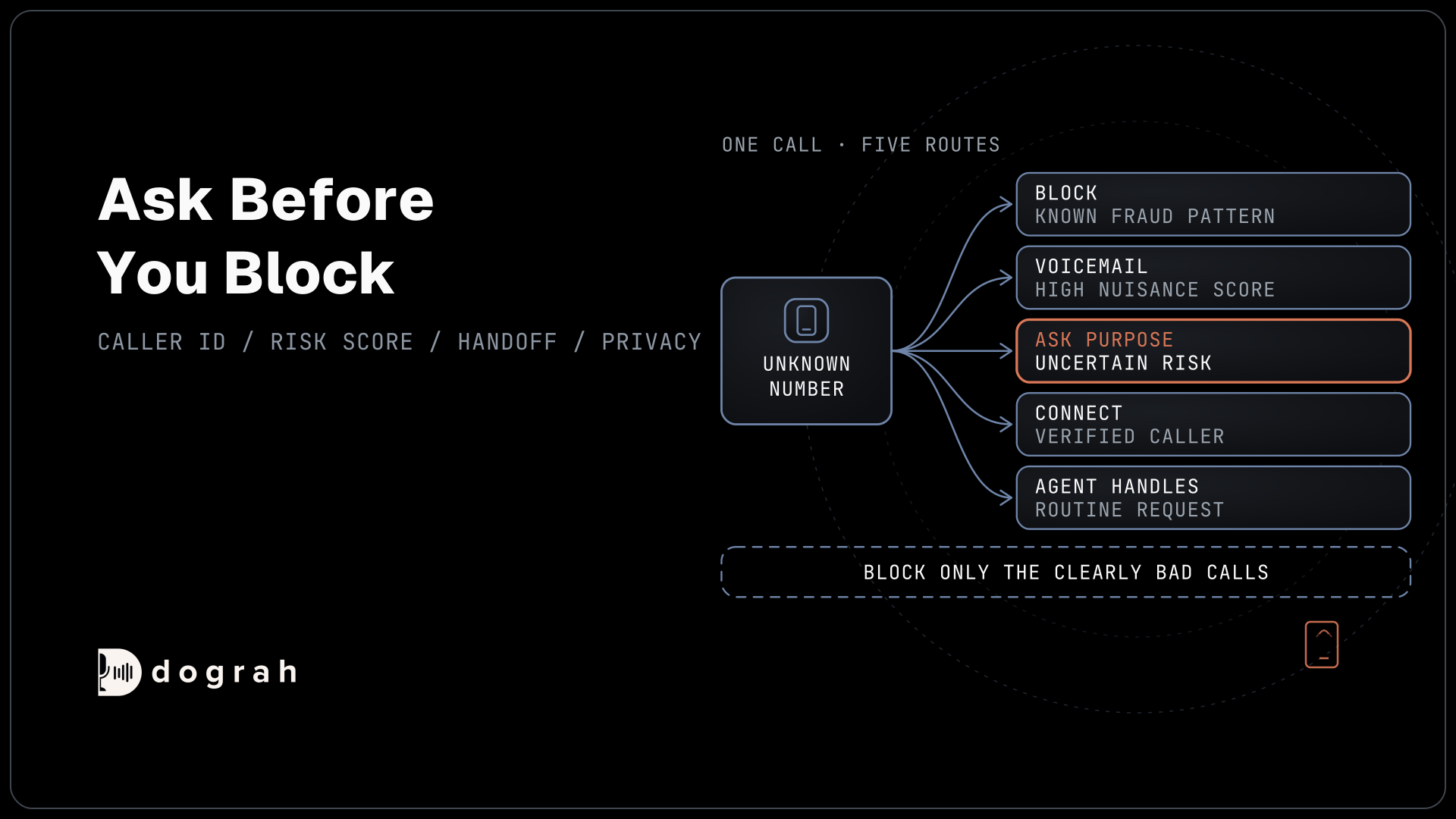
AI call screening reads signals from an incoming call and decides what happens in the second or two before the phone would ring. A Congressional Research Service report on the FCC's robocall work shows how blocking began. In November 2017 the Federal Communications Commission (FCC) let phone companies block calls from numbers that should never place calls, or that are invalid, unallocated or unused, and a June 2019 ruling let them offer call blocking by default. Modern screening adds caller reputation, calling patterns and stated intent, so it can treat two unknown numbers differently.
| Call signal | Screening result | What happens next |
|---|---|---|
| Known spam or fraud pattern | Block | Call never rings and the attempt is logged |
| Robocall with a high nuisance score | Send to voicemail | Caller can leave a message and the phone stays silent |
| Unknown number, uncertain risk | Screen and ask purpose | A short question is asked before the owner is connected |
| Saved contact or verified caller | Connect directly | Phone rings as normal |
| Routine request such as a booking or payment status | Agent handles | Agent completes the task or transfers to a person |
| Suspected voice spoofing or high-risk request | Step-up verification or human review | Caller confirms identity before the call connects |
For the step-up row, the mechanics of call transfer and human handoff matter more than the classifier's accuracy, since a suspicious call that reaches a trained person beats one that gets dropped.
How screening reads a caller's intent
Screening stacks evidence, quick signals first. Carrier attestation through STIR/SHAKEN, the caller ID signing standard US carriers use, makes a number harder to spoof. Reputation shows how often a number has been reported and whether it dials thousands of handsets an hour, and a retry three seconds after a hang-up looks like a dialer. The opening words count too, so a caller who mentions an appointment and then asks for a card number has contradicted themselves.
Last comes audio authenticity, a score for how likely the voice is synthetic, which should be one input among several and never a verdict. The VoiceWukong benchmark tested 12 deepfake voice detectors, and only AASIST2 kept its equal error rate under 20%, at 13.50%. A false positive blocks a customer who needed you and a false negative lets fraud through, so the score should start a verification step and leave the decision to it.
The signals combine into one risk score, with cut-offs set per language, accent, handset type and intent. Say a caller asks to change the bank account on file, the number doesn't match the record and the voice scores as possibly synthetic. Send a code to the number on record or bring in a person, because rejecting punishes a real customer with a cold and connecting hands an attacker the account. You should see each call's score and the inputs behind it, or you can't tune it.

Open Source Alternative to Vapi / Retell
Self-hosted voice agent platform — no per-minute fees
dograh-hq/dograh
Star on GitHub
Blocking unwanted calls without losing real ones
Blocking works best as triage, with only the clearly bad calls stopped. A study of automated voices in unwanted calls ran a voice honeypot on real US numbers and recorded 10,987 calls over 66 days. Of the calls whose opening its detector labelled synthetic, only 0.44% said they were automated, while about 17% announced that the call was recorded. A screener has to judge from signals, and a legitimate business's agent should name the business in its greeting.
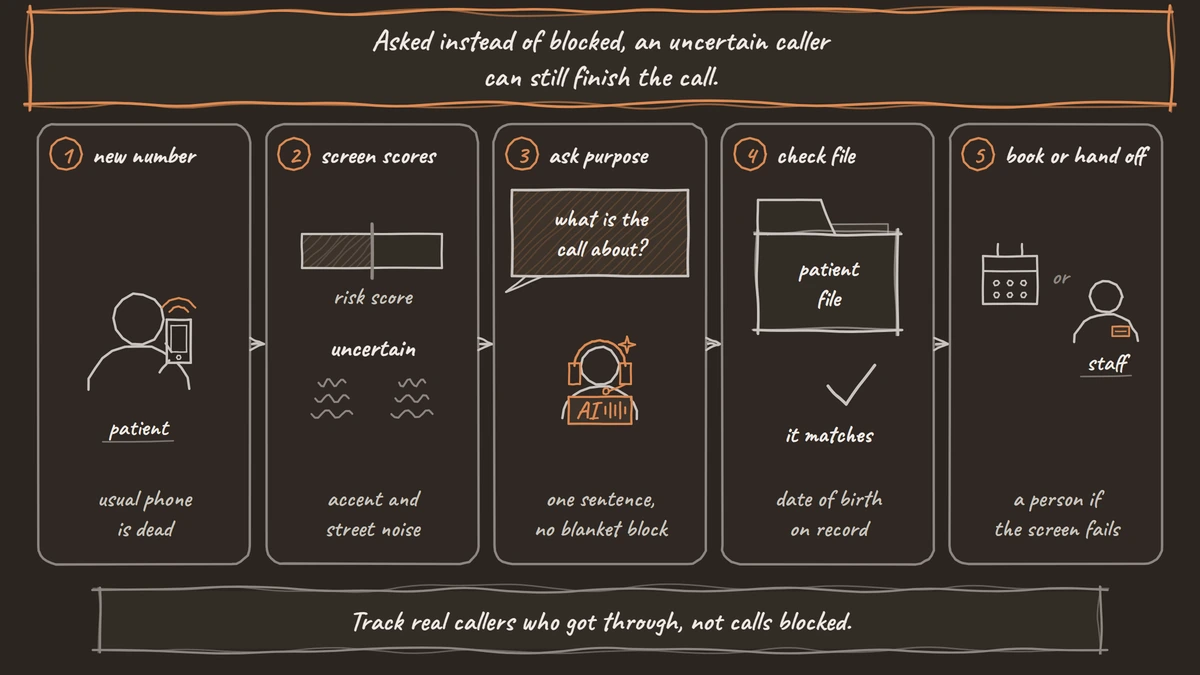
In the FCC report on call-blocking tools, Hiya's answer-rate data showed consumers seldom pick up calls marked as spam, and a TNS survey found most respondents wanted scam and fraud calls blocked automatically, with nuisance calls sent to voicemail. Uncertain callers, scammers and new customers alike, sit in between. Accents, speakerphones, hearing aids and international numbers make speech models stumble in ways that look like fraud, so give these callers a path they can finish, from a one-sentence purpose to an approved check or callback, and on to a person.
Then track the legitimate-contact rate (real callers who got through), the false-positive rate, the abandonment rate (callers who hung up during screening) and the resolution rate, broken down by language and country, since blocked-call volume says little.
Handling routine calls without a person picking up
Some calls need no judgment, such as a clinic booking against a live calendar or a logistics firm offering two delivery slots and writing the choice back to dispatch. Ask the purpose first, verify identity with an approved check such as a date of birth before reading anything sensitive back, and complete the task in the system of record. AI service desk automation from Vight follows the same idea, where the agent's value comes from closing the ticket.
When a request leaves the script, transfer in one step. In Dograh, the Transfer Call tool calls the destination first and connects the caller only when someone answers. If nobody answers within the timeout (30 seconds by default) or the line is busy, the agent gets a transfer_failed result and the caller stays with the agent. The prompt then decides the next step, such as writing a callback request into your system through an HTTP API tool so someone calls back the same business day.
Outbound reminders also need voicemail detection, or reports fill with failed calls that did deliver a message. Disputes, complaints and anything close to medical advice should go to a person even when the agent could answer.
Where screening runs and who can see the data
Before asking about accuracy, ask where transcripts, recordings and model inference run, how long each is kept and whether people review them. In its FCC proposal on AI and unwanted robocalls, the Commission said tools that analyse call content pose significant privacy risks, because application or device providers process very sensitive call content while already holding users' personal information. It asked whether they store it on the device or in the network, for how long, and whether they share it with third parties.
| Architecture | Where analysis runs | Who can access transcripts | Retention control | Best fit |
|---|---|---|---|---|
| Device-local | On the phone | Device owner, plus provider staff where its policy allows human review | Set on the device by the user | Personal use with no server processing |
| Carrier network | Inside the carrier's network | Carrier staff under its policies | Set by the carrier's own policy | Blocking and labelling at network scale |
| Cloud vendor | Vendor servers | Vendor, and people if its policy allows review | Set by vendor contract | Fast setup for small teams |
| Private or self-hosted | Customer's servers or cloud account | Customer's own team | Set by the customer | Healthcare, government and regulated firms |
A vendor cloud is quick to switch on, while a private deployment costs operational work and gives you back control. A voice AI data security review walks through what each setup leaves open. None is a compliance certificate on its own, so confirm your obligations with counsel.
Join the Dograh Community
Dograh is an OSS alternative to Vapi. Join our Slack community for queries, releases, best practices & community interactions.
Where screening fails on real phone lines
Many calls still arrive as narrowband 8 kHz audio compressed by codecs such as AMR-NB and G.711, plus packet loss and background noise that blur the cues classifiers rely on. The RealComm study recorded the same speech before and after real mobile calls and found that detectors degrade substantially after call transmission. Combining simulated audio augmentation with real-call training cut one detector's equal error rate from 37.94% to 22.37%.
So test at your line's codec settings with real recorded calls, and combine several speech windows before anything permanent, such as blocking a number. Calibrate per language, since one threshold penalises whichever accent the model saw least, and report latency next to error rates. Lighthouse Legal's piece on limits and human handoffs in screening shows why the handover point decides which errors you can accept.
How to pilot AI call screening safely
Before a screened call reaches a real customer, get a launch gate signed off. It maps every call type to its result, sends anything unmapped to a person, sets thresholds per language and includes a handoff path tested by failing the screen on purpose. If you choose to say callers are speaking with an automated assistant, or local law requires it, put that in the greeting with the business's name.
Then run one call type, such as appointment booking, in shadow mode, where the system logs what it would have done while your current process still answers. A structured voice AI pilot writes the stop-or-expand rule before the numbers arrive. Expand only when the legitimate-contact rate holds and the false-positive rate stays inside the agreed band for each language, and if either slips, fix the threshold or prompt and run the week again.
How Dograh meets screeners and hands off calls
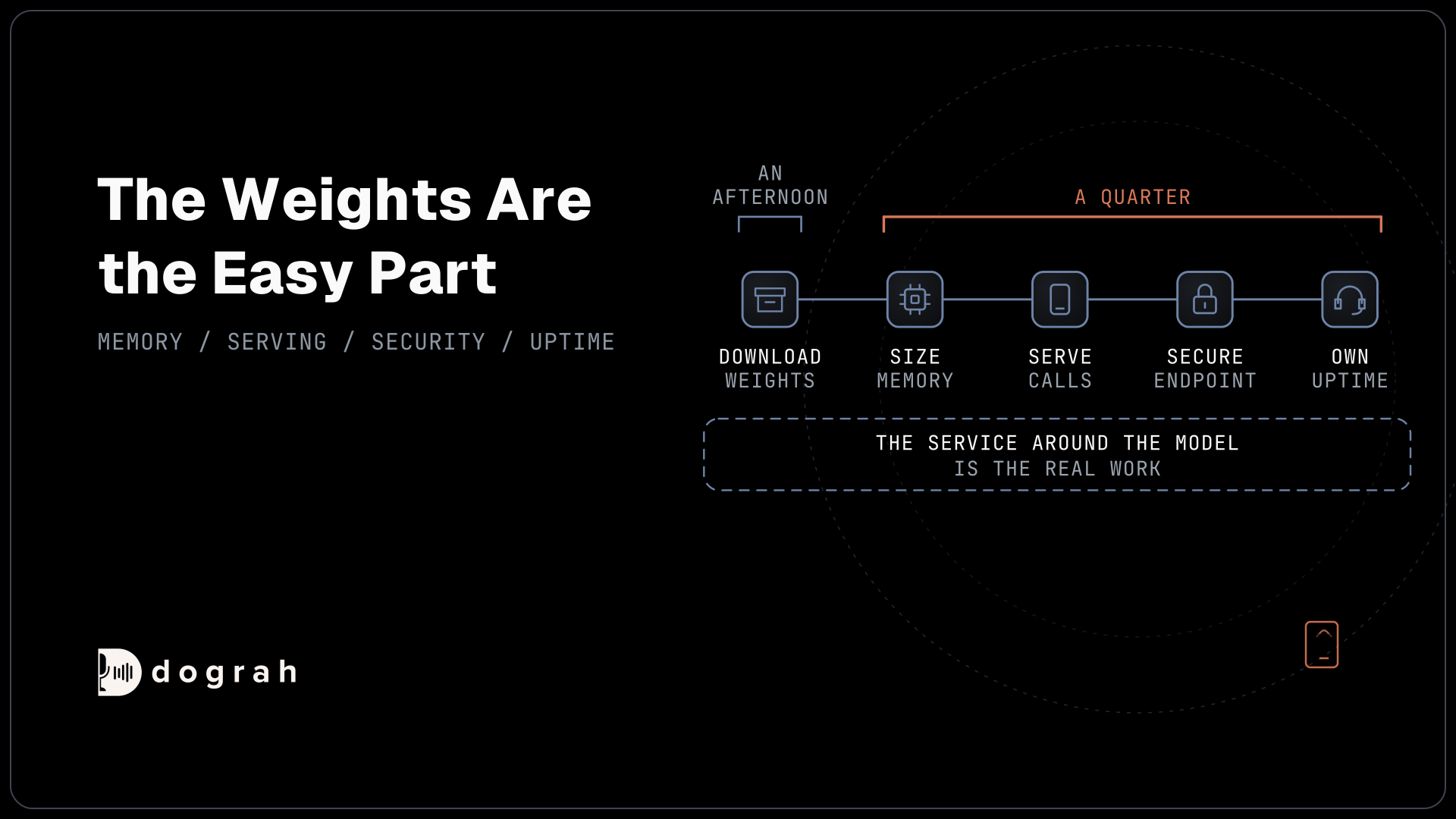
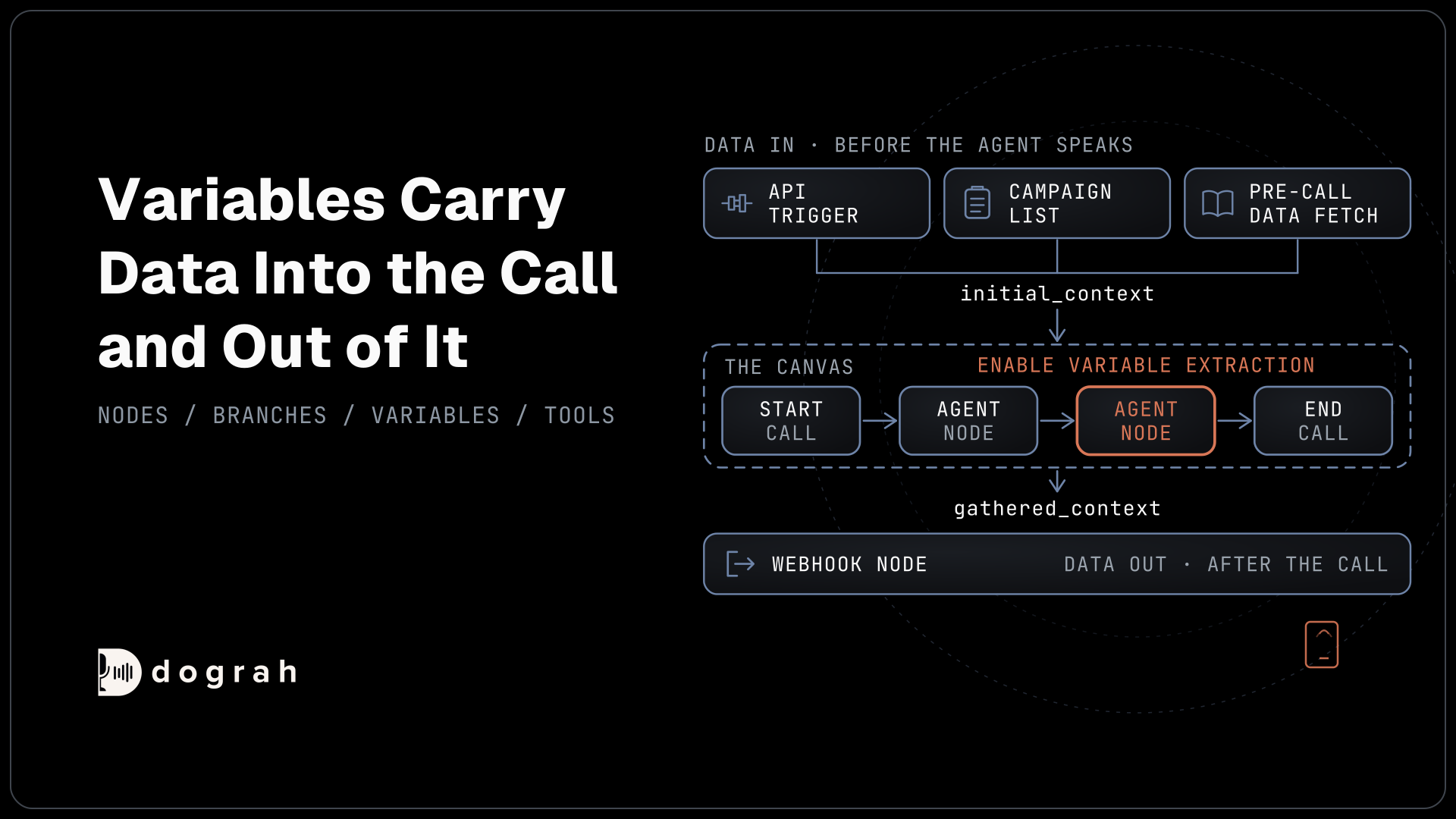
Dograh is the orchestration layer that runs a voice agent's call flow, tools and telephony, and screening reaches it from the other side too, since your agent's outbound reminders may be screened. Turning on Enable voicemail and screening handling in the agent's Settings lets the agent tell a person from a voicemail, a screening service or a phone menu. When it hears a screener, it plays your Screening message, typed text or a recording with the business name and reason for the call, then waits for the person. This works on outbound calls that use separate speech and language models.
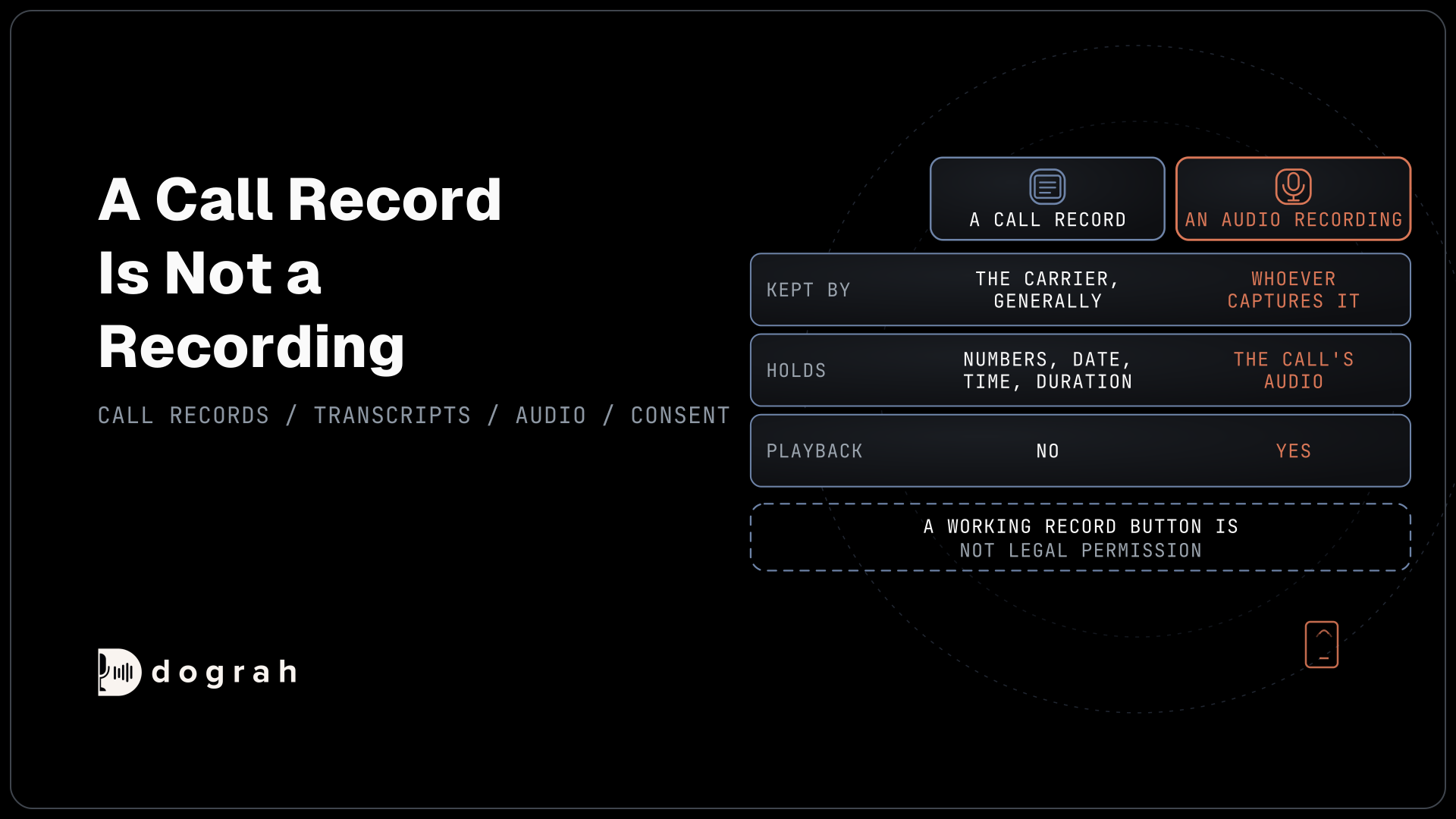
Once tracing is set up, View Trace shows the speech-to-text, AI and voice time for each turn, so a slow greeting or transfer sits beside your pilot's error rates.
The QA node scores each step of a finished call with its own tags, a 1-10 score and a summary. It runs on editor test calls and live calls alike, and its Sample Rate (%) setting picks a share of those calls at random, test calls included. That gives a second read on calls where the agent drifted off script.
Because the code is open under the BSD 2-Clause license, your security team can read how calls are handled before one goes out. You can run the platform on your own servers or let Dograh Cloud host it. When it is self-hosted, recordings and transcripts sit in storage you run, and if the speech and language models run inside your network too, the audio and model inference stay there as well. For patient calls, run it self-hosted with your own or local models and ask Dograh about compliance support on Enterprise. A model provider, a cloud host or a phone carrier that stores patient data may need its own business associate agreement (BAA), so confirm the setup with your counsel. Running the platform yourself carries no per-minute platform fee, while servers, model keys and phone minutes still cost money and your team looks after the database and upgrades. Support comes from the open-source community, with custom SLAs on Enterprise, and teams that would rather not host it can use the Cloud version, which runs it for a 1¢-a-minute platform fee.
Glossary
- Equal error rate
- The point where a detector's false-positive and false-negative rates are equal. A lower figure means fewer mistakes in both directions.
- STIR/SHAKEN
- The caller ID signing standard US carriers use, so the receiving network can check that the originating carrier vouched for the calling number.
- Step-up verification
- An extra identity check, such as a code sent to the number on record, asked for only when a call looks risky.
- Shadow mode
- A pilot setup where the system scores real calls and logs its decisions while the existing process still answers them.
Frequently Asked Questions
Built with Outrank tool