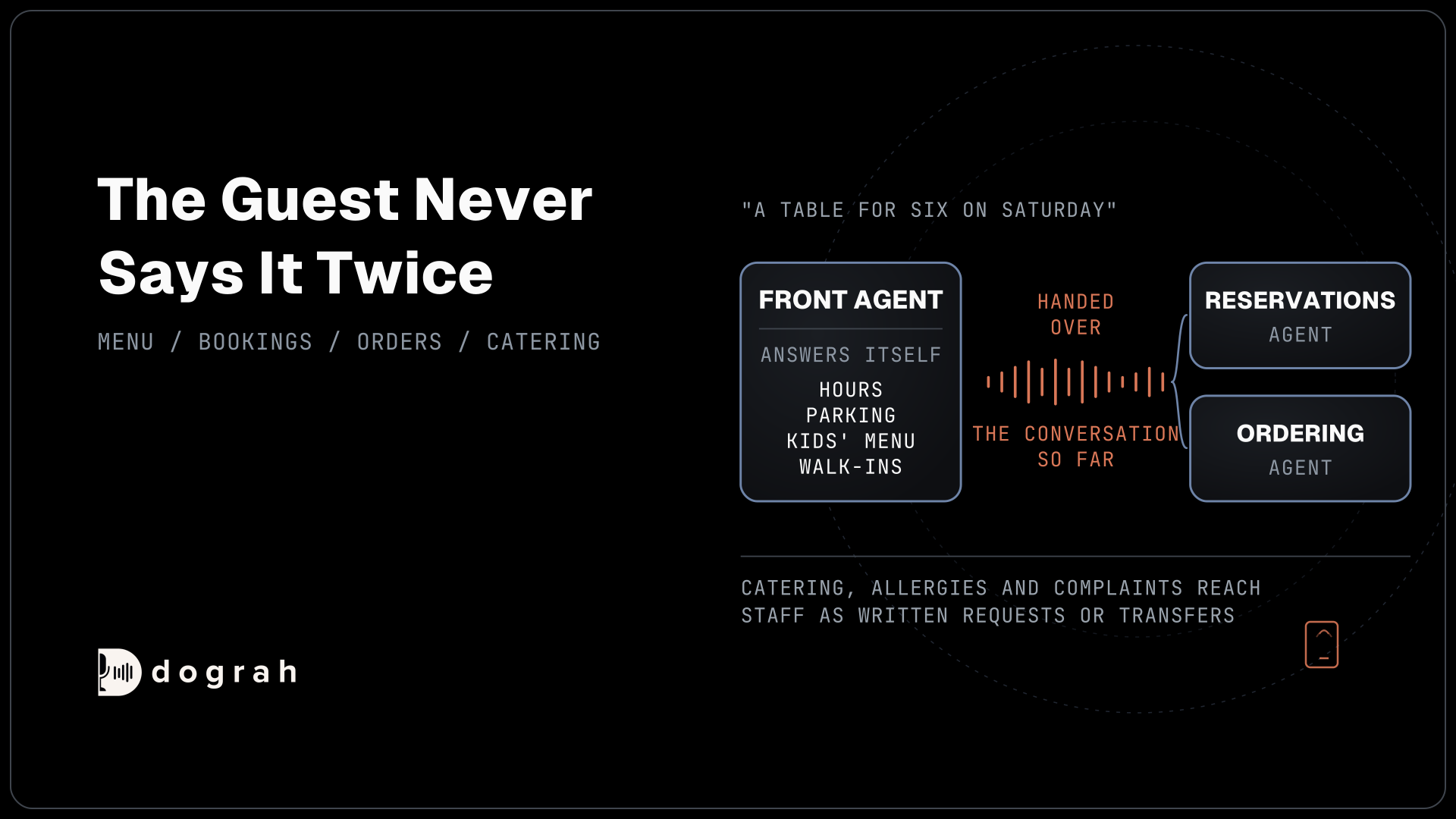

An AI answering service for restaurants picks up when staff can't, usually after a few rings or when every line is busy during service. It answers hours and menu questions itself, hands reservations and orders to the agents built for them, and passes catering, complaints and allergy questions to staff as written requests or transfers.
Key Takeaways
- Your phone system decides when the agent answers: rings, busy lines or set hours.
- One front agent sorts the call, then hands it on with the conversation so far.
- Catering, allergies and complaints reach staff as written requests or transfers.
This post is part of our guide to AI voice agents for restaurants, which hands over questions, then bookings, then orders. Below, we cover when the agent picks up and how it sorts each call, with each part shown in Dograh, the open-source AI voice agent platform we build.
The phone rings hardest during service
The phone rings most when the kitchen is busiest and the host is seating a table. Revmo's study of 12,091 restaurant calls, from a company that sells restaurant AI phone agents, found that 40% of calls to quick-service restaurants went unanswered, with miss rates higher at peak hours. Callers gave up after about 5.5 rings, and the average hold time for full-service callers was 73 seconds.
After closing is the easy case, because nobody is there and every call can go to the agent. The harder case is the Friday rush, when staff are in the building but can't reach the phone. A guest who wants a table for six hears the phone ring out and books somewhere else.
An answering service fixes that hour. It takes the calls staff can't pick up, deals with the simple ones on its own and moves the rest to the right place.
Your phone system decides when the agent answers
The restaurant's phone system decides when the agent picks up, and the agent answers whatever it sends. Most systems and carriers support conditional call forwarding, which forwards a call only when a condition is met. Three rules cover most restaurants. Ring the host stand first and forward to the agent after three or four rings. Forward at once when every line is busy. Send every call to the agent outside opening hours.
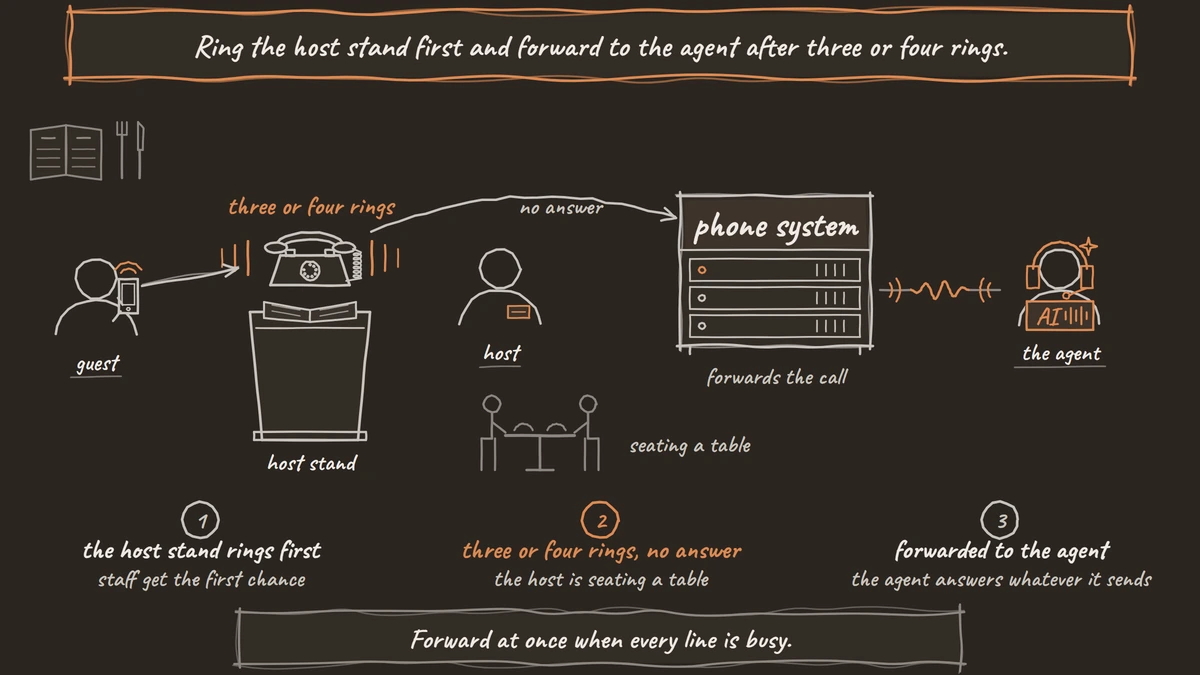
In Dograh, the agent's number has its Inbound workflow set to the answering agent, so a forwarded call reaches it straight away. A group with several locations can point every branch's number at the same agent. The number the guest dialled reaches Pre-Call Data Fetch, so the agent loads that branch's hours and menu as the call connects.
The rush has a ceiling too. The agent takes as many calls at once as your concurrency limit allows, and past it a new call is turned away. Our post on overflow call handling shows how to give those calls a second route.
One front agent sorts every call
One front agent answers every forwarded call and works out what the guest wants in the first turn. Simple questions it answers itself. Opening hours, parking, the kids' menu and whether you take walk-ins come from its Knowledge Base, so the menu sheet and FAQ you already have feed the answers. Specials that change daily are read live from the POS.
Reservations and orders go to agents built for them. Transfer to Agent moves the guest to the reservations agent or the ordering agent on the same call, with a labelled transcript of the conversation so far. Set the destination to "Continue the conversation" or "Introduce itself, then continue", and the guest who already said "a table for six on Saturday" never says it twice.
Each destination gets its own tool, named for where it goes, and the model chooses between them from their descriptions. Transfer to Agent runs on cascade agents, the speech-to-text, language model and voice setup most restaurants use. The full booking call is in AI voice agents for restaurant reservations, and the order call in AI voice agents for phone ordering.

Open Source Alternative to Vapi / Retell
Self-hosted voice agent platform — no per-minute fees
dograh-hq/dograh
Star on GitHub
What goes to staff in the middle of service
Some calls need a person, even mid-rush, and the agent's job is to get them there with the details written down. Catering and private events are worth more than any single table, so the agent collects the date, headcount and contact details, reads them back and sends them to the events team as a lead. AI voice agents for catering inquiries covers that lead in full.
Allergy questions and complaints go to the manager. The agent never says a dish is safe for an allergy. It writes a note to your system through an HTTP API tool, then uses Transfer Call on Twilio, Telnyx, Plivo, Cloudonix or Asterisk ARI. Dograh calls the manager first and connects the guest only when someone answers. On Twilio, it can play a short spoken introduction to both people. If nobody answers within 30 seconds, the default timeout, the guest stays with the agent, which takes a callback request.
"Tell the manager I left my jacket" only needs a message. The agent records the message as the guest said it, and a Webhook node sends it to the manager's inbox or your team chat after the call, with links to the transcript and recording.
WhatsApp calls and after closing
Guests who call your WhatsApp Business number can reach the same agent. Dograh answers WhatsApp voice calls through Meta's calling API, for inbound calls only. Transfer Call is not available on WhatsApp calls, so a request for staff there becomes a callback request written to your system.
After closing, the phone system sends every call to the agent. Hours and menu questions get the same answers, booking and ordering agents work as they do during service, and anything for staff waits as a callback request for the morning.
Join the Dograh Community
Dograh is an OSS alternative to Vapi. Join our Slack community for queries, releases, best practices & community interactions.
Running it without adding staff
The lines a guest hears most can be recorded by a real person. Dograh plays a pre-recorded clip when one fits, such as the greeting or "The team is with guests right now, I can help", and falls back to a text-to-speech voice for everything else. Every call keeps a full trace, so when a booking goes wrong you can see what the agent heard and which step it took.
Read a sample of calls each week. Dograh's built-in QA scores each step of the calls it samples, and a sample of 5 to 10% of live calls is enough to find where the front agent sorts calls wrongly.
You can run the agent on your own server or have it hosted for you. Self-hosted Dograh has no per-minute platform fee, but servers, model keys and phone minutes still cost money. Dograh Cloud charges a 1¢-a-minute platform fee. You bring your own keys for the speech and language models or run open models locally.
Start with one location and one rule: the agent answers after four rings during dinner service. Read a week of transcripts, then add the busy-line rule and the after-hours rule.
Glossary
- Conditional call forwarding
- A phone-system rule that forwards a call only when a condition is met, such as no answer after a set number of rings, every line busy, or outside opening hours. It decides when the agent picks up.
- Front agent
- The first agent a forwarded call reaches. It answers simple questions from its Knowledge Base and hands booking and order calls to the agents built for them.
- Transfer to Agent
- A Dograh tool that hands a live call to another Dograh agent with a labelled transcript of the conversation so far, so the guest does not repeat themselves. It runs on cascade agents.
- Callback request
- A note the agent writes to the restaurant's system when a guest needs a person who is not free, with the guest's number and reason, so staff call back after the rush.