
An AI answering service for plumbers picks up after hours and whenever every plumber is on a job. It checks burst pipes, no-water calls and sewage backups against your list, takes the message and promises only your callback window. For companies that want to own it, Dograh, the open-source AI voice agent platform, runs it self-hosted or on Dograh Cloud.
Key Takeaways
- Forward unanswered daytime calls to the agent as well as night calls.
- Your written emergency list decides which calls reach the on-call plumber.
- A Dograh agent promises only the callback window your company wrote down.
A plumber under a sink at 2 p.m. misses the same calls as one asleep at 2 a.m. We cover what a plumbing answering service does, daytime overflow, emergency triage, messages and callbacks. Then we talk about how the setup runs in Dograh, the open-source voice agent platform.
What a plumbing answering service does today
A human plumbing answering service picks up, takes a message and pages the on-call plumber when the caller says it is an emergency. It bills for operator time. Moneypenny's US live receptionist plans, for example, run from $165 a month for 50 minutes to $422 for 200 minutes, with extra minutes at $2.39 to $2.85 each depending on the plan.
Many calls never reach anyone at all. Invoca's home services benchmarks, drawn from calls tracked on its platform, found that 52% of callers to home services businesses speak with a person, with sub-industries ranging from 32% to 74%. When a caller does get through, 45% of leads convert on the call. Our post on what a missed call costs in the trades works through that loss with your own numbers.
An AI agent changes what happens after hello. A message service leaves the office a list of callbacks, while an agent can book a slot from your schedule or pass the call to a plumber before the caller gives up and rings the next company.
Some callers will still want a person, especially with water on the floor. In a survey of 6,000 consumers run by ServiceForge, a company that sells live answering, 85% said they prefer a real person when contacting a local service. So the agent keeps the on-call plumber one transfer away on every emergency, and any caller who asks for a person gets a callback with a stated time.
Overflow while the plumbers are on jobs
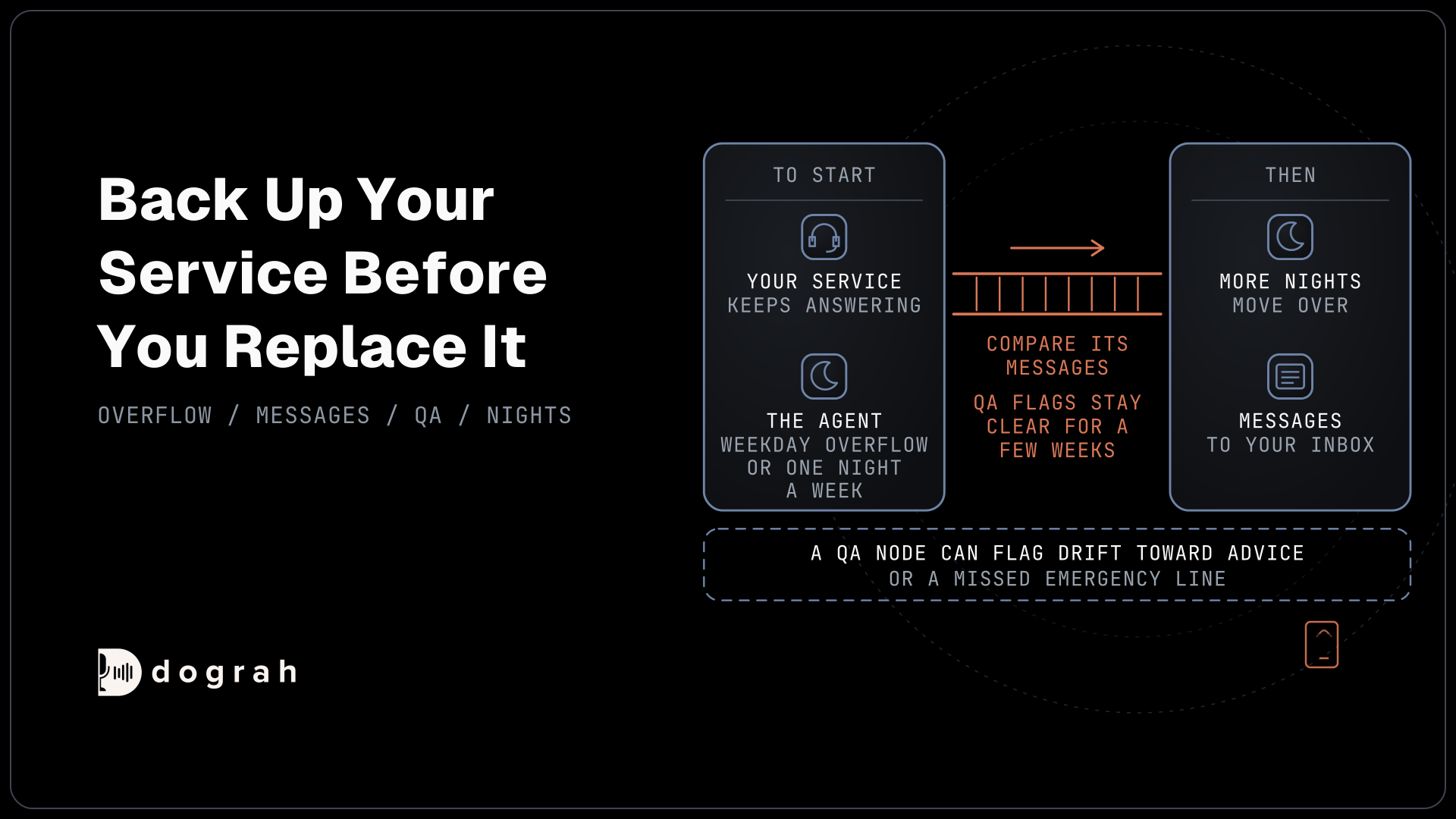
Daytime calls are lost as often as night calls, because a two-van company has nobody free when both plumbers are on jobs. The fix sits in your phone system. Keep the office line ringing first, and set it to forward a call to the agent's number when nobody answers within a few rings or the line is busy.
The same agent can act differently by the hour. Dograh fills in built-in time variables such as {{current_time_America/Chicago}} and {{current_weekday_America/Chicago}} in the prompt, so one prompt can say "during office hours, book the next open window" and "after 6 p.m., send emergencies to the on-call plumber and take a message for the rest".
Daytime overflow also changes what the caller expects. At 11 a.m. they assume they have reached the office, so the agent books against today's schedule and says plainly when the next window is, even if it is tomorrow. A cold snap can push many calls at once, and our post on an AI answering service for HVAC companies covers sizing the concurrent call limit for the busiest hour.
Burst pipes, no water and sewage backups
Each of these three calls turns on a question the owner writes. A burst pipe matters most while water is still running. No water matters most when it is the whole house rather than one tap, and a sewage backup matters most when it is coming up inside the home.
The agent asks those questions in the owner's words and checks the answers against the owner's written list. It never decides urgency on its own. A pipe that burst and has been shut off may wait for the first morning window, while one still pouring through a ceiling goes to the on-call plumber now. A caller whose problem is not on the list hears the next open window and that the office has the details.
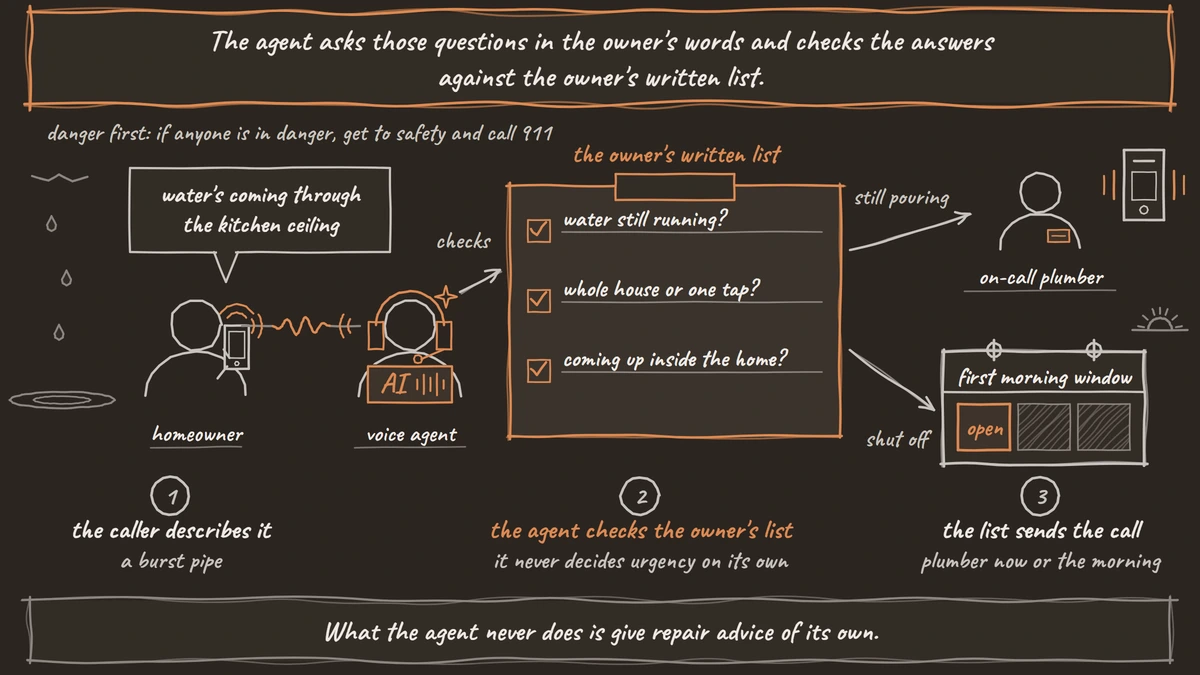
Danger comes before any of this. A caller with water near outlets or a panel hears a fixed line telling them that if anyone is in danger, get to safety and call 911. Gas smells, flooding near electrics and whether the agent may say where the main shut-off valve is are covered in AI voice agents for plumbing companies, along with the approved wording for each.
What the agent never does is give repair advice of its own. It does not guess at causes, suggest a fix or quote a price beyond your published list. Any advice past "the plumber is on the way" is your company's approved wording, set as fixed text.

Open Source Alternative to Vapi / Retell
Self-hosted voice agent platform — no per-minute fees
dograh-hq/dograh
Star on GitHub
A message the plumber can act on
Every call that does not end in a booking or a transfer ends in a message, and the plumber should be able to act on it in one read. For a plumbing company that means the caller's name, the address, the problem as the caller stated it, whether water is still running, how to get in and the best number to call. The agent reads the number back digit by digit, since a wrong digit loses the job.
After the call, a Webhook node sends those fields to your job system's API, whether you run Jobber, ServiceTitan, Housecall Pro or something else. Temporary failures are retried by themselves, up to 5 attempts, so a short outage at 3 a.m. does not lose a burst pipe. Each field is the agent's record of what the caller said, so the recording and transcript links travel with it as the exact version. Our post on the AI after-hours answering service covers the message format and who reads the queue first in the morning.
Callback promises the company can keep
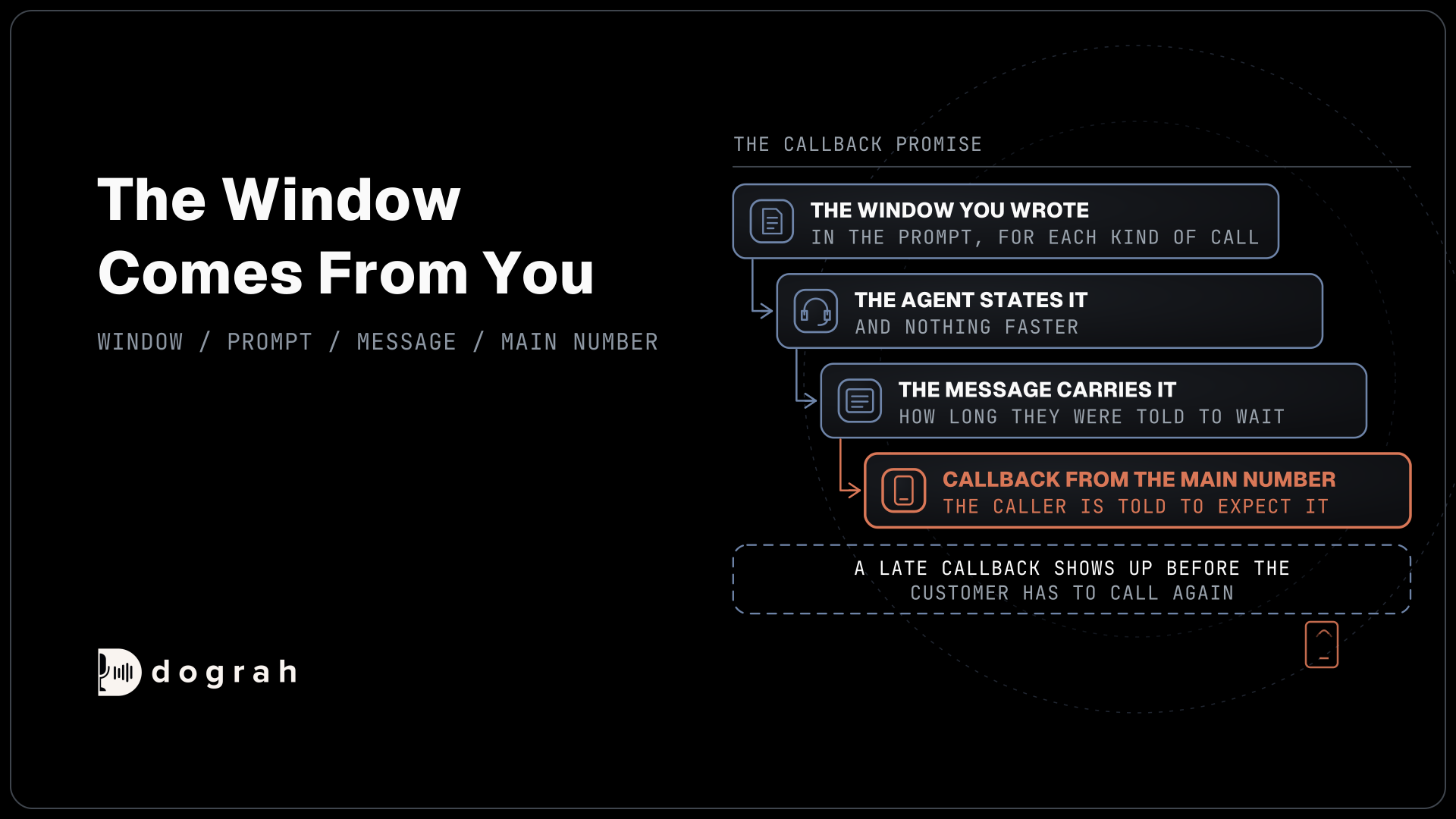
A callback promise is only worth what the company can deliver, so the window comes from you and never from the model. Write it in the prompt for each kind of call, such as "the on-call plumber calls you back within 20 minutes" for an emergency and "the office calls you after 8 a.m." for everything else. The agent states that window and nothing faster.
Say who will call and from which number. An overnight callback from a plumber's personal mobile often goes unanswered, because it looks like an unknown number, and our post on missed calls in the trades explains why. Call back from the company's main number, and have the agent tell the caller to expect it.
The promise also goes into the record. The message carries the window the agent stated, so the on-call plumber and the morning office can see how long the customer was told to wait, and a late callback shows up before the customer has to call again.
Join the Dograh Community
Dograh is an OSS alternative to Vapi. Join our Slack community for queries, releases, best practices & community interactions.
How this runs in Dograh
Emergencies on the owner's list end in Transfer Call, which works on Twilio, Telnyx, Plivo, Cloudonix and Asterisk ARI. Your on-call schedule changes through the week, so set the destination source to Dynamic HTTP Resolver and Dograh asks your system for tonight's number during the call. Dograh calls the destination first and connects the caller only when someone answers. No summary travels with the transfer by default, so the agent writes the address and whether water is still running to your job system through an HTTP API tool first.
If the on-call plumber does not answer within the 30-second default, the caller stays with the agent. The prompt then has it take a callback request with the promised window and page the plumber through an HTTP API tool. That tool's Messages play a short line as it starts, and an update if it runs long, so the caller is never left in silence.
Fixed words go where Dograh speaks them exactly as written, in the Greeting Text, a pathway's Transition Speech or a pre-recorded clip in the owner's own voice. Choosing a pathway is still the language model reading its written condition, so test it over a real phone with phrases like "water's coming through the kitchen ceiling". After launch, a QA node can review calls and flag any burst-pipe call that never reached the on-call path.
Where the agent runs is your choice. Hosting Dograh on your own machines removes the per-minute platform fee. You still cover the servers, the model keys and the phone minutes, and your team owns the database and every upgrade. For support you lean on the open-source community, or on custom SLAs with Enterprise. Dograh Cloud is the other route, running the agent for you for a 1¢-a-minute platform fee. Either way the agent takes 10 concurrent calls by default, a limit you can raise.
Glossary
- Overflow forwarding
- A phone system rule that sends a call to another number when nobody answers within a set number of rings or the line is busy. Here it sends unanswered daytime calls to the agent.
- Time variable
- A built-in value such as the current time or weekday in a chosen time zone, filled into the prompt so one agent can book by day and triage at night.
- Transition Speech
- Typed text or a recording that plays exactly as written when the call enters a pathway. Approved safety wording lives here so it never changes between calls.
- Callback window
- The time the agent promises a caller will hear back, such as within 20 minutes. It is written by the company in the prompt, never chosen by the model.