
An AI answering service for insurance agencies covers the front desk. It routes calls by line of business, takes quote requests for licensed producers and sends after-hours claims to the carrier. It never advises on coverage or binds. For agencies that want to own it, Dograh, the open-source AI voice agent platform, runs it self-hosted or on Dograh Cloud.
Key Takeaways
- Agencies want phone service, and accept self-service for documents, billing and claims.
- Quote requests are collected by the agent and priced by a licensed producer.
- A Dograh agent routes each call by line of business to the right person.
One hour at an agency front desk can bring a renewal question, a new auto quote and a fender bender. We cover the call mix, routing, quote requests, policy service and after-hours claims. Then we talk about how Dograh runs the routing, the transfers and the hosting.
What an agency's front desk handles
An independent agency's phone carries a different mix from an insurer's. The agency sells many carriers' policies, so one hour can bring a quote request for a home policy, a certificate of insurance for a contractor, a billing question that belongs to a carrier and a claim reported by a policyholder. Each call goes to a different place.
Agents still want those calls by phone. In the Big "I" 2026 Agency Universe Study, run by Zeldis Research with Future One across 1,376 respondents, 86% of agents said they want customer service to run through their agency by phone or other non-online methods. There are about 37,000 independent agencies, and 46% now use AI, up from 15% in 2024. Agencies were comfortable with self-service for policy documents, billing and claims, but not for buying policies or getting quotes.
That split is a good map for an answering service. The agent can finish document and billing requests and take a claim report, while a quote goes to a licensed person. Answering services price that work in different ways. Moneypenny's AI receptionist plans, for example, bill per call, starting at $99 a month for 50 calls, with 250 calls at $435, while a human receptionist bills by the minute.
Routing by line of business and account manager
The first job is routing, because a commercial client and a personal auto client rarely need the same person. The agent asks what the call is about in plain words and records the line of business, such as personal auto, home, commercial or life, as the caller describes it.
Existing clients usually want their own account manager. Pre-Call Data Fetch sends the caller's number to your agency management system as the call connects and loads the matching client record, including who manages the account. That lookup only finds a record, since anyone could be holding that phone.
So every call runs greet, verify, then disclose. The agent names no policy, premium or claim until the caller passes the check your agency uses, such as date of birth with the last digits of the policy number. A caller who fails the check still gets routed or leaves a message, with nothing read back.
Quote requests go to a licensed producer
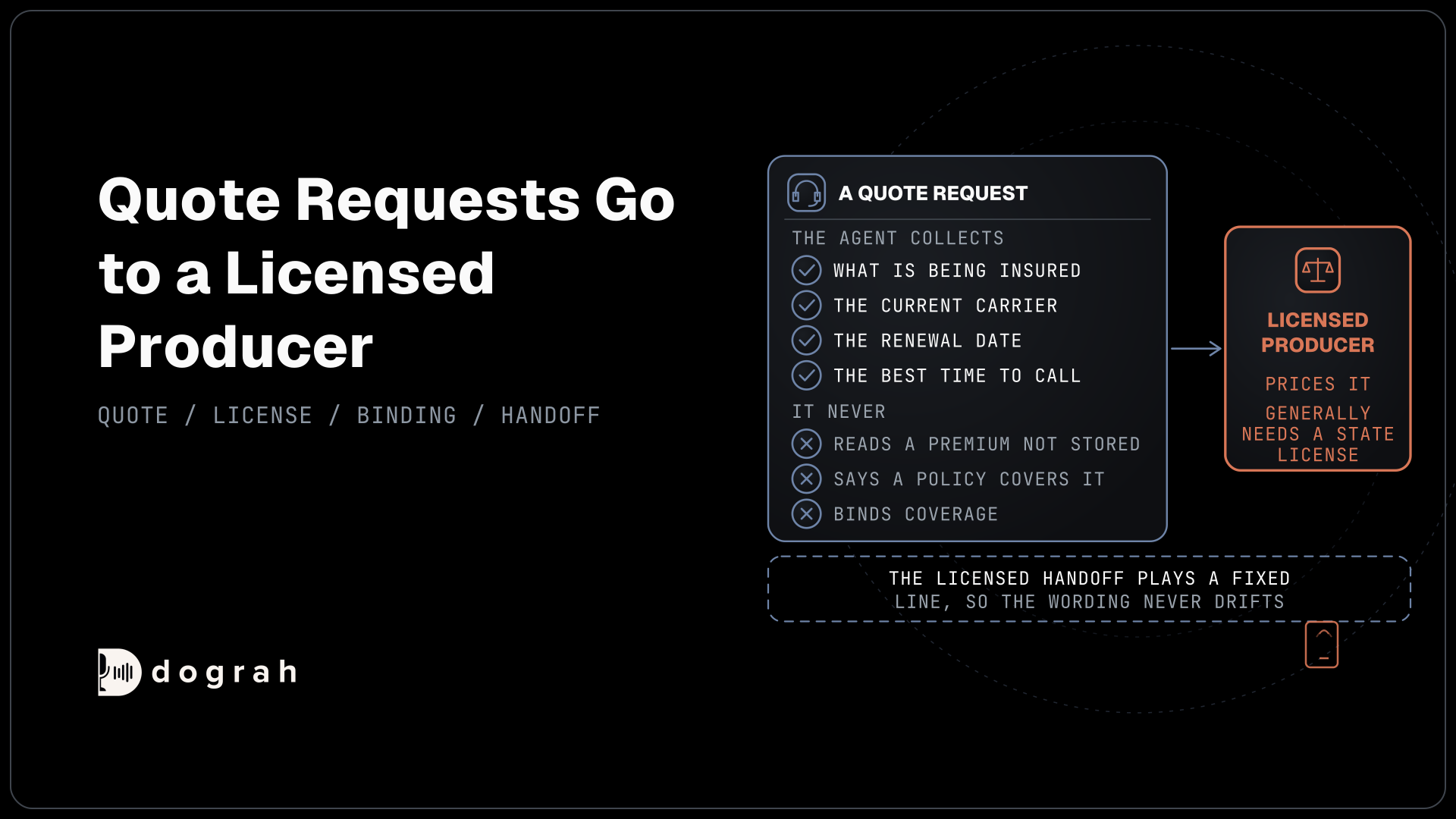
A quote request is where the license line matters most. The agent collects the facts a producer needs, such as what is being insured, the current carrier, the renewal date and the best time to call, and records each answer as the caller stated it. It never reads out a premium unless it comes from a stored carrier quote, and it never says whether a policy covers something. The outbound call after a quote goes out has its own consent rules, covered in AI voice agents for quote follow-up in insurance.
The NAIC Producer Licensing Model Act, which each state enacts in its own version, says a person may not sell, solicit or negotiate insurance without a license for that line. Unlicensed staff may do clerical work only indirectly related to a sale. Binding coverage is a licensed person's decision under the agency's carrier agreements, so the agent never binds and never says a policy is in force. Selling, advising on or binding a policy generally needs a state producer license, so confirm your own position with counsel.
AI voice agents for insurance covers both lines no policy call crosses, and AI voice agents for coverage questions shows where reading the policy stops and advice starts.

Open Source Alternative to Vapi / Retell
Self-hosted voice agent platform — no per-minute fees
dograh-hq/dograh
Star on GitHub
Policy service the agency can finish
Many service calls end on the call. A client needs an ID card, a contractor needs a certificate of insurance for a job site, or someone wants to know when a payment is due. Once the caller is verified, the agent can log the request in your agency management system through an HTTP API tool, and your system or the carrier sends the document.
Documents and payment links never pass through the call itself. An HTTP API tool asks your own system to send its secure link by email or text, and callers answer by voice. Billing questions often belong to a carrier, so the agent reads the right carrier's billing contact from your files or takes a message for the account manager.
Access to the agency management system is the step to check first. The Big "I" study names multiple carrier interfaces as agencies' biggest technology challenge, and an agent adds one more connection. Many systems open an API to partners, as HawkSoft's API partner program does, so ask your vendor what an outside tool may read and write before you build.
Claims reported after hours
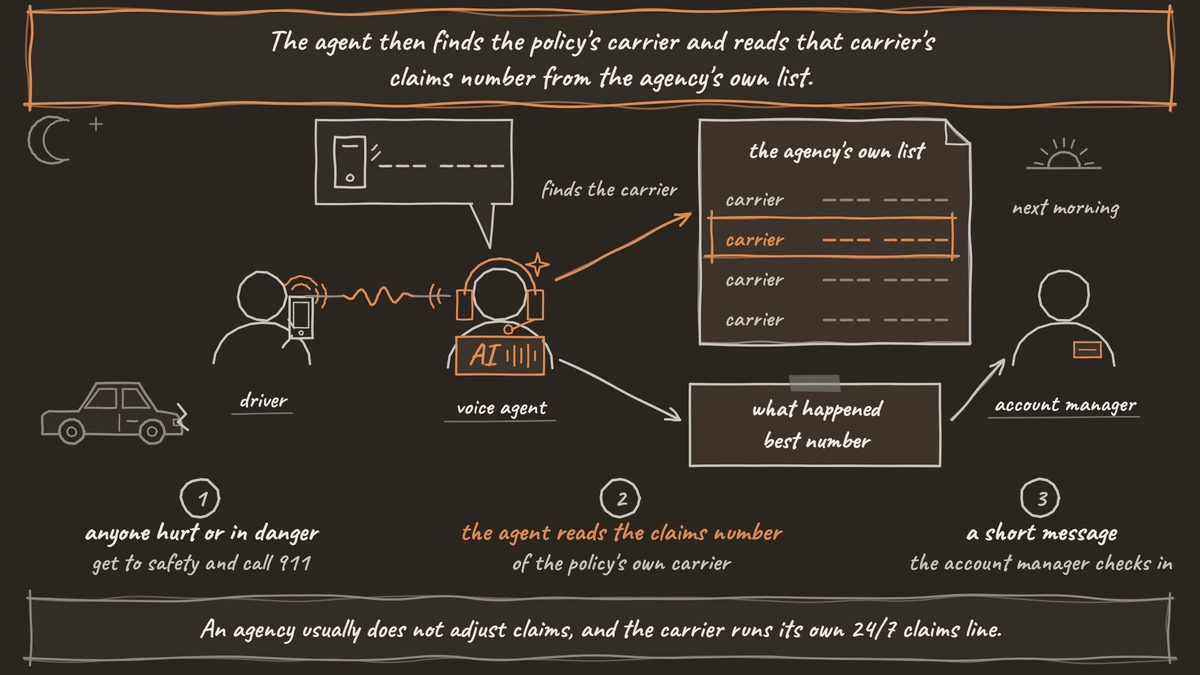
An agency usually does not adjust claims, and the carrier runs its own 24/7 claims line. So a policyholder who calls at 11 p.m. after a crash needs that carrier's number, quickly. Anyone hurt or in danger first hears a fixed line telling them to get to safety and call 911.
The agent then finds the policy's carrier and reads that carrier's claims number from the agency's own list. Store the list as a Knowledge Base file, one line per carrier, and update it whenever you appoint a new carrier. The agent also takes a short message, such as what happened and the best number, so the account manager can check in the next morning.
The claim report itself, with its sensitive details and recording questions, is the carrier's call. AI voice agents for FNOL intake covers that call for teams that take first notice of loss directly.
Join the Dograh Community
Dograh is an OSS alternative to Vapi. Join our Slack community for queries, releases, best practices & community interactions.
How this runs in Dograh
Handoffs to a licensed person end in Transfer Call, which works on Twilio, Telnyx, Plivo, Cloudonix and Asterisk ARI. Context Mapping reads the line of business the agent recorded and sends commercial calls to the commercial team and personal lines to the account manager, with a fallback number for anything unmatched. Dograh calls the destination first and connects the caller only when someone answers.
No summary travels with a transfer by default, so the agent writes the caller's details to your agency management system first. If nobody answers within the 30-second default, the caller stays with the agent, which takes a callback request through an HTTP API tool. That tool's Messages play a short line as it starts, and an update if it runs long.
The licensed handoff gets its own pathway with a fixed line, such as "That's a question for one of our licensed agents, so let me connect you," set as Transition Speech so the wording never drifts. A QA node with a custom prompt can review calls and flag any line that sounds like a coverage opinion, such as "you're covered".
Where client data lives decides the hosting. An agency that runs Dograh in its own environment pays no per-minute platform fee. The servers, model keys and phone minutes are still costs, and someone on your side keeps the database running and applies upgrades. Support on the open-source version comes from the community, and Enterprise adds custom SLAs. An agency that would rather not host anything can use Dograh Cloud, which runs it for a 1¢-a-minute platform fee.
Glossary
- Producer license
- The state license a person needs to sell, solicit or negotiate insurance for a line of business. The agent collects facts and hands licensed work to a licensed person.
- Binding authority
- The power to put coverage in force, granted to an agency by a carrier and used only by licensed staff. The agent never binds a policy.
- Agency management system (AMS)
- The software an agency runs its book on, with clients, policies and activity notes. The agent reads and writes it through the system's own API.
- Context Mapping
- A Transfer Call destination source that maps a value the agent gathered, such as line of business, to a number, with a fallback for anything unmatched.