
An AI answering service for garage door repair answers after hours with your urgency questions. A door stuck open at night or a car trapped inside goes to the on-call technician, with your fallback line if nobody answers. Dograh, the open-source AI voice agent platform you can self-host or use on Dograh Cloud, sends those calls to your on-call number.
Key Takeaways
- A broken spring gets a fixed "don't touch it" line, never repair advice.
- Your written urgency list decides who reaches the on-call technician tonight.
- Write the fallback line and a callback tool into the Dograh prompt.
Garage doors fail at awkward moments, with a car stuck inside before work or a door that won't close at midnight. The urgency questions come first, then the spring safety line, the technician's details and the handoff. How a Dograh agent handles a transfer nobody answers closes the post.
What a garage door answering service handles at night
After-hours calls to a garage door company are rarely casual. A door stuck open overnight leaves a home or a shop unsecured, and a car trapped behind a dead door means someone misses work. A human answering service takes a message and pages the technician, billed by the minute. PATLive's live answering plans, for example, run $189 a month for 100 minutes with extra minutes at $2.09, or $349 for 200 minutes at $1.99 each after that.
A message alone leaves the caller guessing until morning. An agent can ask the questions your technician would ask, write the job into your system and put the urgent calls through to a person. Routine calls, such as a noisy opener or a yearly tune-up, get a booked window instead.
The emergency call is also the wrong moment for a sales offer. A maintenance plan pitched to someone whose door just broke sounds like an upsell, so keep plan offers for a later call the customer agreed to. The agent's job on this call is the door.
The urgency questions your company writes
Urgency is your company's decision, written down as a short list, and the agent follows it. A typical list names a door stuck open at night on a home or a business as a security call. A car trapped inside that the caller needs before morning is a timing call, and a commercial door that won't close at closing time sits on the list too. A broken spring with the door down and closed may go to the first morning window, if your list says so.
The agent asks in plain words, such as "Is the door open or closed right now?" and "Is there a car inside that you need before morning?" For a spring it asks "Did you hear a loud bang, or can you see a gap in the spring above the door?" It also asks whether the door is at a home or a business.
The agent checks the answers against your list and never decides urgency on its own. A call on the list goes to the on-call technician. Anything else hears the next open window and that the office has the details. Our post on the AI answering service for plumbers shows how to word the callback promise so the company can keep it.
Springs and cables get a fixed safety line
Springs are the dangerous part of a garage door, so the agent's words about them never change. The Door and Access Systems Manufacturers Association's safety tips call springs "arguably the most important and most dangerous part" of the door, and say spring systems "should be repaired only by trained professionals". Cables get the same warning, to be replaced only by a trained technician.
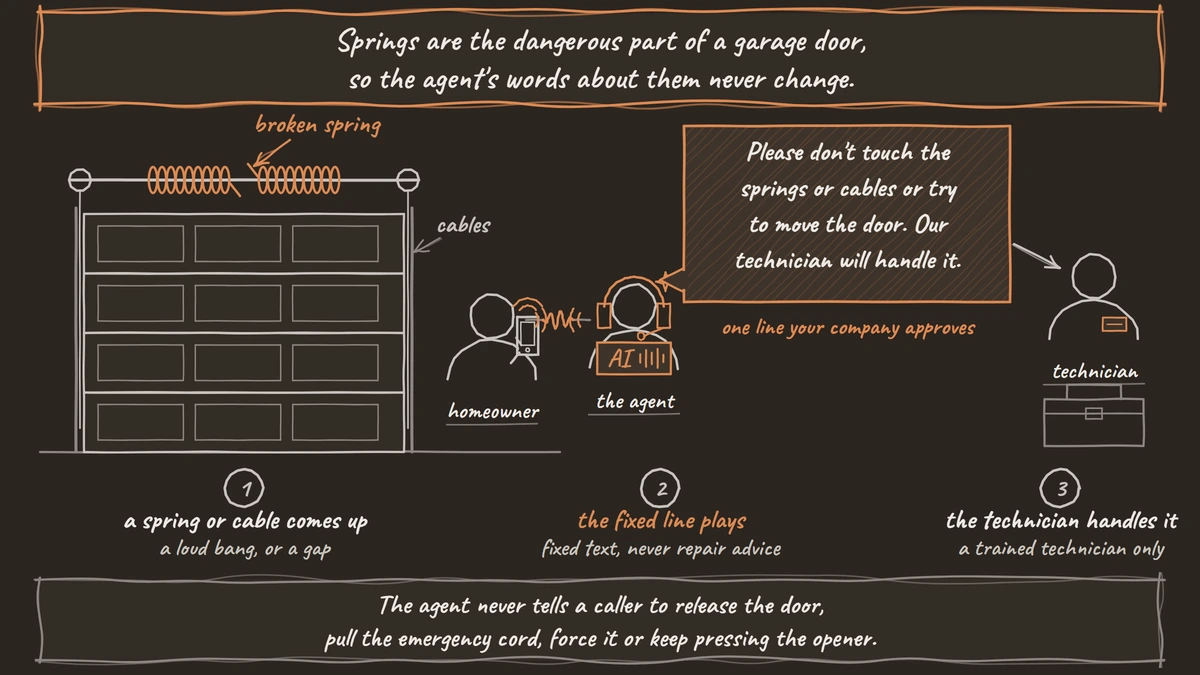
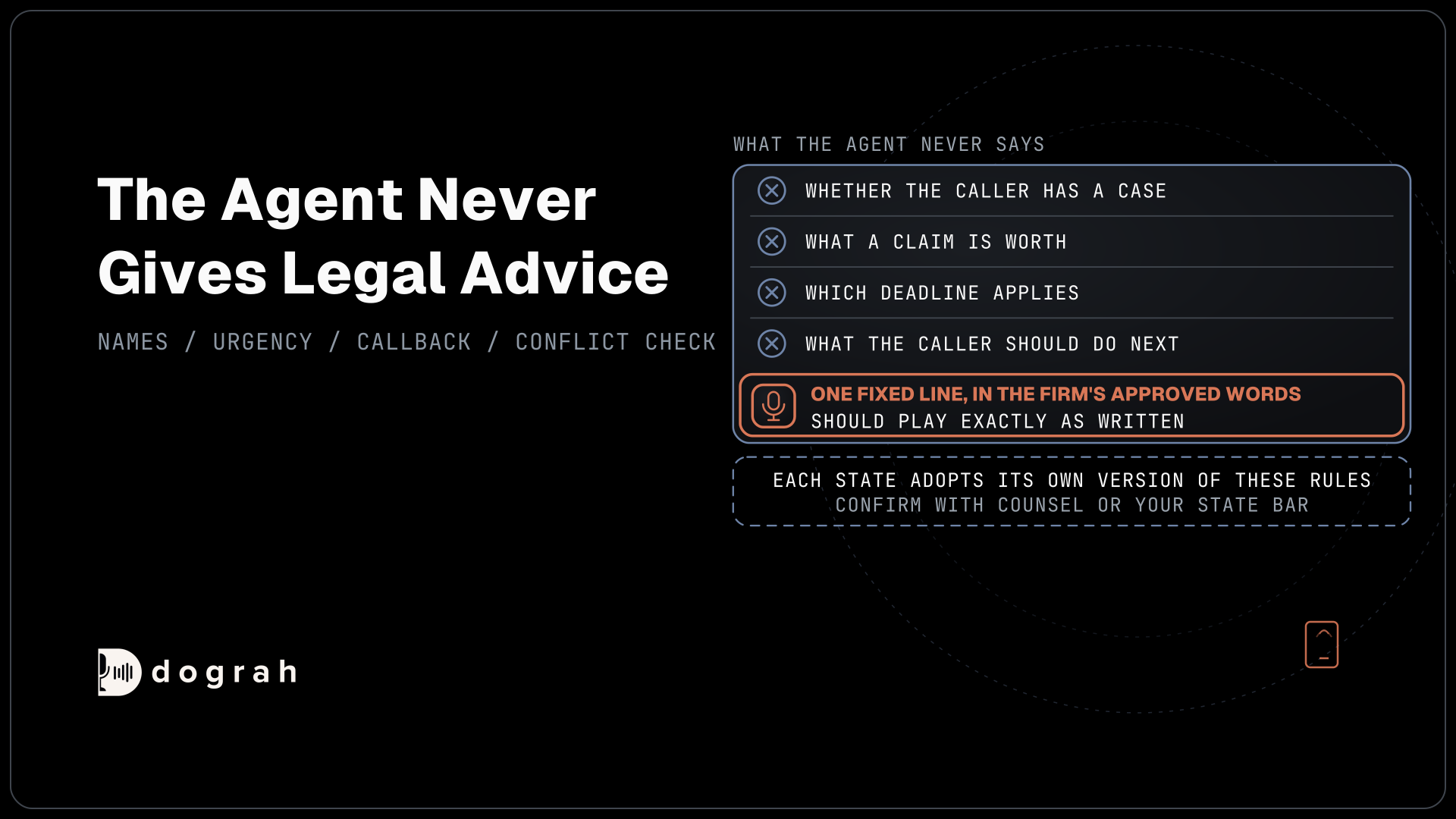
So any mention of a broken spring, a snapped cable, a door off its track or a door hanging crooked gets one line your company approves, "Please don't touch the springs or cables or try to move the door. Our technician will handle it." It plays as fixed text, so the wording is the same on every call. The agent never tells a caller to release the door, pull the emergency cord, force it or keep pressing the opener.
Danger comes before all of this. A person hurt by the door, or someone pinned or trapped, hears "If you're in danger, get to safety and call 911." The agent never tries to judge whether the scene is safe, and it moves to the address only after the line has played.

Open Source Alternative to Vapi / Retell
Self-hosted voice agent platform — no per-minute fees
dograh-hq/dograh
Star on GitHub
Details the technician needs before the call ends
The technician should be able to load the van from the message. That means the address, home or business, the door's state as the caller described it, whether a spring or cable is involved, the opener brand if the caller knows it and the best number to call. The agent reads the number back digit by digit, since one wrong digit loses the job.
The details go into your system before any transfer. An HTTP API tool posts them to your dispatch software. ServiceTitan and Jobber both use OAuth sign-in with tokens that expire, so a short script or an automation tool usually holds the sign-in and passes the job along. A transfer carries no written summary, and the optional spoken introduction, available on Twilio, is off by default, so this is how the technician sees the job before saying hello. Each field is the agent's record of what the caller said, so the call recording stays the exact version.
The handoff and the fallback line
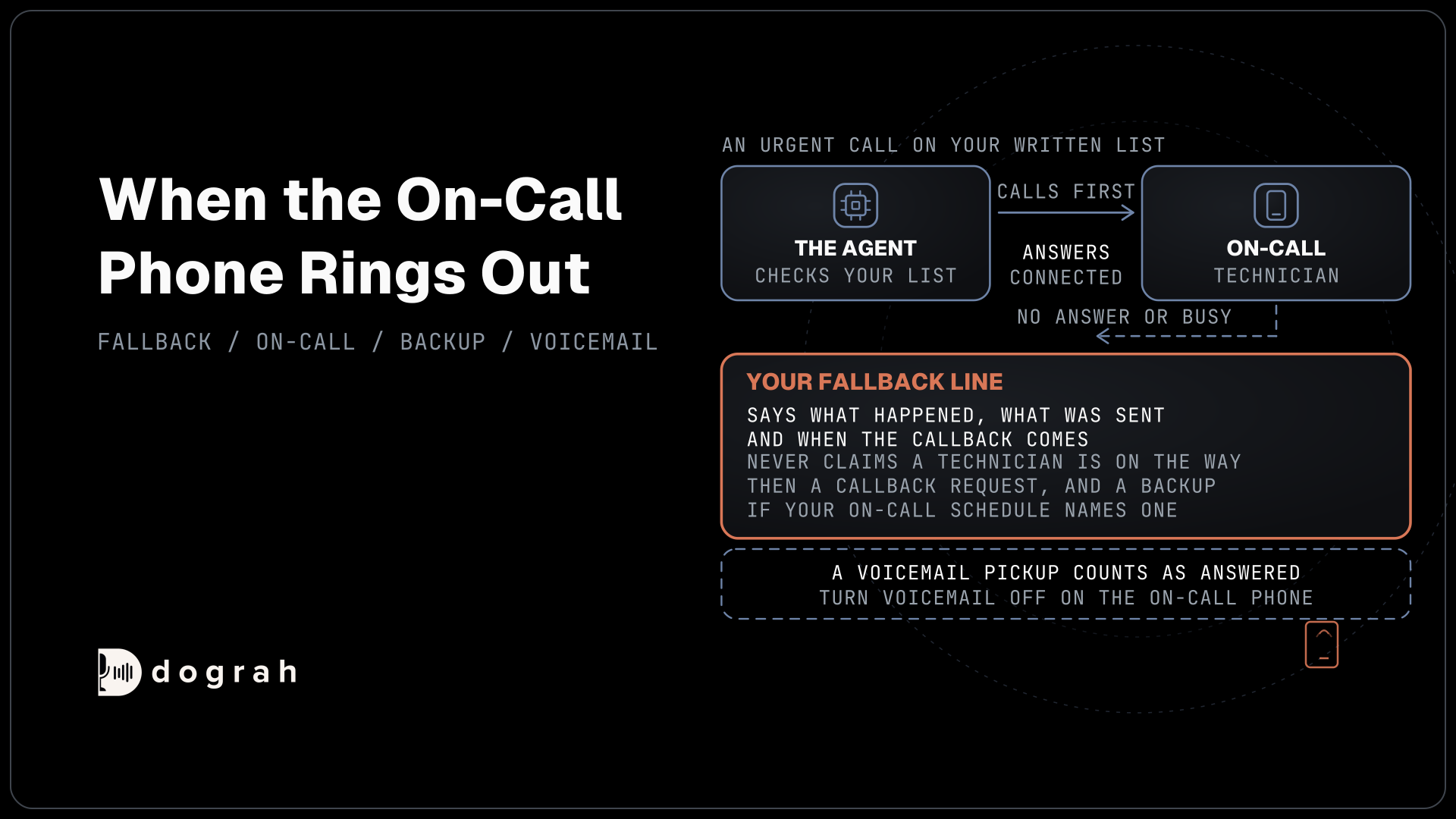
Urgent calls go to a person, and the caller has to hear something useful when that person does not pick up. A technician finishing another job, or asleep through the ring at 1 a.m., is normal. The fallback is a short line your company writes once, such as "Our technician couldn't take the call right now. I've sent your details, and they'll call you back within 30 minutes from our main number." The window comes from you, so it is one the company can keep.
The fallback never claims a technician is on the way. It says what happened, what was sent and when the callback comes. The agent then takes a callback request and, if your on-call schedule names one, pages a backup technician. Our post on AI receptionist call transfer covers the handoff in general, and the locksmith answering service post shows how to pull tonight's number from an on-call schedule.
Test the fallback as often as the transfer itself. Call the line at night, let the technician's phone ring out and listen to what the caller hears. Ringing out only works on a phone with no voicemail, because a voicemail pickup counts as answered and the caller is connected to the voicemail instead of hearing the fallback. Have each technician turn voicemail off on the on-call phone or set it to answer after the Transfer Timeout. A fallback that sounds wrong in a test will sound worse on a real emergency.
Join the Dograh Community
Dograh is an OSS alternative to Vapi. Join our Slack community for queries, releases, best practices & community interactions.
How this runs in Dograh
Urgent calls end in Transfer Call, which works on Twilio, Telnyx, Plivo, Cloudonix and Asterisk ARI. A fixed on-call number uses the Static / Template destination source, and an on-call schedule that changes by night fits the Dynamic HTTP Resolver. Dograh calls the destination first and connects the caller only when someone answers. Browser test calls cannot run a transfer, so test it on a real phone line.
If nobody answers within the 30-second default, or the line is busy, the transfer comes back to the agent as failed and the caller stays on the call. A voicemail pickup is the exception, as the handoff section explains, so keep voicemail off on the on-call phone. The fallback lives in the prompt, as an instruction such as "If the transfer fails, say our fallback line and take a callback request." For exact words, use a pre-recorded clip. Record the line on the Recordings page and insert it into the prompt by typing "@", as set out in pre-recorded audio. The language model still chooses the moment to play it, so a real phone test is the proof.
The callback request goes to your system through an HTTP API tool, and a second one can page the backup technician. Each tool can play a short start message, and a later update if the request is slow. Built-in time variables such as {{current_time_America/New_York}} let one prompt book windows by day and run the urgency list after 6 p.m. After launch, a QA node can review calls and flag any failed transfer that ended without a callback request.
You decide where it runs. With Dograh on your own server there is no per-minute platform fee, though the server, the model keys and the phone minutes still cost money and your team handles the database and upgrades. The open-source community provides support, and Enterprise adds custom SLAs. Companies that prefer not to host anything can use Dograh Cloud, where a 1¢-a-minute platform fee sits on top of model and phone costs.
Glossary
- Urgency list
- Your company's written list of calls that go to the on-call technician, such as a door stuck open at night. The agent follows it and never decides urgency itself.
- Fallback line
- The words a caller hears when the on-call technician does not answer. It says what happened, what was sent and when the callback comes.
- Transfer Timeout
- How long Dograh rings the transfer destination before reporting a failed transfer to the agent. It is 30 seconds by default and can be set from 5 to 120.
- Pre-recorded clip
- A recording uploaded on the Recordings page and inserted into a prompt with "@", so a line such as the fallback plays in exact words.