
An AI answering service for appliance repair picks up while your technicians are out. It records the appliance, brand, model number, the fault and the warranty type, quotes only your diagnostic fee and books from your open slots. Dograh, the open-source AI voice agent platform, books those visits through your scheduling software, on your own servers or on Dograh Cloud.
Key Takeaways
- The technician needs the model number and fault before the van leaves.
- Quote the diagnostic fee from your list, never a repair price.
- Point the Dograh agent at your scheduling software so it offers only open slots.
A technician without the right part has to book a second trip. We start with the service you may use now, then move to what a technician needs, warranty and safety calls and booking from real slots. Then we show how Dograh books the visit through your own software.
What an appliance repair answering service does now
A human answering service takes a message, notes a callback number and passes it to the office. It bills by the minute. MAP Communications' plans, for example, start at $49 a month plus $1.37 a minute, and the Business plan is $179 for 125 minutes, then $1.30 a minute, with no long-term contract.
A message still leaves the office with a pile of callbacks in the morning, and some of those callers have already booked with someone else. An AI agent can finish the call. It asks what the technician needs, books a slot from your schedule and passes urgent calls to a person. Our post on an AI answering service for electricians shows the same pattern in another trade.
Be honest about what it cannot fix. Yale Appliance, a retailer with its own service team, completed 33,190 service calls in 2025. In October 2026 its CEO, Steve Sheinkopf, wrote that the company had 35 field technicians and "I could use 20 more right now." When the technicians are booked solid, faster answering does not bring the visit forward.
What the agent can promise is a clean booking. The visit lands in a real slot, and the technician arrives knowing the appliance, the fault and the likely part. That saves the second trip, which is the visit a short-staffed team can least afford.
The details a technician needs before the visit
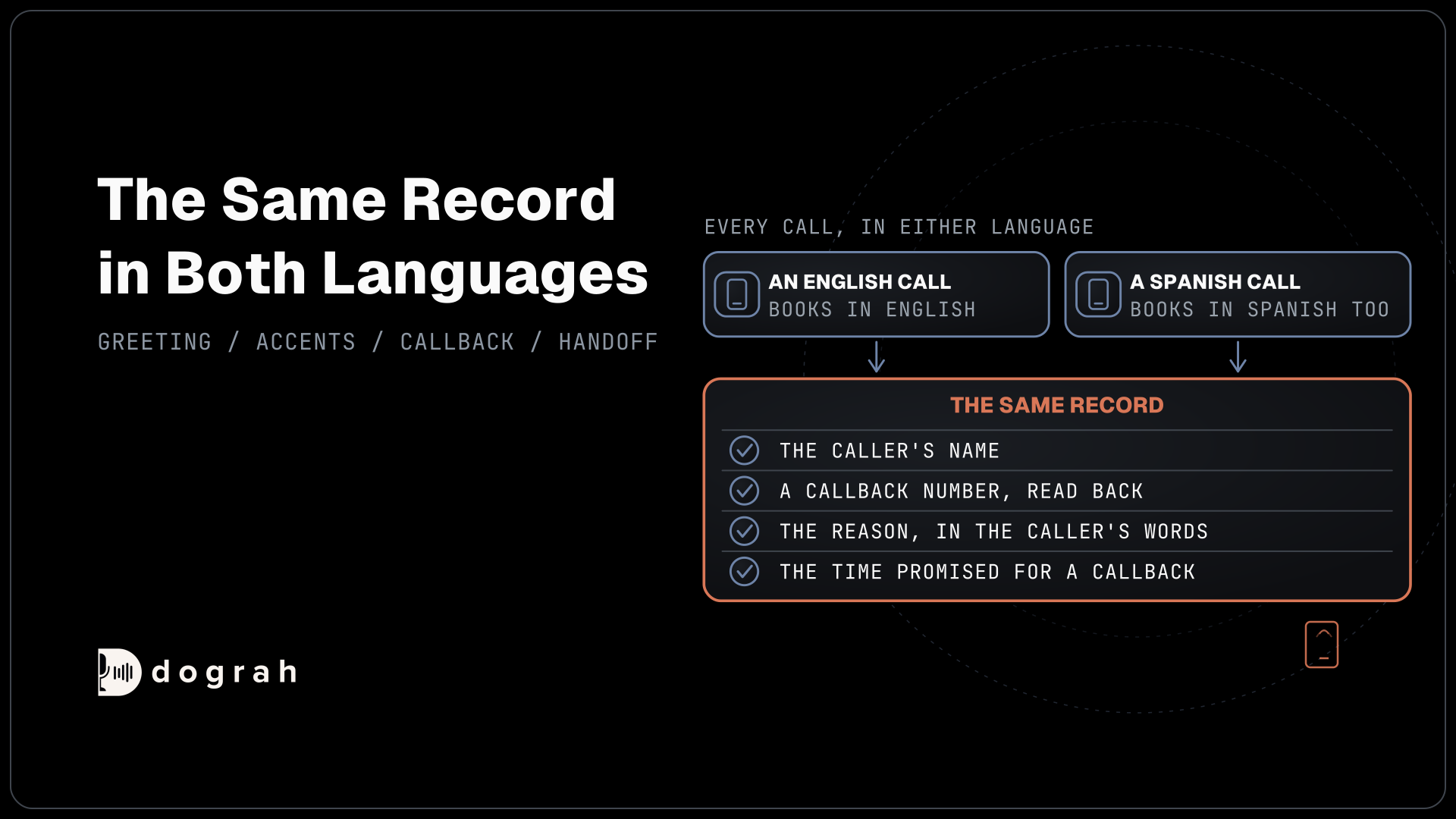
The model number matters most, because it decides which part the van carries. The agent asks for the appliance type, the brand, and the model and serial numbers from the rating tag. Then it asks for the fault in the caller's own words, any error code on the display and when the problem started.
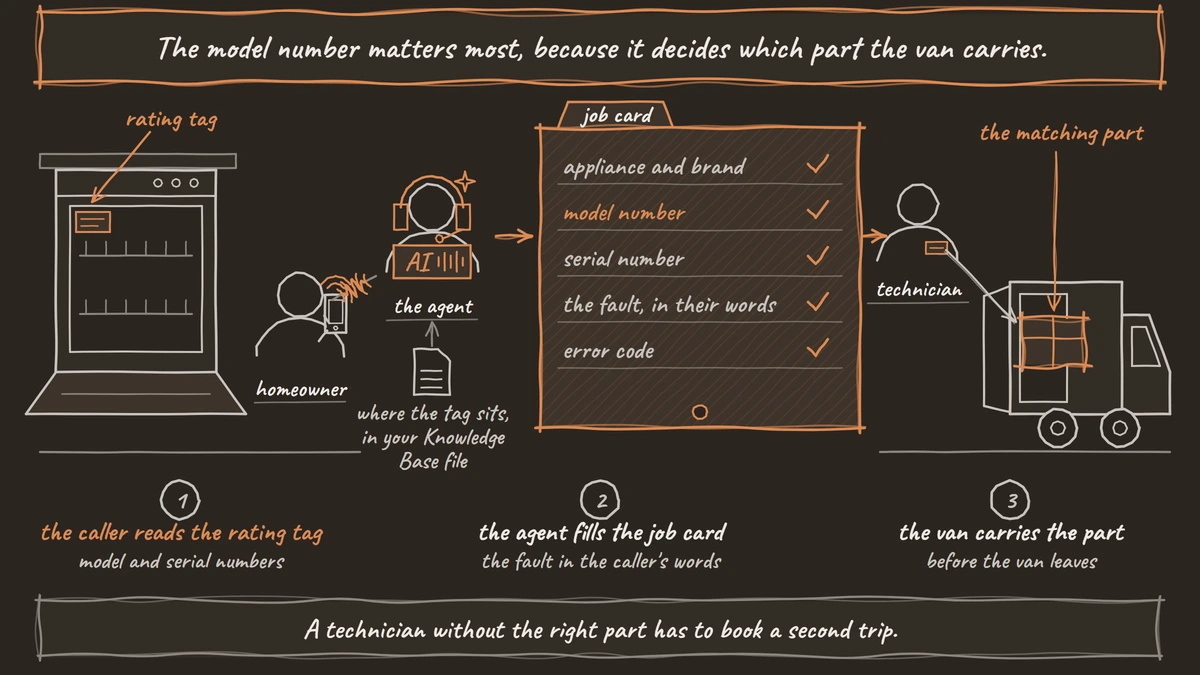
Many callers cannot find the tag. Write where it usually sits for each appliance type into a Knowledge Base file, in your company's words, and the agent reads from that file instead of guessing. It reads the model number back character by character, since one wrong letter can mean the wrong part.
Brand and part names trip up speech-to-text. Words such as "Sub-Zero", "Bosch" or "igniter" go into the Dictionary in the agent's settings. Dograh passes them as a hint to the speech-to-text models that accept one, such as Deepgram, AssemblyAI and Dograh's own, which makes the spelling your technicians use more likely.
Each answer is saved with variable extraction on the agent step. This AI step fills each field from the conversation, and your Extraction Prompt can ask it to keep the caller's own wording, such as an error code exactly as read off the display. The recording stays the exact record, so a technician who doubts an error code can listen to the caller read it out.
Warranty calls and the diagnostic fee
Warranty changes who should do the repair, so the agent records it without ruling on it. It asks for the purchase date and whether the caller has a manufacturer warranty, an extended warranty or a service plan. Your written rules then decide the path, such as the manufacturer's service network for some brands or a paid diagnostic visit for everything else.
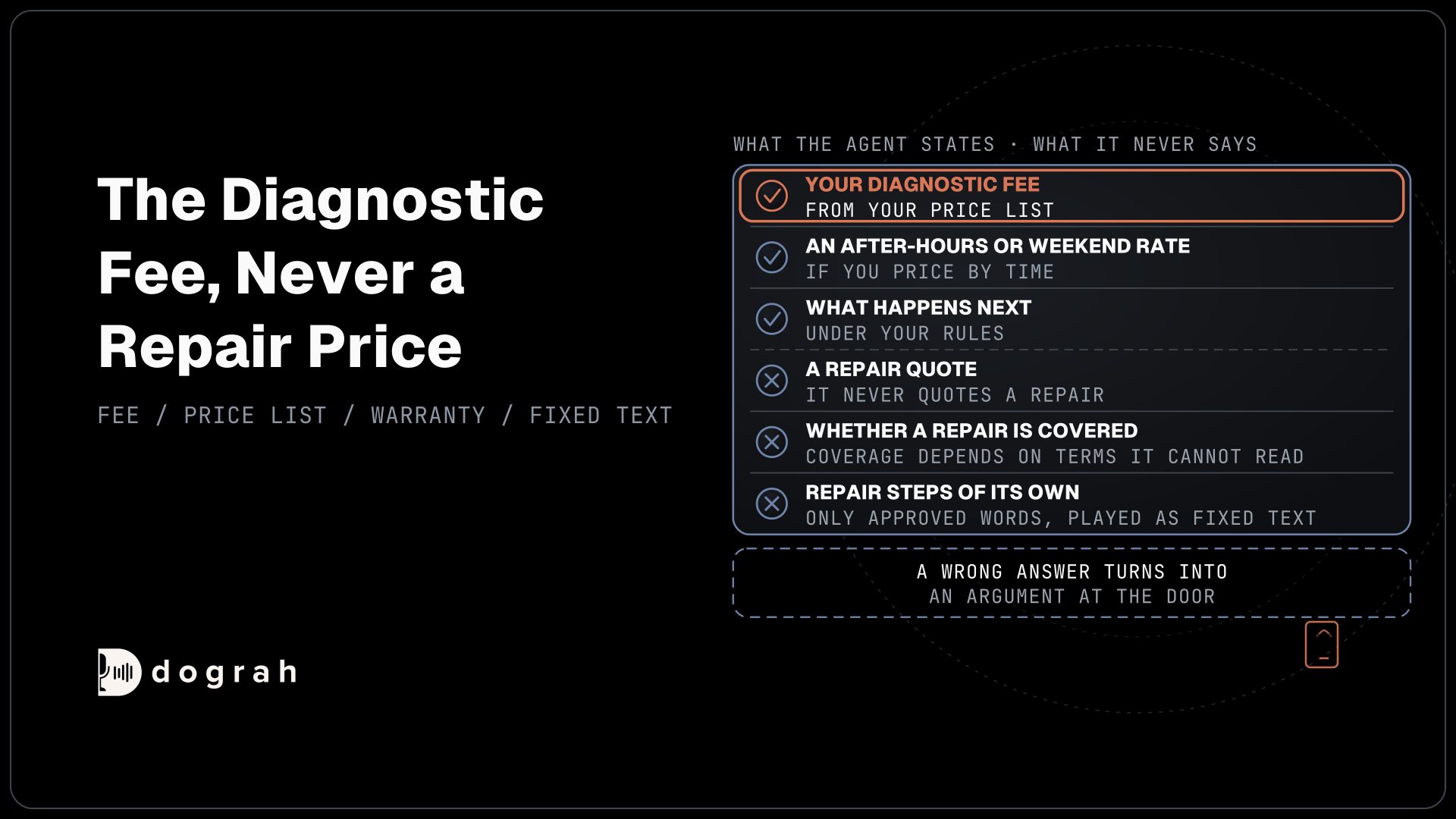
The agent never says whether a repair is covered. Coverage depends on terms it cannot read, and a wrong answer turns into an argument at the door. It tells the caller what happens next under your rules and lets the office confirm the rest.
Price follows the same rule. The agent states your diagnostic fee from your price list, including any after-hours or weekend rate if you price by time, and it never quotes a repair. It also gives no repair steps of its own, such as unplugging and retrying, opening a panel or moving a gas appliance, unless your company approved the exact words and they play as fixed text.

Open Source Alternative to Vapi / Retell
Self-hosted voice agent platform — no per-minute fees
dograh-hq/dograh
Star on GitHub
Gas smells, smoke and sparks
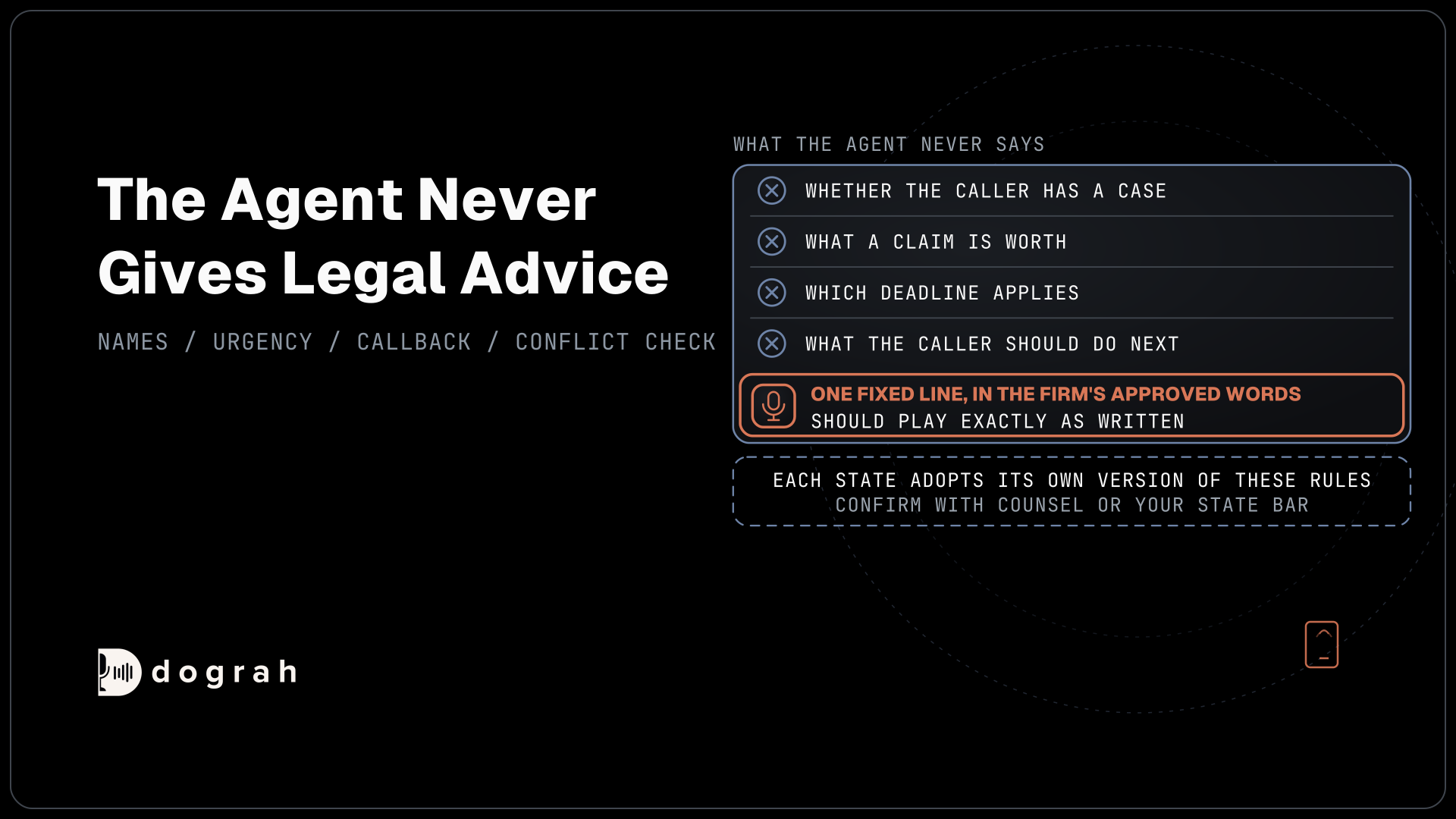
A gas smell gets one fixed line before any other question. Federal pipeline safety guidance tells people not to use a phone or a switch near a suspected leak and to call 911 from well away from it. So a caller who mentions gas near a range, a dryer or a water heater hears "If you smell gas, leave the building now and call 911 or your gas company from outside."
The agent asks nothing first, and the call ends there. A Webhook node then sends the number and the outcome to your system, so a person can follow up later. Our post on a contractor answering service with AI shows where that line is set so it plays word for word, and gas furnaces and carbon monoxide are covered in AI voice agents for HVAC companies.
Smoke, sparks or a burning smell from an appliance get their own fixed line, "If you're in danger, get to safety and call 911." The agent does not ask the caller to check the unit or describe the damage first.
Booking a visit from real open slots
A booking is only real if your scheduling software made it. The agent asks your software for arrival windows through an HTTP API tool, and the software returns only slots that already allow for the service area, the job length and the technician who knows that brand. The agent offers those windows and nothing else.
Once the caller picks one, a second tool writes the booking, and the agent reads it back with the job number your software returns. Add a Preset Parameter named workflow_run_id with the value {{initial_context.workflow_run_id}}, so your system can ignore a repeated request for the same call. HTTP API tools do not retry by themselves and time out after 5 seconds by default, so an error comes back to the agent, which then takes a message with the details instead.
After hours, the promise changes but the rule does not. If your software opens no slot until the morning, the agent says so and books the first morning window, or takes a callback request with the time your company wrote in the prompt, such as "the office calls you after 8 a.m." It never says a technician can come sooner than the schedule allows, because a broken promise costs more than an honest wait.
ServiceTitan, Housecall Pro, Jobber and similar systems usually sit behind an automation tool or a small service of your own that holds their sign-in. Our guide on how to build an AI appointment scheduler covers the full booking design, from offering slots to cancellations.
Join the Dograh Community
Dograh is an OSS alternative to Vapi. Join our Slack community for queries, releases, best practices & community interactions.
How this runs in Dograh
Calls your list marks urgent end in Transfer Call, which works on Twilio, Telnyx, Plivo, Cloudonix and Asterisk ARI. Dograh calls the destination first and connects the caller only when someone answers. No summary travels with the transfer by default, so the agent writes the model number and fault to your system through an HTTP API tool first. While that tool runs, its Messages play a short line, and an update if it takes longer. If nobody answers within the 30-second default, the caller stays with the agent, which takes a callback request. A line that rolls to voicemail counts as answered, so turn voicemail off on the number you transfer to, or set it to pick up later than the Transfer Timeout.
When the call ends, a Webhook node sends the saved fields, the recording and the transcript link to your job system. Temporary failures are retried by themselves, up to 5 attempts. Safety lines sit where Dograh speaks them exactly, in the Greeting Text, a pathway's Transition Speech or a pre-recorded clip, and a QA node, with its minimum call length lowered, can flag any gas call that missed the fixed line.
Where it runs is your choice. Running Dograh on your own servers means no per-minute platform fee, though the servers, the model keys and the phone minutes still cost money, and your team looks after the database and upgrades. Support comes from the open-source community, with custom SLAs on Enterprise. Dograh Cloud runs it for you for a 1¢-a-minute platform fee, plus model and phone usage.
Glossary
- Rating tag
- The plate or sticker on an appliance that carries its model and serial numbers. Its location varies by appliance type, so the agent reads your notes on where to look.
- Diagnostic fee
- The fixed charge for a technician's visit to find the fault, set by your company and sometimes higher after hours. It is the only price the agent states.
- Dictionary
- An agent setting that lists brand and part names, such as Sub-Zero or igniter, and passes them as a spelling hint to speech-to-text models that accept one.
- Arrival window
- The span of time your scheduling software offers for a technician to arrive, after allowing for travel and job length. The agent reads out the windows the software returns.