
An AI answering service for electricians picks up while your crew is on site or asleep. It tells a street-wide outage from a house fault, plays fixed safety lines, books jobs and hands urgent calls to the on-call electrician. For contractors who want to own it, Dograh, the open-source AI voice agent platform, runs it self-hosted or on Dograh Cloud.
Key Takeaways
- A dark street is the utility's job, while one dark room is yours.
- Downed lines get a fixed line to stay at least 35 feet away.
- Dograh writes the job down before ringing the on-call electrician.
An electrician inside a panel at 3 p.m. or asleep at 3 a.m. cannot pick up the phone. We cover what a human service catches, power-out calls, danger lines, the urgent list, booking and storm days. Then we talk about how Dograh runs the handoff.
What an electrician's answering service catches
A human answering service for electricians takes a message and pages someone when the caller says it is urgent. Billing follows operator time. AnswerFirst's pricing, which lists electric work among its industries, is $30 a month plus $1.60 to $1.95 a minute depending on usage, with no minimum.
The calls that never reach anyone cost more. Invoca's home services benchmarks, built from calls tracked on its platform across trades such as HVAC and plumbing, found that 52% of callers speak with a person, ranging from 32% to 74% by sub-industry. Of the leads that got through, 45% converted on the call. Electrical work is not one of the trades in that report, so treat it as a pattern for the home services trades rather than an electrician's figure.
An AI agent closes the gap differently. It books the job from your schedule, quotes only your fixed prices and sends the true emergencies to a person, so the morning starts with booked work. Our post on a contractor answering service with AI shows how those messages land in your job system.
Power out, the street or the house
"My power's out" is the call an electrician's line hears most after a storm, and many of those callers need their utility, not an electrician. A street-wide outage is a fault on the utility's side. One dead room, half the house dark or a single circuit that won't come back points to a fault inside the home, which is your job.
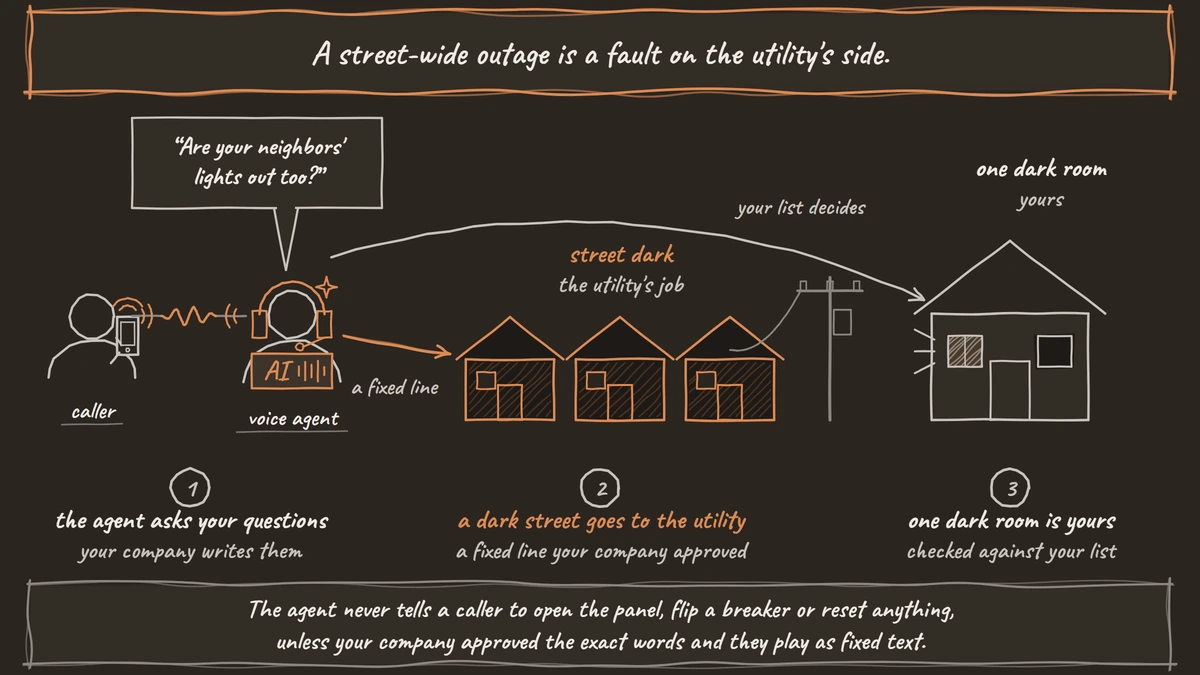
The agent sorts the two with questions your company writes, such as "Are your neighbors' lights out too?" and "Is the whole house dark, or only some rooms?" If the street is dark, it plays a fixed line that your company approved, "A street-wide outage is your utility's job. Report it to them." If the caller asks for the utility's number, the agent reads it only from a Knowledge Base file where you stored the local utilities, and never guesses one.
If only part of the home is out, the agent records what the caller describes and checks it against your list. Your list decides whether partial power or flickering lights go to the on-call electrician tonight, and a single dead outlet books the next window.
The agent never tells a caller to open the panel, flip a breaker or reset anything, unless your company approved the exact words and they play as fixed text. A caller who has already tried the breaker gets that recorded in the message for the electrician.
Downed lines, sparks and shocks
Danger gets the fixed line before any question about the address. The American Red Cross's power outage guidance tells people to stay at least 35 feet from fallen power lines and anything they touch, and to call 911. So a caller who mentions a line down hears "If a power line is down, stay at least 35 feet away from it and anything it touches, and call 911."
Sparks from an outlet, a burning or melting smell, smoke from a panel or a shock get their own fixed lines, "If you're in danger, get to safety and call 911" and, for a shock injury, "If this is a medical emergency, please call 911 now." AI voice agents for electrical contractors covers where those lines are set so they play word for word and how to test them. After any danger line, the agent ends the call and a Webhook node sends the number and outcome to your system for a follow-up.

Open Source Alternative to Vapi / Retell
Self-hosted voice agent platform — no per-minute fees
dograh-hq/dograh
Star on GitHub
The urgent list and the callback promise
Some calls are urgent without being dangerous, and your written list names them. A restaurant whose walk-in cooler has lost power, a home with no heat in winter because a circuit is dead, or a commercial site that cannot open are typical entries. The agent follows the list and never decides urgency by itself.
Calls on the list go to the on-call electrician, and the rest get a callback promise. The window comes from your company, written in the prompt for each kind of call, such as "the on-call electrician calls you within 30 minutes" or "the office calls after 7 a.m.". The agent states that window and nothing faster.
Call back from the company's main number, not a personal mobile, so the customer picks up, and have the agent say which number to expect. The window the agent stated goes into the message too, so the office can see who was promised what.
Quotes and bookings beyond an open calendar slot
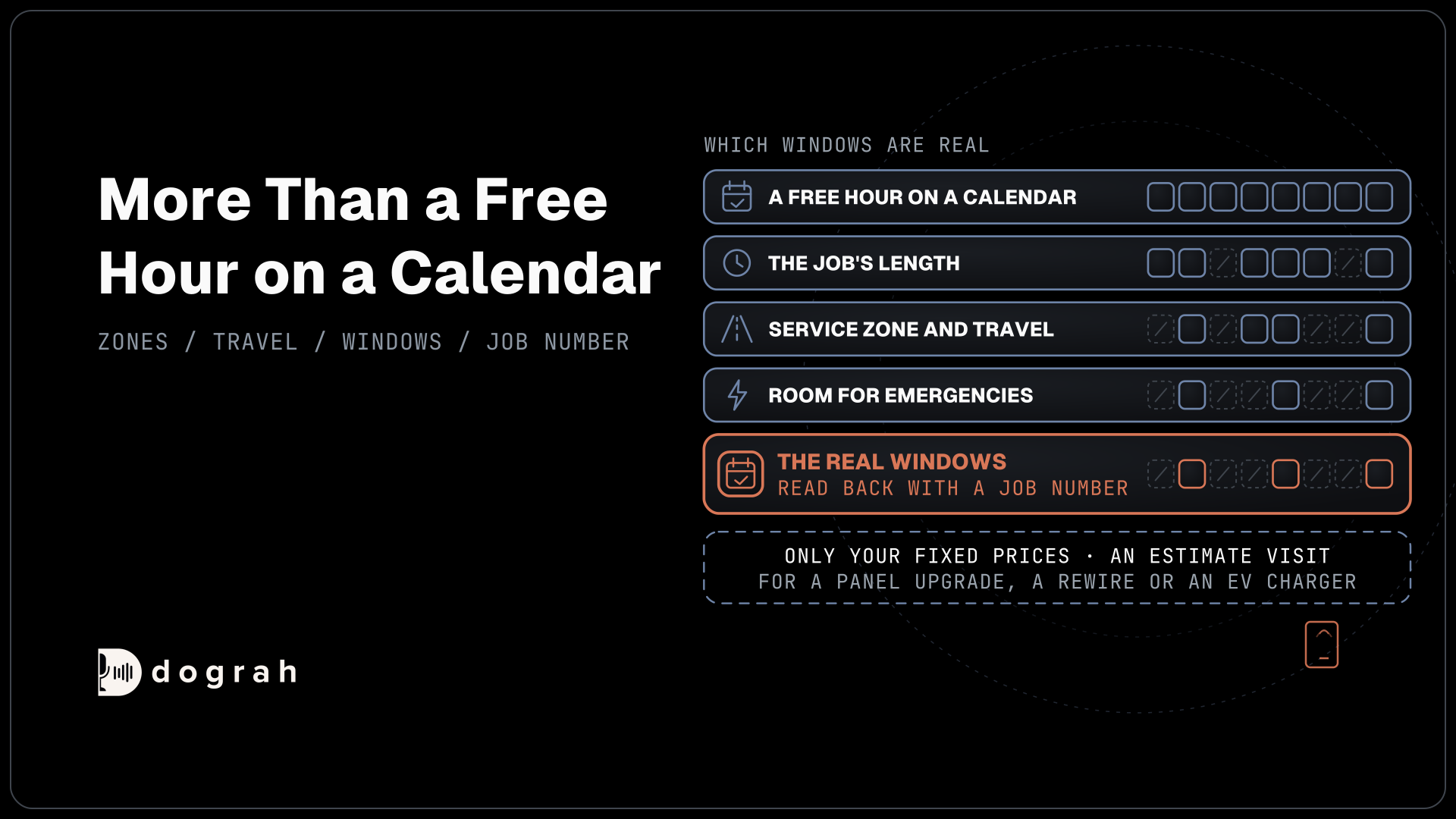
Booking an electrician takes more than a free hour on a calendar. The job's length, the service zone, travel between jobs and how much room you keep for emergencies all decide which windows are real. So the agent asks your field service software for windows through an HTTP API tool, and the software returns only the slots that already allow for zones and travel.
The agent offers only those windows and reads the booking back once your software confirms it with a job number. Prices follow the same rule. It reads only the fixed prices you publish, such as the service call fee, and books an estimate visit for a panel upgrade, a rewire or an EV charger. Our post on electrical contractors covers that quote flow in full.
Join the Dograh Community
Dograh is an OSS alternative to Vapi. Join our Slack community for queries, releases, best practices & community interactions.
Storm days and outage surges
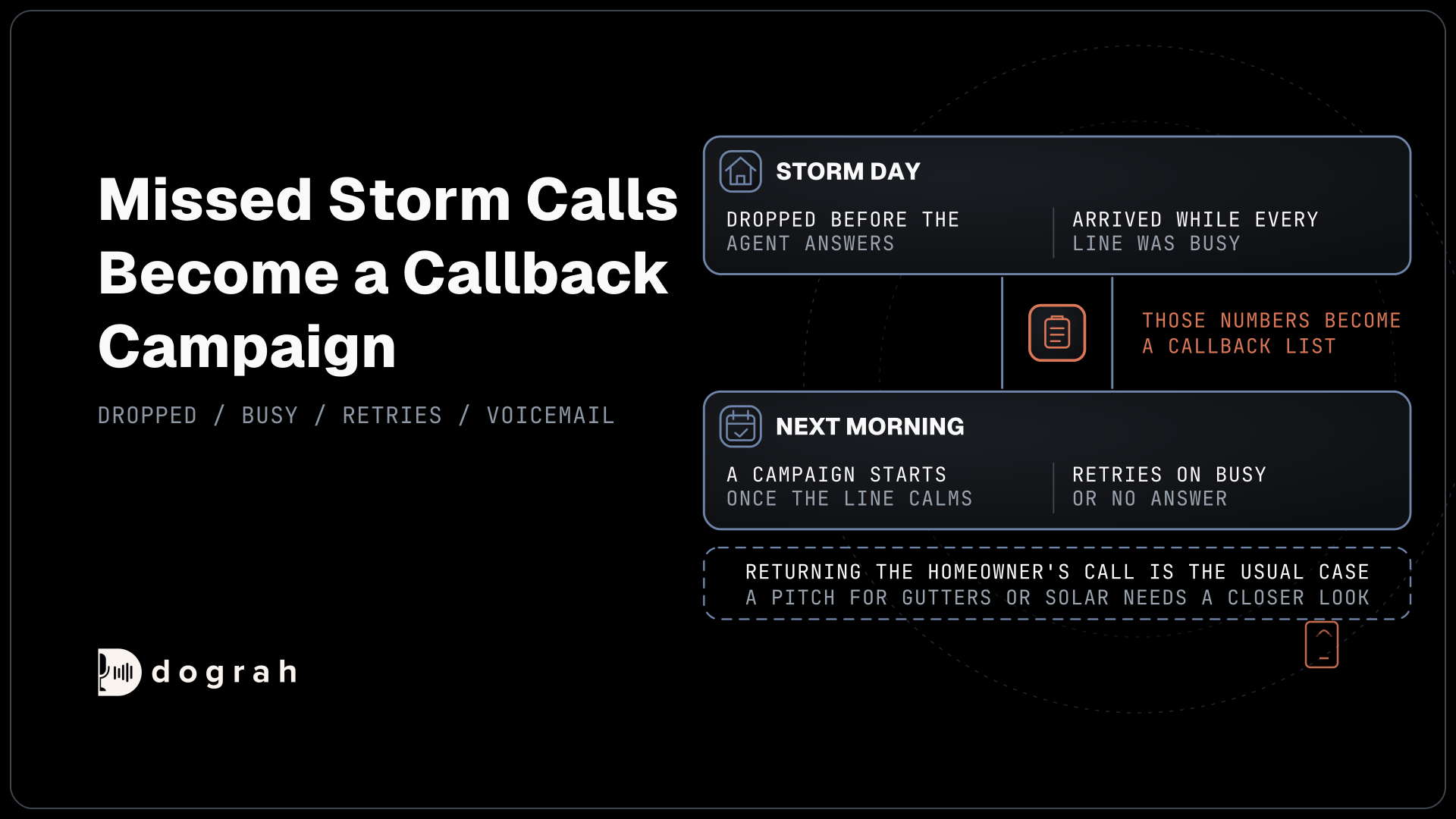
A storm can bring a rush of calls at once, and many of them are utility outages. Put a short notice in the Greeting Text for storm days, after your company name, such as "If your whole street is dark, please report it to your utility." Greeting Text plays word for word before the caller speaks, so many outage callers have their answer before they ask.
The rest still arrive at once. A self-hosted agent runs 10 concurrent calls by default, and you can raise the limit to what your servers and phone provider carry. AI voice agents for roofing contractors covers storm-day volume and callbacks for a trade that lives on storms, and our post on AI voice agents for overflow call handling covers what happens when calls go past the limit.
How this runs in Dograh
Urgent calls end in Transfer Call, which works on Twilio, Telnyx, Plivo, Cloudonix and Asterisk ARI. The agent first writes the address and the problem to your system through an HTTP API tool, because no summary travels with a transfer by default. Dograh calls the destination first and connects the caller only when someone answers. Context Mapping can send commercial callers to your commercial lead and the rest to the on-call electrician, and if nobody answers within the 30-second default, the caller stays with the agent for a callback request.
Fixed words go where Dograh speaks them exactly, in the Greeting Text, a pathway's Transition Speech or a pre-recorded clip. Choosing a pathway is the language model reading its written condition, so test with phrases like "the whole block went dark" and "there's a wire lying in the yard". After launch, a QA node can review calls and flag any downed-line call that missed the fixed line.
You choose where it runs. Put Dograh on your own server and there is no per-minute platform fee. The server, the model keys and the phone minutes still cost money, and your team keeps the database and upgrades in hand. Community support covers the open-source version, and Enterprise adds custom SLAs. Contractors who want the hosting off their plate can use Dograh Cloud, which runs it for a 1¢-a-minute platform fee.
Glossary
- Utility outage
- Loss of power on the utility's side, usually a whole street or area. The caller reports it to the utility, and no electrician can restore it.
- Urgent list
- Your company's written list of calls that are urgent without being dangerous, such as a restaurant cooler with no power. Calls on it go to the on-call electrician.
- Greeting Text
- The opening line Dograh speaks word for word the moment the call connects, set on the Start Call node.
- Concurrent call limit
- The most calls an account runs at the same moment. Self-hosted, it is 10 by default and can be raised for storm days.