
An AI legal answering service picks up every law firm call, records the matter type, urgency and conflict-check names, books a callback and sends urgent matters to the on-call lawyer. It never gives legal advice. For firms wanting call data on their own servers, Dograh, the open-source AI voice agent platform, runs on those servers or on Dograh Cloud.
Key Takeaways
- Ask for the names of every party before the caller tells the story.
- The agent records and routes, and never says whether a caller has a case.
- Self-hosted Dograh keeps recordings on firm servers, though outside models still hear the audio.
A law firm's phone rings at 9 p.m. with an arrest, a hearing tomorrow or an injury case. We cover what a legal answering service costs, the intake call, what the agent never says, urgent calls and the morning record. Then we talk about how this runs in Dograh.
What a legal answering service does and costs
A human legal answering service picks up when the firm cannot, takes a message or a short intake and passes urgent calls to whoever is on call. It bills for receptionist time. Ruby's receptionist plans, for example, run from $250 a month for 50 minutes to $395 for 100, $720 for 200 and $1,725 for 500, with no plan built only for law firms.
Minutes run fast on legal calls. A caller describing an accident, a custody dispute or an arrest rarely finishes in two minutes, so a busy month can move a firm up a plan. An AI agent answers every call at once, at any hour, and asks the same intake questions in the same order every time.
There is a fair case for a person. Many callers in a stressful legal moment want to hear a human, which is why some firms pair AI with live intake staff. So the design keeps a person close. The agent takes the intake, sends urgent matters to the on-call lawyer and books a callback with a stated time, so a person is always the next step.
The intake call, step by step
A legal intake call has a set order, and the order protects the firm. The agent greets with the firm's name, asks what kind of matter it is and checks it against the practice areas the firm takes. A family law call to a personal injury firm becomes a referral or a polite no, not an intake.
Urgency comes next, from questions the firm writes, such as whether anyone is in custody, whether a hearing or a deadline falls in the next few days and whether a protective order is in play. The answers decide whether this call goes to the on-call lawyer now or into the morning queue.
Then names, before the story. The agent asks for the caller's full name and the names of every other party, including companies, so the firm can run its conflict check. Under the American Bar Association's Model Rule 1.18, a person who consults a firm about a matter is a prospective client, and what they say is protected even if the firm never takes the case. If the check finds a conflict, the rule still lets the firm act for the other side in two ways. Both clients can give informed consent, confirmed in writing. Or the lawyer who received the information took reasonable steps to hear only what was needed to decide on representation, is screened from the matter with no part of its fee, and the firm promptly gives the prospective client written notice. That is why the agent keeps the facts short.
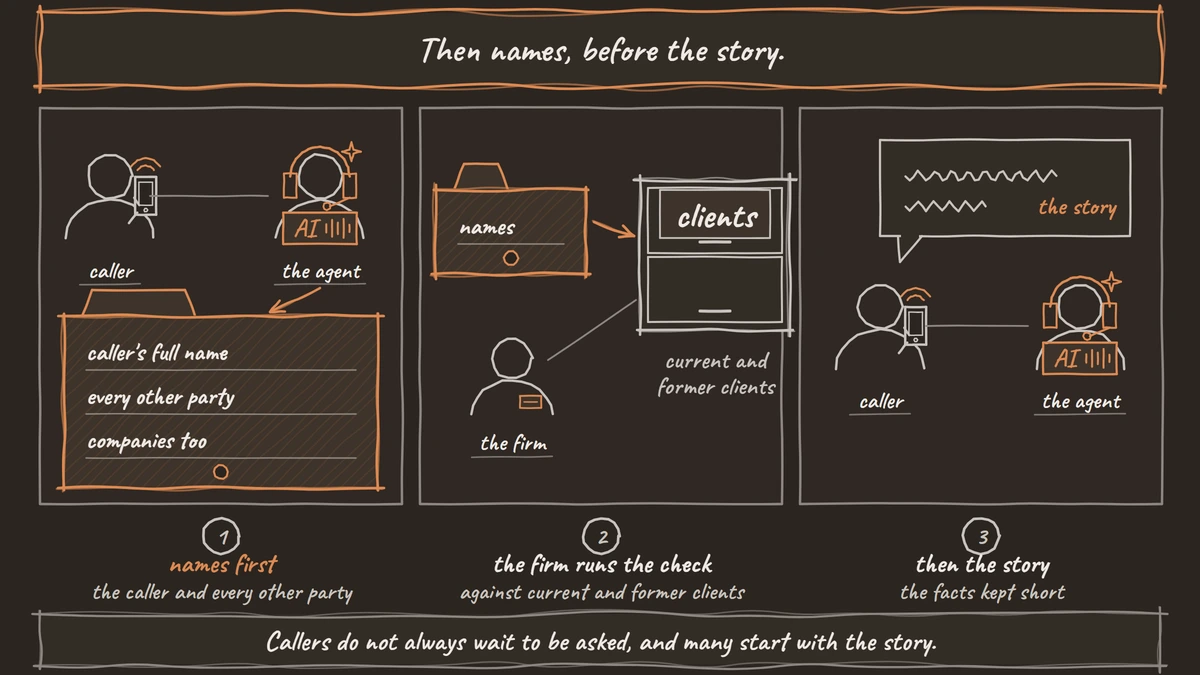
Callers do not always wait to be asked, and many start with the story. Our post on law firm intake and privilege covers how to run the conflict lookup alongside the call and what to do on a hit. The intake ends with contact details read back and a callback slot.
What the agent never says
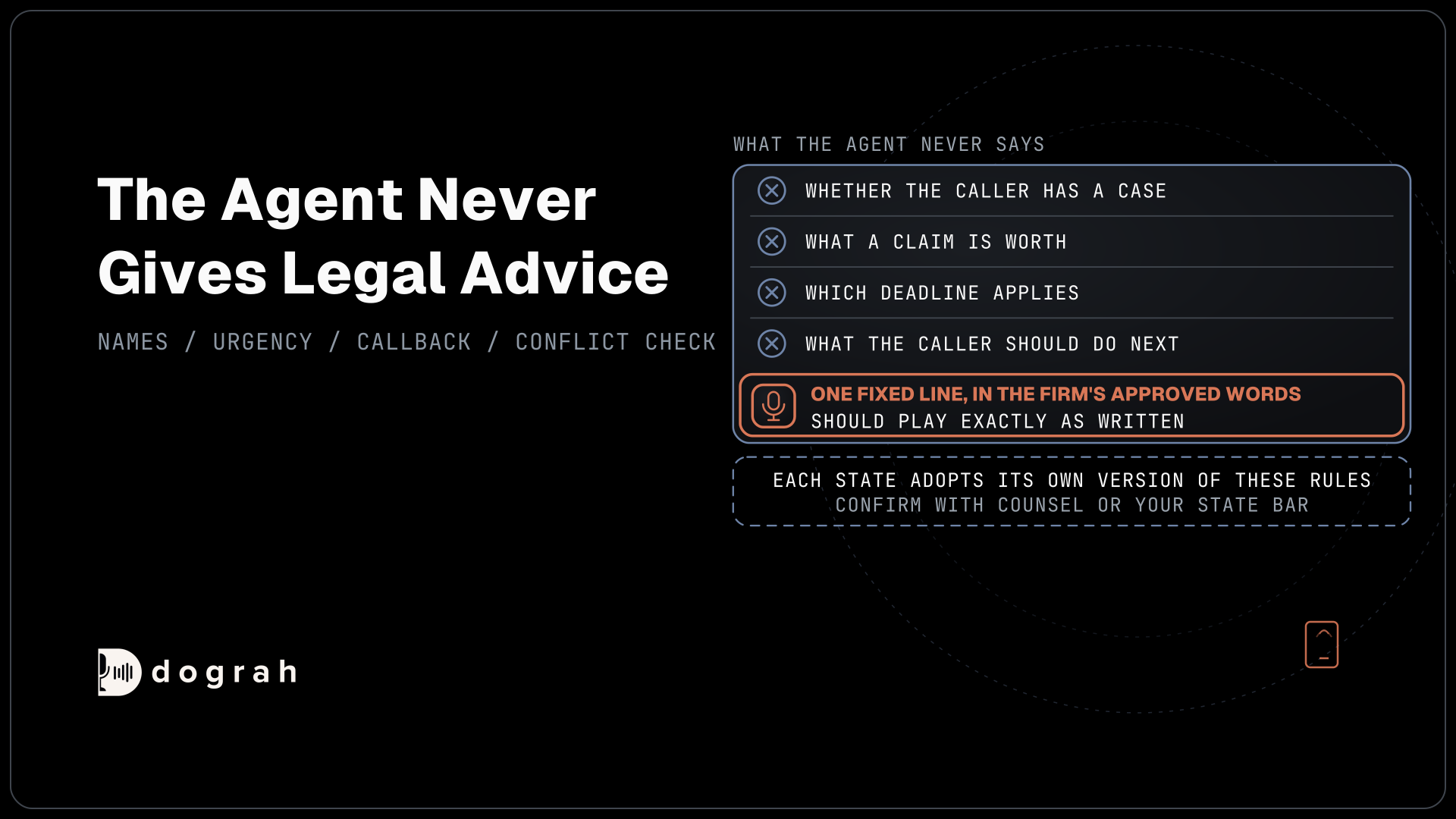
An AI agent on a law firm's line must never give legal advice. It does not say whether the caller has a case, what a claim is worth, which deadline applies or what the caller should do next. It does not promise an outcome or quote a fee beyond what the firm has written down.
Two of the American Bar Association's Model Rules of Professional Conduct explain why. Model Rule 5.5 bars a lawyer from practicing law in breach of a jurisdiction's rules or assisting another to do so, and what counts as practicing law is set by each state. An agent that tells a caller they have a strong case risks assisting the unauthorized practice of law. Model Rule 5.3 asks firms to have measures giving reasonable assurance that a nonlawyer's conduct fits the lawyer's own duties.
The rule speaks of a nonlawyer employed, retained or associated with a lawyer, and applying it to an AI agent is our reading. It is the reading a careful firm should plan for, with written limits and a lawyer who reviews the test calls. Each state adopts its own version of these rules, so confirm how they apply to your firm with counsel or your state bar's ethics guidance.
In practice the agent has one fixed line for these moments, in the firm's approved words, such as "I can't give legal advice, but I've noted your question and a lawyer will call you back." That line should play exactly as written, which a prompt alone cannot promise.

Open Source Alternative to Vapi / Retell
Self-hosted voice agent platform — no per-minute fees
dograh-hq/dograh
Star on GitHub
Urgent calls go to a person
Urgent legal calls go to the on-call lawyer, and the firm decides what counts as urgent. A typical list covers someone in custody tonight, a hearing or court date in the next day or two, a deadline that runs out today and a protective order. The agent checks each call against that written list and never decides urgency on its own.
Danger comes before any of this. A caller who says they are in danger right now, for example from a partner or an ex, hears a fixed line telling them to get to safety and call 911. The agent then offers to take their details for a callback when they are safe.
When the on-call lawyer does not answer, the caller should not be left with nothing. The agent takes a callback request, states the window the firm wrote down, such as "a lawyer will call you within 30 minutes", and pages the lawyer again through an HTTP API tool that calls the firm's own paging system. Callbacks to prospective clients have their own rules, and our post on missed-call recovery for law firms covers Rule 7.3 and consent for them.
The callback and the morning record
Every call that is not transferred ends with a callback booked or a message taken, and the firm should be able to act on it in one read. The agent can offer open slots from the firm's calendar and book one during the call. Our post on legal appointment scheduling covers clearing conflicts before the consult and handling fee questions.
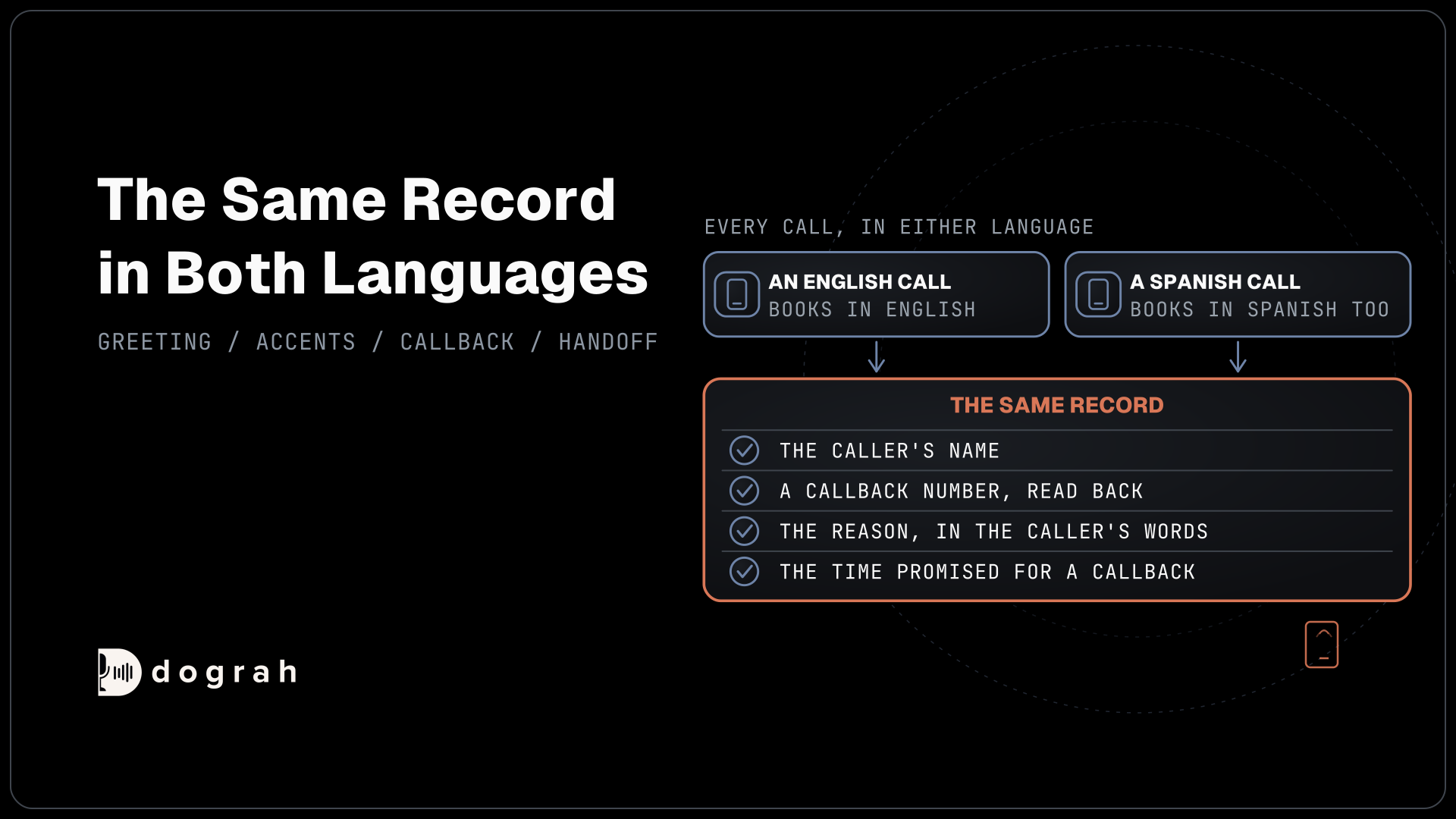
The morning record carries the matter type, the urgency answers, the caller's name and contact, the names of the other parties, the callback time the caller was given and the outcome of the call. Each field is the agent's note of what the caller said, in the caller's own terms. The recording and transcript travel with it as the exact version, so the intake lead can check any detail before the conflict check runs.
Read a sample of those records every week at first, alongside the recordings. The aim is the same as in any pilot of a new service, to compare what the agent captured with what a good intake specialist would have written down, and to fix the questions where they differ.
Join the Dograh Community
Dograh is an OSS alternative to Vapi. Join our Slack community for queries, releases, best practices & community interactions.
How this runs in Dograh
The intake answers become variables. On each Agent node, turn on Enable Variable Extraction, write an Extraction Prompt and list the Variables to Extract, such as matter_type, urgency, adverse_parties and callback_time, each with a type and a hint. The values land in the call's gathered context, and a Webhook node sends them to the firm's case or intake system after the call, with the recording and transcript links.
The conflict lookup and the booking run during the call through HTTP API tools against the firm's own systems, such as Clio, MyCase or its calendar. While a lookup runs, the tool's Messages give the caller a short holding line and an update if the check takes longer, so nobody waits in silence. The fixed no-advice line belongs where Dograh speaks text word for word, in a pathway's Transition Speech or a pre-recorded clip. Our post on how to build a voice agent for law firms walks through each step.
Urgent calls use Transfer Call, which works on Twilio, Telnyx, Plivo, Cloudonix and Asterisk ARI. Dograh calls the destination first and connects the caller only when someone answers. No summary travels with it by default, so an HTTP API tool writes the matter and urgency to the firm's system first. If the on-call lawyer does not pick up within the 30-second default, the caller stays with the agent, which takes the callback request. A voicemail that picks up counts as an answer and connects the caller to it, so turn voicemail off on the on-call number or set it to pick up later than the Transfer Timeout.
Where call data lives depends on who hosts it. When the firm hosts it, the agent, recordings and transcripts sit on its own servers and storage, and saving call audio can be switched off server-wide, though transcripts are still kept. Any outside speech or language model on the firm's keys still receives the call audio or text, so keeping every word inside the firm means open-weight models on the same servers. Our post on every place an intake call goes maps each one. Running it yourself also means paying for servers, model keys and phone minutes, and your team looks after the database and upgrades.
Glossary
- Prospective client
- Under Model Rule 1.18, a person who consults a firm about possibly hiring it. What they say is protected even if the firm never takes the case.
- Conflict check
- Matching the caller and every other party against the firm's current and former clients before it takes a matter. The agent collects the names, the firm runs the check.
- Unauthorized practice of law
- Giving legal advice or services without a license in that jurisdiction. Model Rule 5.5 also bars lawyers from assisting it, which is why the agent gives no advice.
- Variable extraction
- An AI step that pulls answers such as matter type and urgency out of the conversation into fields, following the firm's Extraction Prompt. The recording stays the exact record.