
A bilingual answering service takes English and Spanish calls, books or takes messages in the caller's language and passes harder calls to a Spanish-speaking person. An AI version greets in both languages and follows the caller's choice. For businesses picking their own speech providers, Dograh, the open-source AI voice agent platform, runs on servers they host or on Dograh Cloud.
Key Takeaways
- Greet in both languages, since the greeting plays before the language is known.
- Test Spanish on callers from your own markets, over a real phone line.
- In Dograh, Transfer to Agent hands Spanish callers to an agent with a Spanish voice.
A business with Spanish-speaking customers needs every call answered in the right language. We cover what a human bilingual service costs, how a caller picks a language, Spanish speech and voices, accent tests and the handoff to a person. Then we talk about how the line runs in Dograh.
What a bilingual answering service costs today
Human bilingual answering services bill by the minute or by the call, and the two below also sell an AI receptionist. Abby Connect's bilingual plans start at $164 a month for 50 Abby Minutes and run to $1,380 for 500, with no Spanish surcharge and no per-language fee. A minute with its AI receptionist uses half an Abby Minute, and Spanish-speaking receptionists in its Las Vegas office take the calls that need a person.
Smith.ai sells the same mix. Its bilingual page says its AI detects English or Spanish on its own, its human Virtual Receptionist plans start at $300 a month for 30 calls, a dedicated Spanish line adds $1 a call, and its AI Receptionist is priced per call. Our post on Smith.ai pricing has the plan detail.
Both services let a call move from the AI to a person, and Abby also lets a business run all AI. Keeping a bilingual person within reach is worth copying. An AI agent can answer every Spanish call at 2 a.m. and take a clean message, but a caller with a complaint, a payment problem or a hard accent still needs someone who speaks Spanish. The design question is how fast that person is reached, and what the agent does when nobody picks up.
How a caller picks a language
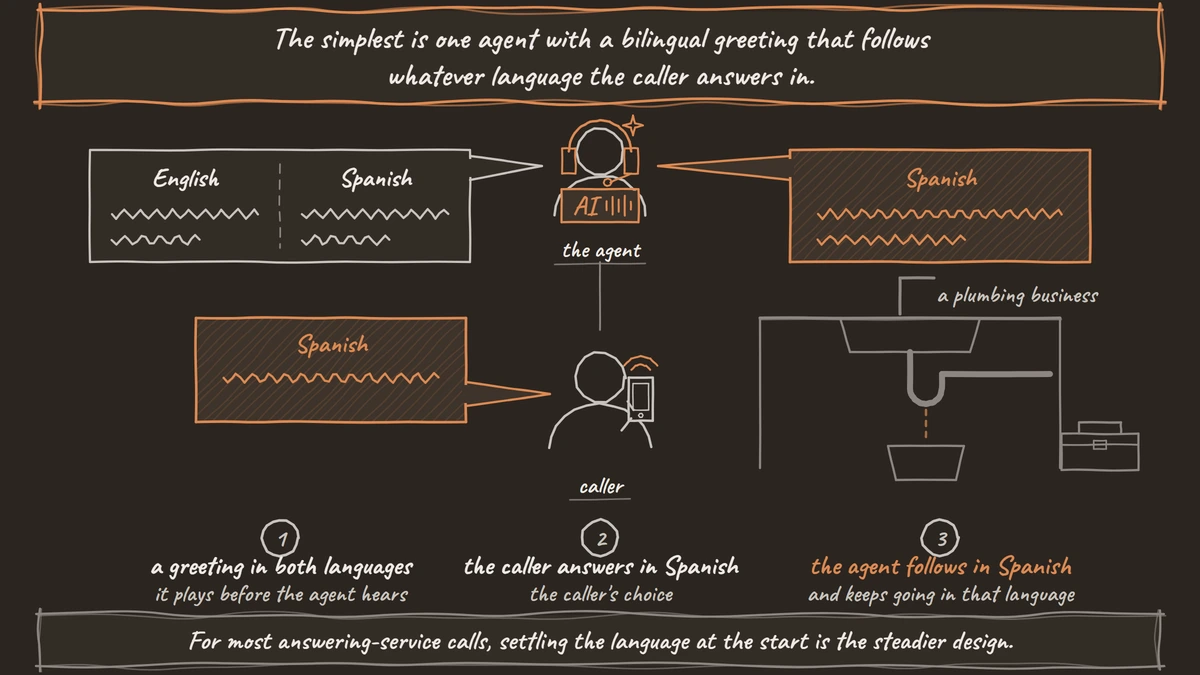
A bilingual line can put a caller in Spanish in three ways, and a small business usually needs only one of them. The simplest is one agent with a bilingual greeting that follows whatever language the caller answers in. The greeting plays before the agent can hear the caller, so it has to be in both languages, such as "Hola, hello, thanks for calling Rivera Plumbing."
The second way is a number per language. Publish one number for English and one for Spanish, on your website, your trucks and your Spanish ads, and point each at its own agent. The caller has chosen before the phone rings, and each agent can be tuned for one language from the first word.
The third is a short router agent. It greets in both languages, asks which the caller prefers if it is not clear, and hands the call to an English or a Spanish agent. This fits a business that wants separate prompts and voices per language on one published number. Our post on language switching mid-call covers the trade-offs between these designs.
Whatever the design, the agent should never guess. When it is unsure which language the caller speaks, it asks a short question with both options, switches only after the caller confirms, and keeps going in that language. If it still cannot understand the caller, the safest step is a Spanish-speaking person or a callback in Spanish.
Spanish speech-to-text and voices
Spanish is one of the best-covered languages for speech-to-text, but the codes differ by provider and model. Deepgram's language list shows Spanish as es and es-419, Latin American Spanish, on its Nova-3 and Nova-2 single-language models. Its Nova-3 multilingual and Flux multilingual models list Spanish as es only. Google's speech-to-text offers about 20 Spanish locales, including es-US and es-MX, and Azure Speech lists 22, es-US among them.
Voices follow the same pattern. Azure has voices for 22 Spanish locales, es-US among them, Google has es-ES and es-US voices, ElevenLabs lists Spanish for Spain and Mexico, and Cartesia lists Spanish too. Our post on multilingual TTS for voice agents has the locale table by provider. Pick the voice for the Spanish your callers speak, since a voice from Madrid sounds foreign to many callers in Texas.
Be careful with promises about switching mid-call. A caller who moves from English to Spanish halfway through is followed only when the speech-to-text runs in auto-detect mode on a model that supports it, such as Deepgram Flux multilingual or Dograh's own models, and when the voice speaks both languages well. Other setups stay in the language they started in. For most answering-service calls, settling the language at the start is the steadier design.

Open Source Alternative to Vapi / Retell
Self-hosted voice agent platform — no per-minute fees
dograh-hq/dograh
Star on GitHub
Testing Spanish accents before launch
A short test with your own callers' Spanish shows more than any provider's word error rate. Here is a plan we wrote. List the markets you serve, such as Mexican, Puerto Rican, Cuban or Central American Spanish, and find two or three speakers from each. Have them read 20 to 30 lines over a real phone line, with names, street addresses, phone numbers, dates and your service names.
Score what drives the record first. A wrong digit in a phone number or a misheard street name loses the job, while an odd word in small talk does not. Then run a few full calls in Spanish and listen to the agent's side, from the voice reading numbers naturally to the agent reading the phone number back digit by digit. Our post on Spanish AI voice agents for real estate shows how prices and viewing times sound when read aloud in Spanish.
Test on the phone, not in the browser. Most phone calls still reach the agent as 8 kHz audio, while a browser test runs at 16 kHz, and accents that pass in the browser can fail on a handset.
Messages, bookings and the Spanish-speaking person
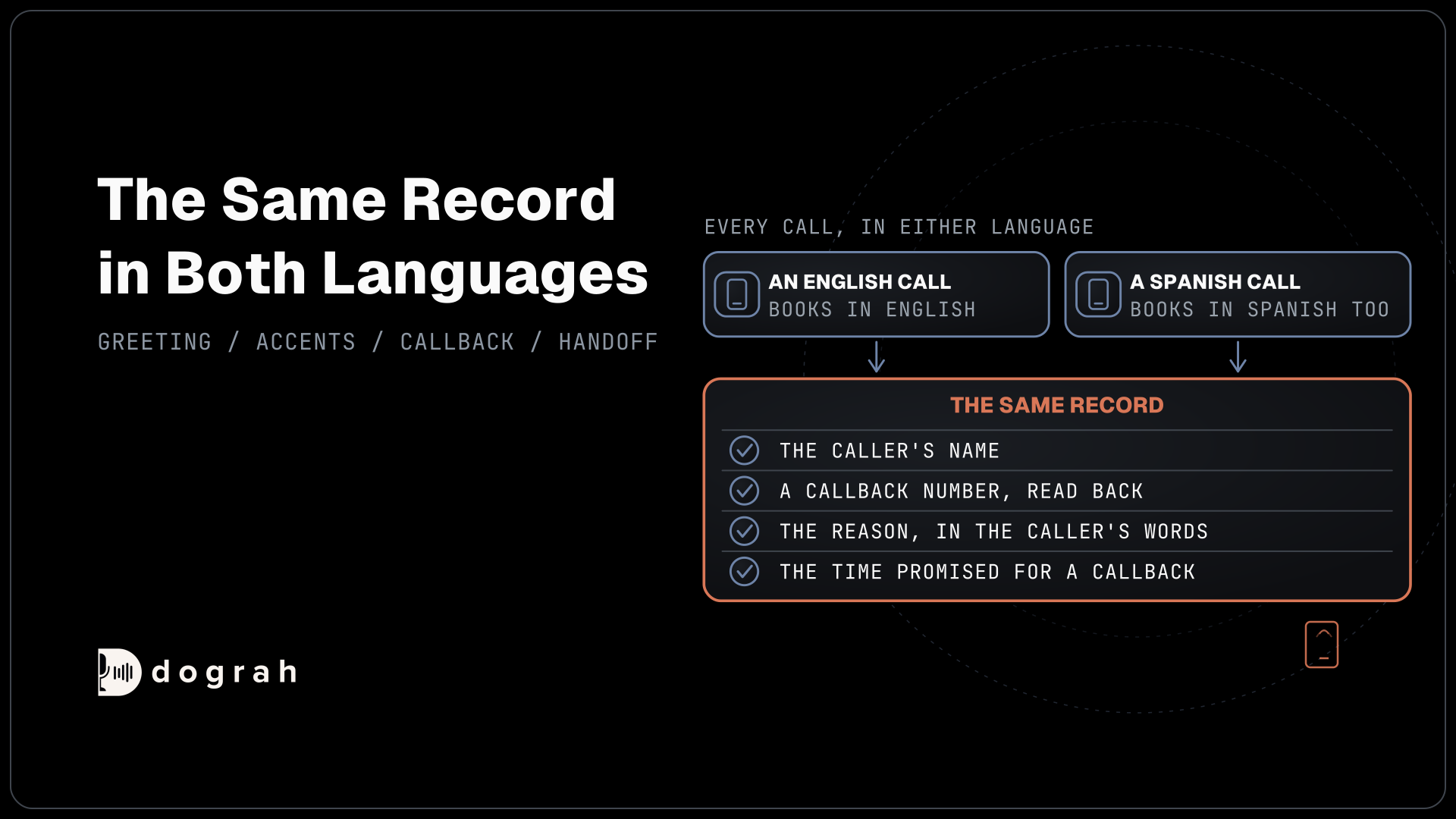
Every Spanish call should end with the same record an English call does. That means the caller's name, a callback number read back, the reason for the call in the caller's words and the time promised for a callback. The agent can book a slot from your calendar in Spanish just as it does in English, so a Spanish caller is never sent to a message when an English caller would get a booking.
Some calls belong with a person. A caller who asks for one, a complaint or anything the agent cannot confirm goes to a staff member who speaks Spanish. If nobody answers, the agent takes a callback request in Spanish and says when the call will come. Medical and legal topics have their own limits, and our post on Spanish AI voice agents for healthcare covers where an interpreter takes over.
Plan the review in Spanish too. A summary written from an English prompt comes back in English, so a Spanish-speaking staff member should read a sample of Spanish transcripts each week, starting with calls that ended in a transfer or a callback.
Join the Dograh Community
Dograh is an OSS alternative to Vapi. Join our Slack community for queries, releases, best practices & community interactions.
How this runs in Dograh
The bilingual greeting goes in the Start Call node's Greeting Text, which plays word for word before Dograh can hear the caller's language. For a number per language, point each number's Inbound workflow at its own agent with a greeting in its own language. For one agent that follows the caller, set Language in the Model tab to "Multilingual (Auto-detect)" and tick English and Spanish under Language hints, which work with Dograh's own models and Deepgram Flux. Hints steer recognition toward those two languages, but they do not guarantee it, so the prompt still tells the agent to ask when the caller's language is unclear. Speech and voice providers are chosen per agent there too, on your own keys.
A router agent hands the call over with Transfer to Agent. The Spanish agent gets its own language model and its own voice, so it answers in a Spanish voice, and it receives a labeled transcript of what was said before. Speech-to-text stays with the call, and it takes the Spanish agent's Language and Language hints only when both agents use the same speech-to-text provider, model and connection. The handover message starts in English, so write it in Spanish, and keep both agents on cascade models, since Transfer to Agent does not run on speech-to-speech agents.
For the Spanish-speaking person, Transfer Call works on Twilio, Telnyx, Plivo, Cloudonix and Asterisk ARI. Dograh calls the destination first and connects the caller only when someone answers. No summary travels with it by default, so an HTTP API tool writes the caller's details to your system first, and if nobody picks up within the 30-second default, the caller stays with the agent, which writes a callback request in Spanish through the same kind of tool. A voicemail that picks up counts as an answer and connects the caller to it, so turn voicemail off on that staff phone or set it to pick up later than the Transfer Timeout.
The speech and voice providers bill your own accounts, and the platform cost depends on where it runs. Running Dograh yourself carries no per-minute platform fee. Servers, model keys and phone minutes still cost money, and your team looks after the database and upgrades. Support comes from the open-source community, and Enterprise adds custom SLAs. Dograh Cloud runs it for you for a 1¢-a-minute platform fee, with models and phone minutes on top.
Glossary
- es-419
- The language code for Latin American Spanish. Deepgram lists it on its single-language models, while its multilingual models list Spanish only as es.
- Router agent
- A short agent that greets in both languages, confirms which one the caller wants, and hands the call to an agent built for that language.
- Language hints
- Checkboxes under Multilingual (Auto-detect) that tell the speech-to-text which languages to expect. They work with Dograh's own models and Deepgram Flux.
- Handover message
- The line the current agent says before Transfer to Agent hands the call over. It starts in English, so a Spanish line needs it rewritten.