
An AI answering service for collision and body shops takes insurer and claim details on the first call, books a drop-off or tow and reads repair status after a check. Coverage and fault go to the insurer, prices to your estimator. Dograh, the open-source AI voice agent platform, runs this claim intake on your own servers or Dograh Cloud.
Key Takeaways
- Nearly half of 2025 repairable inspections came through insurer repair programs.
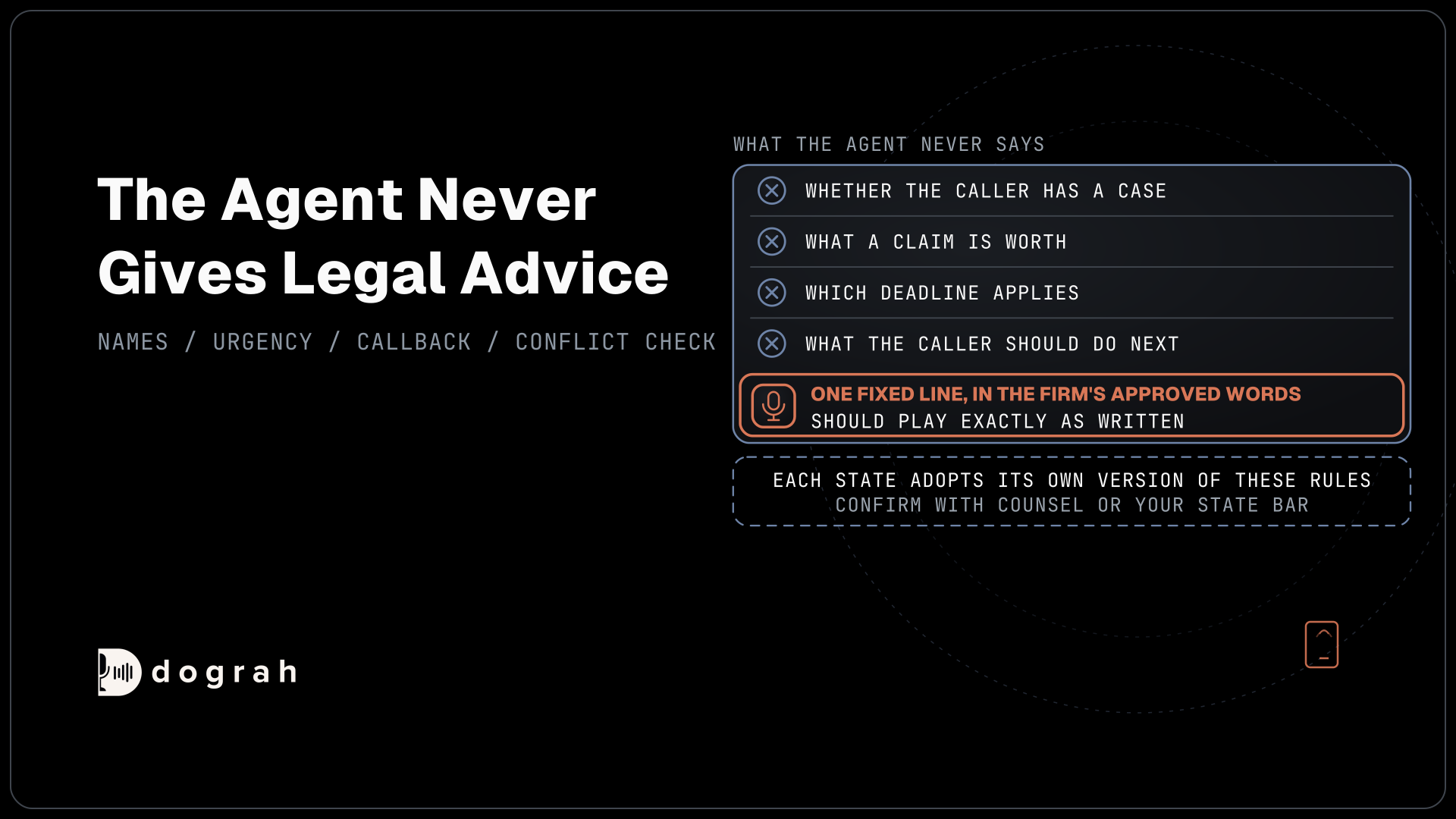
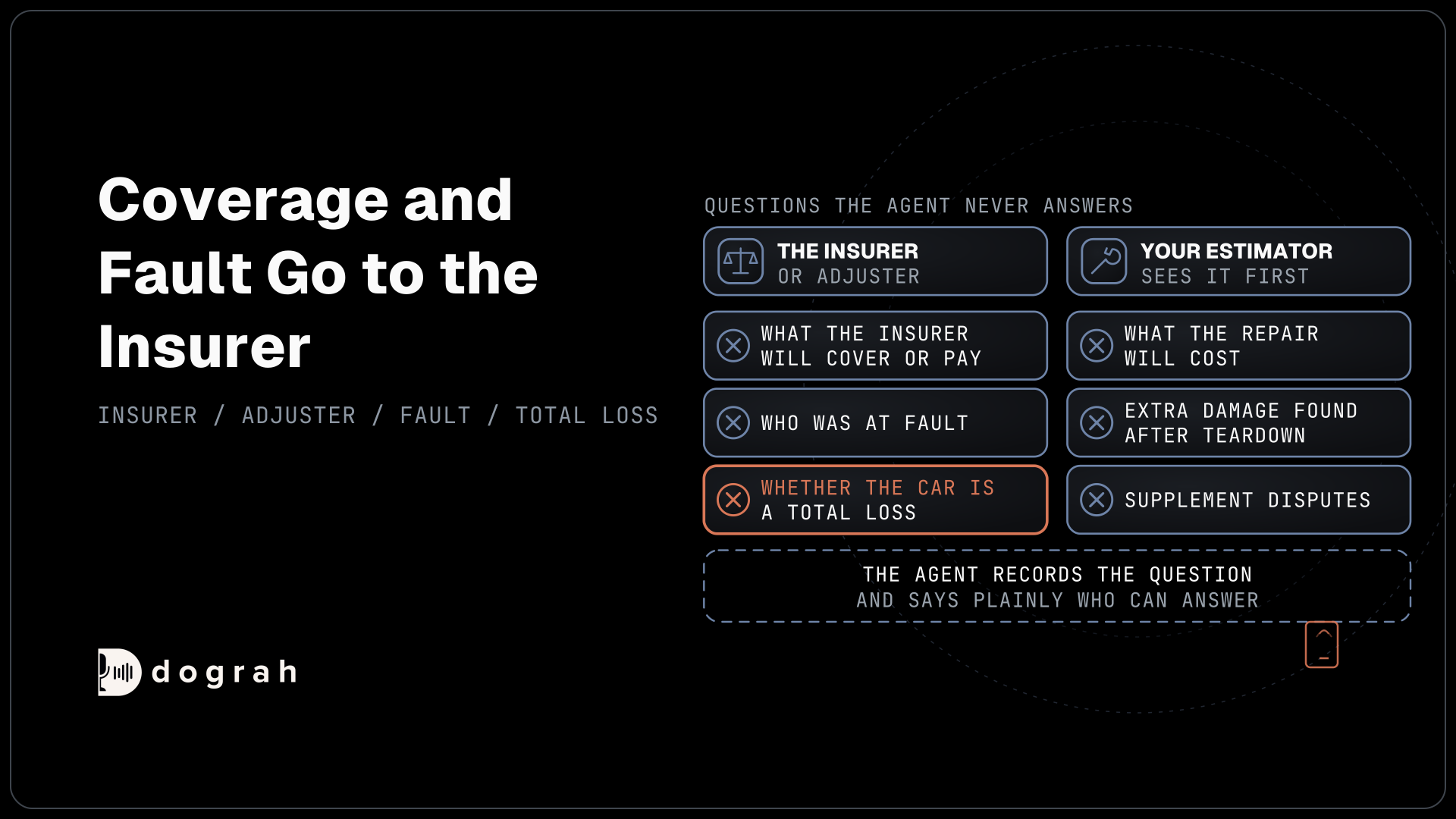
- The agent never says whether a car is a total loss.
- Prompt the Dograh agent to check the claim number or VIN before any status.
A collision caller's first words are usually their insurer's name. This guide walks from the claim details on the first call to the questions the agent leaves alone, status calls and the handoff to staff, and closes on how Dograh reads status and hands the call over.
Why collision calls start with the insurer
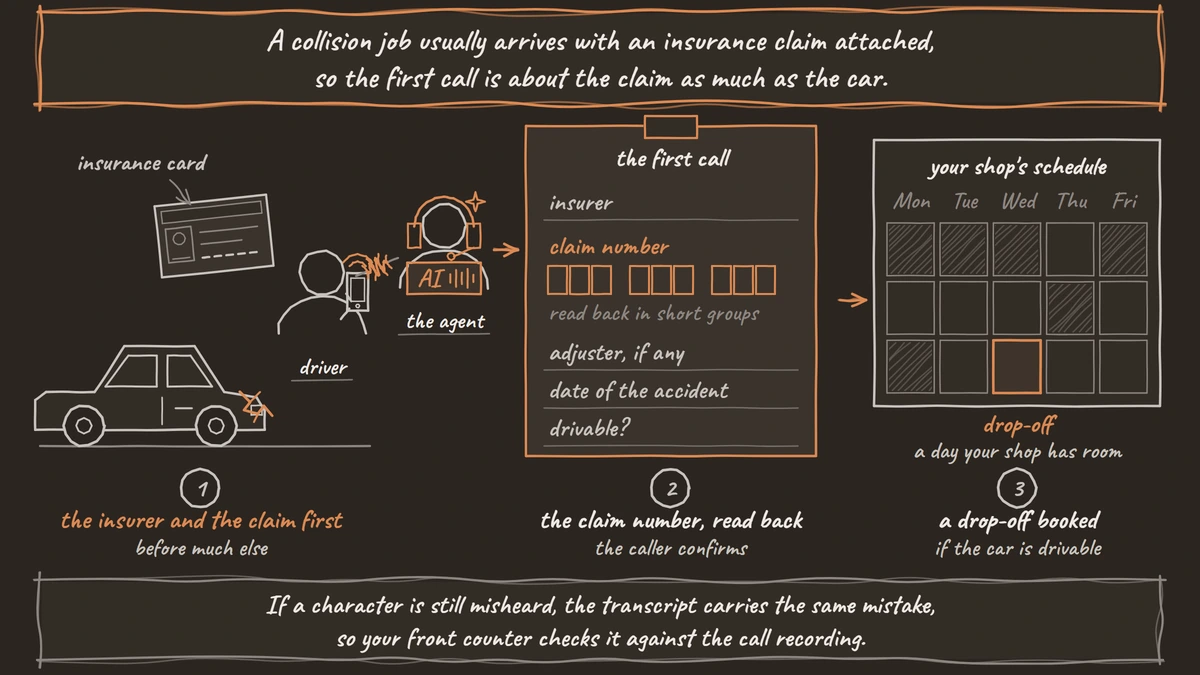
A collision job usually arrives with an insurance claim attached, so the first call is about the claim as much as the car. Repairer Driven News, reporting CCC figures for 2025, puts direct repair programs at 46.7% of repairable-claim inspections, with photo estimating at 26.4%. With close to half of those inspections going through insurer programs, the shop needs the insurer, the claim number and any assignment before it can do much else.
Claims are also getting heavier. CCC's Crash Course 2026 found that total losses reached 23.1% of claims, a new industry high, and that 28.3% of repairable estimates now include calibrations. So "is my car totaled?" is a real question on many calls, and only the insurer can answer it.
Human answering services cover these calls today, and some also set appointments. AnswerFirst charges $30 a month plus $1.60 to $1.95 a minute depending on usage, with appointment setting among its services. An AI agent can book the drop-off and read status from your own system at any hour, while your staff keep the calls that need judgment.
The first call, from claim details to drop-off
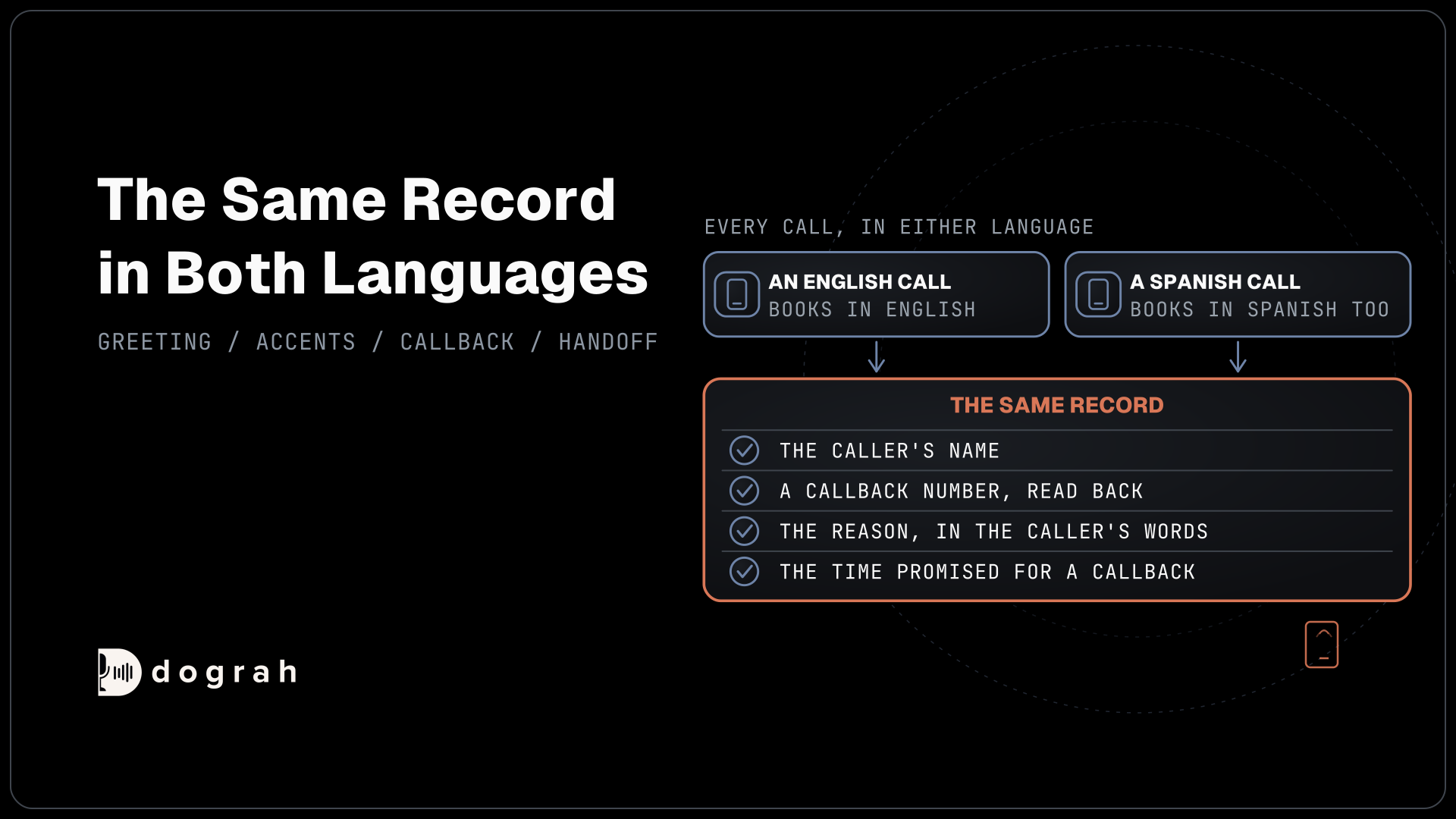
The intake call collects what the estimator and the insurer will ask for, and the agent reads each detail back. It asks for the insurer's name, the claim number, the adjuster's name if the caller has one and the date of the accident. Then it asks whether the car is drivable, where it is now, whether the insurer has already taken photos and whether the caller needs a rental.
Claim numbers are long strings of letters and digits, so the agent reads each one back in short groups and asks the caller to confirm. If a character is still misheard, the transcript carries the same mistake, so your front counter checks it against the call recording.
A drivable car gets a drop-off booked for a day your shop has room. A car that is not drivable gets a tow arranged through your tow partner, and the agent gives no advice on whether to drive it. A caller who mentions an injury hears "If this is a medical emergency, please call 911 now." before anything else. Mechanical drop-offs, extra-work approvals and the rental desk are covered in our post on AI voice agents for auto repair shops.
Questions the agent never answers
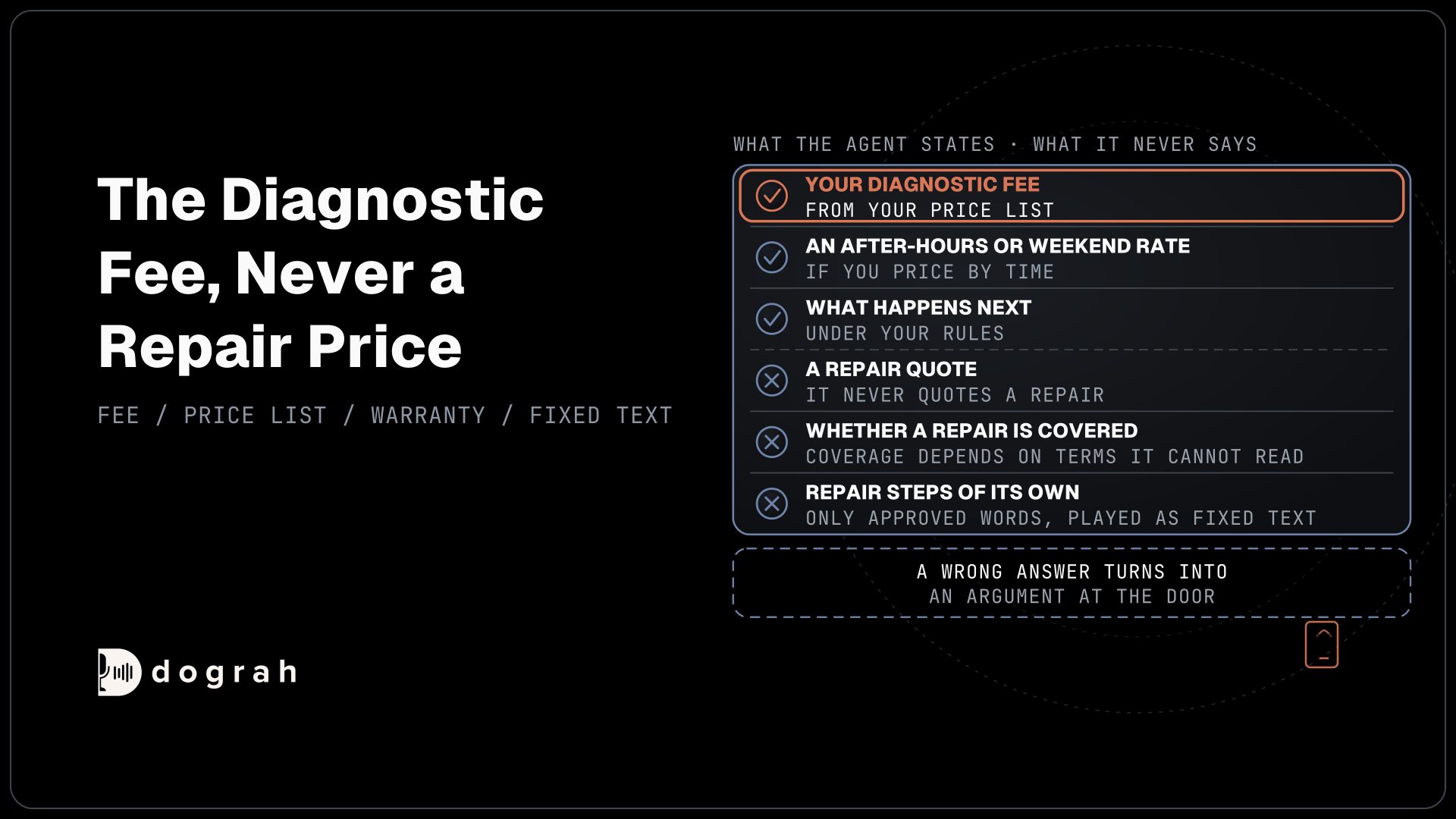
Some questions sound simple but belong to someone else. The agent never says what the insurer will cover or pay, or who was at fault, and it never guesses whether a car will be a total loss. Which shop the insurer requires and what the repair will cost are off limits too.
For each of these the agent says plainly who can answer. Coverage, fault and total-loss questions go to the caller's insurer or adjuster. Repair price and extra damage found after teardown go to your estimator, since the insurer approves a supplement only after the estimator writes it up. The agent records the question so the estimator sees it first.
Questions about the caller's rights under their policy also go to a person. The agent states only your own facts, such as which insurers you work with directly and how long a typical repair takes to schedule, and it leaves everything else to your staff.

Open Source Alternative to Vapi / Retell
Self-hosted voice agent platform — no per-minute fees
dograh-hq/dograh
Star on GitHub
Repair status calls in collision terms
Status calls repeat all day, and collision status has its own words. A car can be waiting on insurer approval, waiting on a supplement, waiting on parts, in calibration after the repair or ready for pickup. Each status needs a plain sentence your shop writes, such as "We're waiting on your insurer to approve extra repairs we found."
The agent finds the repair order by the caller's number, then checks who is calling before it says anything. A phone number finds a record, it does not prove who is on the line, so the agent asks for the claim number or the last characters of the vehicle identification number (VIN) or plate first. Our post on car repair status calls covers the lookup, the check and what to do when the shop system is slow.
Handing the call to the estimator or the counter
Some calls should reach a person quickly, and your shop decides which. Supplement disputes and questions about the bill go to the estimator, and so does a caller upset about a likely total loss. Pickup timing and keys go to the front counter. Keep the agent on the routine calls, since an upset or disputed caller needs someone who can listen and decide.
The person who picks up should not have to start over. The agent writes the claim number and the question, in the caller's words, to your system first, then transfers. If nobody picks up, the caller hears when to expect a callback, and our post on AI receptionist call transfer covers that no-answer path.
Join the Dograh Community
Dograh is an OSS alternative to Vapi. Join our Slack community for queries, releases, best practices & community interactions.
How this runs in Dograh
Status starts before the greeting. Pre-Call Data Fetch on the Start Call node, set to Inbound calls only, sends your endpoint the caller's number and the number they dialed. Your system returns the open repair orders for that number, and the greeting waits for the reply. Your prompt still has the agent check the claim number or VIN before naming any detail.
During the call, HTTP API tools do the rest. One finds the repair order by claim number when the caller rings from a number not on file, and the agent asks for the last characters of the VIN before it reads any status, as your prompt sets out. Another books the drop-off and a third writes the note before a transfer. They call your management system's API. CCC ONE shares data with outside apps through CCC Secure Share, which connects a shop only to apps that developers register with CCC and the shop turns on, so the tools call your own system or one of those apps rather than CCC ONE directly. Each tool can carry Messages, a line spoken as it starts and an update after a delay you choose.
Handoffs use Transfer Call, which works on Twilio, Telnyx, Plivo, Cloudonix and Asterisk ARI. Context Mapping sends supplement and price questions to the estimator and pickup calls to the counter. Dograh calls the destination first and connects the caller only when someone answers, and after the 30-second default the caller stays with the agent. An estimator's voicemail that picks up counts as answered, so turn it off on that line or have it answer later than the Transfer Timeout. Insurer names and terms such as "supplement" and "ADAS" (the driver-assist sensors that need calibration after a repair) go in the agent's Dictionary.
You pick where it runs. Running Dograh on your own servers keeps customer and claim records beside your shop data, with no per-minute platform fee. The servers, the model keys and the phone minutes still cost money, and your team runs the database and the upgrades. Community support covers the open-source version, and Enterprise adds custom SLAs. Shops that would rather not host it can use Dograh Cloud for a 1¢-a-minute platform fee, with model and phone usage billed on top.
Glossary
- Direct repair program (DRP)
- An agreement between an insurer and a shop to repair the insurer's claims. In 2025, 46.7% of repairable-claim inspections went through one, per CCC data.
- Supplement
- Extra repair work found after the first estimate, often after teardown. The estimator writes it up and the insurer approves it.
- Total loss
- A claim where the insurer decides the car is not worth repairing. Only the insurer makes that call, so the agent never answers it.
- Pre-Call Data Fetch
- A Dograh setting that sends the caller's number to your system as the call connects, so open repair orders load before the greeting.