
An AI voice agent for an auto repair shop or car rental desk answers calls while staff are busy. It books drop-offs and rentals from your live system, reads repair status to verified customers and records approvals for extra work for an advisor to confirm. Dograh, an open-source AI voice agent platform, can run this desk.
Key Takeaways
- Verify with the plate or VIN before naming the car or the work.
- The agent records an extra-work approval. The service advisor confirms it.
- Rental bookings never promise a car the fleet system holds for a recall.
Repair shops and rental counters lose calls to the same problem: the person who knows the answer is under a car or handing over keys. Below, we cover bookings, status calls, approval for extra work and the rental desk. Then we set each call up in Dograh.
Why the phone pulls technicians off the car
In a small shop, the person who answers the phone is often the person doing the work. The US Bureau of Labor Statistics counted about 825,800 automotive service technician and mechanic jobs in 2025, with about 66,200 openings a year and a median pay of $50,620 in May 2025. Every call a technician takes is time away from a paid job.
Rental counters have the same squeeze. The staff who could answer "can I keep the car until Sunday" are busy with the customer in front of them. A voice agent takes the routine calls on both lines and sends the rest to a person.
Dealerships with a service drive and a dealer management system have their own patterns for bay booking, reminders and recalls, covered in our guide to AI voice agents for automotive and dealerships. This post is for independent shops and rental desks.
Booking a drop-off or a bay
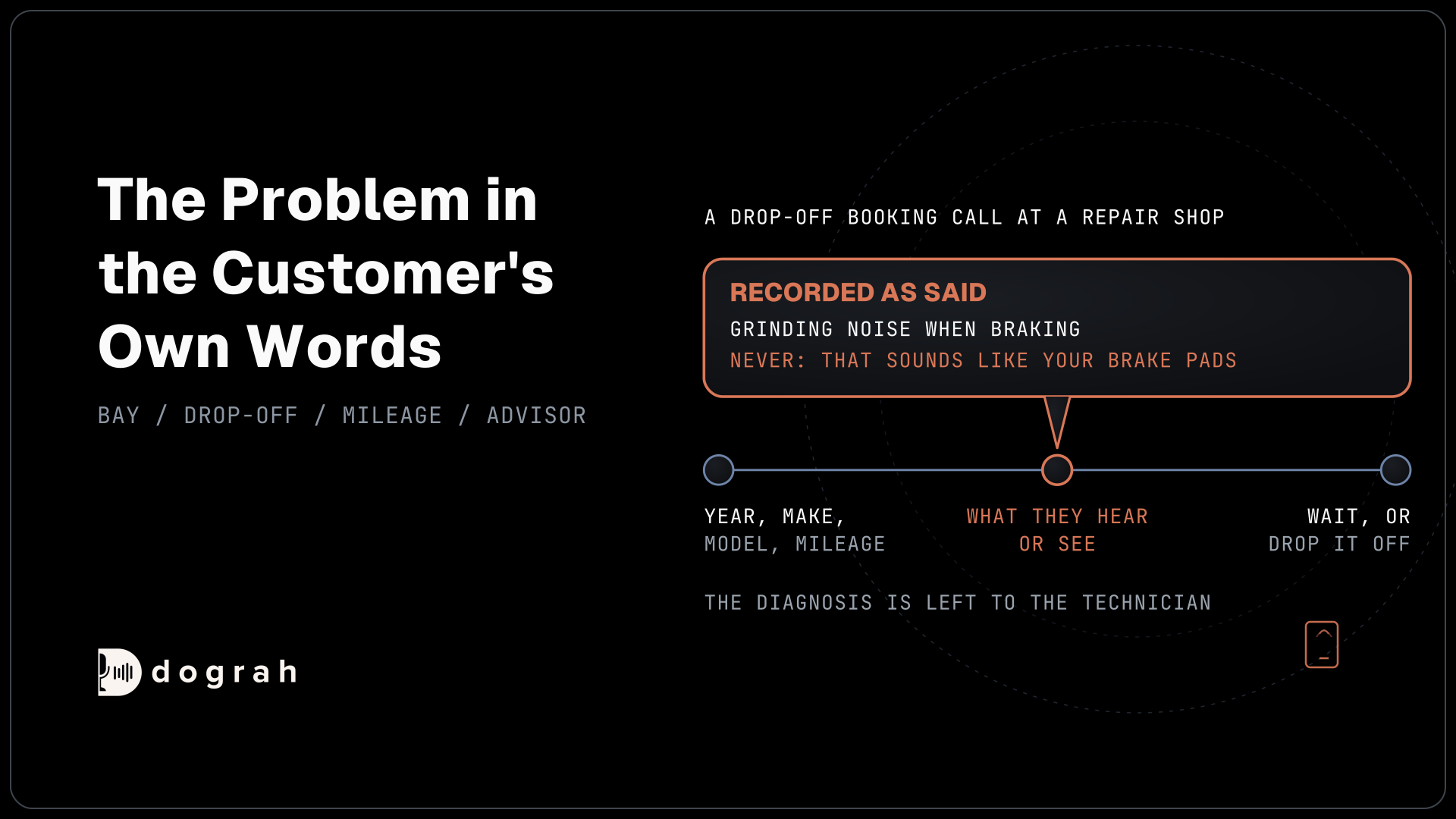
The agent books from the live calendar in your shop management system and records the problem in the customer's own words. It asks for the year, make, model and mileage, what the customer hears or sees, and whether they will wait or drop the car off. Questions about the shuttle, the waiting room or a loaner car are answered from the shop's own Knowledge Base file, which you keep up to date.
An HTTP API tool reads open slots during the call and writes the booking back, and the booking counts only when your system confirms it. Dograh connects this way to any shop or rental system with an API. Our post on AI voice agents for appointment scheduling covers the full read, offer, write and read-back loop.
The agent never diagnoses or prices a repair. "That sounds like your brake pads" is a diagnosis, so the agent records "grinding noise when braking" and leaves the rest to the technician. Model names and part terms that speech-to-text tends to mishear go in the agent's Dictionary in Settings.
"Is my car ready?" status calls
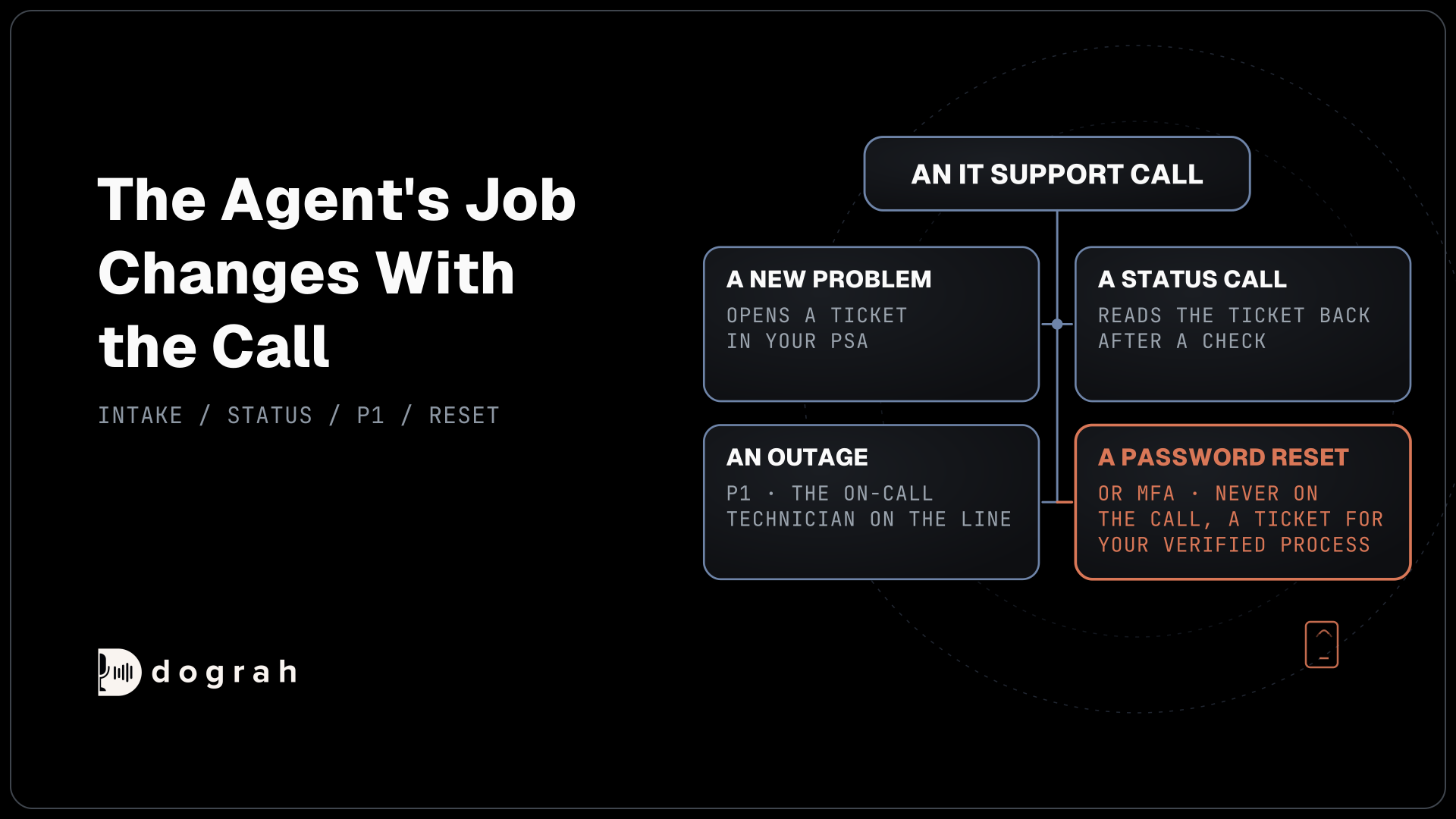
Status calls are short and repetitive, which makes them a good first job for the agent. Pre-Call Data Fetch, set to Inbound calls only, sends the caller's number to your endpoint as the call connects, and the endpoint returns the open repair order.
The number finds the repair order, but it does not prove who is calling. Before naming the car or the work, the agent asks for the plate number or the last four characters of the VIN. Then it reads the status as the advisor wrote it in the shop system. "Waiting on a part, expected Thursday" is fine if the system holds Thursday, and the agent never invents a date.
When a job is running late, the call should still end with something useful. The agent can offer a callback from the advisor at a set time and write that request to the shop system. A customer who asks whether the work is covered by warranty, or why the price changed, goes to the advisor.
Shops can also call out when the job is done. When the repair order closes, your shop system can trigger Dograh's API Trigger to place a "your car is ready" call. Under the Telephone Consumer Protection Act (TCPA), a call to a mobile number in an artificial voice, which includes an AI voice, needs the person's prior express consent, as the FCC's calling rules set out. Ask for that consent at drop-off.

Open Source Alternative to Vapi / Retell
Self-hosted voice agent platform — no per-minute fees
dograh-hq/dograh
Star on GitHub
Extra work: the agent records, the advisor confirms
When a technician finds more work, the approval call is where the shop most needs a clean record. In California, a shop may get a customer's approval for work beyond the written estimate by phone, text or email. It must then record the date and time, the name of the person who approved, the number or email used, the added work, its cost and the new total, as the Bureau of Automotive Repair sets out for the Automotive Repair Act.
So the agent never decides anything here. The advisor writes the revised estimate in the shop system. The agent calls the customer, reads the added work and the new total from that estimate, and records the yes or no with the time and the number it called through an HTTP API tool. The advisor then confirms with the customer before any work starts. Rules differ by state, and whether a customer's yes to an AI agent counts as authorization on its own is a point to confirm with counsel before you rely on it.
Questions about whether the extra work is really needed go straight to the advisor. The call recording and transcript are the exact record of what was said, because the answer the agent extracts is an AI summary, not a word-for-word copy.
The rental desk: bookings, extensions and returns
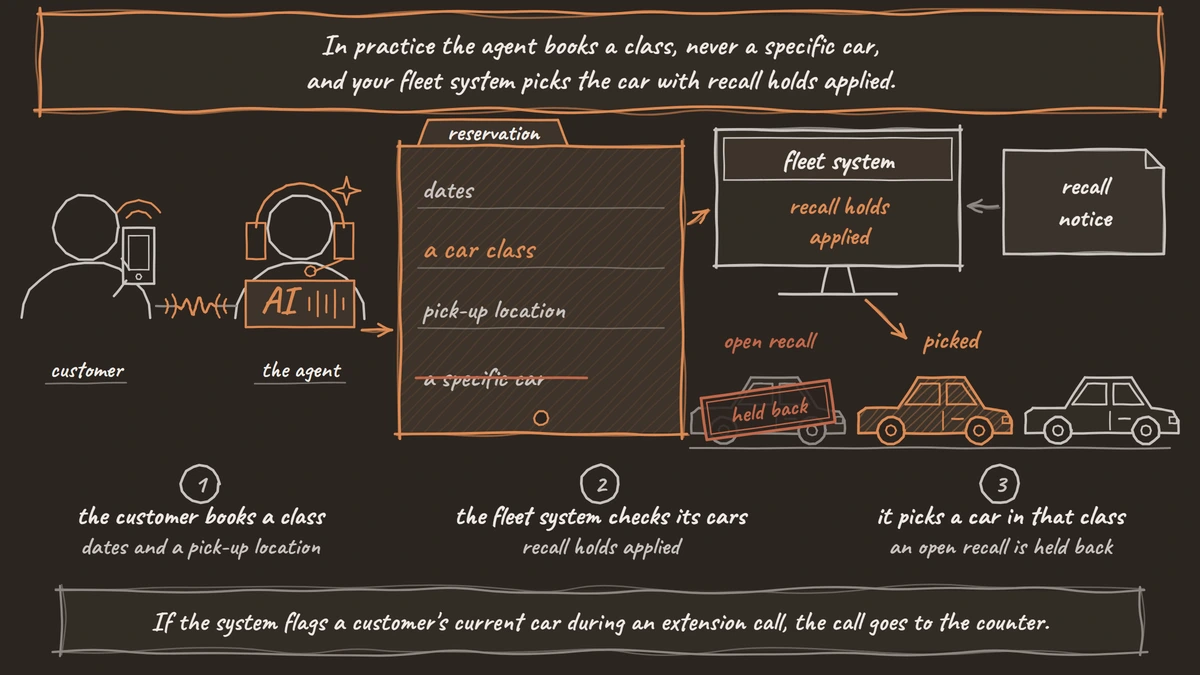
Rental calls are bookings under another name, built from dates, a car class and a pick-up location. The agent reads availability from your rental system and writes reservations, extensions and new return times back through HTTP API tools. A customer asking to keep the car two more days gets an answer from the system, not a guess. Location rules, such as after-hours key drop or the grace period on a late return, come from a Knowledge Base file per location, so the agent answers the same way the counter would.
Recalls change what the agent may promise. Under the federal Raechel and Jacqueline Houck Safe Rental Car Act, a rental company may not rent a vehicle with an open safety recall until the defect is fixed. Where the recall notice says no fix is available yet but lists interim steps, the car can be rented once those steps are done. In practice the agent books a class, never a specific car, and your fleet system picks the car with recall holds applied. If the system flags a customer's current car during an extension call, the call goes to the counter.
Damage, accidents and breakdowns go to a person. Anyone in danger is told to get to safety and call 911, and breakdown calls follow the safety-first flow in our guide to AI voice agents for roadside assistance. Deposits and payments never happen by voice. An HTTP API tool asks your rental or payment system to send its own secure link.
Join the Dograh Community
Dograh is an OSS alternative to Vapi. Join our Slack community for queries, releases, best practices & community interactions.
Handing the call to the advisor or the counter
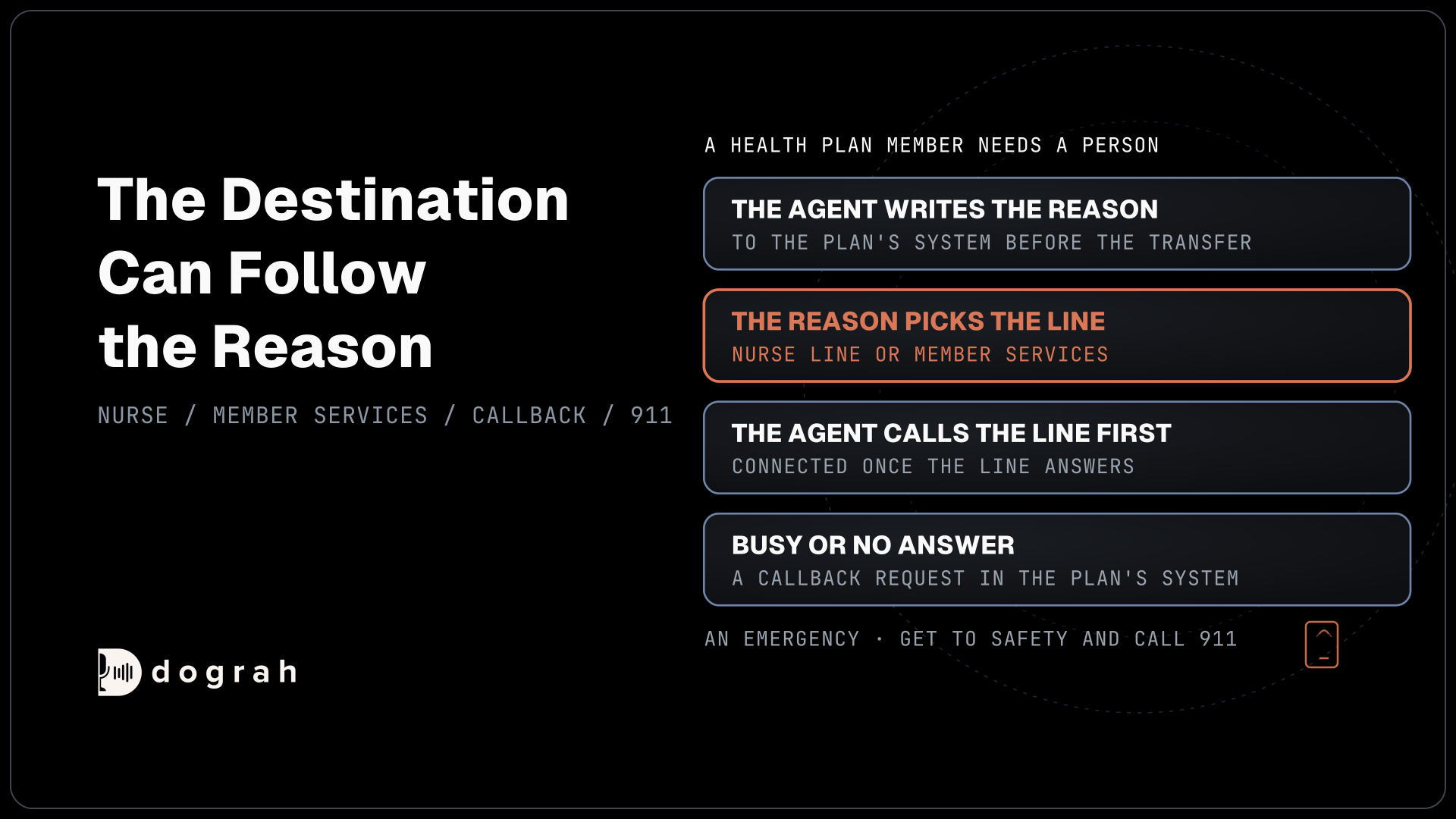
Most handoffs at a shop go to one of two people, the service advisor or the rental counter. Transfer Call works on Twilio, Telnyx, Plivo, Cloudonix and Asterisk ARI, and its Context Mapping option picks the destination from what the call was about, repair or rental.
Dograh calls the advisor or the counter first while the caller hears hold music, and puts them through once someone picks up. If the advisor is under a car and does not pick up within the timeout, 30 seconds by default, the agent is told the transfer failed and the call carries on. It then writes a callback request to your shop system. No summary goes across by default, so the agent writes the note first. Test each transfer over a real phone call before launch, because browser test calls cannot transfer to a phone number.
Running it in your shop's own voice
Regular customers know the voice at the counter, and you can keep it. With pre-recorded clips, the agent plays your own recordings for the greeting and the hours and falls back to a cloned version of the same voice for everything else. If you want to tell callers they are speaking with an automated assistant, or your state requires it by law, write it in the Greeting Text with the shop's name. Then switch off Allow Greeting Interruption on the Start Call node so the full line plays.
Built-in QA scores a sample of calls step by step, and a QA prompt can flag any call where the agent named a price or a diagnosis. Self-hosted Dograh has no per-minute platform fee, but servers, model keys and phone minutes still cost money. Dograh Cloud charges a 1¢-a-minute platform fee.
A chain of shops or rental branches has routing and local-number questions of its own, covered in our guide to AI voice agents for franchises. For a single shop, start with status calls, where the agent only reads, then add bookings and approvals once a week of calls sounds right.
Glossary
- Repair order
- The shop's record of one job on one car, holding the customer's complaint, the work done and its status. The agent finds it from the caller's number and reads status from it only after verifying the caller.
- Extra-work approval
- A customer's approval for work beyond the written estimate. California lets shops take it by phone, text or email if they record who approved, when, on which number, the added work and the new total.
- Open safety recall
- A safety recall whose fix has not yet been done on a given car. Federal law bars rental companies from renting such a car until it is fixed, or until interim steps in the notice are done.
- Shop management system
- The software an independent shop uses for bookings, repair orders, estimates and invoices. The agent reads and writes it through its API during the call.