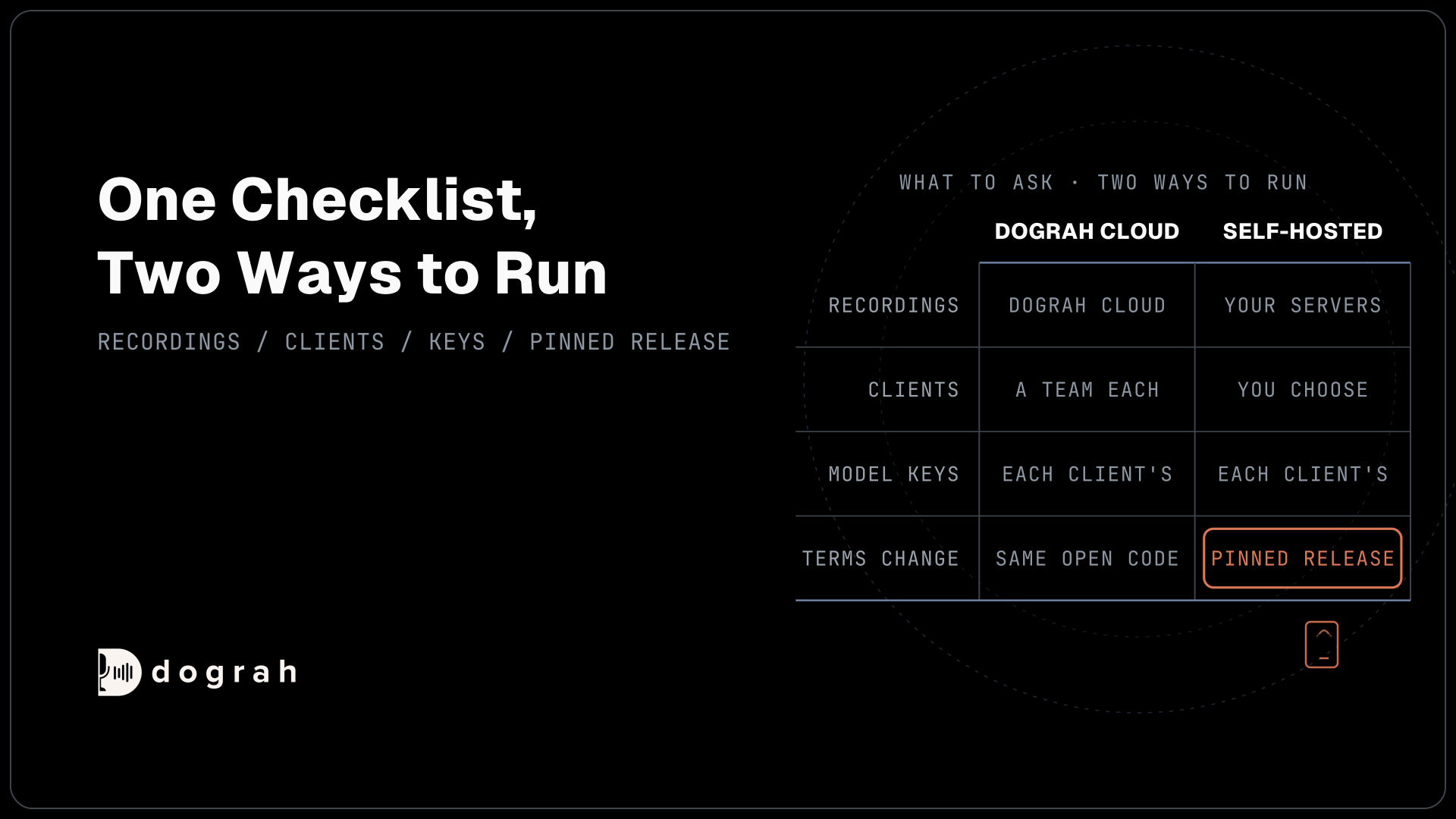

Check five things in a white-label voice AI platform. Look at how deep the branding goes, where it runs, how it keeps clients apart, whether each client can use its own model keys, and what happens when the platform changes its terms. Dograh, the open-source AI voice agent platform we build, runs self-hosted under your brand or on Dograh Cloud.
Key Takeaways
- Ask whether the branding stops at the call or reaches the dashboard.
- Each client should run on its own records and its own model keys.
- Open source settles terms changes, because you keep running the version you chose.
This post is part of our guide to running an AI voice agent agency, where your brand on the call sits beside the stack, pricing and keeping clients apart. Below are five questions to ask any platform, how closed platforms and open source answer each, and a table of answers.
How deep the branding goes
Branding on a voice AI platform can reach the call, the dashboard or both, and the difference shows the day a client logs in. Almost every platform lets you set the agent's greeting, voice and caller ID, so callers hear your client. The dashboard is where platforms split. Retell does not rebrand its own dashboard, and clients join a workspace as read-only members.
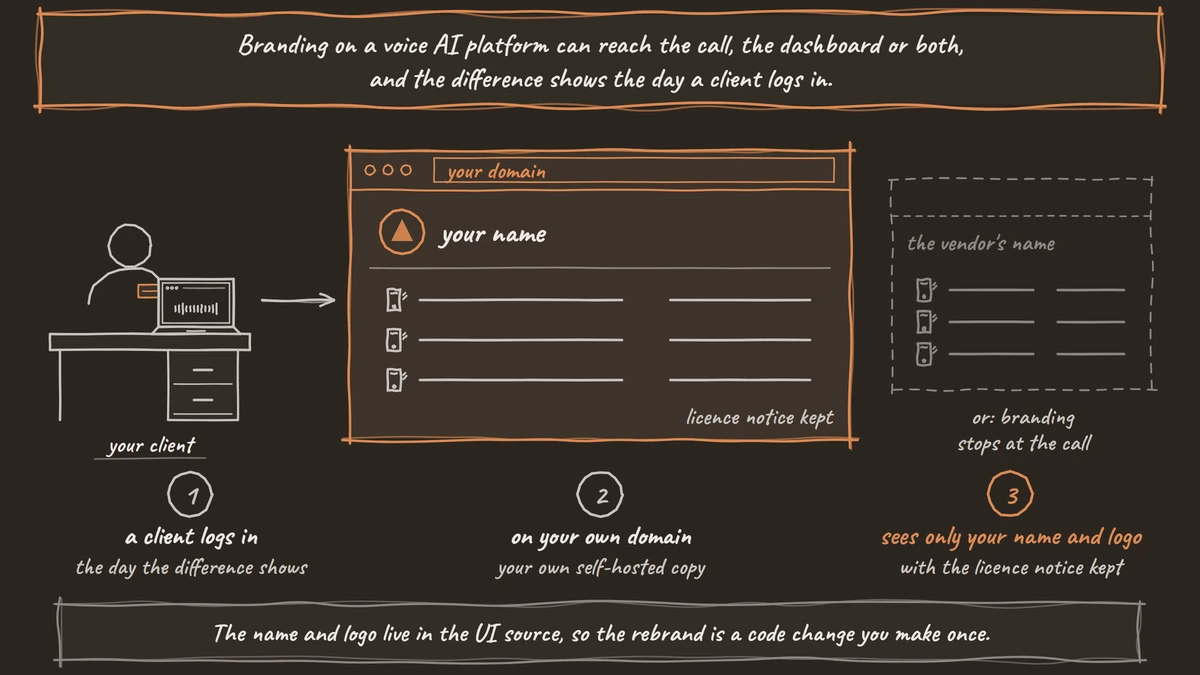
Open source answers this one through the licence. Self-hosted Dograh is released under the BSD 2-Clause licence, so an agency can run its own copy on its own domain under its own name and logo, with the licence notice kept. The name and logo live in the UI source, so the rebrand is a code change you make once.
On Dograh Cloud, the call carries your client's brand and the dashboard stays ours. Ask every platform the same question: can a client log in on my domain and see only my name?
Where the platform runs
Where the platform runs decides where your clients' recordings and transcripts live. A hosted-only platform keeps them in the vendor's cloud, in whatever regions it offers. Dograh runs three ways: self-hosted on your own servers, on Dograh Cloud, or as an Enterprise install on-premises or in a private cloud.
Self-hosting lets you put a client's calls in the country its contract names, as long as the models run there too. Bring your own key (BYOK) does not get you there on its own. It moves the contract with the model provider to you or the client, while the audio still travels to that provider. Full data sovereignty comes only from open-weight models running on your own servers, which a self-hosted install can use for speech-to-text, the language model and the voice.
How each client is kept apart
Ask what one client can see of another, and what they share underneath. On Bolna's sub-accounts, each client's agents and call logs are separate, while phone numbers and providers stay at the organization level and billing is consolidated, and sub-accounts are an Enterprise feature. Retell gives each client a workspace with its own API key and its own usage bill, created in the dashboard. Vapi charges $20 a month for each additional organization.
On Dograh Cloud, each client gets its own team, which you switch between from the sidebar. A team is a full organization with its own agents, numbers, model keys, files and billing, so nothing is shared between clients. Everyone in a team has full access to it, so invite only the people who should see every setting.
Self-hosted, you choose the split. Clients can sit in one install with their own agent, phone setup and model keys each, sharing one concurrency limit and visible to everyone who logs in. Or each client can have its own login, which makes it a separate organization with its own limit.

Open Source Alternative to Vapi / Retell
Self-hosted voice agent platform — no per-minute fees
dograh-hq/dograh
Star on GitHub
Model choice and each client's keys
Model choice decides who pays the model bill and who can change it. A bundled reseller plan picks the speech-to-text, language model and voice for you, which keeps one simple minute rate and leaves you with no way to give one client a different voice.
With your own keys, each client can run on its own accounts. Dograh lets you connect several accounts for the same provider and give each agent its own named model configuration, so client A's calls bill client A's OpenAI key and client B's calls bill client B's. One connection can also hold several keys that Dograh rotates between, and you can set a backup language model that takes over if the main one errors, which is off until you turn it on. Our post on BYOK vs managed models covers when each makes sense.
When the platform changes its terms
The question no feature list answers is what happens when the platform changes. Vapi retired its Workflows product on August 18, 2026, and existing workflows stopped running the next day, so every agency built on it rebuilt each client's agent. Our post on the hidden costs of closed voice AI platforms covers that case and the price and plan changes that work the same way.
Ask how much notice the platform gives before it retires a feature, whether you can export agent definitions, recordings and transcripts, and whether your price is fixed for the contract.
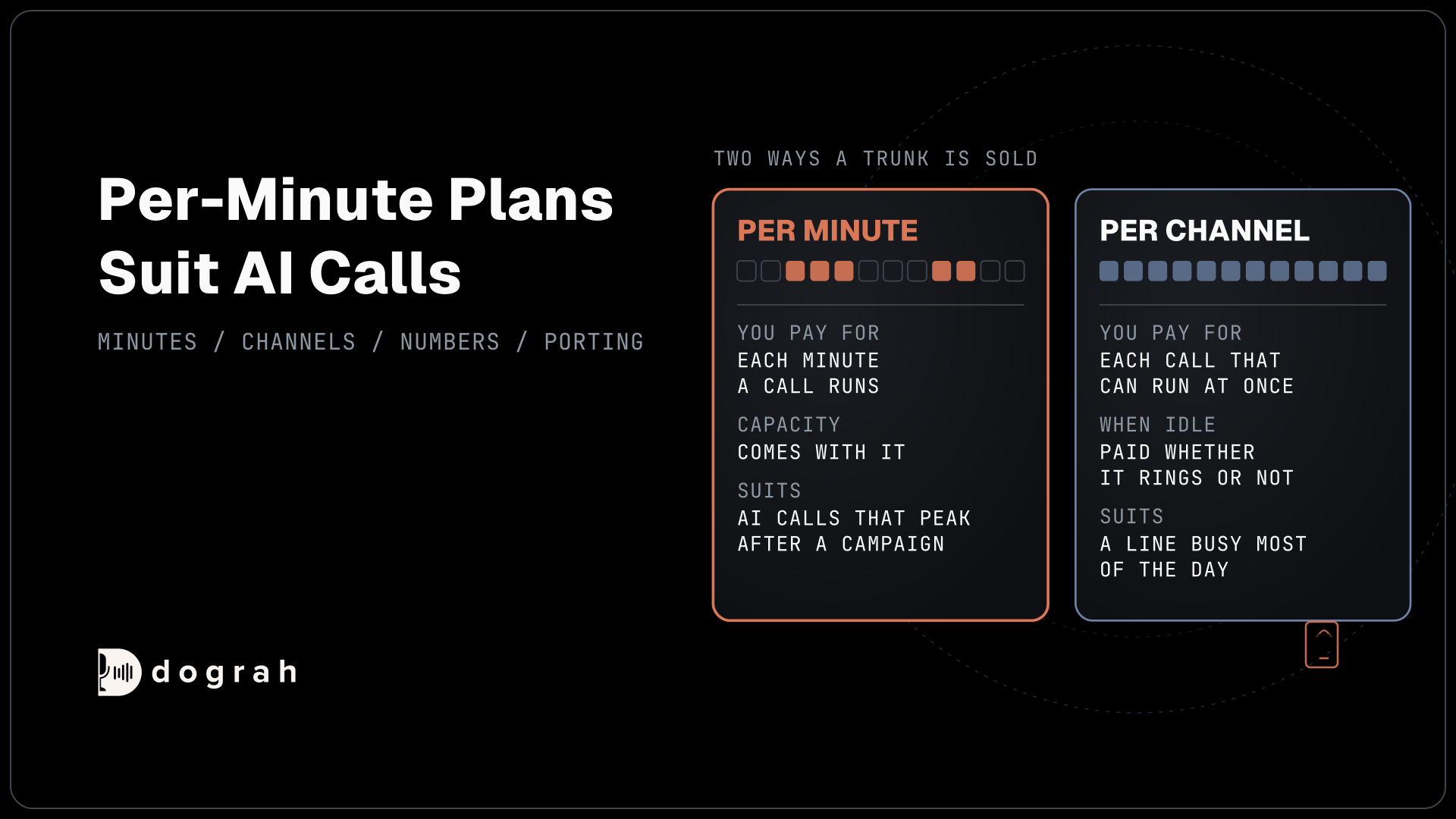
Open source answers the question differently. A self-hosted copy is code you run, so you stay on a pinned release, the version you chose, and upgrade after testing your clients' agents on the new one. Self-hosted Dograh has no per-minute platform fee, but servers, model keys and phone minutes still cost money. Dograh Cloud charges a 1¢-a-minute platform fee. It runs the same open-source code, so a client can move to your own servers later.
The checklist in one table
The table compares how each platform keeps clients apart, what stays shared at the top and how each client is billed. Dograh appears twice, once for each way to run it.
| Platform | How clients are separated | Shared at the top | Billing per client | Plan |
|---|---|---|---|---|
| Retell (agency workspaces) | One workspace per client, made in the dashboard, own API key | The dashboard, which is not rebranded | Each workspace billed for its own usage | Pay as you go, 20 concurrent calls per workspace |
| Bolna (sub-accounts) | Agents and call logs per sub-account | Phone numbers and providers | Consolidated, with a per-sub-account view | Enterprise feature |
| Dograh Cloud | One team per client, switched from the sidebar | Nothing, each team is its own organization | Billing account per team | Pay as you go, 10 concurrent calls included |
| Dograh self-hosted | Agent, phone setup and model keys per client, or a login per client | The concurrency limit, if clients share one organization | Paygent rate cards per client | No per-minute platform fee, your servers |
Run the five questions on any platform before your first client signs, because each answer becomes a promise you make to every client after it. If your first product is a receptionist, our post on the white-label AI receptionist covers what the client sees and who holds the numbers.
Join the Dograh Community
Dograh is an OSS alternative to Vapi. Join our Slack community for queries, releases, best practices & community interactions.
Glossary
- Branding
- How far your brand reaches on a platform. Some stop at the call, where callers hear your greeting and voice, and others reach the dashboard, the domain and the emails your clients see.
- Sub-account
- A separate space for one client inside an agency's account. Platforms differ on what stays shared above it, such as phone numbers, provider keys, billing or the concurrency limit.
- Bring your own key (BYOK)
- Running the speech and language models on your own or your client's provider accounts. It moves the contract and the bill to that account, while the call audio still reaches the provider.
- Pinned release
- A specific version of self-hosted software that you keep running until you choose to upgrade. It means a platform change reaches your clients only after you have tested it.