
Voice cloning consent is the speaker's specific, informed permission, covering what the clone says, where, for how long and how to withdraw. US rules treat cloned voices on calls as artificial voices, and EU rules require AI notices and marked synthetic audio. Whether you self-host Dograh or use Dograh Cloud, you bring your own voice provider and keep the record.
Key Takeaways
- Get written consent that names the lines, agents, term and pay.
- A provider's consent check helps, but your own signed record is the proof.
- EU rules require machine-readable marks on synthetic audio and disclosure of deep fakes.
Cloning a real person's voice for a phone agent takes more than a good recording. We cover what consent has to include, the US and EU rules with their dates, watermarking, and a sample checklist. Then we talk about how the consent and the AI notice fit a Dograh agent.
What valid voice consent includes
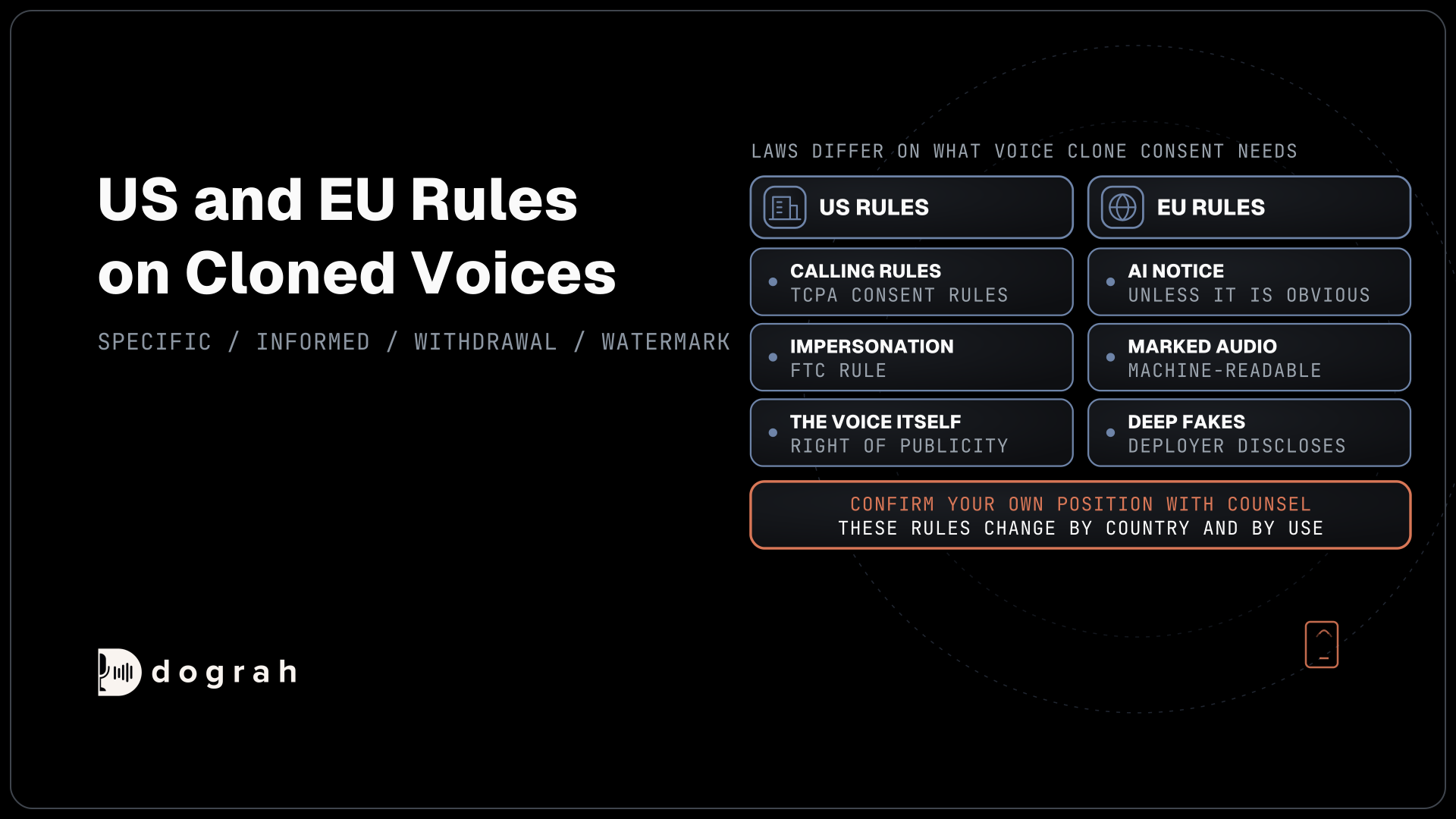
Laws differ on what voice clone consent needs, so a safe standard is consent that is specific, informed and freely given, kept on a signed record, and that the speaker can take back. A clause buried in an employment contract that says the company may use your voice for AI is written, but it is neither specific nor informed, and CAMB.AI, a voice provider, makes the same point about blanket wording.
Freely given is the hard part with staff. A request from a manager rarely feels optional, so offer a paid voice actor as the default and treat an employee's voice as their choice, with no effect on their job if they say no. Specific means the agreement names what the clone will say, on which lines and agents, in which languages and for how long. Informed means the speaker has heard a sample of the clone on a phone call before they sign, because a clone on a handset can sound different from the studio version.
Withdrawal needs a plan before it is needed. The agreement says how the speaker withdraws, how fast the voice comes off every agent and what happens to the clone at the provider. Leaving the company is the same moment in practice, so set the end date when someone leaves, or a notice period both sides agree. Pay belongs in writing too, whether it is a one-off fee or a fee for each year of use.
Some voices should not be cloned at all. A clone of a staff member that callers know by name can mislead them into thinking they are talking to that person. Our post on voice cloning for AI voice agents covers when a clone helps a phone agent and when it backfires.
US rules for cloned voices
US federal law reaches cloned voices through the calling rules. In its February 2024 ruling, FCC 24-17, released 8 February 2024, the Federal Communications Commission said AI-generated voices, cloned voices included, are "artificial or prerecorded voice" under the Telephone Consumer Protection Act (TCPA). So the TCPA's consent rules apply to calls that use them, and every artificial-voice message must name the business at the start and give a number to reach it. The ruling adds no rule that the call must say the words "I am an AI".
Impersonation is a separate federal rule. The Federal Trade Commission's rule on impersonation of government and businesses, in force since April 2024, makes it unlawful to materially and falsely pose as a government body, a business or its officers. A clone used to pass a call off as a real bank or a real official falls under it. The rule as it stands does not cover impersonating a private individual.
State law protects the voice itself through the right of publicity. Tennessee's Ensuring Likeness Voice and Image Security Act (the ELVIS Act), in effect since 1 July 2024, gives every individual a property right in their name, photograph, voice and likeness, and counts a simulation of the voice as the voice. It makes publishing or otherwise making available a person's voice actionable when the one doing it knows the person did not authorize the use, and it reaches anyone who distributes a tool whose primary purpose is producing an identifiable person's voice without permission.
Federal law may follow. The NO FAKES Act of 2026, S. 4591, was approved by the Senate Judiciary Committee on 18 June 2026 and placed on the Senate calendar, but it is not law.
EU rules on notices and marked audio
The EU AI Act puts three duties on cloned voices in calls, all applying since 2 August 2026. Under Article 50 of the EU AI Act, people must be told they are interacting with an AI system unless it is obvious. Providers of systems that generate synthetic audio must add machine-readable marking so it can be detected as artificial. Deployers who use audio that is a deep fake, such as a clone of a real person, must disclose that it was artificially generated.
The marking duty had a grace period for older tools. Under the Digital Omnibus on AI, systems already on the market before 2 August 2026 were given until 2 December 2026 to add the marking. For a business running a phone agent, the marking sits with whoever provides the voice model. The interaction notice is a duty of the agent's provider, which is the business itself when it builds its own phone agent, and the deep fake disclosure sits with the business as the deployer.
Notice wording is easy to get wrong, and our post on what a voice agent must tell callers under Article 50 has sample opening lines. These rules change by country and by use, so treat this as our reading for a typical agent and confirm your own position with counsel before a cloned voice goes live.

Open Source Alternative to Vapi / Retell
Self-hosted voice agent platform — no per-minute fees
dograh-hq/dograh
Star on GitHub
What watermarking does and does not prove
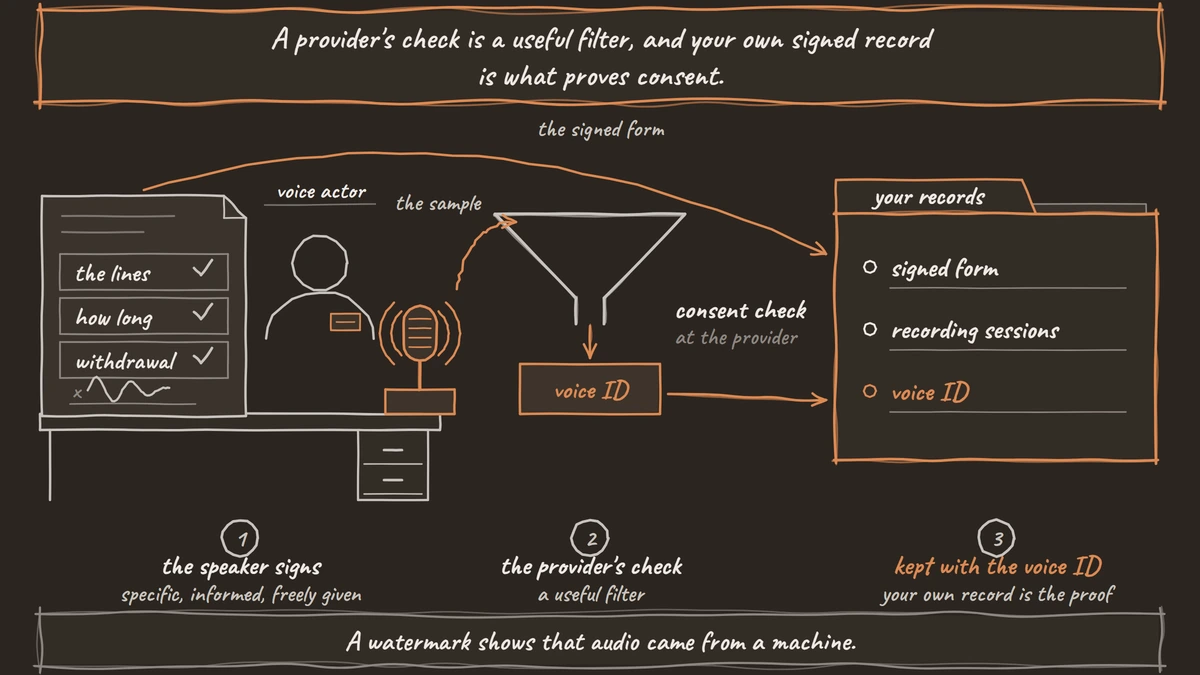
A watermark shows that audio came from a machine. It does not show that the person whose voice it copies agreed. Chatterbox, an open MIT-licensed model that can clone voices, marks every output with Resemble AI's Perth watermark, and the EU AI Act asks providers of audio generators for marks of this kind. Marks like these help a listener or a platform detect a clone after the fact.
Consent checks at the provider have the same limit. Hugging Face researchers built a voice consent gate in which the speaker reads a freshly generated consent sentence live, speech recognition checks the words, and only then does that recording become the cloning sample. Its authors say it is not foolproof, since a person could still generate a matching phrase using another TTS system. A provider's check is a useful filter, and your own signed record is what proves consent.
Deepfake voice calls are no longer rare. In Hiya's State of the Call 2026 report, 31% of more than 12,000 consumers in six countries said they had received a deepfake voice call in the past year. A clone also creates a security risk for everyone else. A voiceprint can be biometric data under some laws, as our post on why voice data counts as biometric data explains, and a good clone can fool voice-based checks. That is why callers should be verified without relying on how they sound, covered in our post on verifying callers without a voiceprint.
A sample voice cloning consent checklist
The checklist below is a sample we wrote for phone agents, not a legal form. Use it to brief your lawyer and to check that nothing is missing before a clone goes live.
- Who. The speaker's full name, and whether they are a paid voice actor or a staff member who chose to take part.
- What. The lines and topics the clone may say, and topics it may never say, such as prices or medical advice.
- Where. The agents, phone numbers, languages and countries where the voice runs.
- How long. A start date, an end date or a review date, and what happens when the speaker leaves.
- Pay. The fee and how it is paid, once or each year.
- Withdrawal. How the speaker withdraws, and how many days it takes to remove the voice from every agent and delete the clone at the provider.
- Disclosure. How callers are told they are talking to an automated assistant, in the places where the law requires it or where you choose to.
- Records. The signed form, the original recording sessions and the provider's voice ID, kept together and checked once a year.
Providers run their own checks too, from consent recordings to gated access for cloning, and our post on voice cloning tools compared lists them. None of those checks replaces your own record.
Join the Dograh Community
Dograh is an OSS alternative to Vapi. Join our Slack community for queries, releases, best practices & community interactions.
Consent and the AI notice in a Dograh agent
With Dograh, the clone is made at your voice provider and used on your own key, so the consent stays your responsibility. Dograh runs a cloned voice by its voice ID, which you paste into Voice with Enter Custom Value in the agent's voice settings. Inworld and Speechify, for example, take a cloned voice ID there. Keep the signed consent with that voice ID in your own records, so anyone who sees the ID can find the agreement behind it.
The AI notice goes in the opening step. Write it into the Greeting Text on the Start Call node, with the business's name, if you want to tell callers they are speaking with an automated assistant or your location requires it by law. Greeting Text plays word for word, and Allow Greeting Interruption is on by default, so switch it off for a notice that must play in full. A recorded greeting works the same way if you want the notice in a human voice.
Withdrawal is a short job if the records are in order. A voice ID can sit in the Organization Default or a named model configuration that many agents inherit, in one agent's own settings, or in an API trigger that sets the voice for a single run, so check every one. Replace it with another voice in each place, then delete the clone in the provider's account on the agreed date and note it in the consent file.
Glossary
- Voice ID
- The identifier a voice provider gives a cloned or stock voice. The agent uses it to speak in that voice, so the consent record should be filed under it.
- Machine-readable marking
- A signal embedded in synthetic audio, such as a watermark, that software can detect. The EU AI Act puts this duty on providers of audio generators.
- Deep fake
- Under the EU AI Act, generated or altered audio, image or video that resembles real people and would falsely appear authentic. Deployers must disclose it.
- Right of publicity
- A person's legal control over commercial use of their name, likeness and, in laws such as Tennessee's ELVIS Act, their voice.