
Voice authentication matches a voice to a stored voiceprint, which cloned voices can fool. Without a PIN, match known facts for routine requests and use a code to the number on file, a callback or a person for risky ones. Dograh, the open-source AI voice agent platform you can self-host or use on Dograh Cloud, runs them through your systems.
Key Takeaways
- Passive voiceprints check natural speech, and cloned voices can now fool them.
- NIST rules out voice comparison and knowledge questions as proof of identity.
- Match the strength of the check to the risk of the request.
Voiceprints were sold as the end of security questions, and then voice cloning got easy. We explain how voice biometrics works, what cloned voices did to it and what NIST allows, then rank the checks that work without a PIN. Then we talk about how a Dograh agent runs them.
How voice biometrics works
Voice biometrics starts with enrollment. The system records a customer's voice, often over a few calls, and turns it into a voiceprint, a set of measurements of how that person sounds. On later calls it compares the caller's voice with that voiceprint, produces a confidence score and approves the caller when the score clears a threshold.
There are two kinds. Active authentication asks the caller to say a passphrase, such as "my voice is my password". Passive voice biometrics listens to natural conversation in the background, so the caller never notices a check took place.
The case for it is real. NICE, which sells voice biometrics, says voice biometrics typically authenticates callers in 10 to 30 seconds of natural speech, against 45 to 90 seconds for knowledge-based questions, and that modern systems include anti-spoofing to detect synthetic voices. Callers dislike security questions, and agents dislike asking them, so a check that runs in the background is easy to sell.
The weak point is the threshold. A voiceprint gives a score, never a certainty, and anything that sounds close enough to the customer clears it. For years that meant a skilled impersonator or a recording. Now it means software.
What cloned voices did to voiceprints
Voice cloning turned the threshold into a target. Sam Altman, OpenAI's chief executive, told a Federal Reserve conference in Washington on 22 July 2025 that some financial institutions still accept a voiceprint as authentication, and that "AI has fully defeated that."
Research points the same way. A January 2026 preprint cloned 50 Mandarin speakers from about 20 minutes of speech each and tested the clones against an open speaker verification model. Its authors write that such clones can easily bypass speaker verification, and that anti-spoofing detection generalizes poorly to synthesis methods it was not trained on. Its tests used one open model rather than a commercial product, and it has not been peer reviewed, so read it as a warning rather than a measured rate.
Detection is harder on a real phone line than in a lab. In a guest article in the ABA Banking Journal, Anat Goldstein and Farook Sattar of FinOptima Solutions write that many real-time voice detection systems that perform well in controlled lab settings show reduced accuracy under everyday phone conditions. Among the directions industry and research are taking, they list combining voice analysis with behavioral cues and transaction context.
So a voiceprint can still be one signal among several, but it should never be the check that opens an account. Cloning your own agent's voice is a separate question, about the speaker's rights, covered in our guide to voice cloning consent and ethics.
What NIST says about voices and known facts
The US standard for digital identity rules out both of the easy answers. NIST's authenticator rules, in SP 800-63B-4, say biometric comparison based on voice must not be used to authenticate someone. They also class one-time codes sent over the phone network as a restricted method, and ask verifiers to weigh risk signs such as a recent SIM change or a ported number before relying on one.
Security questions fare no better. NIST's identity proofing rules, in SP 800-63A-4, say knowledge-based verification must not be used for identity verification. These rules bind US federal agencies, and they are a sensible benchmark for any business that takes calls about accounts.
Our reading is that a known fact, such as a date of birth or the last digits of an account number, still has a job on a phone call. It matches the caller to a record for a routine request. It is a weak factor, though, so it should never be the only check before money moves or contact details change. Some sectors set their own rules for how strong the check must be, such as healthcare, covered in our post on patient identity verification on a voice agent, so confirm your verification design with counsel.

Open Source Alternative to Vapi / Retell
Self-hosted voice agent platform — no per-minute fees
dograh-hq/dograh
Star on GitHub
Checks that work without a PIN
The right check depends on what the caller wants. A caller booking a routine appointment needs less proof than one asking to change the bank account a refund goes to, and treating both the same either annoys every caller or lets the risky request through.
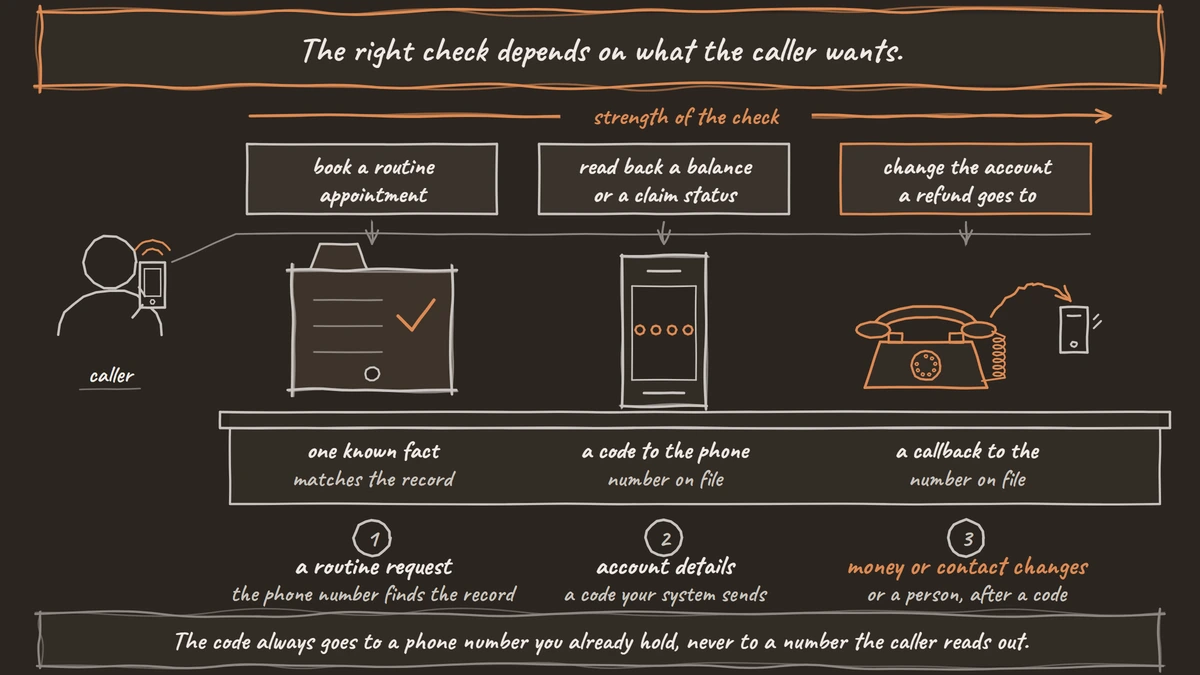
| What the caller wants | The check that fits |
|---|---|
| A routine request, such as booking an appointment | The phone number finds the record, and one known fact matches it |
| Account details read back, such as a balance or a claim status | A one-time code your system sends to the phone number on file |
| Money moved, contact details changed or a password reset | A callback to the number on file, or a person, after a code |
The code row carries NIST's caution. Your system should check for a recent SIM change or port before it sends a code, and the code always goes to a phone number you already hold, never to a number the caller reads out. NIST also rules out email for this kind of out-of-band code. Our post on OTP verification callbacks covers when a code is read back on the call and when it should never be asked for.
A callback is the strongest check on the list, because the business dials a number it already trusts. Our post on voice cloning fraud walks through the full flow for a sensitive request and the actions an agent never takes on voice alone.
How a Dograh agent runs the checks
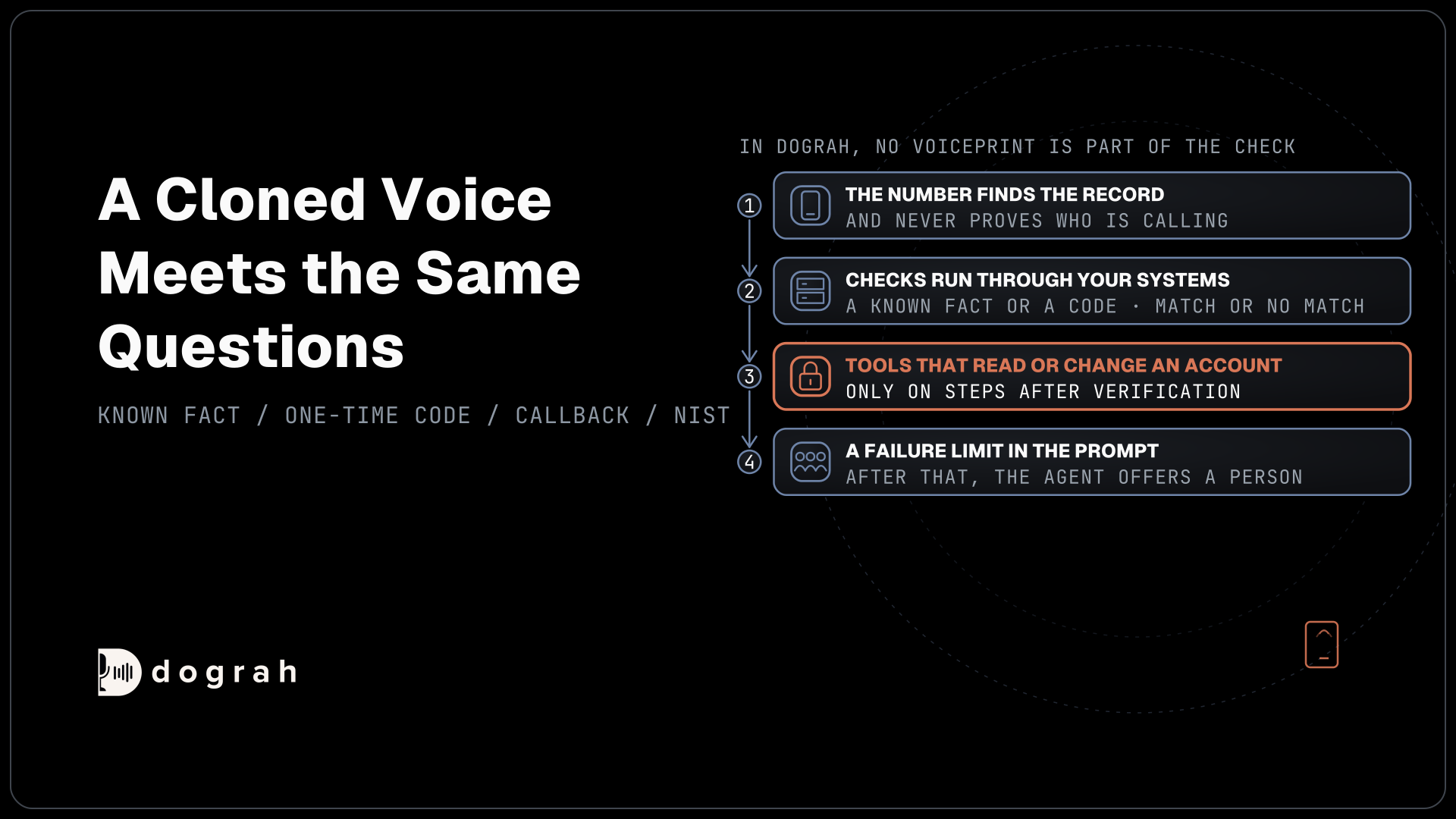
In Dograh, no voiceprint is part of the check. Verification runs through your own systems, so a cloned voice meets the same questions as anyone else. Pre-Call Data Fetch can look up the record by the caller's number, but that only finds the record and never proves who is calling.
For a known fact, an HTTP API tool sends the caller's answer and the account ID from call data to your system. Build that endpoint to reply only with a verdict, such as match or no match, so the stored answer never reaches the model. For a code, one tool asks your system to send it through your own provider, and a second tool checks what the caller reads back. Tools attach to individual steps, so the tools that read or change an account sit only on steps after verification.
Write the failure limit into the step's prompt, such as two failed checks, and test it, since the prompt is what applies it. After that the agent shares nothing more and offers a person through Transfer Call, which works on Twilio, Telnyx, Plivo, Cloudonix and Asterisk ARI. Dograh calls the destination first and connects the caller only when someone answers. If nobody does, the agent hears transfer_failed and the call continues with a callback request.
The callback itself starts from your side. During the call an HTTP API tool writes the request to your system, and your system later starts the call through the API Trigger with the number from its own records.
After launch, a QA check such as "were any account details shared before verification" can run on a sample of live calls. Each flagged call keeps its recording and transcript, so the turn that went wrong is easy to find.
Join the Dograh Community
Dograh is an OSS alternative to Vapi. Join our Slack community for queries, releases, best practices & community interactions.
Where the verification data lives
Verification calls carry the details fraudsters want, so where they are stored matters. On a self-hosted install, the recordings and transcripts sit on your own servers, and on Dograh Cloud they are stored for you. Either way the audio passes through your phone carrier, and the speech and language models are a separate choice from where the calls are stored. With your own keys, the hosted model provider's terms are with you, though the audio still reaches that provider, and open-weight models on your servers keep it inside.
Running it yourself has its own costs. Your team pays for the servers, the model keys and the phone minutes, and looks after the database and upgrades.
Glossary
- Passive voice biometrics
- A check that compares a caller's natural speech with a stored voiceprint in the background, with no passphrase. A good enough clone can clear its threshold.
- Anti-spoofing detection
- Software that tries to tell a live voice from a recorded or synthetic one. Research shows it often fails on cloning methods it was not trained on.
- Knowledge-based verification
- Checking identity by asking what the caller should know, such as a date of birth. NIST rules it out for identity verification, so use it only to match a record.
- Out-of-band code
- A one-time code sent through a second channel, such as a text to the number on file. NIST restricts phone-network codes and asks for SIM change and porting checks.