
Vapi suits developers who want to control every model and keep agents in code. Its limits are a hosting fee on every minute, no way to run it outside Vapi's cloud, and no visual builder. Dograh, the open-source AI voice agent platform we build, answers all three. You can self-host it or run it on Dograh Cloud.
Key Takeaways
- Vapi lets you bring your own keys for speech, model and voice.
- Squads, GitOps and Evals make Vapi strong for teams working in code.
- Every Vapi minute carries a $0.05 hosting fee, and it runs only in Vapi's cloud.
Vapi is a developer platform for voice agents, where you pick the speech, model and voice providers and Vapi runs the calls. We give the verdict first, three things Vapi does well and three ways it limits teams, each with the open-source answer, and close with who should pick it.
The verdict on Vapi
Vapi is one of the best hosted platforms for a developer team. You can choose every model, connect your own keys, run a custom language model on your own server, split an agent into a squad of specialists, and manage the whole setup as code with tests. If your team lives in Git and wants a managed service that someone else keeps running, Vapi is easy to recommend.
It limits teams in three ways. Every minute carries Vapi's hosting fee on top of the providers you pay. Vapi runs only in its own cloud, so recordings and transcripts sit there. And since it retired its visual Workflows, building an agent means writing prompts and configs rather than drawing a flow.
| Vapi | |
|---|---|
| Best at | Model choice, Squads, agents as code with GitOps and Evals |
| Price shape | $0.05 a minute hosting plus your providers, with Core at $29 a month and Pro at a $999 monthly minimum |
| Calls at once | 4 on usage-only, 10 on Core, 30 on Pro, extra lines $10 a month each |
| Where it runs | Vapi's cloud only |
| Builder | Prompts, Squads and config files, with the visual Workflows retired |
| Best for | Developer teams that want a managed service and work in code |
Model choice down to each layer
Vapi's first strength is that it does not lock you into its models. With provider keys you connect your own accounts for the transcriber, the language model and the voice, and your usage bills to those accounts. You can also point Vapi at a custom language model on your own server or any OpenAI-compatible endpoint.
That reaches speech-to-speech too. Vapi's docs cover OpenAI's Realtime models and a path to GPT-Live, where one model hears and speaks without separate speech-to-text and voice steps. Our post on OpenAI Realtime API pricing works through what those models cost per minute.
Vapi also offers transcriber fallback, so a call can switch to a second speech-to-text provider if the first one fails. For a team that has already tested which models suit its callers, this level of choice is the reason to use Vapi.
The custom language model option matters most for teams with their own fine-tuned model or a gateway that routes between providers. Vapi sends the conversation to your endpoint and speaks whatever comes back, so the reasoning stays in code you control even though the call runs in Vapi's cloud.
Squads, GitOps and Evals
Vapi's second strength is how well it fits a software team. Squads split one agent into several specialists that hand the caller to each other with a handoff tool, including silent handoffs the caller does not hear, and each member can be pinned to a version of its assistant.
The setup can live in your repository. Vapi's config-as-code docs describe GitOps for assistants, squads, tools, structured outputs, simulations and evals, so a change goes through review like any other code change.
Evals close the loop. You write mock conversations with the answers you expect, run them against an assistant, and see which ones fail before a change reaches a caller. Few hosted platforms join versioning, review and testing this tightly.
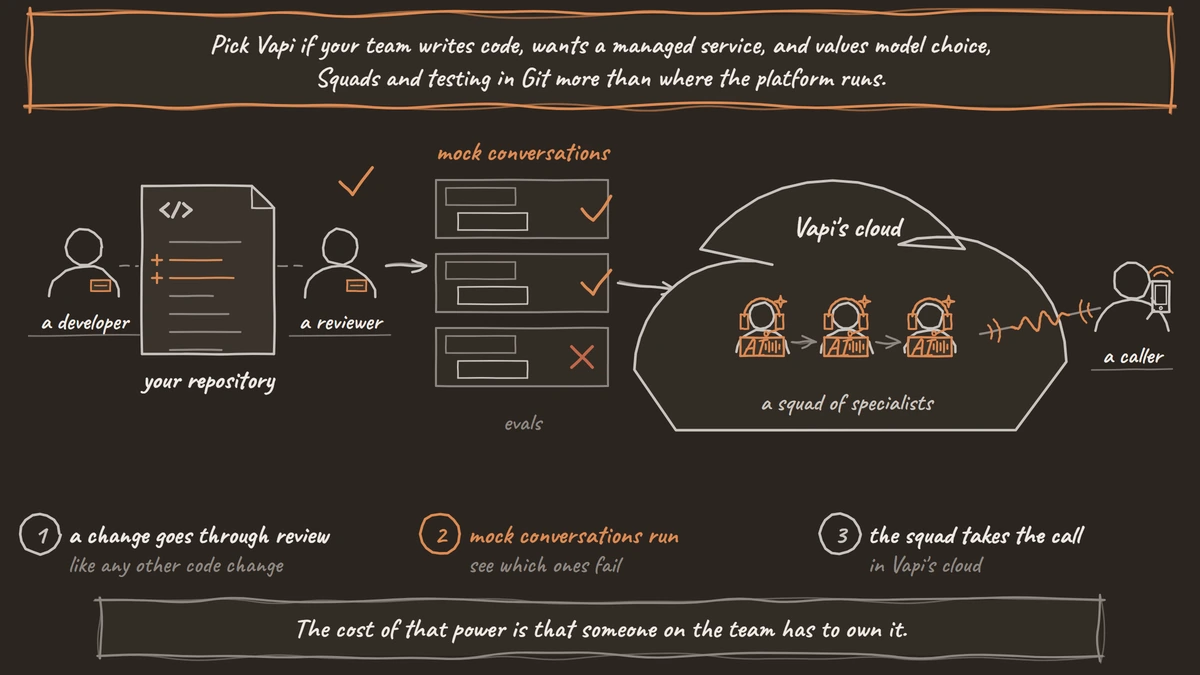
The cost of that power is that someone on the team has to own it. Squads, version pins and eval files are code, and they need the same care as the rest of your codebase. For a team without a developer, that is a lot of machinery for one phone line.
Phone numbers on your terms
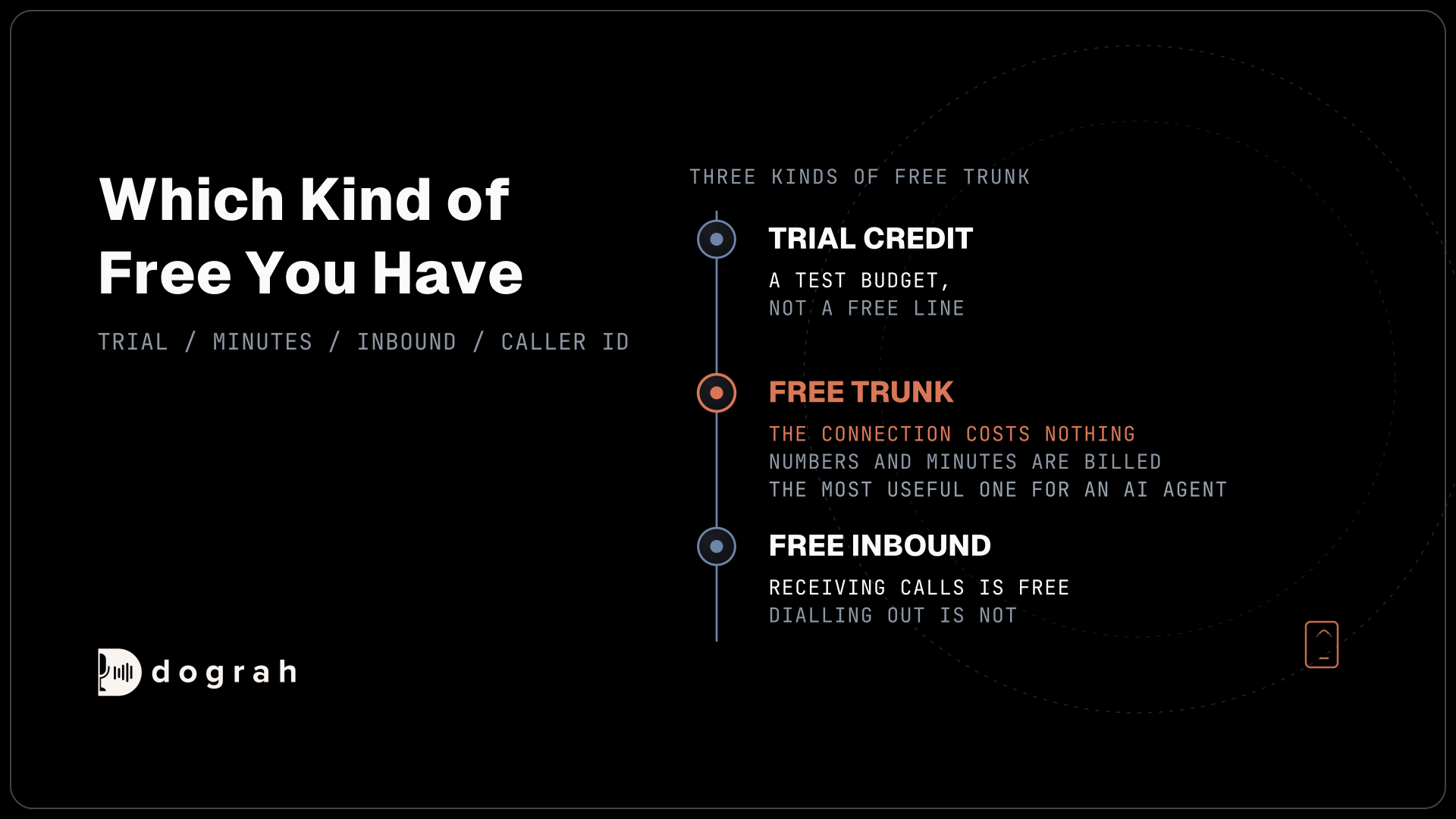
Vapi's third strength is telephony choice. You can start on a free US number for inbound calls, or import numbers you already own on Twilio or Telnyx and keep your carrier.
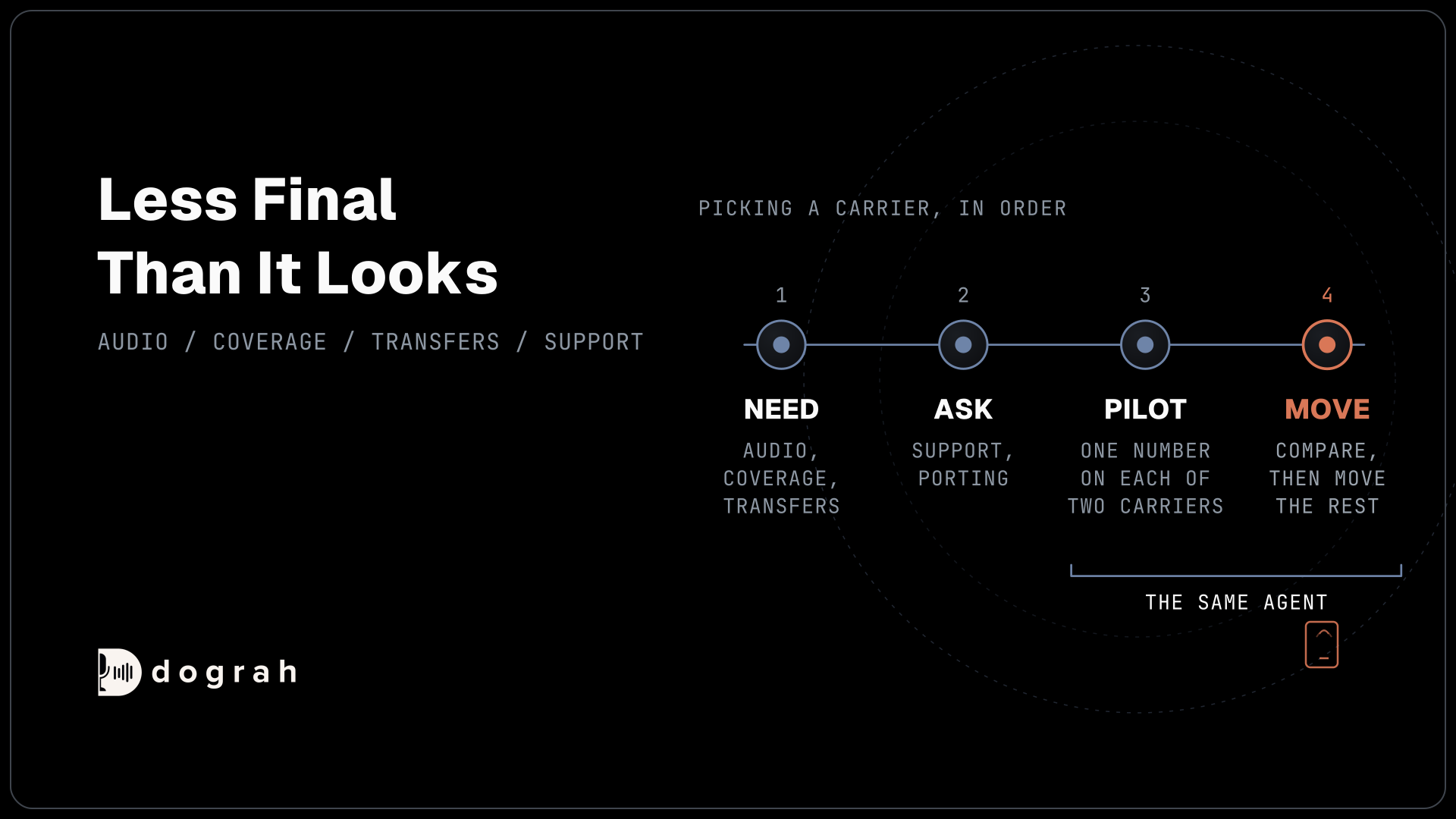
That makes trying Vapi easy. A developer can take a first call on a free number the same day, then move a real business number across once the agent works, without changing carrier.
Vapi also lists Twilio calling minutes, at $0.008 inbound and $0.014 outbound a minute, so a team can see the phone part of the bill before it signs up.

Open Source Alternative to Vapi / Retell
Self-hosted voice agent platform — no per-minute fees
dograh-hq/dograh
Star on GitHub
A hosting fee on every minute
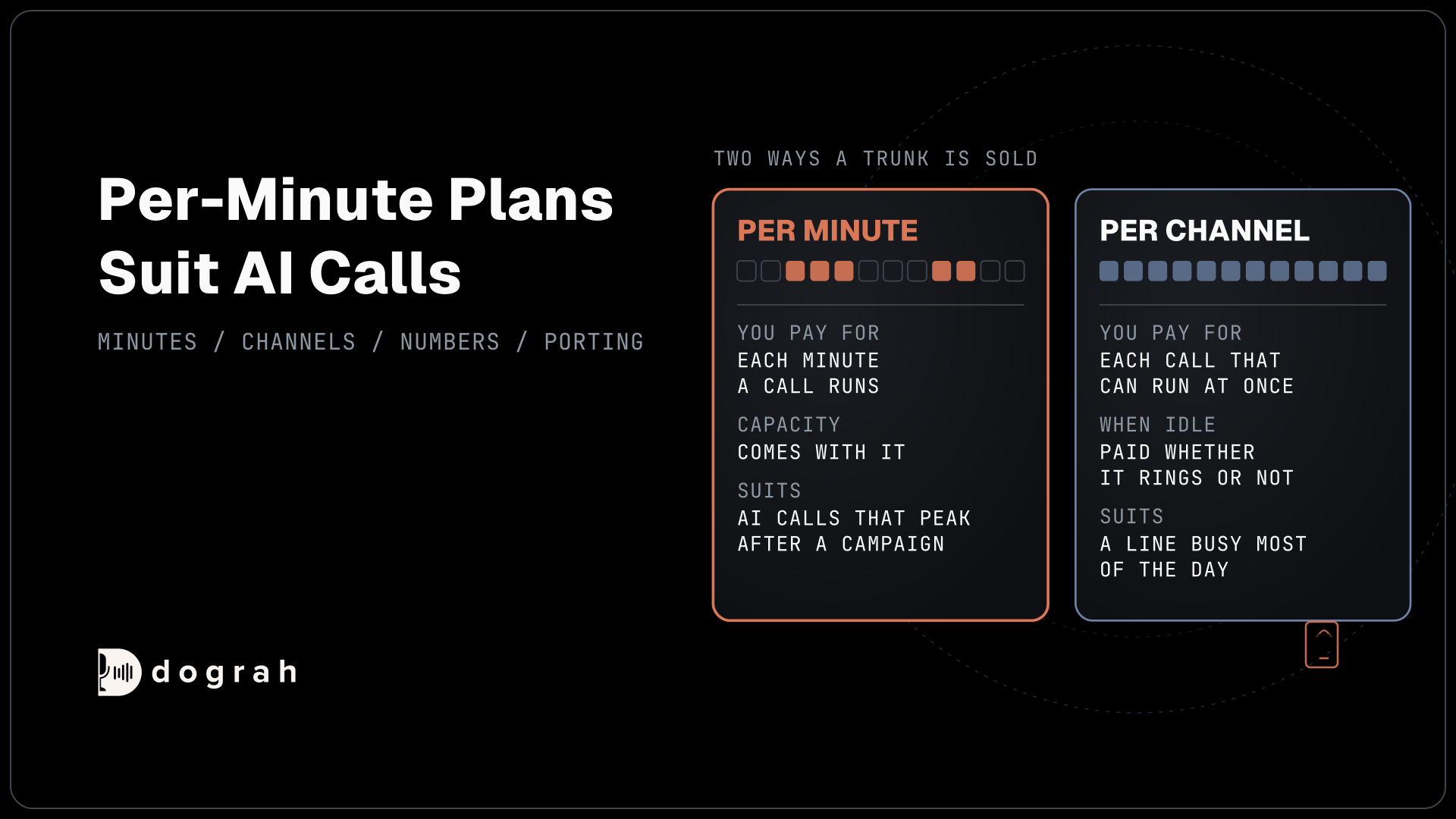
Vapi charges for running the call on top of every provider you pay. Vapi lists $0.05 a minute for hosting on every plan, with $5 in free credits to start. The usage-only plan allows 4 calls at once, Core costs $29 a month for 10, and Pro carries a $999 monthly minimum for 30. Extra lines cost $10 a month each, and HIPAA is a $2,000 monthly add-on.
Here is a labelled example. A team running 10,000 minutes a month pays $500 in Vapi hosting before any speech, model, voice or phone minute. Our Vapi pricing breakdown builds three full monthly bills with every part included.
At low volume the fee hardly matters next to the model and voice minutes. It grows in step with every call, though, so a team that expects to scale from a pilot to a full queue should price the hosting line at its target volume, not its first month.
The open-source answer is a different meter. Self-hosted Dograh has no per-minute platform fee, but servers, model keys and phone minutes still cost money. Dograh Cloud charges a 1¢-a-minute platform fee. The self-hosted version runs 10 calls at once by default, and you raise that limit yourself on your own hardware, with your servers and carrier setting the ceiling.
Vapi runs only in Vapi's cloud
Vapi is a hosted service, and its docs describe no version you install. Every assistant, squad, recording and transcript lives in Vapi's cloud, kept for 14 days on usage-only and up to 180 days on Pro.
For many teams that is the point of buying a hosted platform. For a bank, a hospital or a public body that must keep call audio on its own servers, it rules Vapi out before features come up. Provider keys do not change that: bringing your own key moves the contract to the provider, not the data.
The open-source answer is to run the platform yourself. Dograh is open source under BSD-2-Clause, and you can self-host it with Docker on your own servers or use the managed cloud. Like Vapi, it lets you pick each model and bring your own keys. Only self-hosted Dograh with local open-weight models keeps call audio on your servers, and that setup needs no contract with us.
Running it yourself has its own costs. Dograh's Docker docs ask for a server with at least 8 GB of RAM and 4 vCPUs for a remote deployment, and your team owns updates, backups and uptime. For a regulated team, that work is usually the price of keeping the audio in.
No visual builder since Workflows retired
Vapi moved its visual builder to Squads. Its Workflows migration guide asked teams to move their Workflows to Squads before Workflows was retired on 18 August 2026. Today a Vapi agent is a set of prompts, tools and handoff rules, edited in the dashboard or as code.
For developers that is fine, since prompts and handoff rules are easier to review in a pull request than a drawing. For an operations lead who wants to see the call as a drawing, change one step and hand it back to engineering, it is a real loss.
The open-source answer offers both. Dograh's workflow builder draws the call as connected nodes, with a global node for the instructions that apply across the call and pathways between steps.
The same agent can also be defined as JSON and sent to the Create from Definition API, using the workflow definition schema, or drafted by an AI coding assistant through Dograh's MCP server.
For a squad-style handoff, Transfer to Agent passes the call to another Dograh agent with a labelled transcript of the conversation so far. You choose whether the new agent greets the caller, carries straight on, or introduces itself and then carries on.
Dograh also runs speech-to-speech models from OpenAI, Azure, Google, Grok and Ultravox, though a handoff to another agent and a spoken transfer introduction need a cascade agent with separate speech-to-text and voice steps.
Join the Dograh Community
Dograh is an OSS alternative to Vapi. Join our Slack community for queries, releases, best practices & community interactions.
Who should pick Vapi
Pick Vapi if your team writes code, wants a managed service, and values model choice, Squads and testing in Git more than where the platform runs. It is a good home for a developer team building agents for its own product, with volume that keeps the hosting fee small next to model costs.
Look past it if call audio must stay on your own servers, if non-developers need to edit the call flow, or if the hosting fee on top of every minute adds up at your volume. Our Vapi alternatives guide lays out the other options, and the move from Vapi to open-source voice AI walks through rebuilding assistants, tools and numbers.
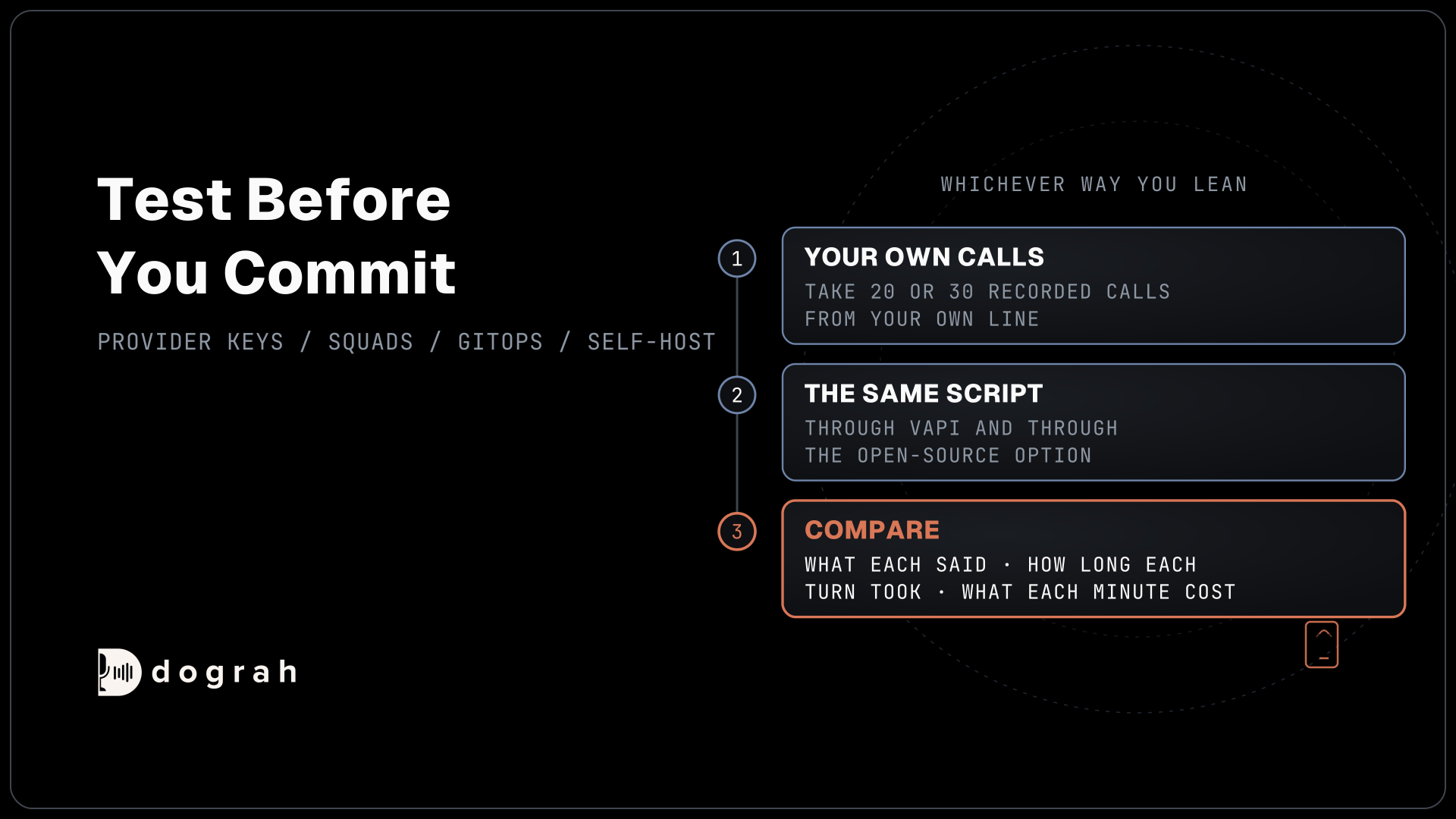
Whichever way you lean, test before you commit. Take 20 or 30 recorded calls from your own line, run the same script through Vapi and through the open-source option, and compare what each agent said, how long each turn took and what each minute cost.
If you are weighing hosted developer platforms against each other, our Bland AI review covers a platform that takes the opposite approach to models. Bland runs its own models at one rate, where Vapi lets you bring your own.
Glossary
- Squad
- Vapi's way of splitting one voice agent into several specialist assistants that hand the caller to each other with a handoff tool. It replaced Vapi's visual Workflows.
- Provider keys
- Your own API keys for the transcriber, language model and voice, connected to Vapi so that usage bills to your accounts. They move the contract to the provider, not the data.
- GitOps
- Managing configuration as files in a Git repository, so every change goes through review and can be rolled back. Vapi supports it for assistants, squads, tools and evals.
- Create from Definition
- Dograh's API that builds an agent from a workflow defined as JSON, with the same nodes and edges the visual builder draws.