
Bland AI suits teams that want one vendor to run the whole call at one per-minute rate. It fits less well when you need your own models, your own servers, or volume past the plan caps. Dograh, the open-source AI voice agent platform we build, fits those cases. You can self-host it or run it on Dograh Cloud.
Key Takeaways
- Bland bundles speech, language model and voices into one per-minute rate.
- Start and Build cap both calls at once and calls per day.
- Private hosting, the BAA and data residency sit in Bland's Enterprise plan.
Bland AI sells a full voice agent stack made up of phone lines, speech recognition, language model, voices and a builder, all on one bill. We open with the verdict, then test Bland on building agents, models and voices, phone lines, limits at volume and compliance, and close with where open source fits.
The verdict on Bland AI
Bland is a strong product for one buyer, a team that wants a vendor to own every part of the call and is happy to run on that vendor's models. Its builder, its Norm assistant and its messaging channels cover a lot of ground quickly, and its compliance list is longer than most hosted platforms publish.
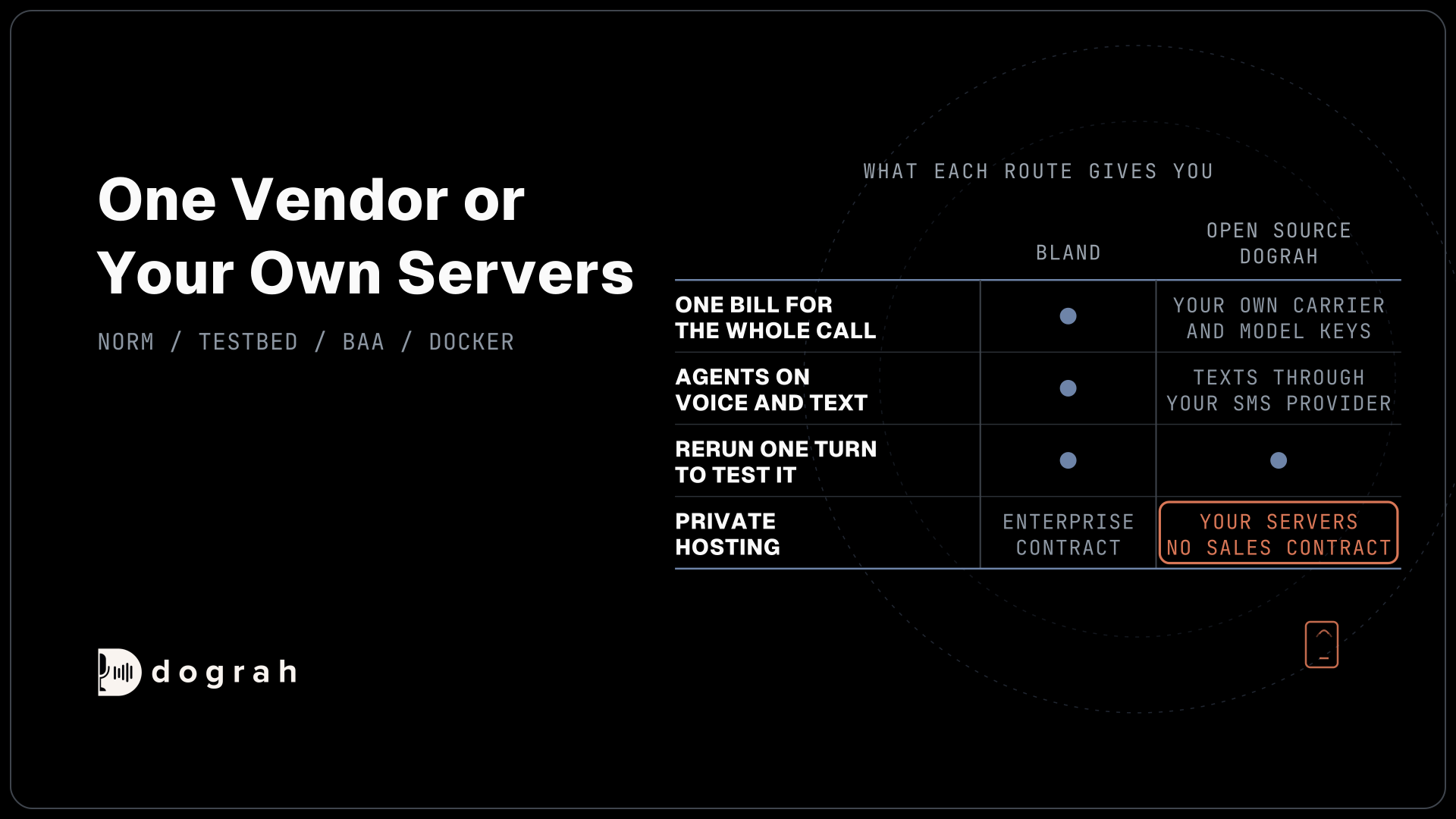
It is a weaker fit in three places. The models are the ones Bland runs. Private hosting, the business associate agreement (BAA) and data residency need an Enterprise contract. And the self-serve plans cap how many calls you can place in a day, so growth means a plan change before it means more servers.
| Test | Bland AI | Verdict |
|---|---|---|
| Building agents | Bland Agents builder, Norm assistant, Testbed for single turns | Strong, with a move off pathways to finish |
| Models and voices | LLM, transcription and voices included in one rate | Simple to buy, little to choose |
| Phone lines and transfers | Your Twilio, SIP trunks or Bland's built-in Twilio, plus SMS, RCS and iMessage | Strong |
| Limits at volume | 10 calls at once and 100 a day on Start, 50 and 2,000 on Build | Caps arrive early |
| Compliance and hosting | SOC 2, HIPAA, GDPR, PCI, FedRAMP 20x, ISO 27001, with BAA and on-prem on Enterprise | Strong list, contract-gated |
Building agents with Bland Agents and Norm
Bland's building tools are its best argument. The Bland Agents builder covers prompts, variables, scenarios, tools, knowledge and publishing in one place, so a team writes the agent's goals and rules rather than wiring every branch by hand.
Norm sits on top. Bland describes it as an AI assistant that builds, edits, tests and debugs voice agents from a plain-language instruction, and it also ships as a plugin for coding assistants. That narrows the gap that older reviews described between Bland's depth and its ease of use, so weigh reviews written before Norm with that in mind.
Testing is thoughtful too. Bland's Testbed takes one turn from a real conversation, lets you change what the agent was told, and runs it again so you can see whether the answer changes. For a team tuning a prompt against real calls, that is the right loop.
The cost is a migration Bland has set for you. Its migration guide asks teams to move production agents from the older pathways and personas to Bland Agents by 15 November 2026, and it offers an API that plans an agent from a legacy pathway graph. For a team with dozens of pathways in production, that is real work on Bland's timetable rather than its own.
Models and voices on one rate
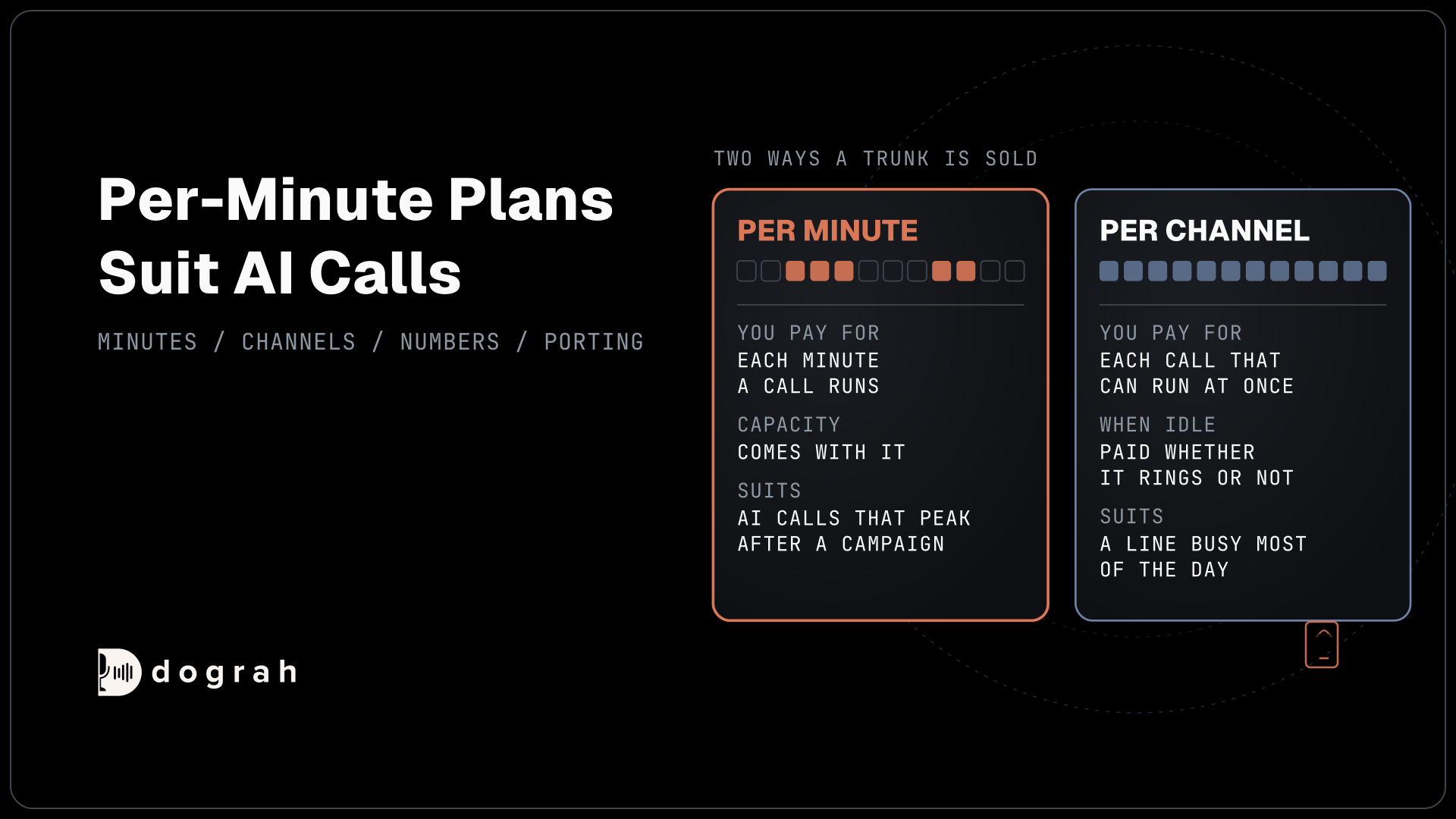
Bland's pricing is built around not making you think about models. Bland promises no token charges and no model-provider pass-throughs, with the language model, real-time transcription and premium voices included in the per-minute rate: $0.14 on Start with no platform fee, and $0.12 on Build plus a $299 monthly platform fee.
Bland's documentation says it owns the full voice AI stack, from telephony through speech-to-text, the language model and text-to-speech. Bland claims sub-400 ms response latency and support for 40+ languages. Those are Bland's own figures, and the fair way to check them is on your own calls.
The trade is choice. The rate covers the models Bland runs, so a team that has tested a particular language model or speech model on its own callers is buying Bland's stack, not that model. If a newer model handles your accents or your domain words better, the decision to adopt it sits with Bland.
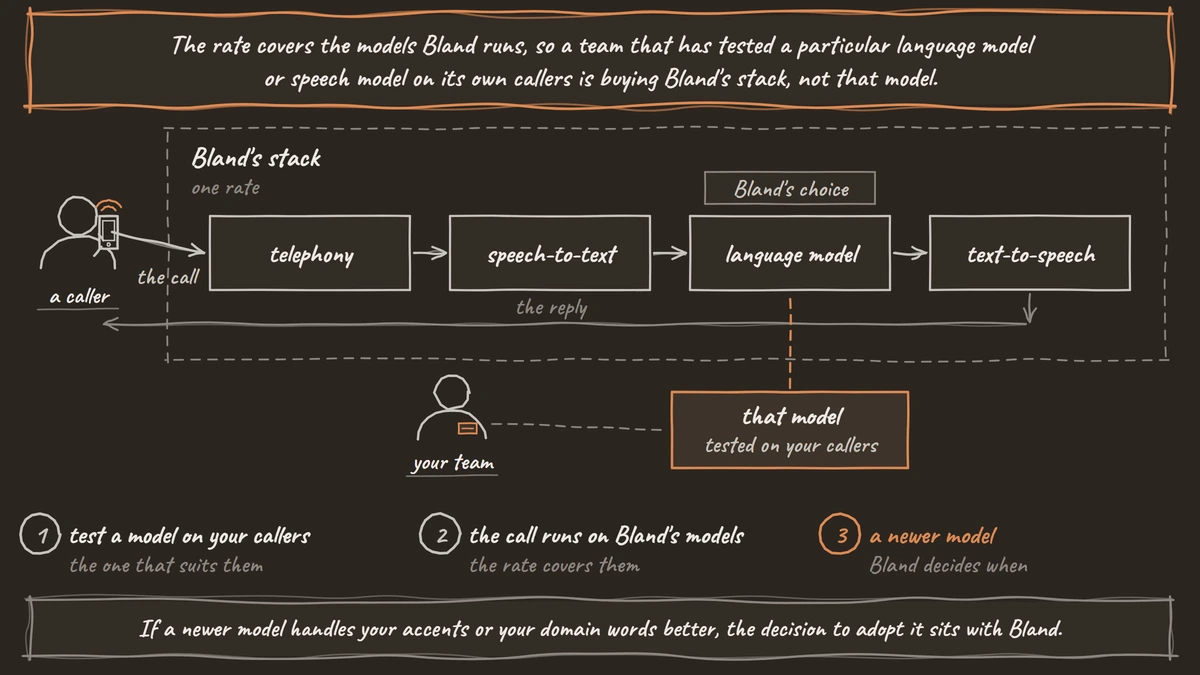
For many teams that is fine. One number per minute and no keys to manage is a real benefit, especially for a small team without anyone who wants to compare speech models.
Phone lines, transfers and messages
Bland is flexible on phone lines. Its pricing FAQ says it works with your existing Twilio account, with SIP trunks from any contact-center or telephony provider, or with Bland's built-in Twilio at pass-through cost. With bring your own telephony, customers pay no transfer fees.
On Bland's own numbers, transfers cost extra. Time after a call is handed to a person is billed at $0.05 a minute on Start and $0.04 on Build. A team that transfers 1,000 minutes a month on Start pays $50 for that alone, which is small, but it belongs in the budget.
Bland's documentation also lists a live transcript stream after a transfer, so the person who picks up can follow what was said. And Bland runs agents on more than the phone. Its messaging docs cover SMS, RCS and iMessage agents. For a business that wants one agent across voice and text in one product, that is a clear plus.

Open Source Alternative to Vapi / Retell
Self-hosted voice agent platform — no per-minute fees
dograh-hq/dograh
Star on GitHub
Limits at volume
Your plan sets the ceiling, not the platform. Bland claims its platform supports up to 1 million concurrent calls, but the self-serve plans set what you can use: Start allows 10 calls at once and 100 calls a day, and Build allows 50 at once and 2,000 a day. Enterprise sizes concurrency to your volume under a contract.
Here is a labelled example. An outbound team planning 1,500 calls a day outgrows Start on the first morning and fits inside Build. At 3,000 calls a day it needs Enterprise, which means a sales process before the next campaign. Knowledge bases follow the same pattern, with 10 on Start and 50 on Build.
Count your busiest hour as well as your busiest day. Start also limits calls per hour, at 100, and Build at 1,000, so a campaign that dials everyone at 9 a.m. can hit the hourly limit while the daily total still looks safe.
None of this is unusual for a hosted platform, and for an inbound line of a few hundred calls a day the caps never bite. They matter for outbound teams and for anyone whose volume jumps with seasons. Our Bland AI pricing breakdown works through a full monthly bill on each plan, including phone time and transfers.
Compliance and private hosting
Bland's compliance list is one of the longest among hosted voice platforms. Its pricing FAQ lists SOC 2 Type I and Type II, HIPAA with a signed BAA, GDPR with a data processing agreement, PCI DSS self-attested, FedRAMP 20x Class A and ISO 27001, with documentation available under NDA on Enterprise.
The catch is where those sit. On the plan table, private hosting, the BAA, single sign-on and data residency are in the Enterprise column, with on-prem or VPC available. A clinic on Build that needs a BAA for patient calls has to move to Enterprise first, and the software stays closed in every setup.
For a federal buyer or a large insurer that is buying Enterprise anyway, this list is a reason to pick Bland. For a smaller team that only needs private hosting, it is a contract to sign, and a sales cycle to wait through, before the first patient call. Our Bland AI alternatives guide compares how other platforms package the same items.
Join the Dograh Community
Dograh is an OSS alternative to Vapi. Join our Slack community for queries, releases, best practices & community interactions.
Where self-hosted open source fits instead
Open source fits when the three weaker spots matter more than one bill. Dograh, the platform we build, is open source under BSD-2-Clause, and you can self-host it with Docker on your own servers without a sales contract, or use Dograh Cloud.
You pick each layer yourself. In model configurations you choose the language model, speech-to-text and text-to-speech separately. The choices are Dograh's own models, a supported provider on your own key, or open-weight models you run. Bringing your own key moves the contract to that provider, not the data. Only self-hosted Dograh with local open-weight models keeps call audio on your servers.
Volume grows on your hardware. Self-hosted Dograh runs 10 calls at once by default, and you raise that limit yourself, with your servers and carrier setting the real ceiling. Dograh Cloud pay-as-you-go includes 10 calls at once, with more on request.
Phone lines come from your own carrier account. To hand a caller to a person, Transfer Call dials the destination while the caller hears hold music and connects them once someone answers. If nobody answers, the line is busy or the transfer fails, the agent gets transfer_failed back and the call continues. It runs on Twilio, Telnyx, Plivo, Cloudonix and Asterisk ARI. Texts go out through your own SMS provider, called by an HTTP API tool during the call.
Testing looks a lot like Bland's Testbed. In Test Chat, each typed turn has Rerun this turn and Edit and rerun this turn, and every phone call keeps a full trace of each turn's speech-to-text, model and voice time.
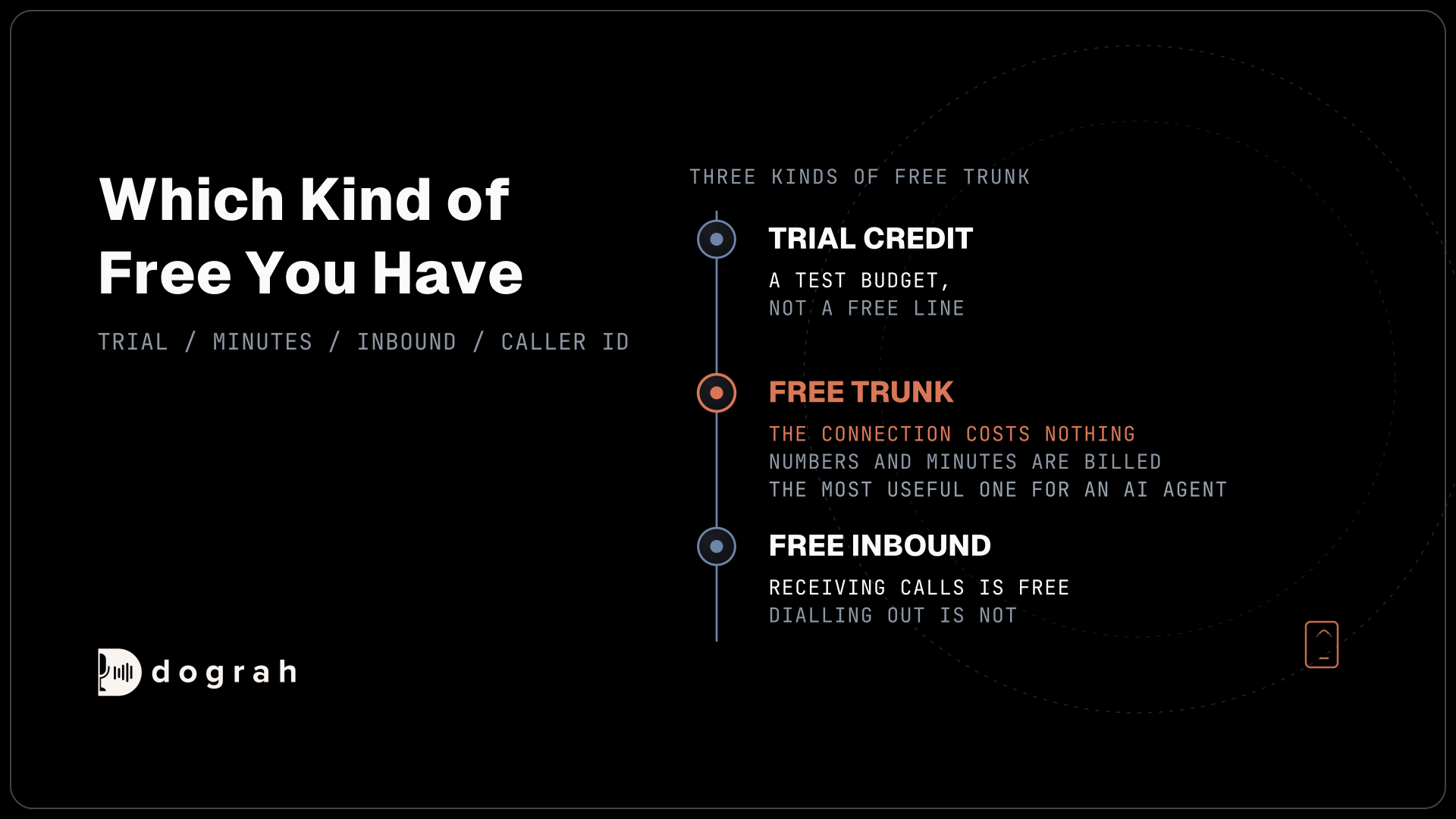
Price runs on a different meter. Self-hosted Dograh has no per-minute platform fee, but servers, model keys and phone minutes still cost money. Dograh Cloud charges a 1¢-a-minute platform fee. Models are billed by the providers you choose.
For patient calls, self-hosted Dograh needs no BAA with us, because we never see the data, though your model providers may need their own BAAs.
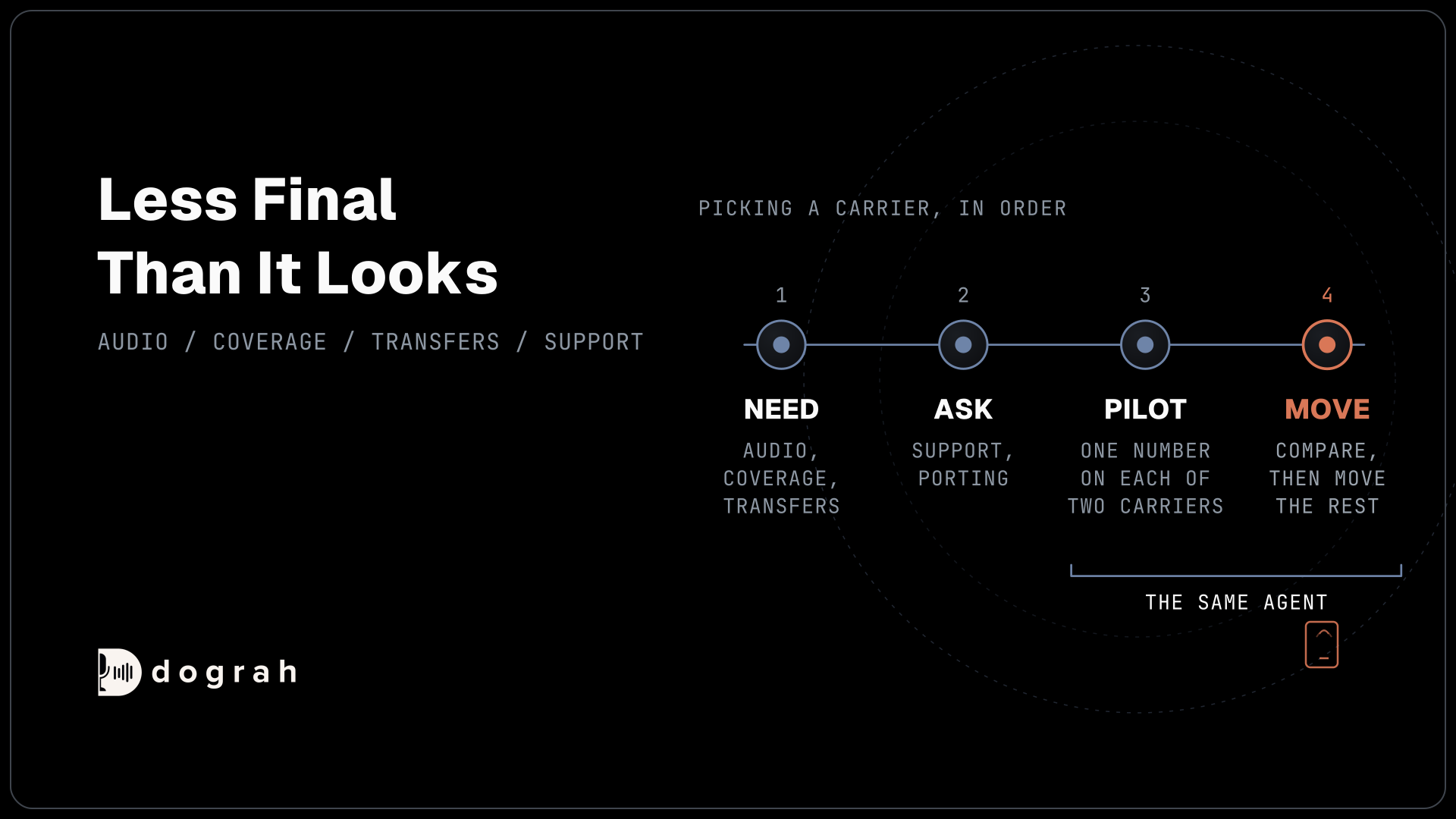
If you decide to move, our guide to migrating from Bland AI to open-source voice AI walks through each step, and our Vapi review covers the other big hosted developer platform.
Glossary
- Bland Agents
- Bland's current agent builder, covering prompts, variables, scenarios, tools, knowledge and publishing. Bland asks teams to move production agents from the older pathways and personas to it.
- Norm
- Bland's AI assistant that builds, edits, tests and debugs voice agents from a plain-language instruction. It also ships as a plugin for coding assistants.
- Bring your own telephony
- Connecting your own carrier account or SIP trunk instead of using the platform's numbers. On Bland, customers who do this pay no transfer fees.
- Business associate agreement (BAA)
- The contract HIPAA requires before a vendor handles patient data for a covered entity. Bland lists its BAA in the Enterprise column of its plan table.