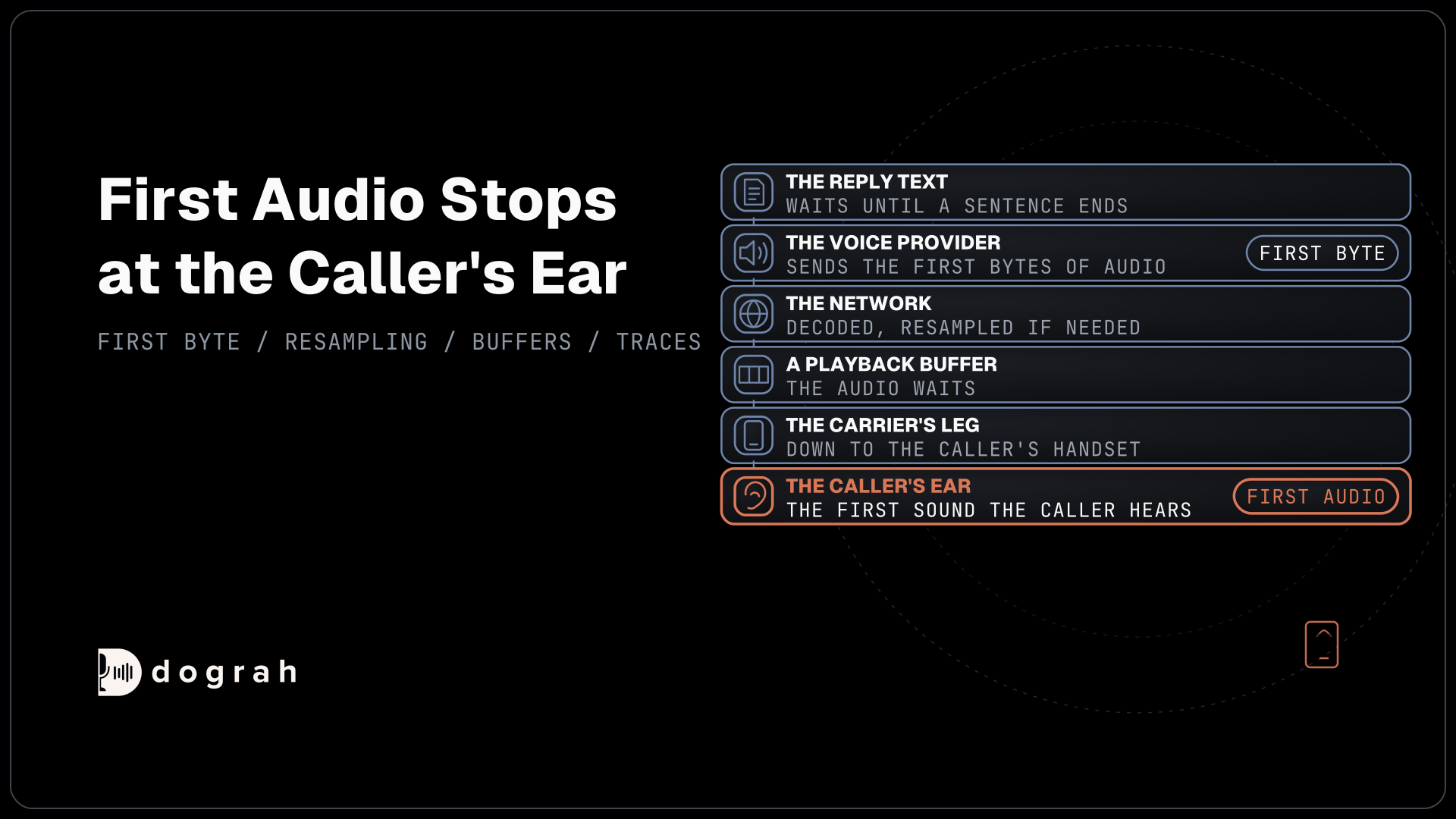

Time to first audio is the time from a reply's text being ready to the first sound the caller hears. It grows with sentence buffering, any resampling to 8 kHz and playback buffers, so measure it on phone calls. In Dograh, the open-source AI voice agent platform, you can swap voices per agent and compare voice time in call traces.
Key Takeaways
- First byte stops at the provider's server, and first audio stops at the caller's ear.
- Sentence buffering adds delay before the first byte, and resampling and playback buffers add it after.
- A misheard word can cost a whole extra turn, more than a slow voice.
A voice that starts late makes an agent sound like it is thinking too hard, but a fast voice cannot save a slow turn. This post defines time to first audio and traces where it hides after the first byte, with a way to measure it on Dograh phone calls.
What time to first audio measures
Time to first audio is the wait between the moment the reply text is ready and the moment the caller hears its first sound. It is the voice's share of a turn, and the definition our guide to choosing a TTS model also uses.
Some writers use the same name for the whole turn, from the caller's last word to the agent's first sound. That longer gap also holds the time to detect that the caller has finished, to transcribe the words and to write the reply. In this post we call it the turn gap, and our post on speech latency breaks it down stage by stage.
Keeping the two apart matters because they have different fixes. A slow first audio points at the voice provider, the audio path or the way text reaches the voice. A slow turn gap can sit anywhere in the pipeline, and the voice is often not the biggest part.
Why first audio comes later than first byte
Most voice providers publish time to first byte, the time from sending text to receiving the first bytes of audio. AssemblyAI's guide to TTS latency points out that those first bytes can be a header or silence, and that the number isolates work on the provider's servers.
Time to first audio runs until the first audible sample plays for the listener, so it adds everything after the server. The audio crosses the network to your agent, gets decoded and, if the provider sent a higher rate such as 24 kHz, resampled to the line's 8 kHz. Then it waits in a playback buffer and travels down the carrier's leg to the caller's handset.
Each of those steps is small, and together they can be larger than the gap between two providers on a speed chart. That is why a provider with a better published first byte can still sound slower on your calls.
Where the delay hides before the first word
The first hidden wait is before the voice provider even starts. Pipecat, the open-source framework under Dograh, buffers the reply text until a sentence ends before it sends it to the voice by default, a step called sentence aggregation. Pipecat's own code notes that this sounds more natural and adds about 200 to 300 ms per sentence, as an estimate rather than a measurement.
So the length of the first sentence matters. A reply that opens with "Sure, I can check that." starts speaking sooner than one that opens with a 30-word sentence, because the voice cannot start until the first sentence is complete. Prompting the agent to lead with a short sentence is often the cheapest speed-up.
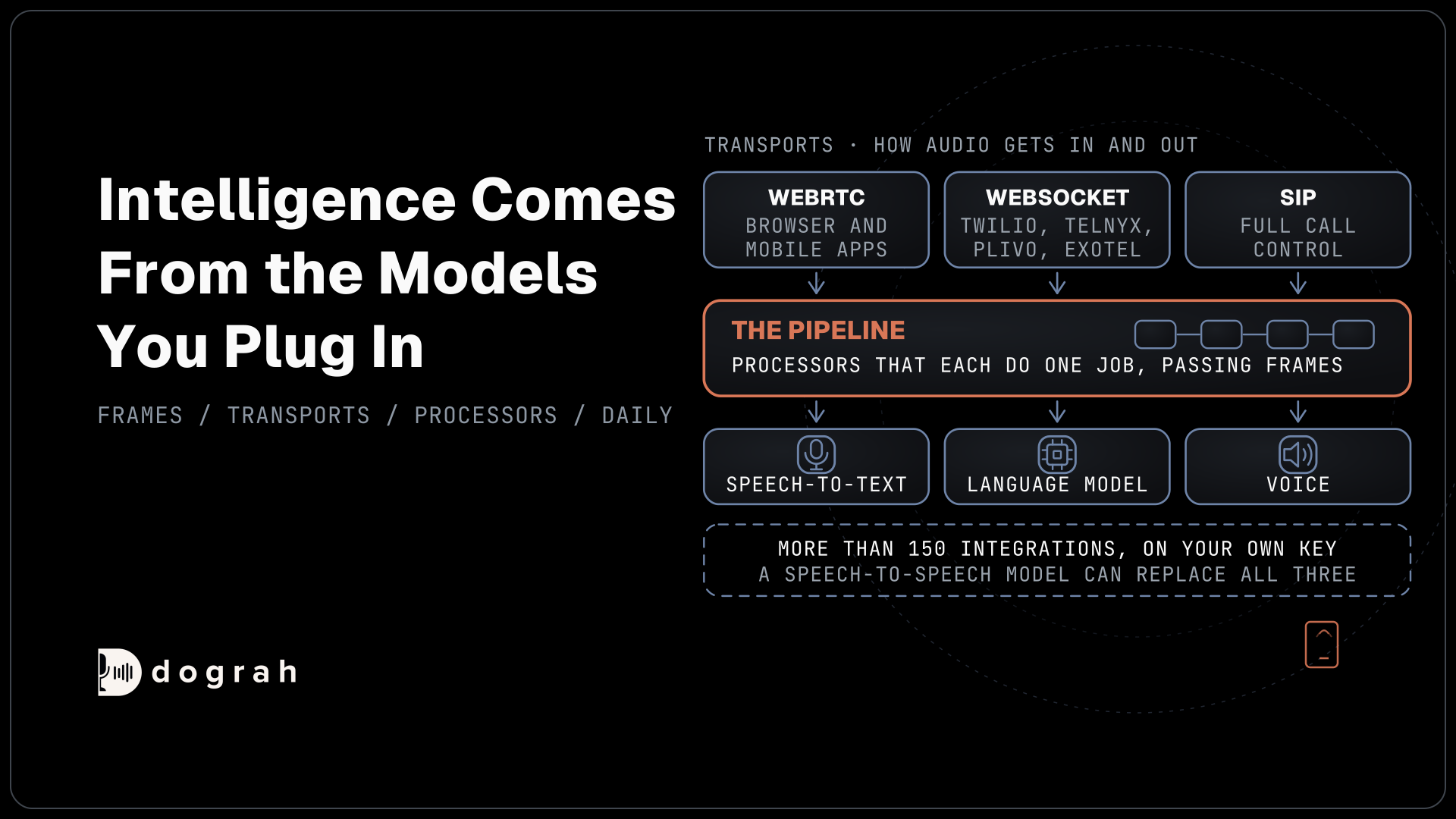
The audio format is the next one. Asking the provider for audio that already matches the phone line, such as 8 kHz mu-law where it is offered, saves resampling on every chunk. Dograh already asks the voice provider for audio at the call's 8 kHz rate, so on Dograh phone calls this step is handled for you. Distance adds the rest, so run the agent close to the voice provider's region and the carrier's media servers.

Open Source Alternative to Vapi / Retell
Self-hosted voice agent platform — no per-minute fees
dograh-hq/dograh
Star on GitHub
What one measured agent stack shows
Published per-stage numbers from real agents are rare. One of the clearest is a voice agent latency playbook posted on Hugging Face in March 2026, which traced a stack of Deepgram Nova-3, Ministral 3B on Ollama and Pocket TTS on LiveKit Agents with Langfuse.
| Stage, 23 simple turns | P50 | P95 |
|---|---|---|
| End-of-utterance detection | 554 ms | 858 ms |
| Language model, first token | 566 ms | 2,246 ms |
| Voice, first byte | 243 ms | 296 ms |
| Perceived latency, whole turn | 1,392 ms | 3,384 ms |
The voice was the steadiest stage, with only about 50 ms between its typical and slow turns. The language model was the widest, and its slow turns made most of the slow turn gaps. The sample is small, the hardware is not reported and the stack is not a phone line, so read it as a shape rather than a benchmark.
When a faster voice is not the fix
The table shows a pattern worth checking on your own stack. Once the voice streams and starts in a few hundred milliseconds, swapping it for a faster one saves little next to the wait for end-of-turn detection or a slow model reply.
AssemblyAI makes a sharper point in the same guide, writing that "the most expensive delay in a voice agent conversation isn't a slow first audio frame. It's a whole extra turn." A misheard account number makes the agent ask again, and that costs seconds rather than milliseconds. So check transcription accuracy and turn detection alongside the voice before you blame it.
Join the Dograh Community
Dograh is an OSS alternative to Vapi. Join our Slack community for queries, releases, best practices & community interactions.
How to measure first audio on your own calls
Vendor charts are a starting point. The Artificial Analysis TTS leaderboard measures time to first audio per model as the first decoded audio plus any leading silence up to a set loudness threshold, averaged over recent days. That method is the right idea, since it counts the first sound rather than the first byte.
On your own agent, measure in the conditions callers get. Use real reply text with account numbers, addresses and prices, run from the region the agent runs in, and test at the number of calls you expect at once. Place real phone calls rather than browser calls, since a browser skips the carrier legs and the 8 kHz line.
Report the 50th and 95th percentile across at least a few dozen turns rather than an average. A voice with a good typical figure and a poor P95 latency will still leave some callers waiting, and those are the turns where people start talking over the agent.
Reading voice time in Dograh call traces
Dograh records timings in call traces once tracing is set up. Add your Langfuse host, public key and secret key in Platform Settings, or set the Langfuse variables on a self-hosted install, as the tracing guide describes. After a call, View Trace on the call's page opens its trace.
Each voice span records the provider's time to first byte as Pipecat measures it inside Dograh, when the first audio arrives from the provider. It does not include the carrier's leg or the caller's playback buffer. Treat it as the provider's share and the sentence wait, and remember the rest of first audio sits after it.
The Reasoning Delay shown in a call's transcript is something else, the language model's first byte only. Never compare it with a whole-turn budget such as 800 ms. Our guide to debug a call with traces shows how to read each stage of a turn.
Comparing two voices on the same agent
Models are set per agent in Dograh, so a fair comparison changes only the voice. Open the agent's Model tab, pick a different voice provider on your own key, and keep the language model, the speech-to-text and the prompt the same. The voice settings list the providers and their fields.
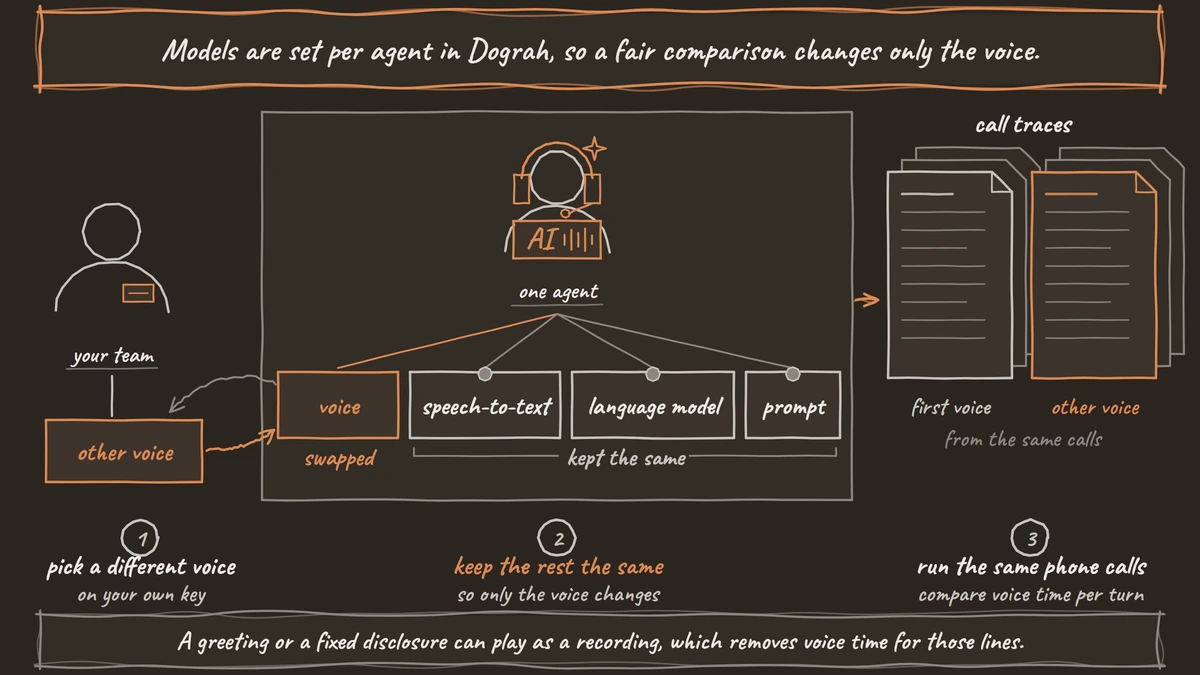
Then run the same scripted Phone Calls on each voice and compare the voice time per turn in the traces, at the 50th and 95th percentile. Our guide to choosing a TTS model covers the listening side of the same test.
Some lines do not need synthesis at all. A greeting or a fixed disclosure can play as a recording, which removes voice time for those lines, as our post on pre-recorded audio explains with the pre-recorded audio setup.
Glossary
- Time to first byte (TTFB)
- The time from sending text to a voice provider until its first audio bytes arrive. It measures the provider's servers, and the first bytes can be silence.
- Time to first audio (TTFA)
- The time from a reply's text being ready until the caller hears its first sound. It adds the network, any resampling and playback buffers to the first byte.
- Sentence aggregation
- Holding reply text until a sentence ends before sending it to the voice. It sounds more natural and makes a long first sentence start later.
- P95 latency
- The time that 95 out of 100 turns stay under. It shows the slow turns that an average hides.