
Synthflow vs Pipecat is a hosted no-code platform against an open-source framework. Synthflow sells contact centers an annual enterprise agreement and helps launch agents in weeks. Pipecat is free Python code your developers run and host anywhere. For no-code building on open code, Dograh, the open-source AI voice agent platform, runs a Pipecat fork on your servers or Dograh Cloud.
Key Takeaways
- Synthflow sells one annual enterprise agreement, with no rate by the minute.
- Pipecat is free code, with built-in transfers on its Daily PSTN and SIP routes.
- Sources disagree on when owning the stack pays, from tens of thousands to 1M minutes.
Synthflow is something you buy, and Pipecat is something you build with. We put them in one table, then cover how each is bought, launch speed, control, data and compliance, and the volume where owning the stack pays, before showing open-source Dograh, no-code building on a Pipecat fork.
Synthflow vs Pipecat in one table
Synthflow runs the whole agent for you under one contract, and Pipecat hands your engineers the engine. The rows below line them up on what a contact center or product team weighs first.
| Synthflow | Pipecat | |
|---|---|---|
| What it is | Enterprise voice agent platform with a visual flow builder and APIs | Open-source Python framework for real-time voice agents |
| Code | Closed | BSD-2-Clause, maintained by Daily and the community |
| How you buy it | One annual enterprise agreement, priced against expected call volume | Free to download, Pipecat Cloud by the active minute |
| Speed to launch | Live in weeks, with forward-deployed engineers where included | Depends on your engineers and the product you build around it |
| Who builds | Synthflow's engineers with your team, then your team in the flow builder | Your engineers, with Pipecat Flows for structured calls |
| Models and voices | OpenAI GPT models, Claude and Llama, LLM usage included, ElevenLabs voices | More than 150 services on your own keys |
| Phone systems | Built-in Zoom, Five9, RingCentral, 8x8, Twilio, Telnyx, Vonage and Freshcaller, plus Genesys and SIP through Enterprise setup | Serializers for Twilio, Telnyx, Plivo, Exotel, Vonage and Genesys, built-in transfers on Daily PSTN or SIP, basic carrier call control on WebSocket routes |
| Where data sits | A US or EU workspace chosen at setup | Wherever you run it |
| Compliance | Signs a BAA, SOC 2 Type 2, ISO/IEC 27001, GDPR, PCI DSS v4.0.1 | Yours, through your hosting and providers |
| Price shape | One price for the year, with CRM integrations, transcription, voices and SMS included | Framework free, Pipecat Cloud $0.01 to $0.03 an active minute, models, phone and engineers on top |
The three rows that settle most decisions are how you buy, how fast you launch and who controls the pipeline. The sections below take them in turn.
How each one is bought
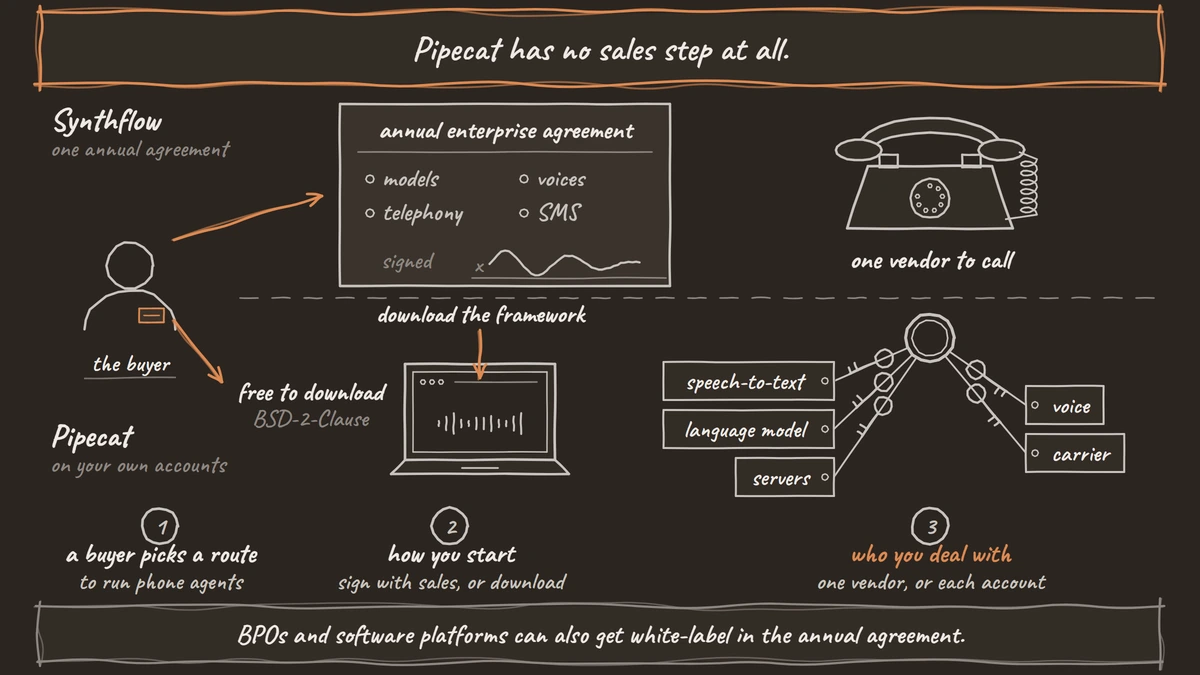
Synthflow sells one route. Every new deployment starts on an Enterprise contract, "sold as an annual enterprise agreement" with the price "set for the year against the call volume you expect". There is no free plan or trial and "no rate by the minute". The agreement covers concurrency planning, routing, escalation paths, handoffs and fallback logic, with CRM integrations, transcription, voices and SMS included and MSA and DPA support for procurement.
That shape suits a buyer who wants one contract and one vendor to call. BPOs and software platforms can also get white-label in the annual agreement. Our post on Synthflow pricing goes through what the contract covers in more depth.
Pipecat has no sales step at all. You download the framework under BSD-2-Clause and pay each model provider, your carrier and your servers on your own accounts. If you would rather not run servers, Pipecat Cloud pricing starts at $0.01 per active minute on the smallest agent size, with Daily phone calls at $0.018 a minute, and no contract to sign before the first test.
Speed to launch
Synthflow sells speed with help attached. It says agents go live "in weeks", with forward-deployed engineers working with your team where the agreement includes launch support. For a contact center with no voice engineers, that is the shortest supported path to real calls, because Synthflow's own people do much of the build.
Pipecat's speed depends entirely on your team. WebRTC.ventures, an agency that builds custom stacks, says a custom route takes "weeks of custom orchestration for turn-taking, interruption handling, and telephony integration". A first browser demo on Pipecat can run in an afternoon, but a phone agent ready for customers takes far longer.
Phone handling is one reason. Pipecat lists no built-in transfers or reconnects on its WebSocket routes for Twilio, Telnyx, Plivo and Exotel, where call control stays basic and sits with the carrier, while its Daily PSTN and SIP routes carry transfers. After that comes the product around the pipeline, from an editing screen for non-developers to call lists, stored recordings and QA. Our comparison of Dograh vs Pipecat walks through that list.
Control over models, phone systems and the pipeline
Synthflow picks most of the stack for you. It names OpenAI GPT models, Anthropic's Claude and Meta's Llama, with LLM usage included, and voices from a built-in ElevenLabs integration. It connects to Zoom, Five9, RingCentral, 8x8, Twilio, Telnyx, Vonage and Freshcaller out of the box, brings in Genesys Cloud and other SIP systems through an Enterprise setup, and runs its own telephony infrastructure.
That list is Synthflow's strength for contact centers, which rarely want to rewire their phone system. The trade is depth of change. WebRTC.ventures says Synthflow's "simplicity means limited extensibility" once an agent needs custom middleware, unusual integrations or changes inside the audio pipeline.
Pipecat gives up the ready list in exchange for full control. Pipecat's GitHub repo lists more than 150 services you can wire in on your own keys, and every stage of the pipeline is a processor you can replace or write yourself. Its phone side has a telephony serializer for each of Twilio, Telnyx, Plivo, Exotel, Vonage and Genesys. Our explainer on what Pipecat is covers frames, processors and transports.
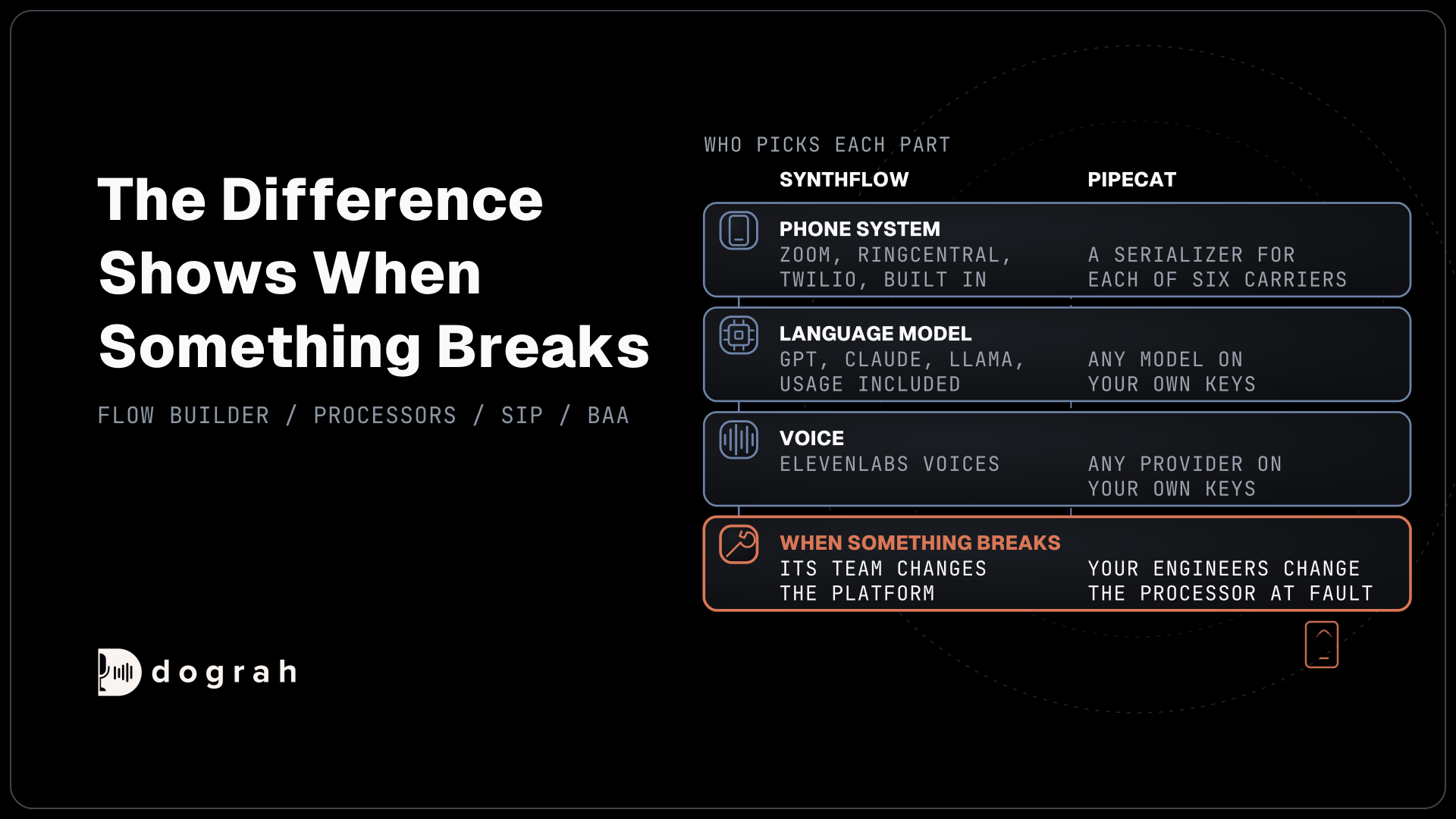
The difference shows when something breaks. On Synthflow, changes inside the platform come from Synthflow's team. On Pipecat your engineers read the code and change the processor at fault themselves, which is also the work you signed up for.

Open Source Alternative to Vapi / Retell
Self-hosted voice agent platform — no per-minute fees
dograh-hq/dograh
Star on GitHub
Data, compliance and where calls run
Synthflow runs calls in its own cloud with a choice of region. You "Choose a US or EU workspace at setup to keep Synthflow workspace data and processing in that region", though it notes that connected providers can process some requests elsewhere. It mentions no self-hosted or on-premise version.
Its compliance list is long. Synthflow says it "signs a Business Associate Agreement with customers using its HIPAA Setting" and lists SOC 2 Type 2, ISO/IEC 27001, GDPR and PCI DSS v4.0.1. It describes its AI governance as aligned with ISO/IEC 42001 and the EU AI Act, and lists DORA too. Our Synthflow review covers how the HIPAA Setting works.
Pipecat has no compliance story of its own because it is code rather than a service. The audio goes to the machine you deploy it on and to the model providers you call. That gives you full control over where data lives, and it also makes every agreement, from your cloud host to your speech vendor, yours to sign and check. Confirm with counsel which agreements your calls need before patient or card data goes through them.
The volume where owning the stack pays
WebRTC.ventures and Softcery agree that hosted platforms win at low volume and owned stacks can win at high volume. They disagree sharply on where that volume crossover sits. WebRTC.ventures says that "past tens of thousands of minutes per month, the math often shifts in favor of owned infrastructure", speaking of platforms billed by the minute. Synthflow's annual price is set against expected volume instead, so for its buyers the line moves with the price Synthflow quotes.
Softcery's self-hosting cost model puts the line far higher. It finds that below roughly 1M minutes a month, "Hosted wins by two to ten times", because a dedicated team to run the models costs an estimated $300,000 to $500,000 a year. Softcery adds that absorbing the work into an existing team moves the crossover down sharply.
The two figures measure different things. Softcery models running the speech and language models on your own GPUs, while a Pipecat team can still call hosted model APIs and only run the framework. WebRTC.ventures is talking about owning the orchestration layer. For a Synthflow buyer, the real test is your own call volume, the engineers you already have, and the price Synthflow quotes for that volume.
Where Synthflow wins and where Pipecat wins
Synthflow wins when a contact center needs a supported launch and has no voice engineers. One contract covers models, voices, telephony and SMS, the phone-system list reaches the platforms contact centers already run, white-label serves BPOs, and the compliance list answers procurement on day one.
Pipecat wins when your engineers want to own the agent. The code is open, any model or provider can plug in, data stays where you run it, and you can start today with no contract. At high volume the platform line shrinks to your hosting, and the main cost becomes the engineering time to build and run the product.
The choice usually comes down to who you have. A team without engineers will find Pipecat slow, and a team of engineers will find an annual closed contract hard to change once the agent grows.
Join the Dograh Community
Dograh is an OSS alternative to Vapi. Join our Slack community for queries, releases, best practices & community interactions.
No-code building on open code with Dograh
Dograh, the open-source AI voice agent platform, offers no-code building on open code. It runs on a fork of Pipecat that follows upstream releases, so every call goes through the same pipeline this post compares. Agents are built without code on a visual workflow builder, a canvas of nodes and pathways, and on Dograh Cloud new agents can also start from a conversational Agent Builder that drafts the agent from a description.
It reaches a contact center's phone system through your carrier, Cloudonix or Asterisk ARI, alongside Twilio, Telnyx, Plivo, Vonage, Exotel, Vobiz and WhatsApp. Transfer Call works on Twilio, Telnyx, Plivo, Cloudonix and Asterisk ARI, calling the destination first and connecting the caller only when someone answers. Campaigns dial call lists, a QA node reviews each call's transcript node by node after it ends, and once Langfuse keys are added, each call's trace opens there.
The code is under the BSD 2-Clause license. To self-host, a Docker Compose install wants at least 8 GB of RAM and 4 vCPUs on the server. Enterprise customers can also deploy on-premise or in a private cloud with data residency.
Self-hosting takes the per-minute platform fee off the bill, while servers, model keys and phone minutes stay on it. Running the database and upgrades falls to your team, with the open-source community for support and custom SLAs on Enterprise. For a hosted route, Dograh Cloud charges a 1¢-a-minute platform fee, with models and phone minutes on top.
Glossary
- Annual enterprise agreement
- Synthflow's only buying route for new deployments, one price for the year set against the call volume you expect, with no rate by the minute.
- Forward-deployed engineer
- A vendor engineer who works inside the customer's project to build and launch the agent. Synthflow includes them where the agreement covers launch support.
- Telephony serializer
- Pipecat's adapter that converts one carrier's audio stream into the pipeline's frame format, such as its Twilio or Telnyx serializer.
- Volume crossover
- The monthly call volume at which owning the voice stack overtakes paying a hosted platform on total spend. Sources place it anywhere from tens of thousands to about a million minutes.