
LiveKit is a strong open-source base for real-time voice and video, with an Apache-2.0 media server, agent framework and SIP, plus LiveKit Cloud for hosting, models and numbers. Outside Cloud's Agent Builder, the call flow is code you write. For call history, campaigns and QA already built, Dograh ships them open source to host yourself or run on Dograh Cloud.
Key Takeaways
- LiveKit's server, Agents framework and SIP service are Apache-2.0 open source.
- Agent hosting, Agent Builder and built-in inference come only with LiveKit Cloud.
- Cloud plans start free, with Ship from $50 and Scale from $500 a month.
LiveKit sits under many voice products, and it is easy to praise in general but hard to judge for one build. This review covers its parts, self-hosted against Cloud, prices, what you still build and what buyers say. Then we talk about how Dograh ships those platform pieces.
What LiveKit is made of
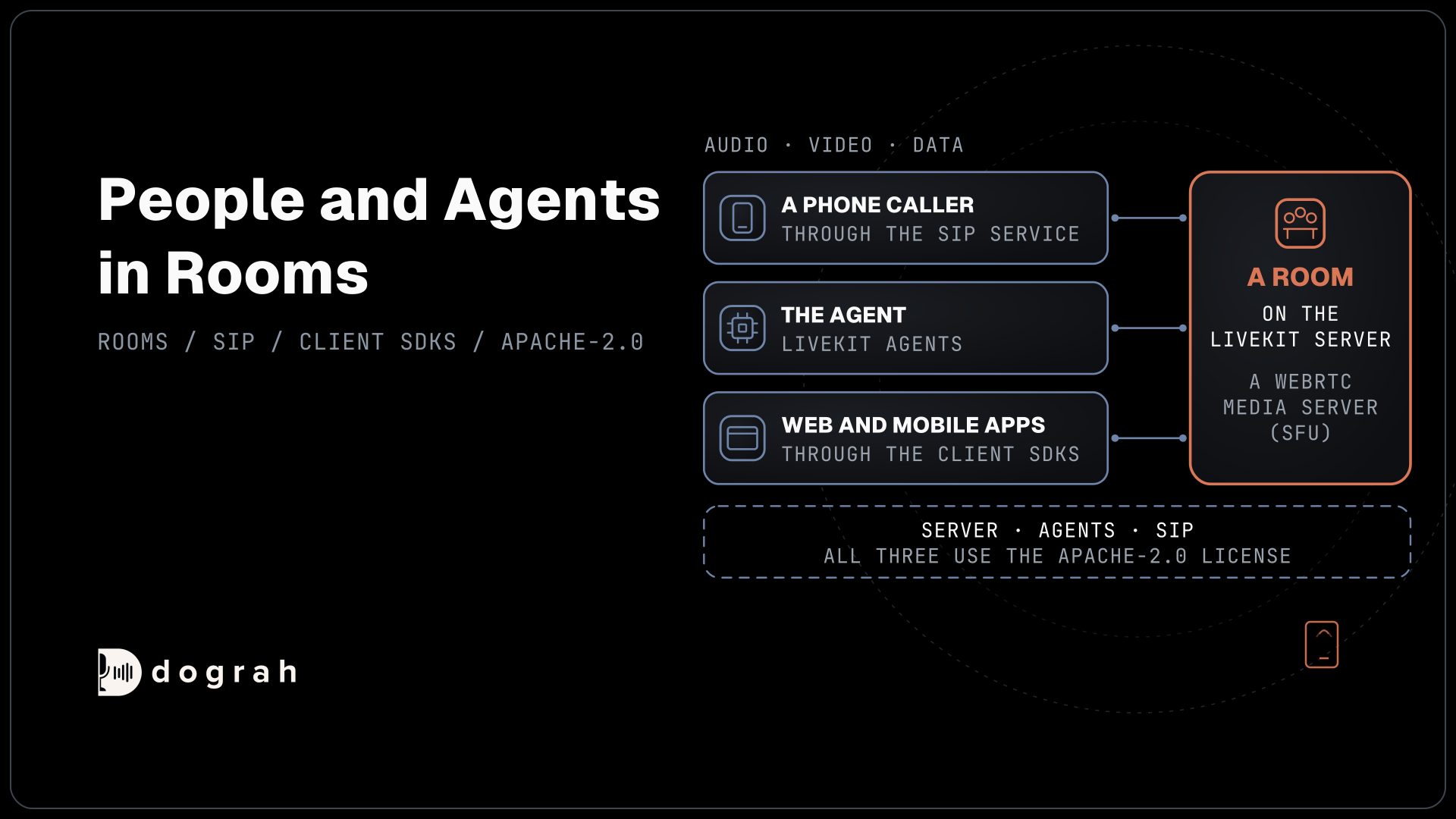
LiveKit is three open-source projects with a hosted service on top. The LiveKit server is a WebRTC media server, an SFU (selective forwarding unit), that moves audio, video and data between people and agents in rooms. LiveKit Agents is the framework, in Python and JavaScript, that joins a speech pipeline or a realtime model to those rooms. The SIP service connects rooms to phone calls.
All three use the Apache-2.0 license, so you can run, change and ship them in a commercial product. The pace is fast. livekit-agents 1.9.0 came out on 25 November 2026, and the server's latest release came a month before.
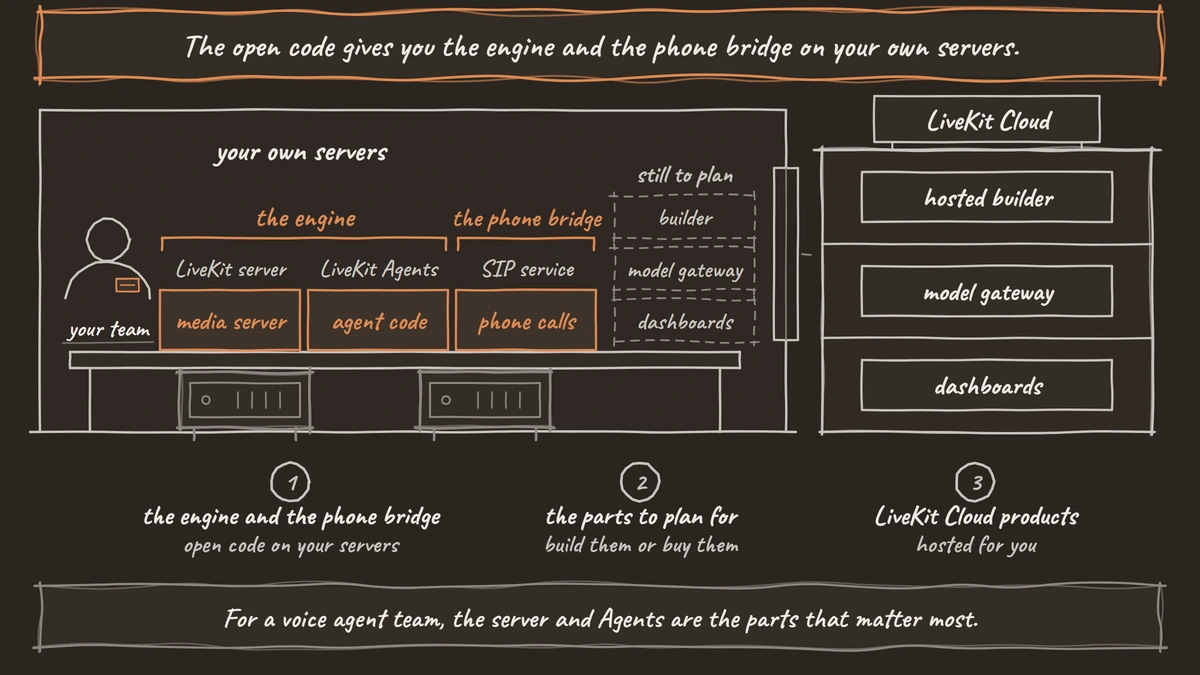
LiveKit also ships client SDKs for web, mobile and desktop, which is why so many voice and video apps sit on it. For a voice agent team, the server and Agents are the parts that matter most.
Self-hosted LiveKit and LiveKit Cloud compared
The clearest way to judge LiveKit is its own comparison of the two routes. LiveKit sets out what each route includes for AI agents and phone calls.
| Feature | Self-hosted | LiveKit Cloud |
|---|---|---|
| Agents framework and SIP | Full support, SIP as a separate service | Full support |
| Agent hosting | You run and scale agent servers yourself | Managed, with automatic scaling and rollbacks |
| Agent Builder | Not offered | Included |
| Built-in inference | Bring your own model keys | Included |
| Agent observability | Custom, through OpenTelemetry hooks | Transcripts, traces and recordings built in |
| Phone numbers | Bring your own SIP trunk | LiveKit Phone Numbers, or your own trunk |
| Uptime target | Yours to set | 99.99% |
The open code gives you the engine and the phone bridge on your own servers. The hosted builder, the model gateway and the dashboards that show what each agent did are LiveKit Cloud products. A team that self-hosts for control or data reasons should plan to build or buy those parts.

Open Source Alternative to Vapi / Retell
Self-hosted voice agent platform — no per-minute fees
dograh-hq/dograh
Star on GitHub
LiveKit Cloud, Inference and phone numbers
LiveKit Cloud is priced by agent session minutes. Its Build plan is $0 with 1,000 minutes and 5 sessions at once, Ship is from $50 a month with 5,000 minutes and 20 sessions, and Scale is from $500 a month with 50,000 minutes. On Ship and Scale, extra minutes cost $0.01 each, and Enterprise is custom.
Inference gives Cloud agents hosted speech-to-text, language and voice models on one bill, with $2.50, $5 or $50 of monthly credits by plan. Phone numbers are native too. LiveKit includes one free US local number, then charges $1.00 a month per number, and toll-free numbers cost $2.00 a month plus $0.02 a minute.
Scale adds SOC 2 Type II reports and a signed BAA for HIPAA, and LiveKit offers on-premise or private deployments through its sales team. If a BAA matters for your calls, confirm with counsel which vendors in your stack need one. Our guide to LiveKit pricing works through a full month on Ship, including the self-hosted side.
What you still build on either route
LiveKit Cloud's Agent Builder makes simple voice agents in the browser without code and can deploy them on Cloud. Anything with workflows, handoffs or tests is code, where you write the call flow, the prompts and the tool calls in Python or JavaScript, as our LiveKit Agents tutorial shows step by step. For a team of engineers, that control is the reason to choose LiveKit.
What sits around the call is also yours for a phone agent. Outbound lists with retries and calling hours, a store of past calls with transcripts and recordings, scoring of finished calls and a screen your operations team can use are all things LiveKit leaves to you. Cloud covers part of that with its observability and builder, and on the self-hosted route the rest is yours to build or add.
That is the gap between a framework and a finished platform. Our post on the two self-hosted install lists shows what each route asks you to install and run.
What buyers say, and one dissent
Developers like LiveKit. On Product Hunt, LiveKit held 5.0 from 41 reviews in November 2026, and one reviewer wrote "Love that it's open source and modular enough to plug into anything". Most of those reviews are about a year old, and they come from builders rather than operations teams.
The dissent comes from Open's LiveKit review. Open sells its own voice agent product, and it still calls LiveKit "one of the cleanest open-source WebRTC implementations in the market". On Agents it is cooler. "This reduces some of the build cost of voice AI. It does not replace it." Open then lists orchestration, tools, integrations, observability and compliance as work that stays with you.
Both views can be true. The engine is excellent, and a business that wants phone agents still needs the product around it.
Join the Dograh Community
Dograh is an OSS alternative to Vapi. Join our Slack community for queries, releases, best practices & community interactions.
Who LiveKit fits and who it does not
LiveKit fits engineering teams building their own voice or video product. It wins on its open WebRTC server, client SDKs for every platform, rooms with many people and video, native SIP with cold and agent-assisted transfers, and a fast release pace. LiveKit Cloud adds one bill for agents, models and numbers, a free tier and a BAA on Scale.
It fits less well for a team that wants phone agents running in weeks without writing the platform first. It also fits less well when you need to self-host and still want a builder, call history and QA out of the box, since those are Cloud products or your own work.
Dograh, an open engine with the pieces built
Dograh, the open-source AI voice agent platform, is a different open engine with those pieces already built. It runs on a fork of Pipecat rather than on LiveKit, and its open code ships the visual canvas for building agents, Campaigns for outbound lists with retries and calling hours, Agent Runs with each call's transcript and recording, and a QA node that reviews each call's transcript node by node after it ends. On Dograh Cloud, the Agent Builder drafts a new agent from your description, and a self-hosted install on the current release builds on the canvas.
Phone calls run on your own carrier, with Transfer Call on Twilio, Telnyx, Plivo, Cloudonix and Asterisk ARI. It calls the destination first and connects the caller only when someone answers. Coding agents such as Claude Code or Cursor can list, create and edit agents through Dograh's MCP server. Dograh vs LiveKit compares the two engines side by side.
Like LiveKit's server, Dograh's code is open, under the BSD 2-Clause license, and it self-hosts with Docker Compose, with on-premise or private-cloud deployment on Enterprise. Self-hosting it carries no per-minute platform fee, though you still pay for servers, model keys and phone minutes, and your team keeps the database and upgrades running. Help comes from the open-source community or custom SLAs on Enterprise, and Dograh Cloud is the hosted route at a 1¢-a-minute platform fee.
Glossary
- SFU (selective forwarding unit)
- A media server that receives each participant's stream and forwards it to the others without mixing. The LiveKit server is an SFU.
- Agent session minute
- LiveKit Cloud's billing unit, one minute an agent spends in a session. Paid plans include a monthly amount, then charge $0.01 a minute.
- SIP trunk
- A carrier connection that carries phone calls over the internet. Self-hosted LiveKit needs one from your own provider to reach phone numbers.
- OpenTelemetry
- An open standard for sending traces and metrics from software. Self-hosted LiveKit agents expose OpenTelemetry hooks for your own observability tools.