
Choosing Dograh vs Inworld AI depends on the layer you need. Inworld sells closed voice models, speech-to-text and a Realtime API, mainly from its own cloud. For teams that want to own the platform that runs the phone call, Dograh is the open-source option to host yourself or run on Dograh Cloud, using Inworld's TTS-2 voice on your own key.
Key Takeaways
- Inworld sells voice, speech-to-text, a Realtime API and hosted language models, all closed.
- Dograh runs Inworld's TTS-2 voice on your key, adding carriers, transfers and Campaigns.
- Inworld serves four regions and offers VPC deployment on your own GPUs.
Inworld AI sells voice models, speech-to-text, a Realtime API and hosted language models from its cloud. Dograh is an open-source AI voice agent platform that runs the phone call around any voice. This post compares voices, realtime, phone calls, hosting and price, then we talk about when each one fits.
Dograh vs Inworld AI at a glance
The two products sit at different layers of a phone agent, so most rows compare a model company with a platform. Each row asks both the same question.
| Row | Inworld AI | Dograh |
|---|---|---|
| What it is | Voice models, speech-to-text, a Realtime API, hosted LLMs and dedicated capacity | An open-source AI voice agent platform that runs the call |
| Code | Closed models | Open source under BSD 2-Clause |
| Voice | Realtime TTS-2 and TTS-2 Flash, with voice cloning | Many voice providers on your own keys, Inworld TTS-2 among them, or local voices |
| Speech-to-text | Realtime STT-1 in more than 30 languages | Deepgram, Speechmatics, AssemblyAI, Soniox, Sarvam and others, or local models |
| Speech-to-speech | The Inworld Realtime API, and Ultravox, now owned by Inworld | Realtime models from OpenAI, Google, Azure, AWS, Grok and Ultravox |
| Phone calls | SIP and PSTN through Telnyx and Twilio, Twilio guides for your own code, and native SIP on Ultravox | Built-in carriers, with Transfer Call on Twilio, Telnyx, Plivo, Cloudonix and Asterisk ARI |
| Call flow and tools | Code against the API, with tool calling | A visual canvas, HTTP API and MCP tools and a Webhook node |
| Campaigns and QA | Outside Inworld's products | Campaigns, a QA node and Agent Runs |
| Where it runs | Inworld's shared fleet in four regions, or a VPC deployment on your own GPUs | Your servers, Dograh Cloud, or on-prem on Enterprise |
| Data terms | Zero data retention from Developer, HIPAA and BAA add-ons on Growth, EU and India residency on Enterprise | Self-hosted, call records stay in your own database and storage, while the model providers you pick still receive audio or text |
| Price shape | Monthly plans with credits, billed per character or per hour | Self-hosted, no per-minute platform fee. Dograh Cloud, a 1¢-a-minute platform fee |
A voice company and a call platform
Inworld is a model company. It makes Realtime TTS-2 and TTS-2 Flash for speech, Realtime STT-1 for transcription and a Realtime API that listens, reasons and talks on one connection. It also serves more than 100 language models through Inworld Inference, and on 30 September 2026 it bought Ultravox, the speech-to-speech company.
Dograh sits one layer up, running the call flow, the tools and the phone line, while the speech and language models are a layer you choose. That layer can be Inworld, another provider, or open models on your own servers. Our Inworld AI review walks through each Inworld product in more depth.
So the comparison is narrower than the name suggests. Where you only need a voice, the two are partners. Where you would build a whole agent on Inworld's Realtime API, the question is whether you write the call platform yourself or run one.
Voices and speech-to-text
Voice is Inworld's strongest card. Inworld says the TTS-2 family covers more than 200 languages and more than 500 dialects, and it calls TTS-2 Flash the fastest model in the family. Instant voice cloning works from a few seconds of audio, and professional cloning is in Beta.
Listener votes back the quality. On Artificial Analysis's Speech Arena, where people pick between clips without seeing model names, Realtime TTS-2 was 10th and TTS-2 Flash 19th, as measured on 27 November 2026. Eleven v4 Turbo was 1st on the same day. Those votes use full-band clips, so judge the final pick on real phone calls.
Realtime STT-1 transcribes more than 30 languages and can return a voice profile with each transcript when you switch it on in the request. In Dograh, Inworld comes in as a voice provider on your key, and speech-to-text runs on a separate provider such as Deepgram, Speechmatics or Soniox, or on a local model. Each agent picks its own speech-to-text, language model and voice.

Open Source Alternative to Vapi / Retell
Self-hosted voice agent platform — no per-minute fees
dograh-hq/dograh
Star on GitHub
Speech-to-speech and the Realtime API
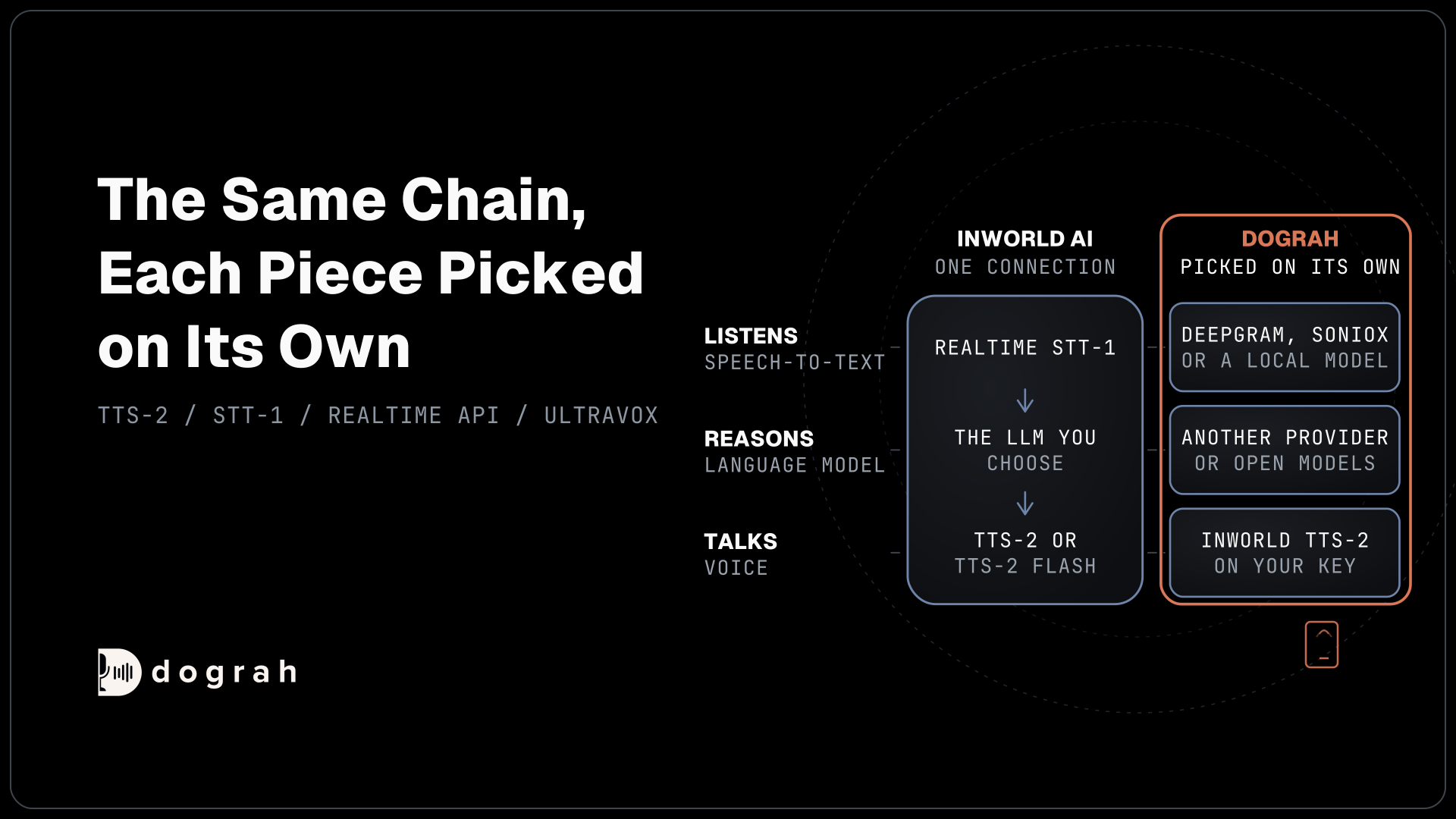
Inworld's Realtime API runs a whole conversation over one WebSocket or WebRTC connection by chaining speech-to-text, the language model you choose and its voice, with tool calling and a migration guide for teams leaving OpenAI's Realtime API. A session is billed for the speech-to-text, language model and voice it uses at plan rates, with no per-minute or per-session price. Hanging up and steering a WebRTC call from your server is in Beta.
Dograh runs speech-to-speech too, through a Realtime configuration in Models that you select in the agent's Model tab. The choices are OpenAI Realtime, Google, Google Vertex, Azure, AWS Nova Sonic, Grok and Ultravox. Ultravox is on that list, so Inworld-owned speech-to-speech can run in a Dograh agent on your Ultravox key.
Our Ultravox review covers that model and its hosted service. Since Inworld's Realtime API is itself a chain of speech-to-text, language model and voice, a Dograh agent can build the same chain with each piece picked on its own.
Phone calls and the call flow
Inworld lists SIP and PSTN connections through Telnyx and Twilio for its voice agents, and Ultravox, which Inworld now owns, has native SIP. Its guides for the Realtime API on Twilio Media Streams and for Inworld voices on Twilio ConversationRelay leave the bridge and the call records to your own code, and on every route the call logic is yours to build.
Dograh connects to Twilio, Telnyx, Plivo, Vonage, Exotel, Vobiz, Cloudonix and Asterisk ARI. On Twilio, Telnyx, Plivo, Cloudonix and Asterisk ARI, Transfer Call calls the destination first and connects the caller only when someone answers. On Exotel, Vobiz and Vonage, you can add an HTTP API tool that logs a callback request when the caller needs a person.
Agents are built on a visual canvas, with HTTP API and MCP tools reaching your systems during the call and a Webhook node sending results after it. On Dograh Cloud, the Agent Builder drafts a new agent from your description, and self-hosted installs on the current release build on the canvas. Outbound lists go out through Campaigns, a QA node checks each finished call's transcript one node at a time, and Agent Runs stores every recording and transcript.
Where each one runs and what Inworld bills
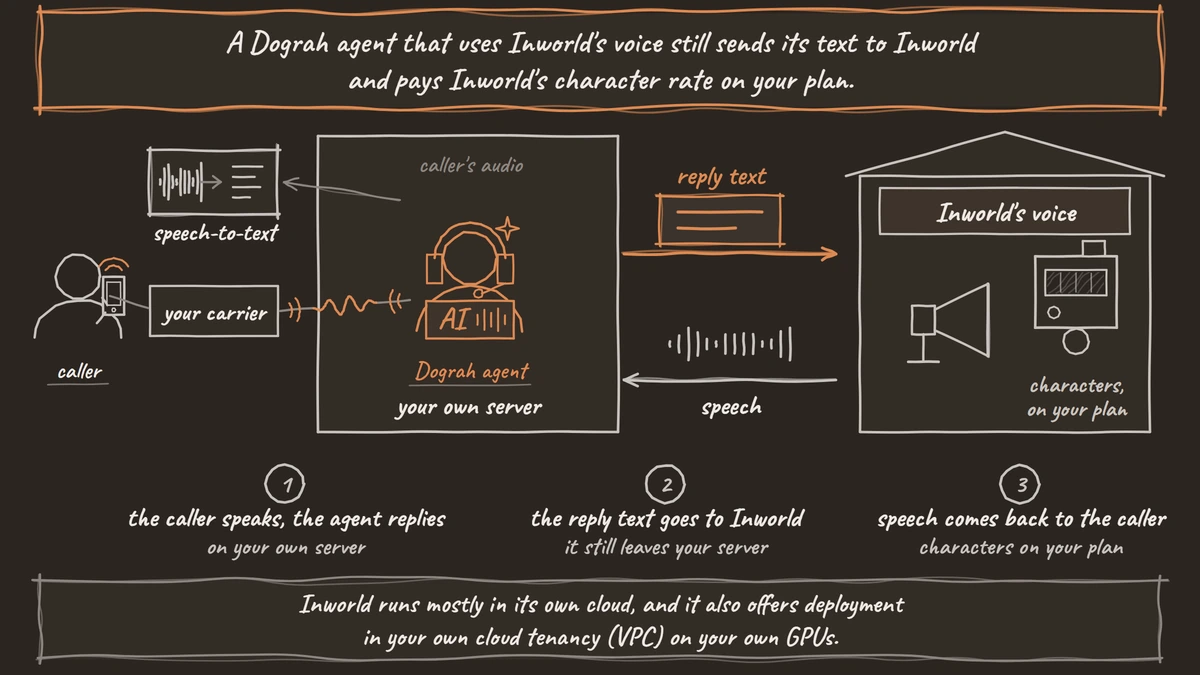
Inworld runs mostly in its own cloud, and it also offers deployment in your own cloud tenancy (VPC) on your own GPUs. Its shared fleet serves voice from four regions, the United States, Europe, India and Asia Pacific, and serves its language models in the US. Zero data retention starts on the Developer plan, HIPAA and a BAA are add-ons on Growth, and EU and India data residency come with Enterprise. For calls that need a BAA, ask counsel which vendors in your stack require one.
Inworld's plans run from On-Demand at $0 to Growth at $1,500 a month, with Enterprise custom, and each plan's fee comes back as credits. TTS-2 drops from $25 per million characters on demand to $12.50 on Growth, and Enterprise rates for the TTS-2 family go as low as $5 per million characters. Our guide to Inworld AI pricing works through a month of calls.
A Dograh agent that uses Inworld's voice still sends its text to Inworld and pays Inworld's character rate on your plan. Where the rest of the call lives depends on where you run Dograh.
Join the Dograh Community
Dograh is an OSS alternative to Vapi. Join our Slack community for queries, releases, best practices & community interactions.
Where Inworld wins
Inworld is the stronger pick when the voice is the product. TTS-2 placed in the Speech Arena's top ten on 27 November 2026, Inworld claims very wide language coverage, and cloning works from seconds of audio. One vendor covers voice, speech-to-text, speech-to-speech and hosted language models, with a per-character price that falls as you commit more.
It also suits developers who want to build their own agent in code. The CLI and MCP server let a coding agent such as Claude Code synthesize speech, clone voices and call models from the terminal, and there are no servers to run. If your team already writes its own call logic and wants the best voice it can rent, Inworld fits that shape well.
Using Inworld's voices inside Dograh
The two combine cleanly. Inworld is a built-in voice provider in Dograh on your own Inworld key. The model defaults to inworld-tts-2, and you can type inworld-tts-2-flash for the faster model, a workspace voice ID for a cloned voice, a language, a speed from 0.25 to 4.0 and a delivery mode of Stable, Balanced or Creative. Ultravox runs on its own key as a speech-to-speech option.
Around that voice, Dograh, the open-source AI voice agent platform, adds the carrier, the call flow, transfers, Campaigns, QA and call history. To test the fit, build one agent with Inworld's voice and place it over a real phone line, since phone audio is narrower than a demo. Our list of Inworld AI alternatives covers other voices and agent layers if you want to compare more options.
The code is open under the BSD 2-Clause license, you self-host it with Docker Compose, and Enterprise adds on-premise or private-cloud deployment. Running it yourself means no per-minute platform fee, though servers, model keys and phone minutes still cost money, and Inworld bills its characters on your plan either way. Your team looks after the database and upgrades, support comes from the open-source community with custom SLAs on Enterprise, and Dograh Cloud runs it all for a 1¢-a-minute platform fee.
Glossary
- Realtime API
- Inworld's speech-to-speech interface, which listens, reasons and talks on one WebSocket or WebRTC connection. A session bills its speech-to-text, language model and voice use at plan rates.
- Delivery mode
- Dograh's setting for Inworld TTS-2 that trades stability for expressiveness. It takes Stable, Balanced or Creative, with Balanced as the default.
- Speech-to-speech
- A setup that takes the caller's audio and answers in audio over one connection. Inworld's Realtime API does it by connecting speech-to-text, your chosen language model and a voice.
- Zero data retention
- A vendor promise not to store the text or audio it processes. Inworld offers it from its Developer plan upward.