
Sierra charges per agreed outcome, such as a resolved conversation, and brings its own team to build the agent. Decagon charges per conversation or per resolution, and support staff write its procedures in plain language. Dograh, the open-source AI voice agent platform we build, is a third option you can self-host or run on Dograh Cloud.
Key Takeaways
- Sierra bills per agreed outcome. Decagon bills per conversation or per resolution.
- Decagon's voice agent speaks 70+ languages on Chord, its own speech model.
- Both are hosted platforms bought by contract, so the vendor picks the models.
Both companies sell an AI agent that answers customers across several channels, and both price by contract. We compare how each one charges, builds, handles phone calls and proves compliance, then say who each fits. If you want to own the voice stack instead, the last section covers Dograh.
How Sierra and Decagon compare at a glance
Sierra and Decagon sell the same kind of product, a hosted AI agent for customer service, and they differ most on the pricing unit and on who writes the agent. Every cell below comes from the vendor's own product, pricing or security pages.
| Row | Sierra | Decagon |
|---|---|---|
| How you pay | Per agreed outcome, such as a resolved conversation or a saved cancellation. Routing calls can be priced per conversation | Per conversation, or a higher rate per resolved conversation with no charge for escalations |
| Channels | Voice, chat, email and WhatsApp | Chat, voice and email |
| Languages | 59 | 70+ on voice, with automatic detection and switching |
| Builder | Agent Studio with Ghostwriter, an Agent SDK and an agent development team | Agent Operating Procedures (AOPs) in plain language, drafted with Duet |
| Voice | Voice Personas, tested with Voice Sims | Voice 3 on Chord, Decagon's own speech model |
| Phone systems | Part of Sierra's hosted platform | Amazon Connect, RingCentral or SIP trunking |
| Compliance list | SOC 2, HIPAA, GDPR, PCI DSS Level 1, FedRAMP High, ISO 27001 and ISO 42001, among others | SOC 2 Type II, GDPR, CCPA, HIPAA, ISO 27001 and PCI DSS, among others |
| Where it runs | Sierra's hosted platform, by contract or through Google Cloud Marketplace | Decagon's hosted platform on multi-region infrastructure |
| Prices | Set in your contract | Set with Decagon's sales team |
Outcomes or conversations: how each charges
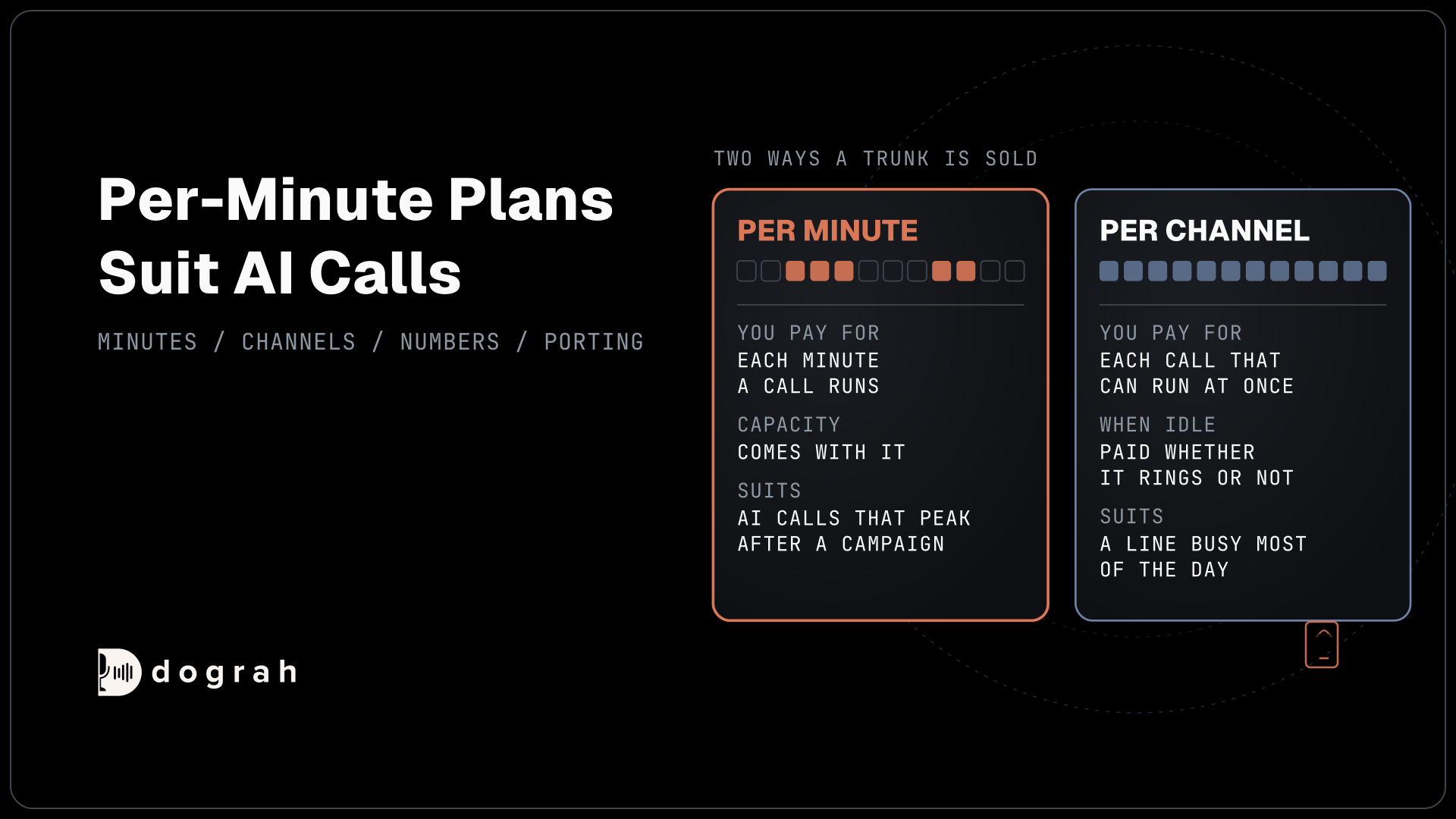
The pricing unit is the biggest difference, because it decides what you pay for a conversation the agent fails to finish. Sierra's explainer on outcome-based pricing ties the bill to outcomes you agree upfront, such as a resolved support conversation, a saved cancellation, an upsell or a cross-sell. When a conversation stays unresolved or gets escalated, Sierra says there is no charge in most cases. Calls that only route or greet callers may be priced per conversation instead, whatever the result.
Decagon's pricing explainer offers two models. Per conversation is a fixed rate for every incoming conversation, with flexible pricing at higher volumes. Per resolution is a higher fixed rate for each fully resolved conversation, with no charge for escalations, and larger resolution commitments lower that rate. Decagon says the vast majority of its customers choose per conversation.
Here is a worked example, with no real prices in it. Say your agent handles 10,000 conversations a month and resolves 7,000 of them. Per conversation, you pay for all 10,000. Per resolution or per outcome, you pay for 7,000 at a higher rate. Our arithmetic says the per-resolution deal comes out ahead only while its rate stays under about 1.43 times the per-conversation rate, which is 10,000 divided by 7,000.
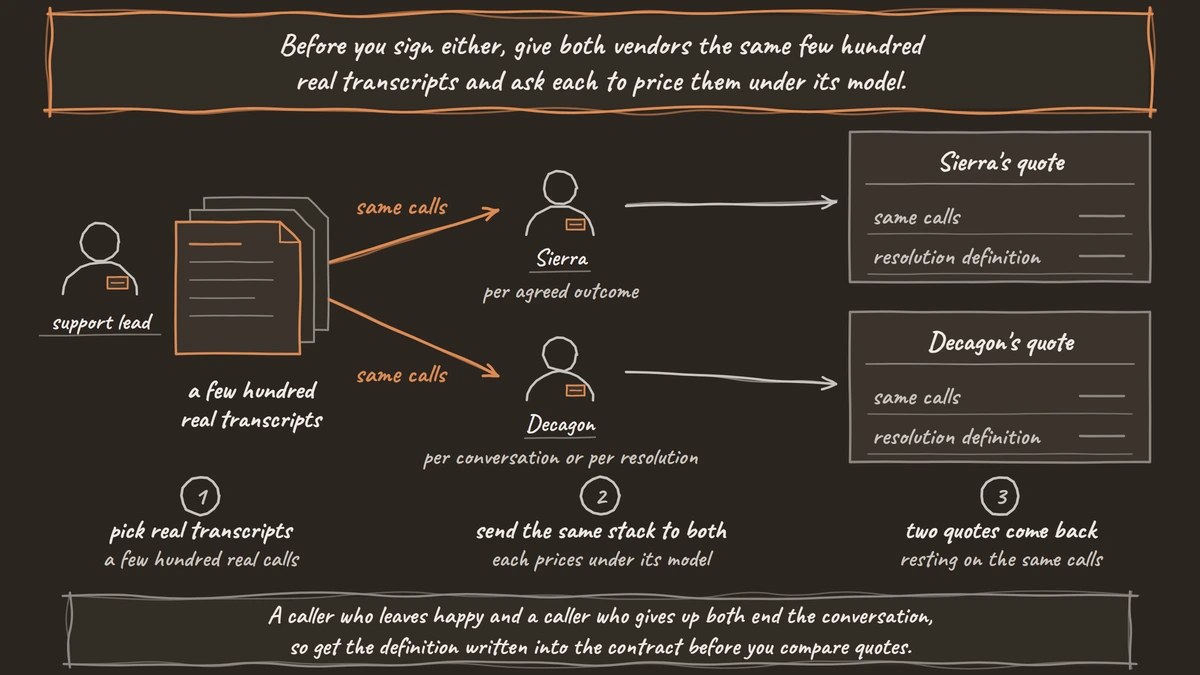
The harder question is what counts as resolved. A caller who leaves happy and a caller who gives up both end the conversation, so get the definition written into the contract before you compare quotes. Our posts on how Sierra's outcome contracts work and Decagon's two pricing models go deeper on each.
Who builds the agent, and how
Sierra builds alongside you, while Decagon hands the pen to your support team. Sierra's Agent Studio is now organised around Ghostwriter, where you build or change the agent by describing how it should behave. Explorer answers questions about your conversations in plain language, developers get an Agent SDK, and Sierra offers its own agent development team to build and tune the agent with you.
Decagon's unit of work is the Agent Operating Procedure. An AOP is a workflow for the agent written in natural language, so a support lead can write the refund or cancellation steps the way they would brief a new hire. Decagon's built-in guardrails enforce the AOPs, policies and brand guidelines during a call, and Duet, Decagon's AI partner, drafts AOPs for you.
The choice here is about ownership inside your company. With Sierra, more of the agent's logic sits with the vendor's team. With Decagon, your operations staff write and change the procedures themselves, which suits a support team that already keeps its own playbooks.

Open Source Alternative to Vapi / Retell
Self-hosted voice agent platform — no per-minute fees
dograh-hq/dograh
Star on GitHub
Voice calls on each platform
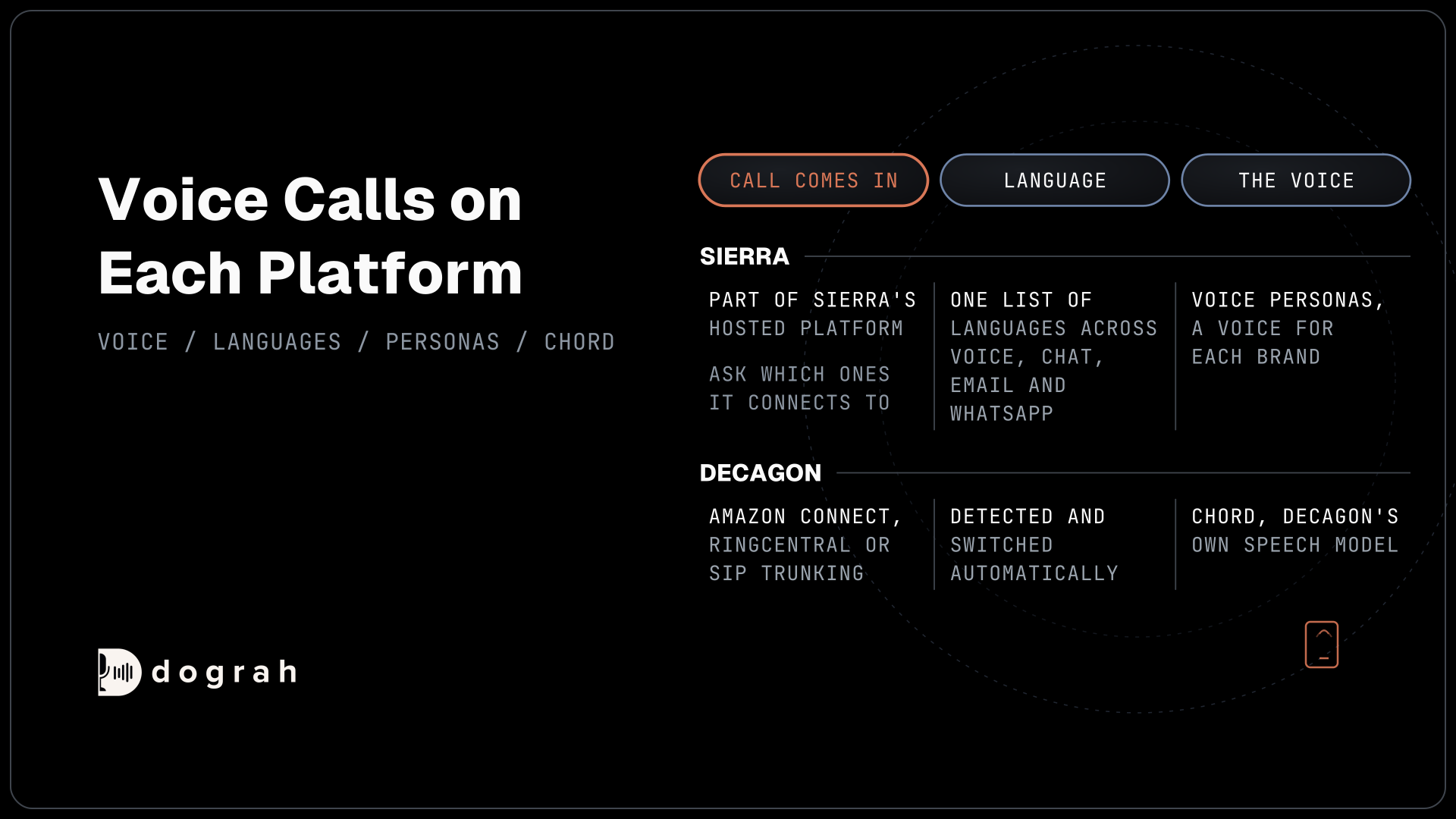
Decagon publishes more detail about voice, so phone-heavy teams will find it easier to check. Decagon's voice page describes support in 70+ languages with automatic detection and switching, outbound calls such as customer updates, and transfers to human agents with a short summary. Its connectors reach callers through Amazon Connect, RingCentral or SIP trunking.
Decagon's voice agent runs on Chord, a speech model Decagon trained for customer conversations. Decagon says Chord is trained on licensed data and consented voice talent, and never on customer-owned data. That matters if your legal team asks where a vendor's voice model came from.
Sierra treats voice as one of four channels, beside chat, email and WhatsApp, and lists 59 languages across them. Its Voice Personas give each brand a voice built from models Sierra chooses, and Voice Sims run simulated voice conversations before a change goes live. If your calls must reach a specific contact center system, ask Sierra which ones it connects to during the sales process.
Compliance and where each one runs
Both vendors carry long compliance lists, and Sierra's adds two items that matter to payments and government work. Sierra's trust and reliability page lists SOC 2, HIPAA, GDPR, PCI, FedRAMP High, CCPA, CSA STAR, ISO 27001 and ISO 42001. Sierra also holds PCI DSS Level 1 Service Provider certification, and it routes card data through separate PCI-certified infrastructure that never touches its core platform or language models.
Decagon's security page lists SOC 2 Type II, GDPR, CCPA, HIPAA, the EU AI Act, ISO 27001 and PCI DSS, on multi-region infrastructure. Both run as hosted services. Your call audio and customer data sit with the vendor under its certifications, and the vendor decides which models process them. For many enterprises that is exactly what the security review wants, because the certifications are the vendor's to maintain.
Join the Dograh Community
Dograh is an OSS alternative to Vapi. Join our Slack community for queries, releases, best practices & community interactions.
Who each one fits
Sierra fits a large consumer brand that wants to pay for results and have the vendor build with it. Paying per outcome suits a team that can define a resolved conversation or a saved cancellation precisely. WhatsApp support matters to some markets, and FedRAMP High or PCI DSS Level 1 on the vendor itself settles some procurement reviews before they start.
Decagon fits a support organisation that wants its own staff to write and change the agent's procedures. A per-conversation bill is easier to forecast than outcomes, since you know your volume before you know your resolution rate. Teams already on Amazon Connect or RingCentral get a direct route for voice.
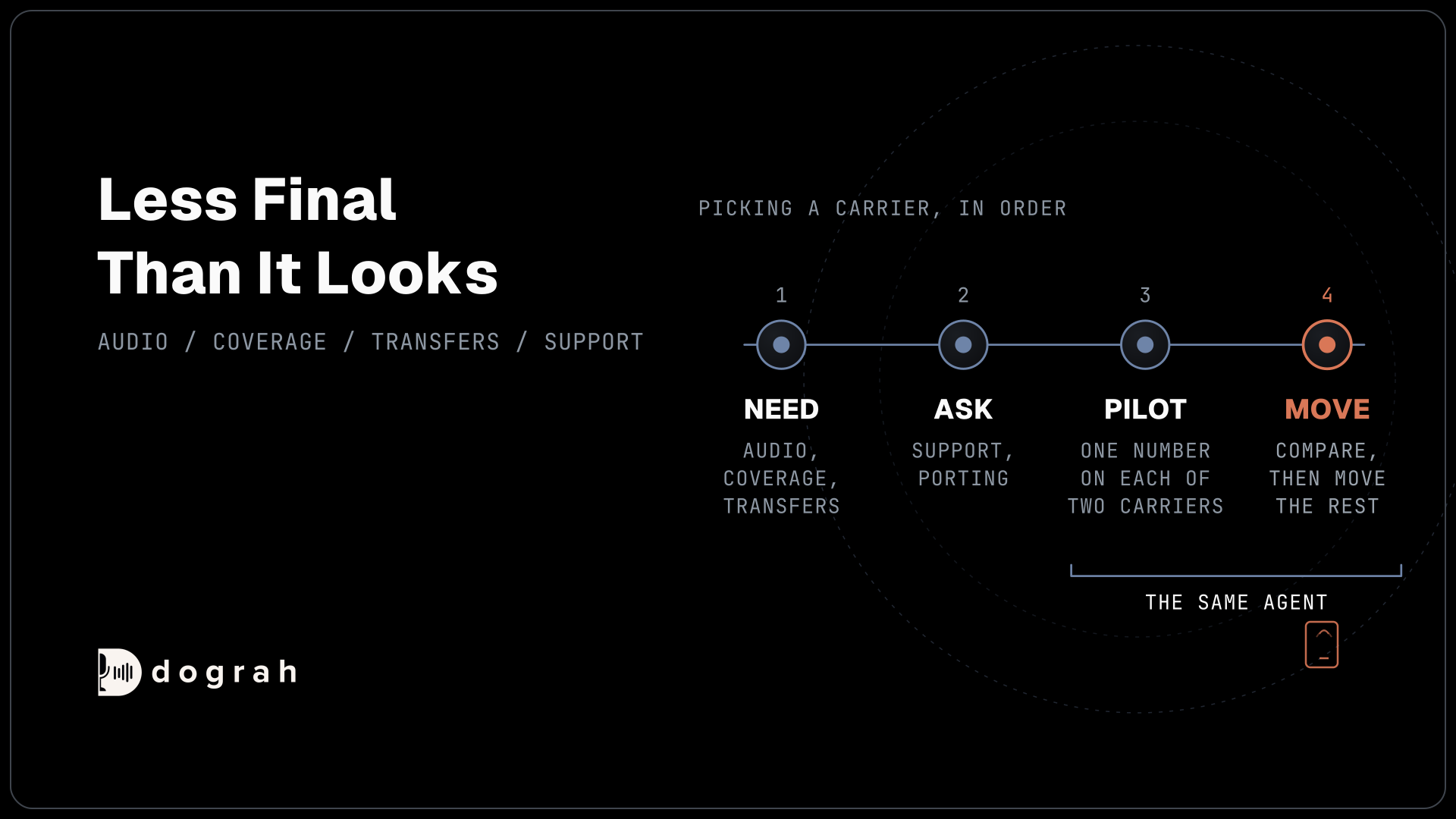
Before you sign either, give both vendors the same few hundred real transcripts and ask each to price them under its model. The two quotes will then rest on the same calls, and the resolution definition will be on paper.
A third option for teams that want their own stack
If the phone is your main channel and you want the platform and the call data on your side, an open-source platform is the other route. Dograh is BSD 2-Clause software, so you can run it on your own servers with Docker or use its managed cloud.
Self-hosted Dograh has no per-minute platform fee, but servers, model keys and phone minutes still cost money. Dograh Cloud charges a 1¢-a-minute platform fee. Models and phone minutes go on your providers' own bills, at their published rates.
You choose every model. Bring your own keys for any LLM, speech-to-text and voice provider, or run open-weight models on your own servers so the audio never goes to a model vendor. For the lines your agent says most, pre-recorded clips play a real human voice, with TTS as the fallback.
Call traces show the speech-to-text, AI and voice time for each turn, so you can see where a slow reply came from.
Built-in QA scores each step of test and live calls, with a sample rate you set. Dograh covers phone calls and a website widget rather than email, so it fits when voice is the channel you want to own.
| Sierra | Decagon | Dograh | |
|---|---|---|---|
| Unit of price | Agreed outcome | Conversation or resolution | Minute on Dograh Cloud, no platform fee self-hosted |
| Who builds | Your team with Sierra's team | Your support staff, in AOPs | Your team, in a visual workflow builder |
| Models | Chosen by Sierra | Chosen by Decagon, voice on Chord | Any provider with your keys, or open-weight models |
| Where it runs | Sierra's cloud | Decagon's cloud | Your servers or Dograh Cloud |
For a closer look at either switch, read Dograh vs Sierra or Dograh vs Decagon.
Glossary
- Outcome-based pricing
- Paying a vendor only when its agent completes an agreed task, such as a resolved conversation or a saved cancellation. Sierra uses it, and in most cases charges nothing for unresolved or escalated conversations.
- Per resolution
- A higher fixed rate charged only for conversations the agent fully resolves, with escalations free. Decagon offers it beside a per-conversation rate, and larger commitments lower it.
- Agent Operating Procedure (AOP)
- Decagon's name for an agent workflow written in natural language, so support staff can describe steps such as a refund the way they would brief a new hire. Guardrails enforce AOPs during a conversation.
- PCI DSS Level 1 Service Provider
- The highest certification level under the Payment Card Industry Data Security Standard for companies that handle card data for others. Sierra holds it and keeps card data off its language models.