
Retell AI is a strong hosted voice platform with built-in testing, a free BAA and per-agent data retention. Its limits are a $0.055-a-minute voice engine fee on every call, paid add-ons, 20 calls at once before extra fees, and no EU operation. Dograh, the open-source AI voice agent platform we build, is the alternative if those limits matter.
Key Takeaways
- Retell's testing tools and free BAA are real strengths for hosted teams.
- Every Retell minute carries $0.055 before models, voice and phone.
- Lines past 20 cost $8 a month each, or $0.10 a minute in burst.
Retell AI is one of the most complete hosted voice platforms, so a fair review weighs real strengths against real limits. We cover building, testing, compliance, the bill and call limits, then give a verdict. The last section covers Dograh for teams that want to run the code themselves.
Retell AI pros and cons at a glance
Retell's strengths sit in building, testing and compliance paperwork, and its limits sit in the bill, the call limits and where it runs. The last column shows how self-hosted Dograh handles the same row.
| Area | Retell strength | Retell limit | On self-hosted Dograh |
|---|---|---|---|
| Building | Single-prompt, multi-prompt and Conversation Flow agents | Closed code, flows live in Retell's console | Visual workflow builder, code you can read and change |
| Testing | Playground, simulation tests, batch runs, A/B tests on live traffic | Tests are billed | QA scored per step on test and live calls |
| Models | LLM choice, plus speech-to-speech on OpenAI realtime models | Every minute also carries the $0.055 voice engine | Any provider on your keys, or open-weight models |
| Compliance | SOC 2 Type 1 and Type 2, BAA at no fee | Your data runs outside the EU | No BAA with Dograh needed, since calls never reach it |
| Call data | Retention set per agent, 1 day to 2 years | Stored in Retell's cloud | Your own database and storage, under your own rules |
| Calls at once | 20 included | $8 a month each above 20, or $0.10 a minute in burst | 10 by default, raised with one setting |
| Where it runs | Retell's cloud, with cloud, VPC or on-prem on Enterprise | No published on-prem price | Your servers, or Dograh Cloud |
| Price | $10 free credit, $0.07 to $0.31 a minute all-in | Paid add-ons for QA, PII removal and more | No per-minute platform fee self-hosted, a 1¢-a-minute platform fee on Cloud |
What Retell does well in building calls
Retell gives builders three ways to shape a call, which covers most teams. A single-prompt agent suits a short, open conversation. A multi-prompt agent splits a call into states. Conversation Flow is a node canvas for dialogue, tools, transfers, code and transitions, for calls that must follow a set path.
The handover options are some of the most complete on any hosted platform. Retell's Transfer Call has three modes it names cold, warm and agentic warm, and Agent Transfer passes a caller to another AI agent mid-call. For a team that wants a person briefed before they pick up, that is ready on day one.
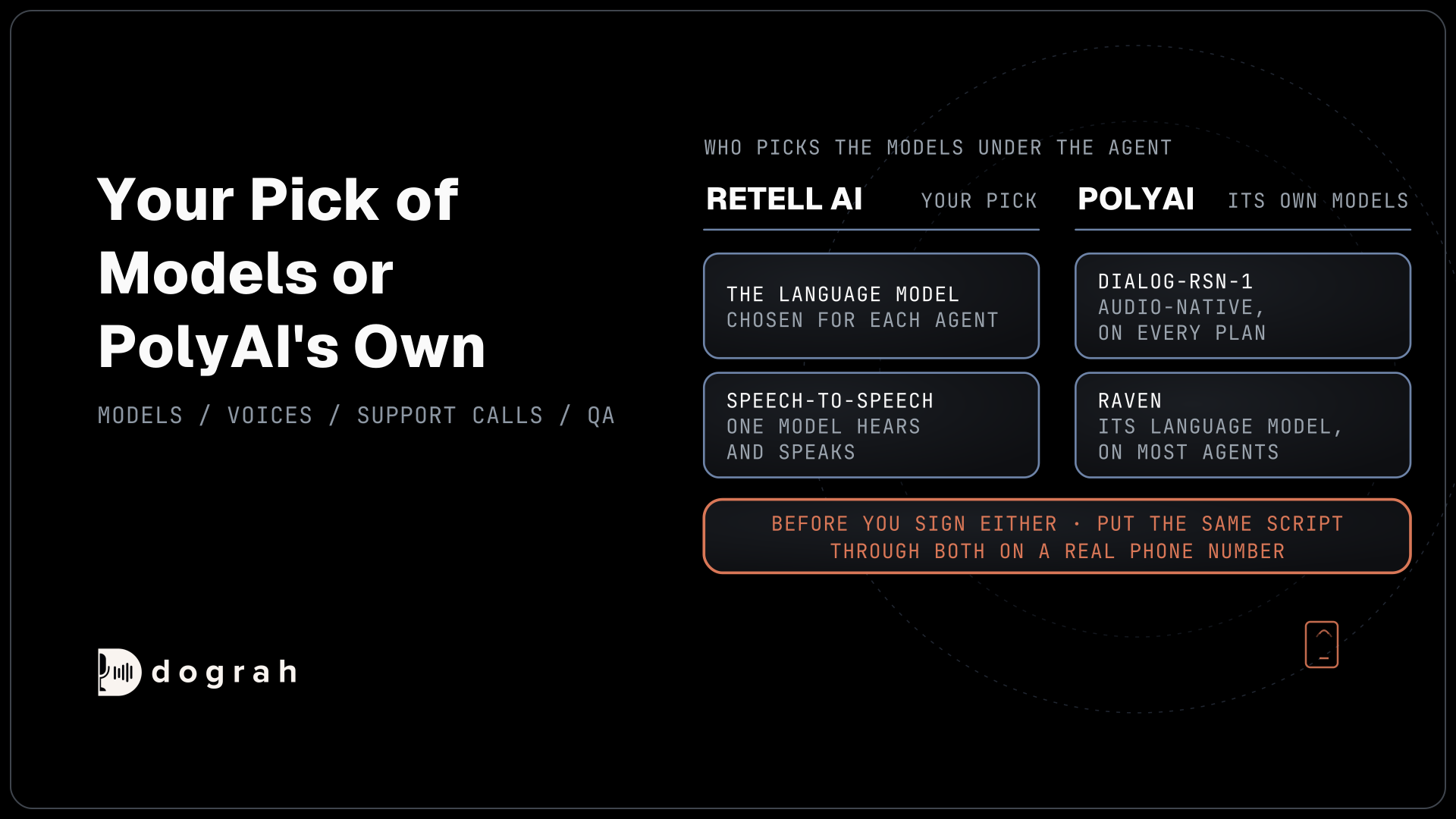
Retell also ships built-in tools for HubSpot, Salesforce, Zendesk and Cal.com, so common CRM, helpdesk and booking steps need no code of your own. Calls can run on Retell's numbers or on your own carrier through a SIP trunk or SIP URI, with custom SIP headers. For the model layer, you pick the language model per agent, and Retell sells speech-to-speech models, OpenAI's realtime models among them, as well as the cascade of separate speech and language models.
Testing is Retell's strongest area
Retell's testing tools are the part of the product most teams would miss after leaving. Retell offers four testing methods. The LLM Playground lets you chat with the agent by hand or with an AI-simulated user and inspect tool calls and transitions turn by turn. Simulation testing saves scenarios as graded test cases and runs them one at a time or as a batch to catch regressions. Web calls and real phone calls cover the audio, latency, transfers and carrier.
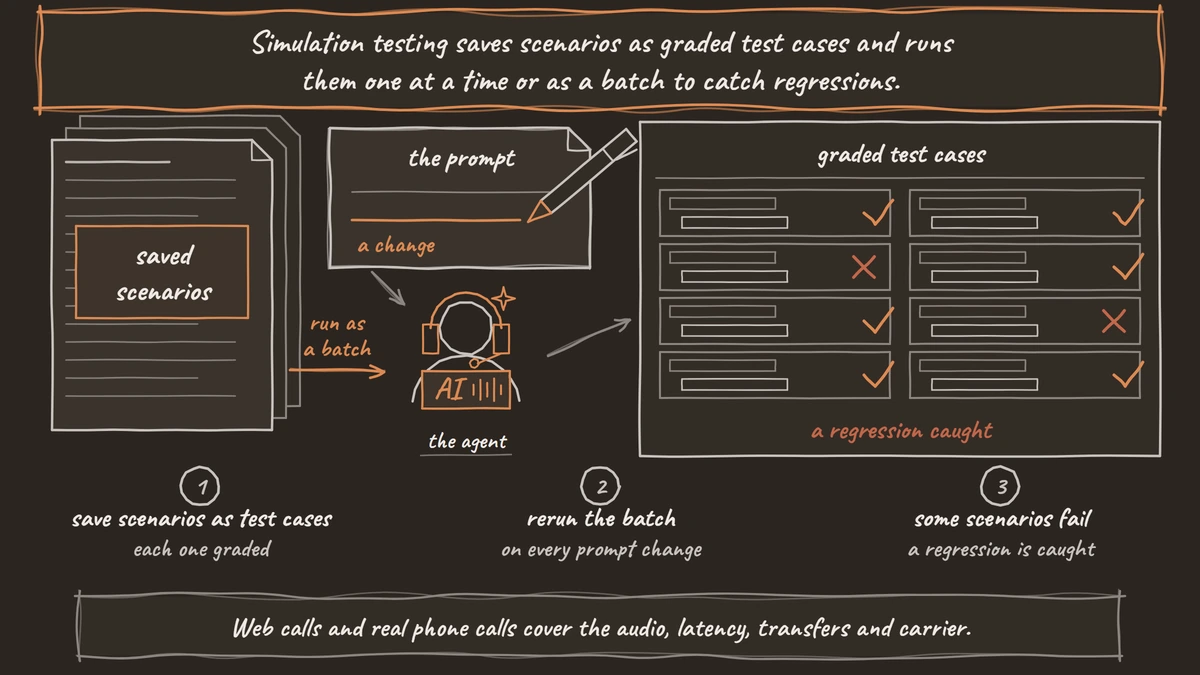
On top of that, Retell runs A/B tests on live traffic, so two versions of an agent can split real calls. Conductor, Retell's AI copilot, helps build agents and generate test cases.
The catch is that testing costs money. Text tests bill per message and voice tests per minute. A team that reruns a large batch on every prompt change should budget for it.

Open Source Alternative to Vapi / Retell
Self-hosted voice agent platform — no per-minute fees
dograh-hq/dograh
Star on GitHub
Compliance, call data and where it runs
Retell holds the paperwork many buyers ask for first. Retell lists SOC 2 Type 1 and Type 2. It signs a business associate agreement (BAA) under the Health Insurance Portability and Accountability Act (HIPAA) with no additional fee, self-signed online, and requires one before any patient data passes through.
Data controls are a fair strength too. You can set retention per agent, from 1 day up to 2 years, for transcripts, recordings and logs, and choose for each agent whether Retell stores everything, everything except personal details, or only basic call attributes.
Region is the main limit. Retell does not currently operate services within the European Union, and EU or UK data needs a data processing agreement with standard contractual clauses. For a European team with a residency rule, that is often the end of the evaluation.
Hosting is a newer story. Retell says enterprises can choose cloud, VPC or on-prem deployment, with air-gapped operation. It is sold through Enterprise sales with no published price or install package, and the code stays closed in every setup. Our post on why on-prem is not open source covers what that difference means in practice.
Where the bill grows
Retell's price starts low and grows with each part you add. Retell charges $0.055 a minute for voice infrastructure on every call. The language model adds $0.0016 to $0.64 a minute, the voice $0.015 to $0.10, and Retell's telephony $0.015, which drops to zero on your own SIP trunk. All in, Retell quotes $0.07 to $0.31 a minute.
Add-ons sit on top, each per minute: the knowledge base $0.005, advanced denoising $0.005, safety guardrails $0.005 and PII removal $0.01. AI quality assurance is free for the first 100 minutes, then $0.10 a minute.
QA is the add-on that changes a bill most. As an example, a team running 10,000 minutes a month with QA on every minute pays (10,000 - 100) x $0.10, so $990 a month for QA alone, on top of the call itself. Scoring a sample instead brings that down, which is why the sample size is worth deciding before launch. Our Retell AI pricing breakdown prices three full example businesses.
Call limits and burst pricing
Retell's limits are generous for a pilot and costly for steady growth. Each workspace gets 20 concurrent calls by default. Each extra call costs $8 a month, and Enterprise starts from 50.
Burst is a setting for peaks. With it enabled, calls above your limit proceed with a surcharge of $0.10 a minute for the whole call, up to the lower of three times your limit or your limit plus 300. Dialer campaign calls and batch calls never use burst. So a 4-minute call that starts above the limit costs an extra $0.40, and a team that peaks at 30 calls at once can instead pay 10 x $8, so $80 a month, for permanent lines.
Without burst, what happens at the limit depends on the call. Outbound calls are rejected, while batch and dialer calls wait for a free line. Inbound calls wait about 40 seconds, then go to the number's fallback number if one is set, or end. Set a fallback number before launch, because otherwise a busy Monday sends callers to a dead line.
Join the Dograh Community
Dograh is an OSS alternative to Vapi. Join our Slack community for queries, releases, best practices & community interactions.
Who Retell fits, and who it does not
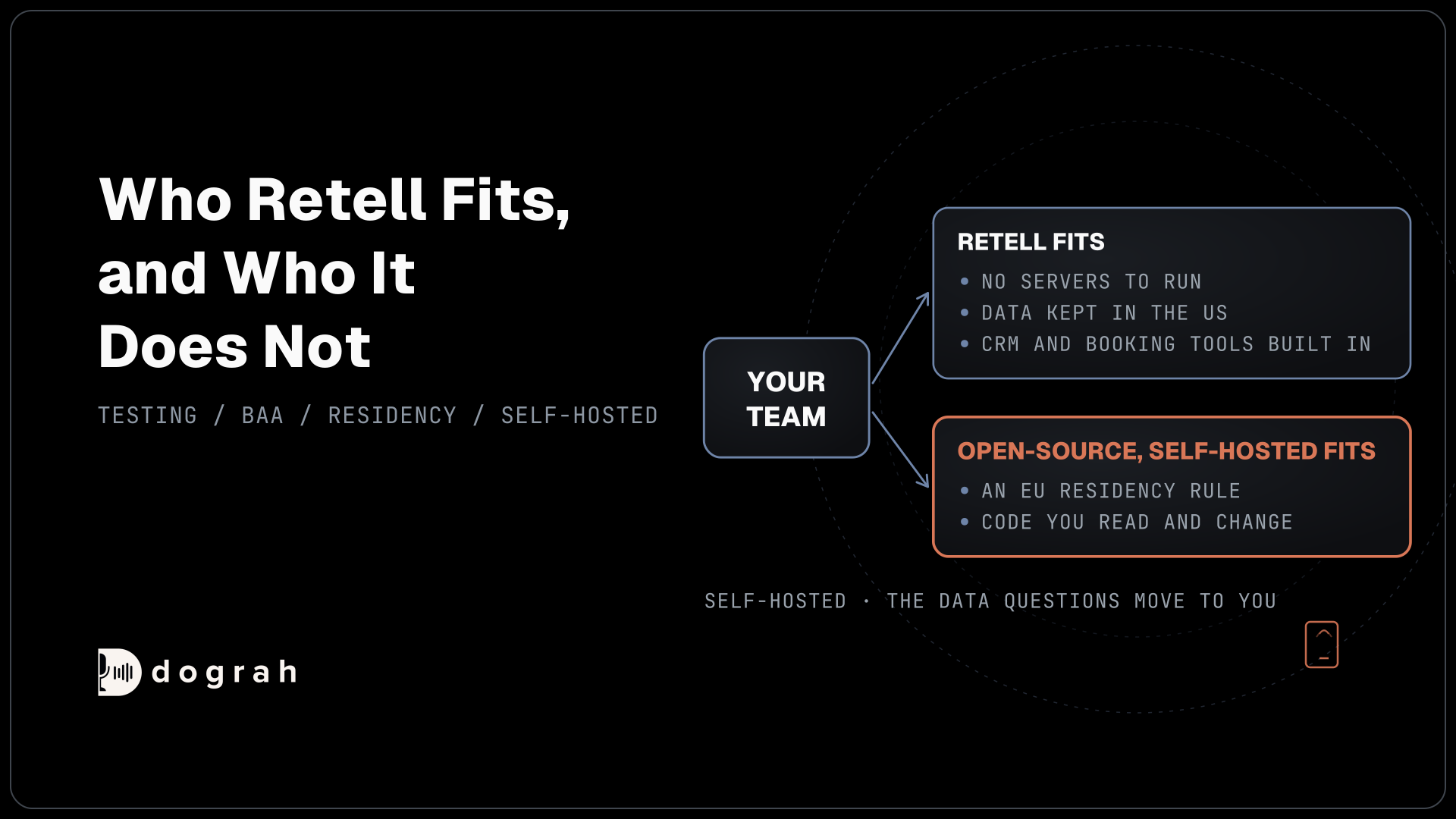
Retell fits a team that wants no servers, keeps its data in the US, and values a mature testing suite and a BAA at no extra fee. It also suits teams that stay under 20 calls at once and want the CRM and booking tools already built. For them, the voice engine fee buys real convenience.
It fits less well in four cases. A European company with a residency rule hits the no-EU line. A team that needs to read or change the platform code cannot, even on-prem. Steady volume above 20 calls at once pays every month for each extra line. And a team that wants QA on every call pays $0.10 a minute for it after the first 100 minutes.
Whichever way you lean, pilot on a real phone number. Most phone calls still reach the agent as 8 kHz audio, while a browser demo runs at 16 kHz, so an agent that sounds right in the console can mishear callers on a phone line.
Where an open-source, self-hosted platform fits instead
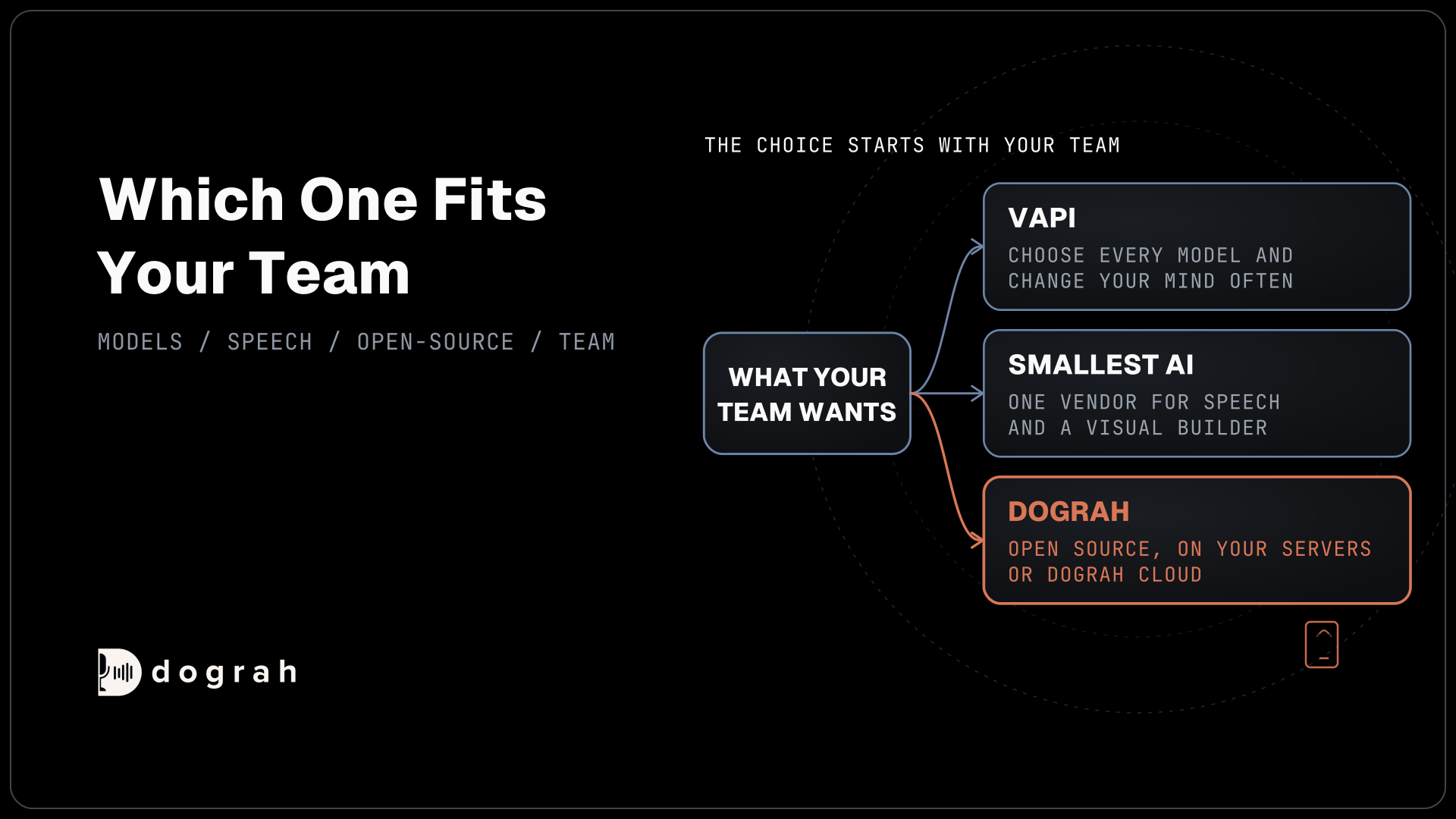
If the limits above are the deciding ones, Dograh is the open-source option. The code is BSD 2-Clause, so you can read it, change it and run it with Docker on your own servers, or use Dograh Cloud. You choose every model, from any provider on your own keys to open-weight models on your own GPUs, and speech-to-speech runs on OpenAI Realtime, Gemini Live, Grok Realtime, Ultravox, Azure Realtime and AWS Nova Sonic.
Self-hosted Dograh has no per-minute platform fee, but servers, model keys and phone minutes still cost money. Dograh Cloud charges a 1¢-a-minute platform fee. Self-hosted, it runs 10 calls at once by default, raised with one setting, and your servers and carrier set the real ceiling. Our post on scaling to thousands of simultaneous calls covers each limit in that chain.
The data questions move to you. Installed in an EU data center with the models hosted there too, the calls stay in that region. Recordings and transcripts sit in your own storage, under the retention rules you set. For patient calls, a self-hosted install needs no BAA with Dograh, while your model providers may need their own and your carrier may need one, depending on what it stores.
Quality checks come with the platform. The QA step scores each step of test and live calls, and you set the share of calls it samples. When a score looks wrong, the call trace shows the speech-to-text, AI and voice time for every turn.
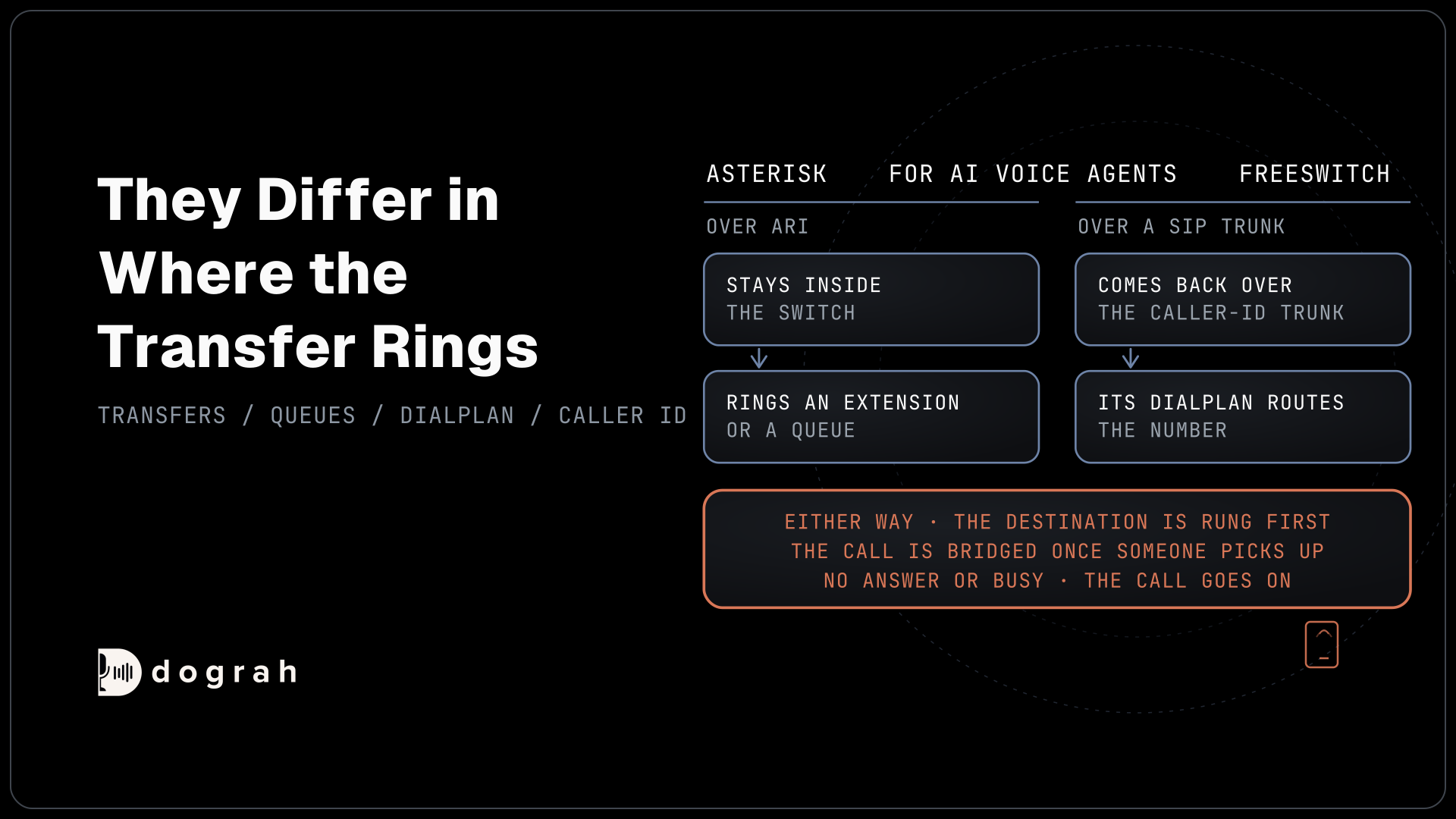
Transfer Call hands a caller to a person on Twilio, Telnyx, Plivo, Cloudonix and Asterisk ARI. The caller hears hold music while Dograh rings the destination, and the two are joined as soon as someone picks up. Business systems connect through HTTP API tools, MCP tools and webhooks. Pre-recorded clips can play your most common lines in a real voice, with text-to-speech for the rest. For the wider field, see our guide to Retell AI alternatives.
Glossary
- Burst
- A Retell setting that lets calls run above your concurrent call limit, up to the lower of three times the limit or the limit plus 300. Each burst call carries $0.10 a minute extra for its whole length.
- Fallback number
- The number Retell sends an inbound call to when every line is busy and the call has waited about 40 seconds. Without one, the call ends.
- Retention per agent
- A setting that decides how long a platform keeps one agent's transcripts, recordings and logs. Retell allows 1 day up to 2 years per agent.
- Voice engine fee
- Retell's $0.055 voice infrastructure charge on every call minute for running the call, billed before the language model, the voice and the phone line.