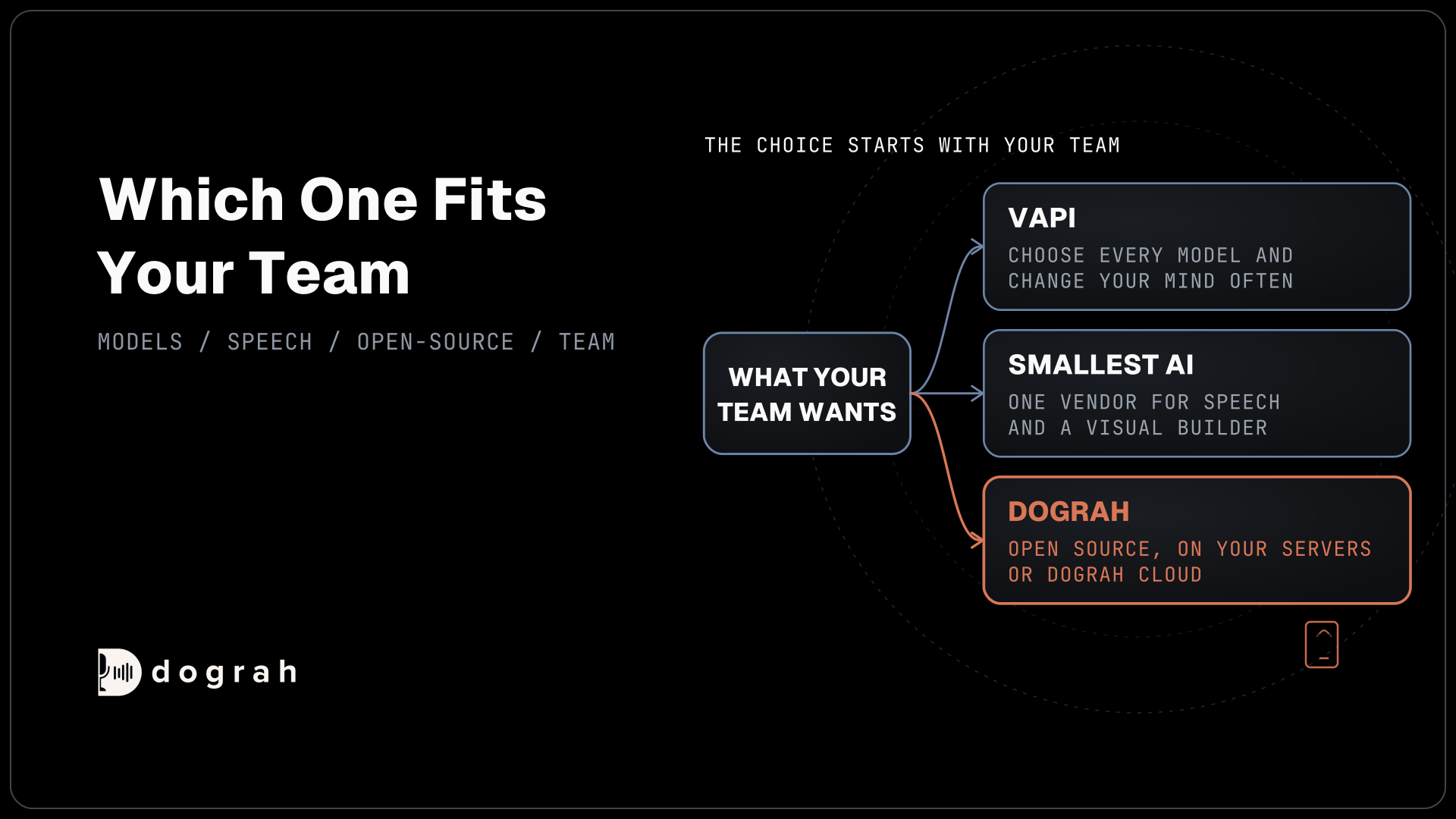

PolyAI suits voice-heavy contact centers that want a phone specialist with published prices, from $49 a month or 9.5 cents a minute. Sierra suits brands that want one agent across chat, messaging and voice, paid per completed task under a contract. Our open-source platform, Dograh, suits teams that want to run the agent themselves.
Key Takeaways
- PolyAI publishes its plans and bills every connected minute, resolved or not.
- Sierra is paid per completed task, so unresolved calls are usually free.
- Sierra lists FedRAMP High. PolyAI offers US, UK, EU and APAC regions.
PolyAI sells minutes of a phone agent, while Sierra sells finished tasks across every channel. We table both, price one month under each model, compare building, models and compliance, then say who each fits. If you want open code you can change, the last section covers Dograh.
PolyAI and Sierra in one table
Both are enterprise platforms that run on the vendor's cloud, but they meter value in different units. Each row is explained in the sections that follow.
| Row | PolyAI | Sierra |
|---|---|---|
| Focus | Voice agents for customer-service calls | One agent across chat, SMS, WhatsApp, email, voice and ChatGPT |
| How you pay | Plans with included minutes, or 9.5¢ a minute and up | Per completed task, with criteria agreed up front |
| Published prices | Essentials $49, Plus $199, Scale $299 per location a month | Set in each contract |
| Builder | Agent Studio, Wren and the ADK | Agent Studio and Ghostwriter |
| Models | Its own Dialog-RSN-1 and Raven | A mix of frontier, open-weight and proprietary models with failover |
| Voice | Built for phone calls, own carrier over SIP at no charge | Over 55 languages with mid-call switching |
| Card payments | PCI card capture on Enterprise | Card details by keypad on PCI DSS Level 1 infrastructure |
| HIPAA | With a BAA on Enterprise | Listed among its certificates |
| Regions and FedRAMP | US, UK, EU and APAC regions | FedRAMP High listed |
Voice specialist or one agent for every channel
The first question is how many channels you want one agent to cover. PolyAI is built around the phone call. Its plans connect to calendars, CRMs and helpdesks, and its Enterprise plan adds contact-center platforms such as NICE CXone, Five9 and Genesys Cloud, so the agent sits inside an existing voice operation.
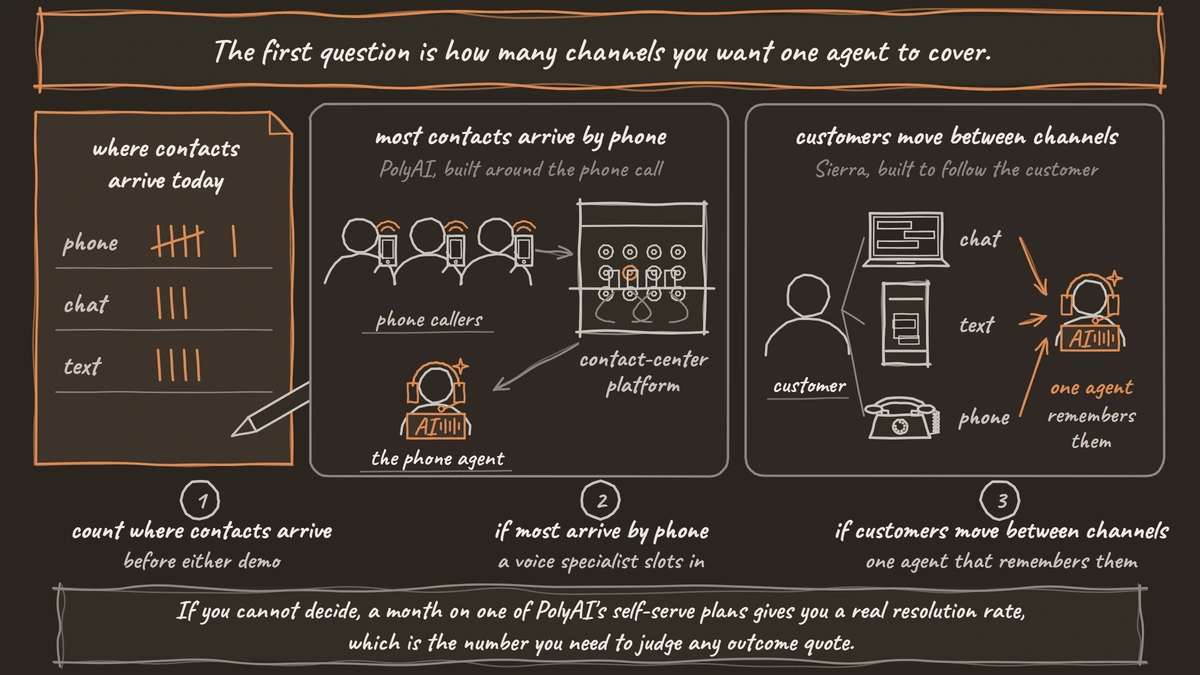
Sierra is built to follow the customer across channels. The same agent answers on chat, SMS, WhatsApp, email, voice and inside ChatGPT. The agent speaks over 55 languages, switches language mid-conversation, and copes with interruptions, background noise and accents.
That makes the choice fairly clear for most buyers. If most of your contacts arrive by phone and a contact-center platform already routes them, a voice specialist slots in. If customers move between a chat window, a text thread and a phone call, one agent that remembers them across channels is worth more than the best phone agent alone. Count where your contacts arrive today before you sit through either demo.
Minutes against outcomes on a real month
The two price models reward different things. PolyAI charges for connected time, so every call costs money whether the agent resolves it or hands it on. PolyAI's Platform route starts at 9.5¢ a minute, made up of 5¢ for the platform, 3¢ for the Dialog-RSN-1 model and 1.5¢ for a standard voice.
Sierra charges when the agent finishes a job. Sierra is paid only when its agent completes a task, with what counts as complete agreed in advance. Escalations and unresolved conversations are usually not charged, and routing or greeter-style uses can be priced per conversation instead.
A worked example makes the trade concrete. Take 8,000 calls a month averaging 3.5 minutes, 28,000 minutes, of which the agent fully resolves 5,000.
| Line | PolyAI Platform | Sierra outcomes | Dograh Cloud |
|---|---|---|---|
| What is counted | 28,000 connected minutes | 5,000 resolved calls | 28,000 minutes |
| Sum | 28,000 x $0.095 = $2,660 | 5,000 x your contracted rate | 28,000 x $0.01 = $280 |
| Unresolved calls | Billed like the rest | Usually not charged | Billed like the rest |
| Still to add | Overage terms on Enterprise | Routing calls if priced per conversation | Your model keys and carrier |
At these numbers, the break-even outcome rate is $2,660 / 5,000 = about 53 cents a resolved call, the point where PolyAI's published route and a Sierra contract cost the same. Above that rate, minutes win, and below it, outcomes do. Resolution rates also move. If a prompt change lifts resolved calls from 5,000 to 6,000, the PolyAI bill stays at $2,660 while the Sierra bill grows by 1,000 outcomes, so outcome-based pricing shares your improvements with the vendor. Our guide to Sierra pricing covers what to settle in the outcome definition before you sign.

Open Source Alternative to Vapi / Retell
Self-hosted voice agent platform — no per-minute fees
dograh-hq/dograh
Star on GitHub
Building the agent and the models under it
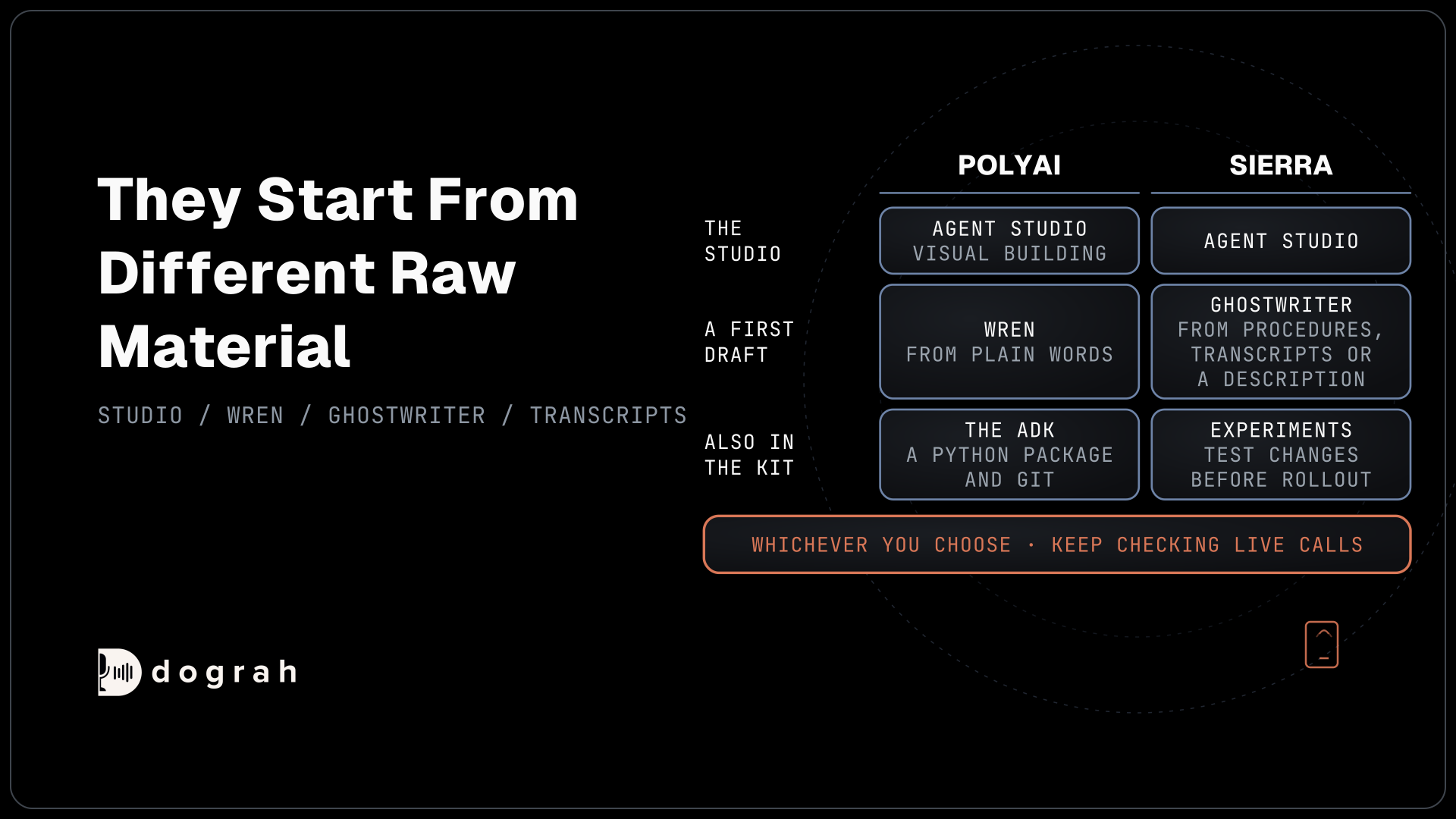
Both vendors let you build in a studio, but they start from different raw material. PolyAI offers Agent Studio for visual building, Wren for describing an agent in plain words and an Agent Development Kit (ADK) with a Python package and Git workflow. On Enterprise, the agent can be built by PolyAI or a partner, with a named account manager and 24/7 support.
Sierra's Agent Studio sits beside Ghostwriter, which drafts an agent from your standard operating procedures, past transcripts or a plain description. Explorer, Monitors and Experiments then help a team see what customers ask and test changes before rollout.
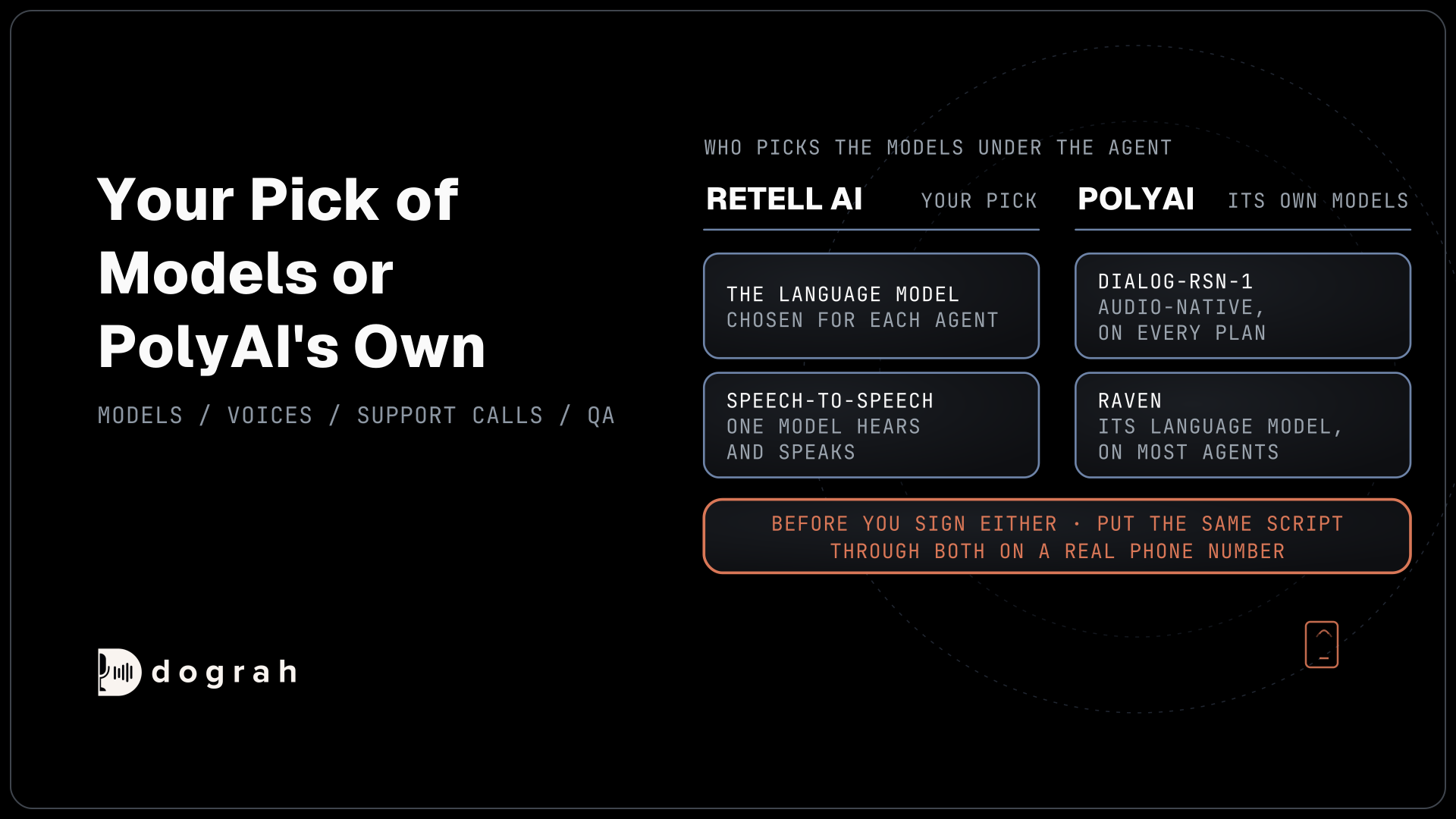
Under the hood the model strategy differs too. PolyAI runs its own models, with Dialog-RSN-1 on every plan and Raven, its customer-service language model, behind most agents. Sierra describes a "constellation" of frontier, open-weight and proprietary language models, and uses model failover, switching providers automatically if one has an outage.
In both cases the vendor chooses the models. With PolyAI you get a model tuned for support calls, and with Sierra you get resilience across providers, chosen by Sierra.
Compliance, payments and data regions
Sierra's certificate list is long. It covers SOC 2, HIPAA, GDPR, PCI and FedRAMP High, along with CCPA, CSA STAR, ISO 27001 and ISO 42001, and Sierra holds PCI DSS Level 1 Service Provider certification. On voice calls, card numbers are entered on the keypad as DTMF tones and passed to the merchant's processor.
PolyAI's plans run on SOC 2 and ISO 27001 certified infrastructure, and it also holds Cyber Essentials Plus and covers GDPR. Enterprise brings HIPAA with a business associate agreement (BAA), PCI card capture, data residency and an uptime SLA. PolyAI runs in US, UK, EU and APAC regions.
So a US public-sector or payments-heavy buyer will look hard at Sierra's FedRAMP High and Level 1 status. A European or UK contact center that needs its call data kept in-region will find PolyAI's regions a direct answer. In both cases the code stays closed and the platform runs on the vendor's cloud.
Join the Dograh Community
Dograh is an OSS alternative to Vapi. Join our Slack community for queries, releases, best practices & community interactions.
Which one fits your team
PolyAI fits a voice-heavy contact center that wants a phone specialist, connectors to its existing platform and a bill it can forecast from call minutes. It suits teams that want to start small on a $49 or $199 plan and grow into Enterprise, and those that need EU or UK data regions. It fits less well when most customers write rather than call.
Sierra fits a consumer brand that wants one agent across every channel and would rather pay for results than for minutes. It suits buyers with procurement teams ready to negotiate an outcome definition, and public-sector buyers who need FedRAMP High. It fits less well for a small team that wants to start without a contract. If you cannot decide, a month on one of PolyAI's self-serve plans gives you a real resolution rate, which is the number you need to judge any outcome quote.
Whichever you choose, keep checking live calls after launch. Sample 5 to 10% of production calls for review, because real callers behave differently with an agent than with a person, and the flow often needs reworking in the first weeks.
Where Dograh fits as the open-source option
If you want a voice agent platform you can read, change and run inside your own perimeter, Dograh is the open-source third option. It is built for voice, on phone lines and a web widget, and you can self-host it or run it on Dograh Cloud.
| Question | PolyAI | Sierra | Dograh |
|---|---|---|---|
| Can you read and change the code? | Closed | Closed | Yes, BSD 2-Clause |
| Where does it run? | PolyAI's cloud in four regions | Sierra's cloud | Your own servers, or Dograh Cloud |
| Who picks the models? | PolyAI | Sierra | You, on your own keys or open models |
| How is it priced? | Plans or per minute | Per completed task | Platform fee only, models and carrier at cost |
Your team builds the call in a visual workflow builder, so the people who know the calls can change the flow the same day, without waiting on a vendor's team.
Every model is your pick, from any language model, speech-to-text and voice to a speech-to-speech model or open models on your own hardware. Self-hosted Dograh has no per-minute platform fee, but servers, model keys and phone minutes still cost money. Dograh Cloud charges a 1¢-a-minute platform fee. That is the $280 column in the example.
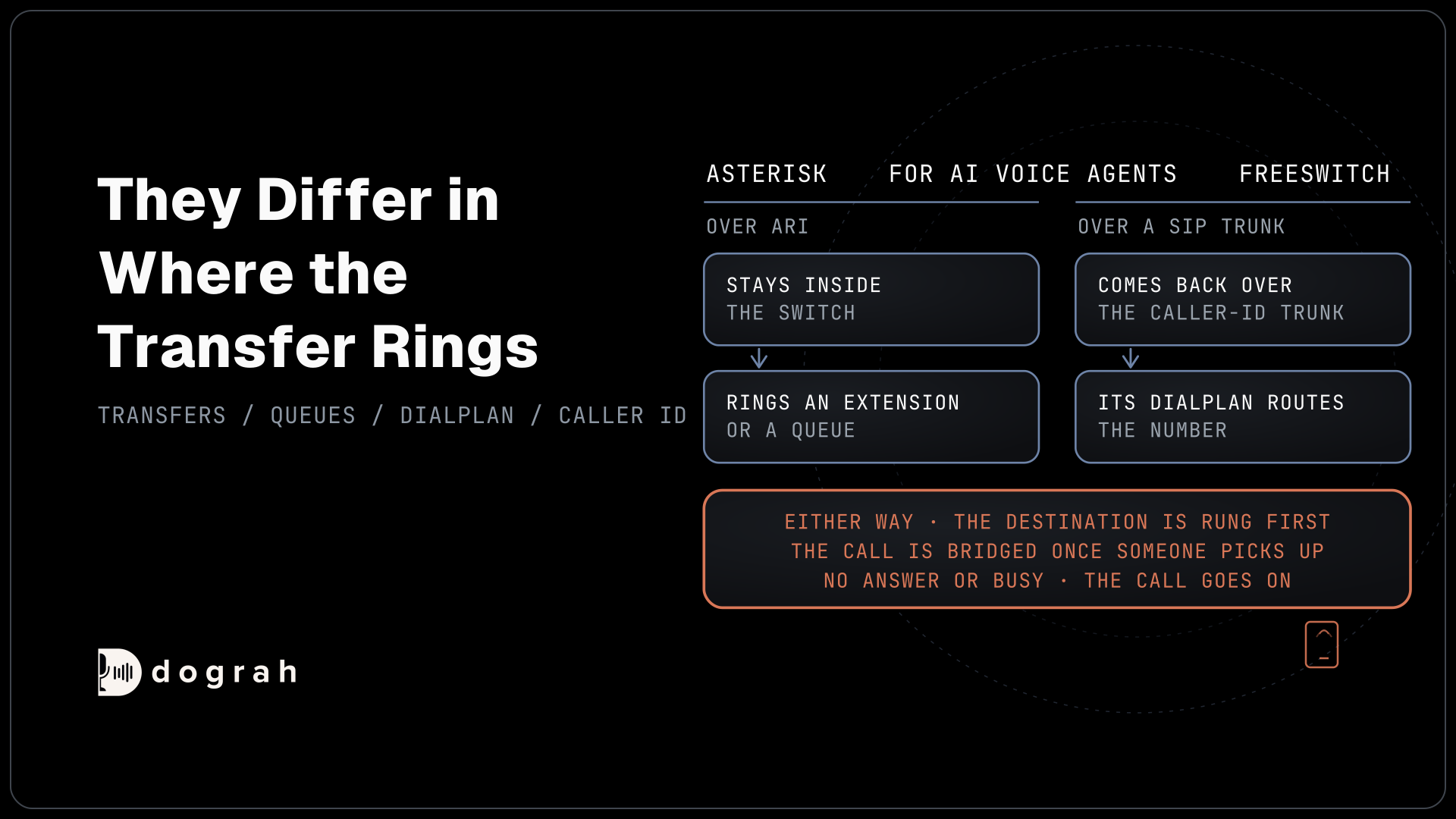
For a contact center with its own phone system, Dograh connects to an existing Asterisk PBX through Asterisk ARI, beside Twilio, Telnyx, Plivo and other carriers. When a caller needs to pay, an HTTP API tool asks your payment provider to send its secure payment link by text or email, so card numbers never pass through the call.
Self-hosting also settles where the data sits. Put the platform and the models in your own data center, and every call stays in your building. Patient calls on a self-hosted install need no BAA with Dograh, as those calls never reach us. Hosted model providers may each need their own BAA, and so may the phone carrier, depending on what it stores.
Built-in QA scores the steps of a sample of your calls, test or live, and every trace shows how long each turn took. That gives your own team the improvement loop that PolyAI's and Sierra's teams run for their customers.
For the wider field, see our guides to PolyAI alternatives and Sierra alternatives.
Glossary
- Outcome-based pricing
- Paying a platform only when its agent completes an agreed task, such as a resolved support request. Sierra prices this way, and escalated or unresolved conversations are usually not charged.
- Break-even outcome rate
- The price per resolved call at which outcome pricing costs the same as paying per minute. In our example, 28,000 minutes at 9.5 cents against 5,000 resolved calls gives about 53 cents.
- Model failover
- Switching a live agent to another language model provider when the first one has an outage. Sierra says its platform does this automatically across several providers.
- DTMF tones
- Keypad tones (dual-tone multi-frequency) used to enter card numbers instead of speaking them, so the digits go to the payment processor and stay out of the transcript. Sierra collects card details this way on PCI DSS Level 1 infrastructure.