
OpenAI Realtime fits phone lines more directly, with SIP and G.711 audio, and GPT-Live-1 scores higher on tool tasks. Gemini 3.8 Live costs far less per minute and covers 99 languages. For teams that want either on their own phone lines, Dograh, the open-source AI voice agent platform, runs both, self-hosted or on Dograh Cloud.
Key Takeaways
- gpt-realtime-2.1 audio costs $32 in and $64 out per million tokens.
- Gemini 3.8 Live audio costs about $0.005 a minute in and $0.018 out.
- GPT-Live-1 (Astra, medium) scored 74.5% on tool tasks, Gemini 3.8 Live 30.1%.
OpenAI and Google sell one model that hears a caller and answers in speech, and a phone agent can run on either. We compare them in one table, then on delay, tool calls, phone audio and price, weigh a cascade against both, and close with running both in open-source Dograh.
OpenAI Realtime vs Gemini Live in one table
The two families differ most on how they reach a phone line and what they charge. Each row below comes from OpenAI's and Google's own pages, except the delay and tool-task rows, which come from the independent Artificial Analysis board as measured on 19 November 2026.
| Row | OpenAI Realtime | Gemini Live |
|---|---|---|
| Current models | gpt-realtime-2.1, gpt-realtime-2.1-mini, gpt-realtime-2, and gpt-live-1 on its own Live endpoint | gemini-3.8-live, gemini-3.8-live-extended-thinking, gemini-3.1-flash-live-preview |
| Connection | WebRTC, WebSocket and SIP | WebSocket only, a bridge carries phone calls |
| Phone audio | Accepts G.711 (audio/pcmu, audio/pcma) at 8 kHz, or 24 kHz PCM | 16-bit PCM at 16 kHz in, other rates resampled, 24 kHz out |
| Turn-taking | Server VAD or semantic VAD | Automatic VAD on by default, about 800 ms silence |
| Tool calls | Function calls your app runs, GPT-Live hands tools to a backend model | 3.8 Live async by default or blocking, 3.1 Flash Live waits for each result |
| Session length | Up to 60 minutes | Connections about 10 minutes, audio sessions 15 minutes without compression |
| Time to first audio | GPT-Realtime-2.1 High 1.21 s, GPT-Live-1 (Astra, medium) 1.34 s | Gemini 3.8 Live 1.18 s, Extended Thinking (High) 1.35 s |
| Tool tasks (tau-Voice 2.0) | GPT-Live-1 (Astra, medium) 74.5%, GPT-Realtime-2.1 High 45.7% | Extended Thinking (High) 68.6%, Gemini 3.8 Live 30.1% |
| List price | Audio $32 in, $64 out per 1M tokens (mini $10, $20), gpt-live-1 $0.05 a minute active plus backend | Audio $3 in, $12 out per 1M tokens, about $0.005 and $0.018 a minute |
| Languages | Language hint in the session | 99 languages listed for the Live API |
On Google's side, Google names gemini-3.8-live as the replacement for Gemini 3.1 Flash Live, so new agents should start on 3.8.
Delay, from two tests that disagree
The independent board puts the two families close together on speed. On Artificial Analysis's speech-to-speech board, as measured on 19 November 2026, Gemini 3.8 Live reached first audio in 1.18 s, GPT-Realtime-2.1 High in 1.21 s and GPT-Live-1 (Astra, medium) in 1.34 s. GPT-Realtime-2.1 Minimal, which spends less effort on reasoning, was fastest of the group at 0.97 s.
A vendor test points the other way. Stream measured OpenAI's Realtime API at a mean of 0.39 s to first audio against 3.06 s for Gemini Live, over about 30 prompts each. That test streamed video frames alongside the audio, ran over WebRTC for OpenAI and WebSockets for Gemini, and used models older than gpt-realtime-2.1 and gemini-3.8-live. It shows how much the connection and the inputs change the result.
Neither test ran over a phone line. On a real call, the carrier, your bridge and the turn-taking settings all add time. OpenAI lets you choose server VAD, which waits for silence, or semantic VAD, which judges from the words whether the caller has finished. Gemini's automatic VAD waits about 800 ms of silence by default, and Google suggests 500 to 800 ms. Shorter waits answer faster but cut slow speakers off, so tune them on recorded calls from your own callers.
Tool calls in the middle of a call
Tool calls are where the two families differ most. On the same board's tau-Voice 2.0 tool tasks, GPT-Live-1 (Astra, medium) scored 74.5%, Gemini 3.8 Live Extended Thinking (High) 68.6%, GPT-Realtime-2.1 High 45.7% and standard Gemini 3.8 Live 30.1%. The models that think before acting score far higher, at the cost of a little delay.
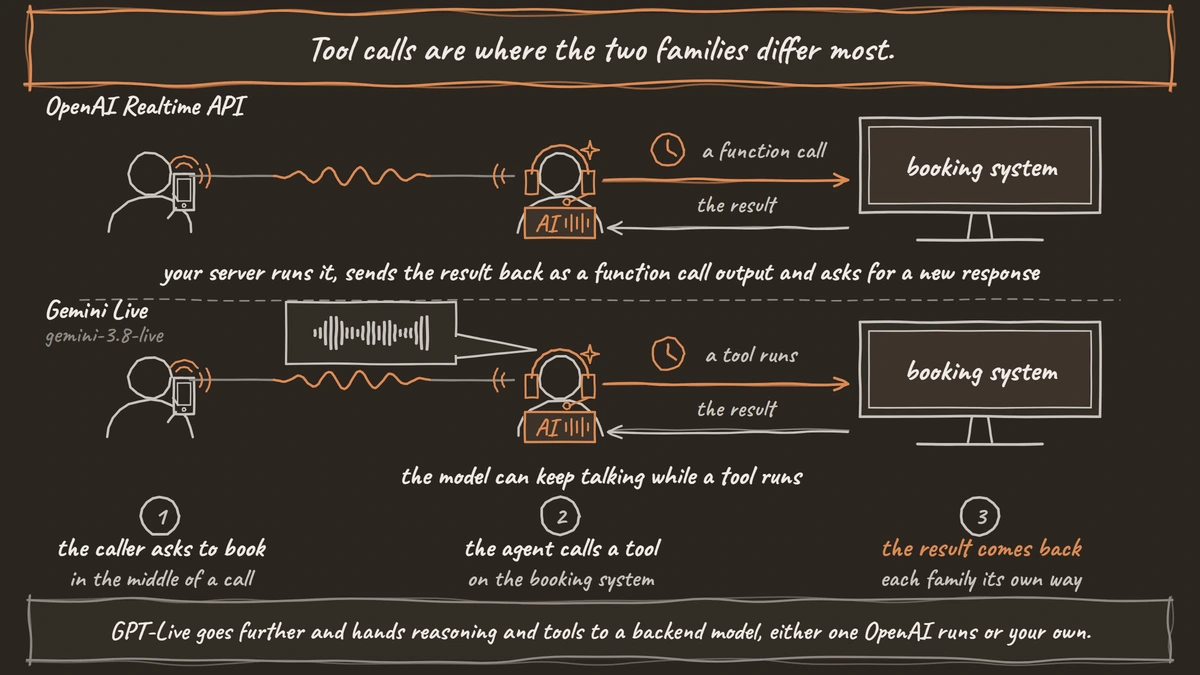
The mechanics differ too. In OpenAI's Realtime API, the model returns a function call with a call ID, your server runs it, sends the result back as a function call output and asks for a new response. GPT-Live goes further and hands reasoning and tools to a backend model, either one OpenAI runs or your own. Gemini 3.8 Live runs tools asynchronously by default, so the model can keep talking while a tool runs, and Extended Thinking runs them asynchronously only. Gemini 3.1 Flash Live waits for each result before it speaks again.
Interruptions matter on both. When the caller talks over Gemini, the server drops pending tool calls and tells you which ones it canceled. In our experience, speech-to-speech models can fail on complex tool calling, where a cascade holds up better. A model that books, checks and updates three systems in one call needs testing on every path before it goes live.

Open Source Alternative to Vapi / Retell
Self-hosted voice agent platform — no per-minute fees
dograh-hq/dograh
Star on GitHub
Phone audio and the path to a phone line
OpenAI meets a phone line more directly. The Realtime API and GPT-Live both accept a SIP connection, and the session accepts G.711 audio at 8 kHz, the format most phone lines carry, as audio/pcmu or audio/pcma. A carrier media stream can send its audio straight in, and OpenAI can send G.711 back, so nothing in between has to change the sample rate.
Gemini Live connects over a WebSocket only, so a phone call needs a bridge, which is your own server or a platform between the carrier and Google. Gemini takes raw 16-bit PCM at 16 kHz, and it resamples other rates when the rate is declared, so a bridge can decode 8 kHz phone audio and pass it on. Output always comes back at 24 kHz, which the bridge converts to 8 kHz G.711 for the caller. Resampling cannot restore what the phone line removed, so judge Gemini's hearing on real calls.
Long calls hit different limits. An OpenAI Realtime session lasts up to 60 minutes. A Gemini Live connection lasts about 10 minutes, and an audio session stops at 15 minutes unless context compression is on, so a bridge has to reconnect through session resumption, with a token that stays valid for 2 hours. Our comparison of GPT-Live-1, Gemini Live and Grok Voice adds Grok to the same phone tests.
Price per minute
Gemini Live costs far less at list price. OpenAI's API prices put gpt-realtime-2.1 audio at $32 per million tokens in and $64 out, with gpt-realtime-2.1-mini at $10 and $20. GPT-Live-1 is billed differently, at $0.05 a minute while active and $0.02 on standby, billed per second, with the backend model and its tools billed separately.
Gemini API pricing lists the same rates for gemini-3.8-live, its Extended Thinking version and Gemini 3.1 Flash Live. Audio costs $3 per million tokens in and $12 out, which Google gives as about $0.005 and $0.018 a minute, and a free tier covers testing.
Token prices hide how a real call adds up, since each new turn bills the conversation again. In our worked examples, the same 5-minute call comes to about $1.17 on gpt-realtime-2.1 without caching in our OpenAI Realtime API pricing breakdown, and about $0.19 on gemini-3.8-live in our Gemini Live API pricing breakdown. Cached input and the mini model narrow the gap on OpenAI's side.
Where each one wins
OpenAI wins on the phone path and on hard tool work. It has its own SIP route, takes 8 kHz G.711 without conversion and runs sessions up to an hour. GPT-Live-1 posts the top tool-task score of the two families, and the gpt-realtime-2.1 family gives a choice of reasoning effort and a mini model at lower token rates.
Gemini wins on price and on languages. Its list price per minute is a fraction of OpenAI's, Google lists 99 languages for the Live API, and 3.8 Live can keep talking while a tool runs. Teams with data residency rules can also reach Gemini Live through Google's Vertex AI, with processing in the EU or US multi-region.
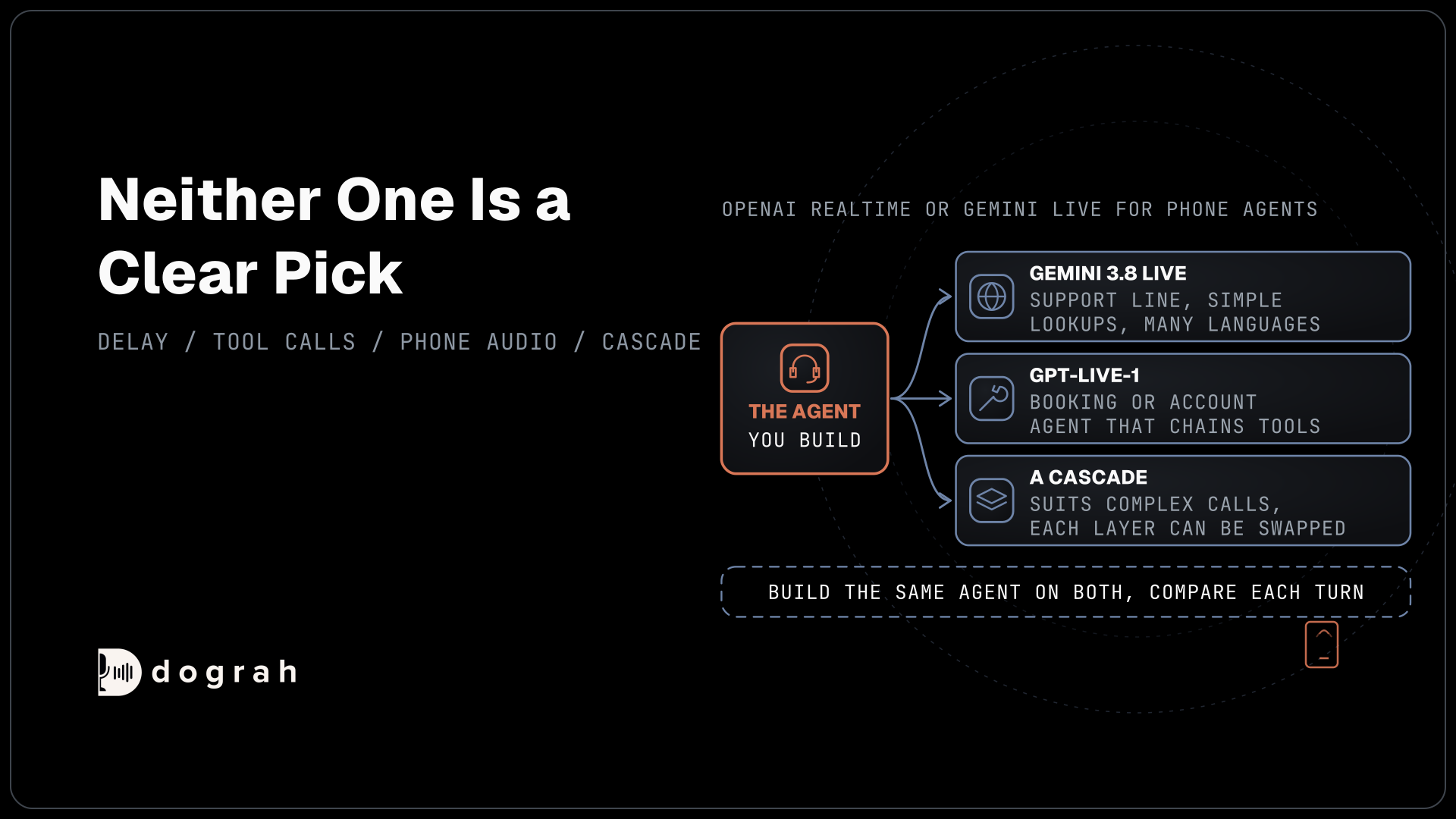
Neither one is a clear pick for every agent. A support line with a few simple lookups and many languages leans to Gemini 3.8 Live. A booking or account agent that chains tools leans to GPT-Live-1. Our ranking of the best speech-to-speech APIs for phone calls sets both against Grok Voice, Eleven Realtime and others.
Join the Dograh Community
Dograh is an OSS alternative to Vapi. Join our Slack community for queries, releases, best practices & community interactions.
A cascade instead of either
A cascade splits the call into speech-to-text, a language model and text-to-speech, each a separate model you choose. AssemblyAI, which sells the speech-to-text half of a cascade, argues that a cascade is safer for phone agents that must capture names, numbers and codes, because a transcript sits between every step and a misheard word can be found and fixed.
OpenAI's own voice agents guide makes a similar point, naming a chained pipeline as the choice when each stage needs to be visible or replaceable. In our view, a cascade is stronger on reasoning, tool calling and voice cloning, so it suits complex calls, and each layer can be swapped as better models arrive.
The trade is delay at every handoff and a less natural flow when callers interrupt. Our post on cascade vs speech-to-speech goes through when one model that hears and speaks beats three separate ones.
Running both in Dograh
Both families run in Dograh, the open-source AI voice agent platform, as Realtime providers on your own keys. Under Providers in the sidebar, click Add Provider and save an OpenAI or Google key. Then, under Models, click Add Configuration and choose Realtime. On the Realtime tab, pick the connection and a model, such as gpt-realtime-2.1, gpt-realtime-2.1-mini, gpt-live-1, gemini-3.8-live or gemini-3.1-flash-live-preview.
A Realtime configuration also needs a text model on its LLM tab. The realtime model holds the conversation, while the text model fills variables from the call and runs other background work such as QA. Each agent picks a Realtime configuration in Models, selected in the agent's Model tab, so one agent can run on OpenAI and another on Gemini. The model configuration setup is the same for both.
Some features behave differently on speech-to-speech. Typed transition lines and typed tool messages do not play, so use a recording for those, and the short spoken introduction on Twilio transfers is skipped. Transfer Call still works on Twilio, Telnyx, Plivo, Cloudonix and Asterisk ARI, and Dograh calls the destination first and connects the caller only when someone answers.
OpenAI or Google bills its usage to your own key. Self-hosting Dograh drops the per-minute platform fee entirely, while servers, model keys and phone minutes keep costing money. The database and upgrades become your team's to maintain. The open-source community is where support comes from, Enterprise adds custom SLAs, and Dograh Cloud handles the hosting for a 1¢-a-minute platform fee. Build the same agent on both models, call it with the editor's Phone Call button and compare each turn in View Trace before you choose.
Glossary
- Time to first audio
- How long a speech-to-speech model takes, after the caller stops, to start sending its spoken reply. Artificial Analysis measures it per model on its live board.
- Context compression
- A Gemini Live setting that trims older parts of the conversation, so an audio session can run past its 15-minute limit.
- G.711
- The standard phone codec at 8 kHz, in mu-law (audio/pcmu) or A-law (audio/pcma). OpenAI's realtime models accept it directly.
- Session resumption
- Gemini Live's way to carry a conversation across a new connection, using a token valid for 2 hours, needed when a call outlasts one connection.