
Gemini 3.8 Live lists audio at $3 per million tokens in and $12 out, about $0.005 and $0.018 a minute, but each turn re-bills the whole session. A 5-minute example call costs about $0.19. Dograh, the open-source AI voice agent platform, runs it on your Google key, and you can self-host it or run it on Dograh Cloud.
Key Takeaways
- Every turn bills the whole session, so late turns cost the most.
- Our example call costs about three times the per-minute meter.
- Shorter agent replies cut output once and input on every later turn.
This post is part of our guide to LLM API pricing for voice agents, where one shared 5-minute call is counted turn by turn and priced across text and speech-to-speech models. Here we price that call on Gemini Live and show what moves the number in Dograh.
How Gemini Live bills a call
Gemini Live is Google's speech-to-speech API. The caller's audio goes in, and the model answers in audio. Google lists its prices per million tokens. On the paid tier, Google charges these rates for gemini-3.8-live.
| What is billed | Price per 1M tokens | Per minute of audio |
|---|---|---|
| Audio in | $3.00 | about $0.005 |
| Audio out | $12.00 | about $0.018 |
| Text in | $0.75 | n/a |
| Text out, thinking included | $4.50 | n/a |
The Extended Thinking version, gemini-3.8-live-extended-thinking, has the same rates, with its thinking billed as text output. The free tier costs nothing and is rate-limited, which suits testing.
The per-minute figures are right for one second of audio. A call is more than that. Audio comes to about 25 tokens a second, and Google's Live API best practices say the API charges per turn for all tokens in the session context window. As the session grows, each turn costs more, because the history is processed again. So a call's price depends on how many turns it has and how long each one is, not only on its minutes.
The 5-minute call, priced as an example
The call is the guide's shared example. It has 12 turns. The caller speaks for about 7.5 seconds a turn, 187.5 audio tokens at 25 a second, and the agent for about 15 seconds, 375 tokens. The 2,000-token instructions, with the tool definitions, go as text on every turn, and each turn re-reads all the audio said so far.
Summed over the call, the model reads 39,375 audio tokens and 24,000 text tokens and writes 4,500 audio tokens. On gemini-3.8-live, the three lines price out as follows.
- Audio in is 39,375 x $3.00 / 1,000,000 = $0.1181
- Text in is 24,000 x $0.75 / 1,000,000 = $0.0180
- Audio out is 4,500 x $12.00 / 1,000,000 = $0.0540
The call comes to $0.1901, about $0.038 a minute in this example. The meter alone, 1.5 minutes of caller speech at $0.005 plus 3 minutes of agent speech at $0.018, gives $0.0615. Re-reading the history makes the bill about three times the meter. The example counts speech only and leaves out the gaps between turns.
The same call on OpenAI's gpt-realtime-2.1 comes to $1.1748 without caching, as our OpenAI Realtime API pricing breakdown shows.

Open Source Alternative to Vapi / Retell
Self-hosted voice agent platform — no per-minute fees
dograh-hq/dograh
Star on GitHub
What makes a longer call cost more
Length costs more than its minutes. Run the same pattern for 24 turns, about a 10-minute call, and audio input grows to 159,750 tokens. The call comes to $0.6233, or about $0.062 a minute. Twice the length costs over three times as much, because each extra turn re-reads a bigger history.
Thinking adds to the output side. On the Extended Thinking model, thinking tokens bill at the $4.50 text output rate, so measure them in the usage data each response reports.
Long calls also hit session limits. Google limits audio-only sessions to 15 minutes without compression, and a single connection lasts around 10 minutes, with session resumption tokens valid for two hours. The native audio models hold a 128k-token context window.
What brings the bill down
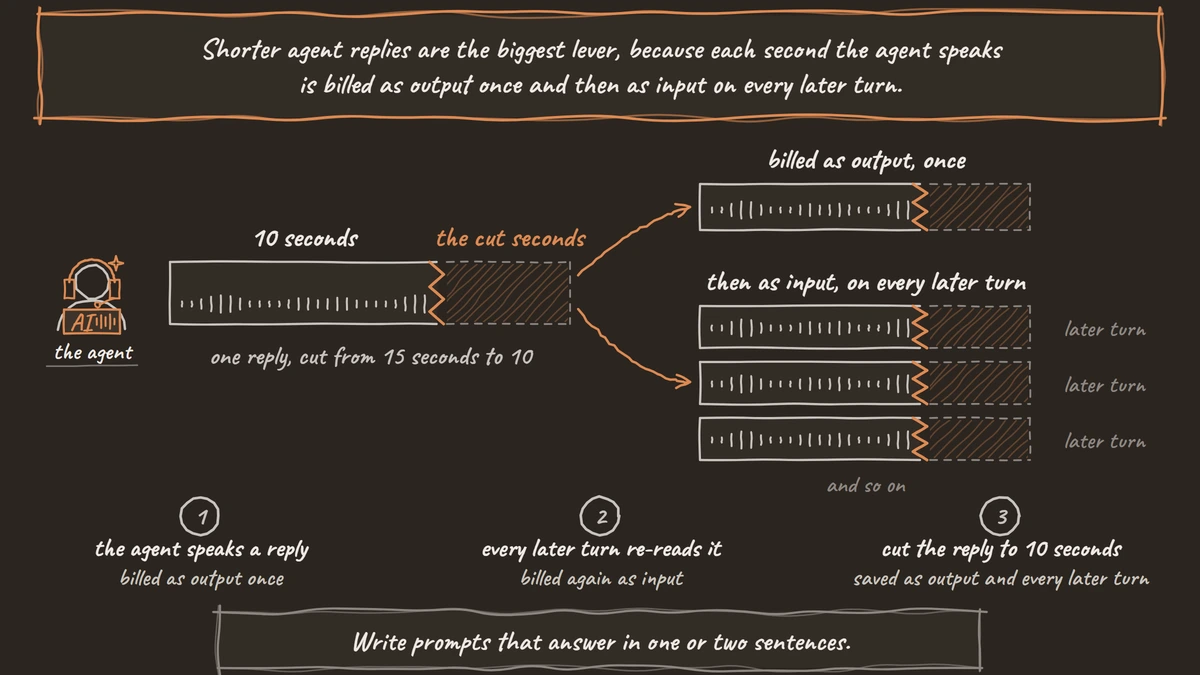
Shorter agent replies are the biggest lever, because each second the agent speaks is billed as output once and then as input on every later turn. Cut the agent's turns from 15 seconds to 10 in the example and the call drops from $0.1901 to $0.1474, about 22% less. Write prompts that answer in one or two sentences.
Context window compression is the next lever for code that calls the Live API directly. Google recommends setting a context window size, so a sliding window drops the oldest turns once the context passes a limit. That keeps late turns from growing without end and also lifts the 15-minute session limit. Pick a window that still holds what the agent needs to remember.
Check the model name too. Google's deprecation schedule retires the earlier Live preview models and names gemini-3.8-live as the replacement, so build on that one. For how Gemini Live sounds on a phone line next to other realtime APIs, see our realtime voice API comparison for phone agents.
Gemini Live in Dograh, per agent
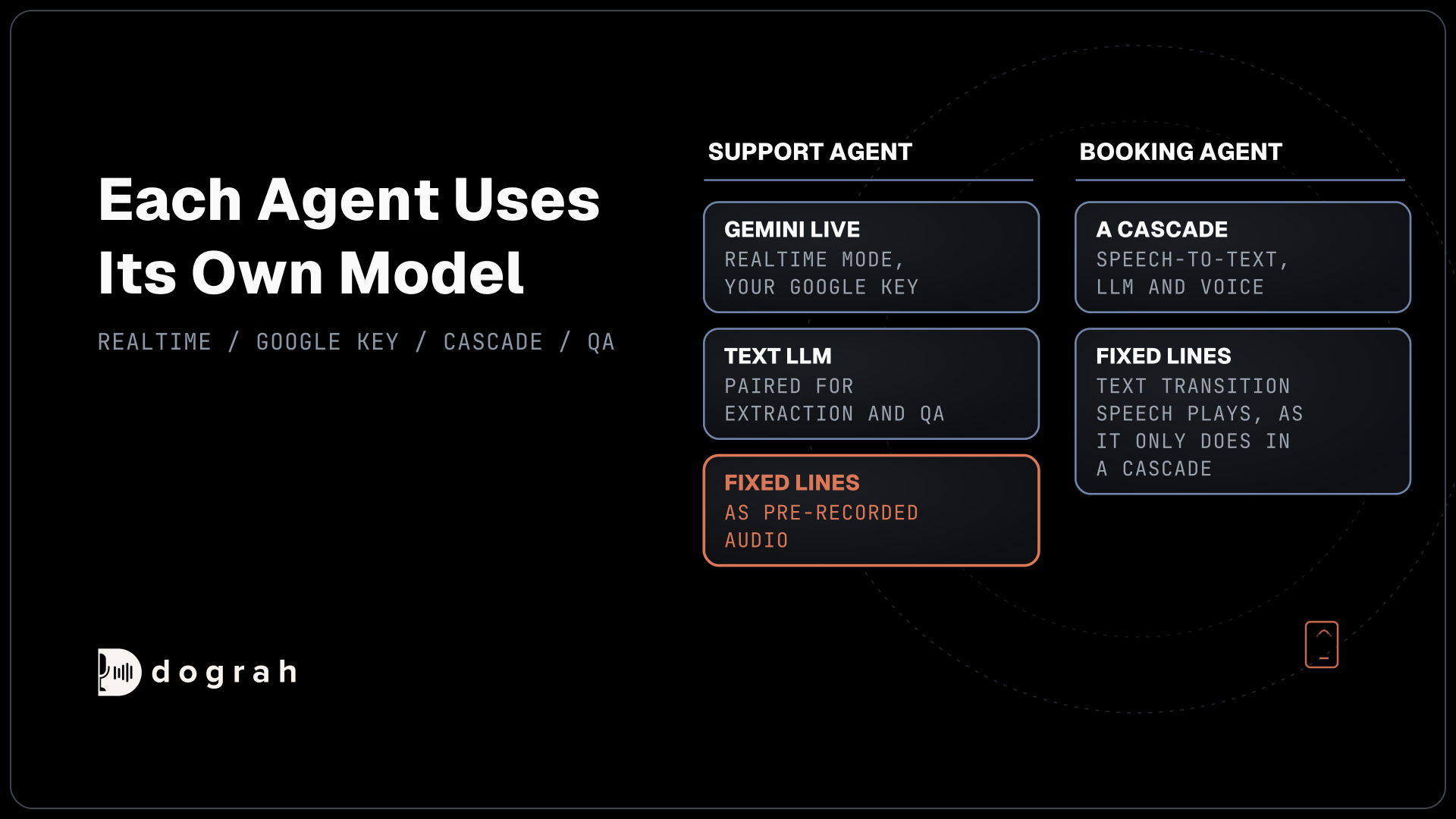
Dograh is the orchestration layer that runs the call flow, tools and telephony, and the speech and language models are a separate layer you choose. To use Gemini Live, add a model configuration in Realtime mode with your Google AI Studio key. gemini-3.8-live is the default model. Realtime mode pairs it with a separate text LLM for jobs such as extraction and QA, and those tokens bill outside the example above.
Fixed lines work differently on speech-to-speech. Text transition speech and text tool messages play only in a cascade, so on Gemini Live set those lines as pre-recorded audio. A recording also costs no output tokens.
Each agent uses its own model configuration, so a support agent can run Gemini Live while a booking agent runs a cascade. Our guide to choosing an LLM for voice agents covers how to test that choice on real calls. Self-hosted Dograh has no per-minute platform fee, but servers, model keys and phone minutes still cost money. Dograh Cloud charges a 1¢-a-minute platform fee.
The phone line is a separate bill again. Our Twilio pricing breakdown prices the minutes for the same 5-minute call. With your own Google key, the Gemini Live tokens bill to your Google account at the rates above.
Join the Dograh Community
Dograh is an OSS alternative to Vapi. Join our Slack community for queries, releases, best practices & community interactions.
Glossary
- Session context window
- Everything a Gemini Live session has collected so far: instructions, earlier audio and text. Google bills each turn for all the tokens in it, so cost per turn grows as the call goes on.
- Audio token
- The unit Google bills Live audio in. Audio comes to about 25 tokens a second, so a minute of speech is about 1,500 tokens on either side of the call.
- Context window compression
- A Live API setting that drops the oldest turns once the context passes a set size. It caps how much each late turn re-reads and lifts the 15-minute limit on audio-only sessions.
- Realtime mode
- A Dograh model configuration that runs a speech-to-speech model such as Gemini Live, paired with a separate text LLM for extraction and QA.