
The best speech-to-speech APIs for phone calls in 2026, ranked on tool tasks, phone fit and price, are GPT-Live, Grok Voice 3.0 and Gemini 3.8 Live, then Eleven Realtime, gpt-realtime-2.1, Ultravox and Nova 2 Sonic. Dograh, the open-source AI voice agent platform, runs six of the seven on your own phone lines and keys.
Key Takeaways
- GPT-Live-1 (Astra, medium) leads tau-Voice 2.0 tool tasks at 74.5%.
- Grok Voice 3.0 leads the Speech to Speech Index at 86.9.
- Dograh runs six of the seven as Realtime providers on your own keys.
A speech-to-speech API hears the caller and answers in one model, and a phone call is its hardest test. We set the ranking criteria, rank seven APIs on them, weigh a cascade as the other route, then we look at which run in open-source Dograh on your keys.
How we ranked them
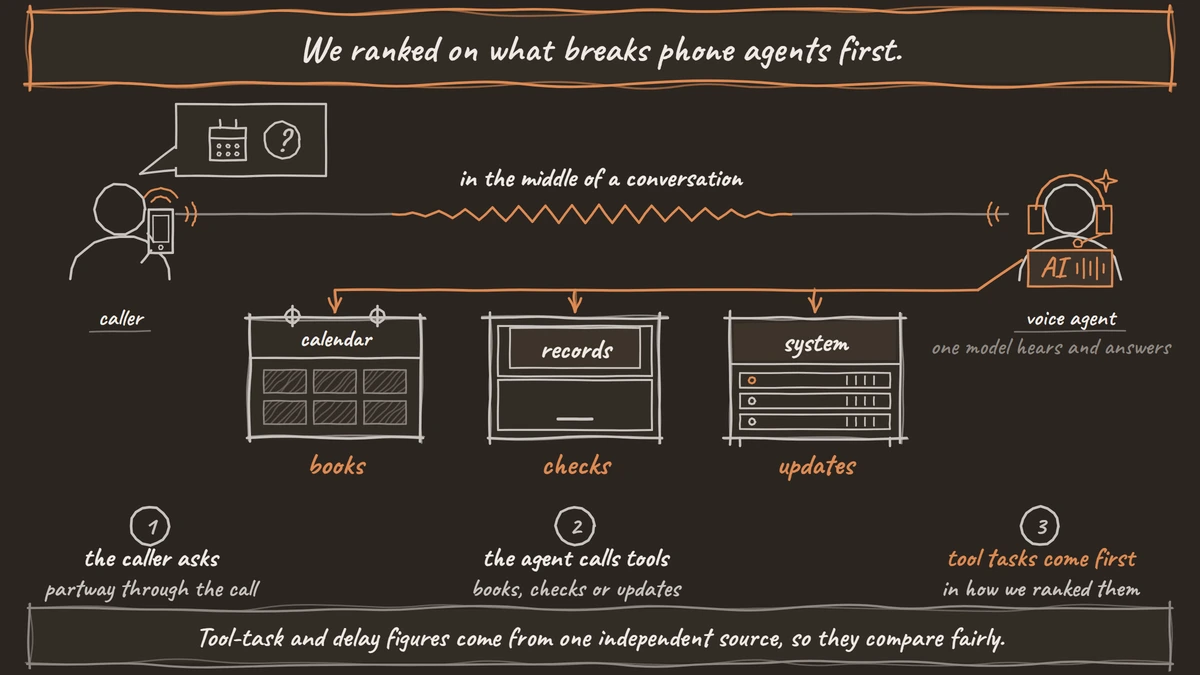
We ranked on what breaks phone agents first. Tool tasks come first, because a phone agent that books, checks or updates something has to call tools in the middle of a conversation, and in our experience complex tool calls are where speech-to-speech models fail most. Our post on speech-to-speech tool calling shows where those calls break.
Phone fit comes second. That means whether the API takes a SIP call or needs a bridge, whether it accepts G.711 audio at 8 kHz, the format most phone lines carry, and how long one session can run. Price per minute comes third, from each vendor's own price page, and time to first audio breaks ties.
Tool-task and delay figures come from one independent source, so they compare fairly. The Artificial Analysis speech-to-speech board runs tau-Voice 2.0, a set of agent tasks done by voice, and measures time to first audio. All board figures here were measured on 19 November 2026, and the board moves, so treat them as a snapshot.
The seven APIs at a glance
The table lists each API in rank order with the figures behind its place. Ultravox is not on the board, and Nova 2 Sonic has a delay figure there but no tool-task score.
| Rank | API | Tool tasks (tau-Voice 2.0) | First audio | Phone path | List price | Runs in Dograh |
|---|---|---|---|---|---|---|
| 1 | GPT-Live (gpt-live-1) | 74.5% (Astra, medium) | 1.34 s | SIP, WebRTC, WebSocket | $0.05 a minute active plus backend | Yes, OpenAI Realtime |
| 2 | Grok Voice 3.0 | 71.6% | 0.81 s | SIP, WebSocket, LiveKit | $0.08 a minute plus $0.004 per text input | Yes, Grok with grok-voice-3.0 |
| 3 | Gemini 3.8 Live | 68.6% (Extended Thinking, High), 30.1% (standard) | 1.35 s, 1.18 s | WebSocket, bridge for phones | About $0.005 a minute in, $0.018 out | Yes, gemini-3.8-live |
| 4 | Eleven Realtime v1 Max | 47.6% | 0.57 s | ElevenLabs API | $0.08 a minute plus LLM tokens | Voices and speech-to-text in a cascade |
| 5 | gpt-realtime-2.1 | 45.7% (High) | 1.21 s | SIP, WebRTC, WebSocket | $32 in, $64 out per 1M audio tokens | Yes, OpenAI Realtime |
| 6 | Ultravox v0.7 | Not on the board | Not on the board | Native Twilio, Telnyx, Plivo, Exotel and SIP | $0.05 a minute | Yes, hosted Ultravox |
| 7 | Amazon Nova 2 Sonic | Not on the board | 1.14 s | Bedrock streaming, 8-minute connections | Amazon Bedrock rates | Yes, AWS Nova 2 Sonic |
1. GPT-Live (OpenAI)
GPT-Live ranks first because it scores highest on tool tasks and meets a phone line directly. GPT-Live-1 (Astra, medium) passed 74.5% of tau-Voice 2.0 tasks, with first audio in 1.34 s, and the faster Sol (low) setting passed 59.3% in 1.24 s. It runs full duplex, so it can listen while it speaks, and it hands reasoning and tool calls to a backend model you choose.
It connects over WebRTC, WebSocket or SIP, and it accepts G.711 audio at 8 kHz. OpenAI's API prices put it at $0.05 a minute while active and $0.02 on standby, billed per second, with the backend model and its tools billed separately. Concurrent sessions run from 50 on the Build tier to 500 on Grow.
The trade is two bills and a voice choice limited to two voices, marin and cedar. For a booking or account agent that chains tools, it is the first one to test.
2. Grok Voice 3.0 (xAI)
Grok Voice 3.0 ranks second, close behind on tools and ahead on speed. It passed 71.6% of tau-Voice 2.0 tasks with first audio in 0.81 s, and it leads the board's overall Speech to Speech Index at 86.9. Grok Voice 2.0 is now deprecated, so new agents should use 3.0.
xAI's Voice Agent guide lists SIP, WebSocket and LiveKit connections, with G.711 audio handled natively, which makes it one of the easier models to put on a phone line. It costs $0.08 a minute plus $0.004 per text input, a flat rate that keeps the bill simple.
It ranks below GPT-Live on the tool score and costs more per minute than GPT-Live's voice layer, though GPT-Live adds its backend bill on top. For an agent where response speed matters most, it is the strongest pick on this list.
3. Gemini 3.8 Live (Google)
Gemini 3.8 Live ranks third on the strength of its Extended Thinking version and its price. Gemini 3.8 Live Extended Thinking (High) passed 68.6% of tool tasks in 1.35 s, while standard Gemini 3.8 Live passed 30.1% in 1.18 s. On 3.8 Live, tools run asynchronously by default, so the model can keep talking while a tool works.
It connects over a WebSocket only, so a phone call needs a bridge that turns 8 kHz phone audio into the 16 kHz audio Gemini takes and converts its 24 kHz replies back. Google prices audio at about $0.005 a minute in and $0.018 out, far below the others at list price, and lists 99 languages for the Live API. Google names gemini-3.8-live as the replacement for Gemini 3.1 Flash Live, so new agents should start on 3.8.
Our comparison of OpenAI Realtime vs Gemini Live goes through the two families on delay, tools, phone audio and price.

Open Source Alternative to Vapi / Retell
Self-hosted voice agent platform — no per-minute fees
dograh-hq/dograh
Star on GitHub
4. Eleven Realtime (ElevenLabs)
Eleven Realtime ranks fourth, with the fastest first audio on the board and a middle tool score. Eleven Realtime v1 Max reached first audio in 0.57 s and passed 47.6% of tool tasks, and v1 Mini passed 46.8% in 0.62 s. ElevenLabs' voices are a large part of its appeal.
ElevenLabs lists both versions at $0.080 a minute of connected audio, plus language model tokens, with burst pricing of $0.160 a minute for audio above your plan's concurrency limit. For an agent where the voice and speed matter more than chained tool calls, it belongs on the shortlist.
5. gpt-realtime-2.1 (OpenAI)
gpt-realtime-2.1 ranks fifth, below GPT-Live on tools but with more control over cost. GPT-Realtime-2.1 High passed 45.7% of tool tasks in 1.21 s, and the Minimal setting reached first audio in 0.97 s at 38.0%. The mini version scores lower, at 29.4% on High.
It shares OpenAI's phone path, with SIP and G.711 support, and sessions run up to 60 minutes. Audio is priced per token, at $32 per million in and $64 out, with gpt-realtime-2.1-mini at $10 and $20. Because each turn bills the conversation again, long calls cost more per minute than short ones.
6. Ultravox (Ultravox)
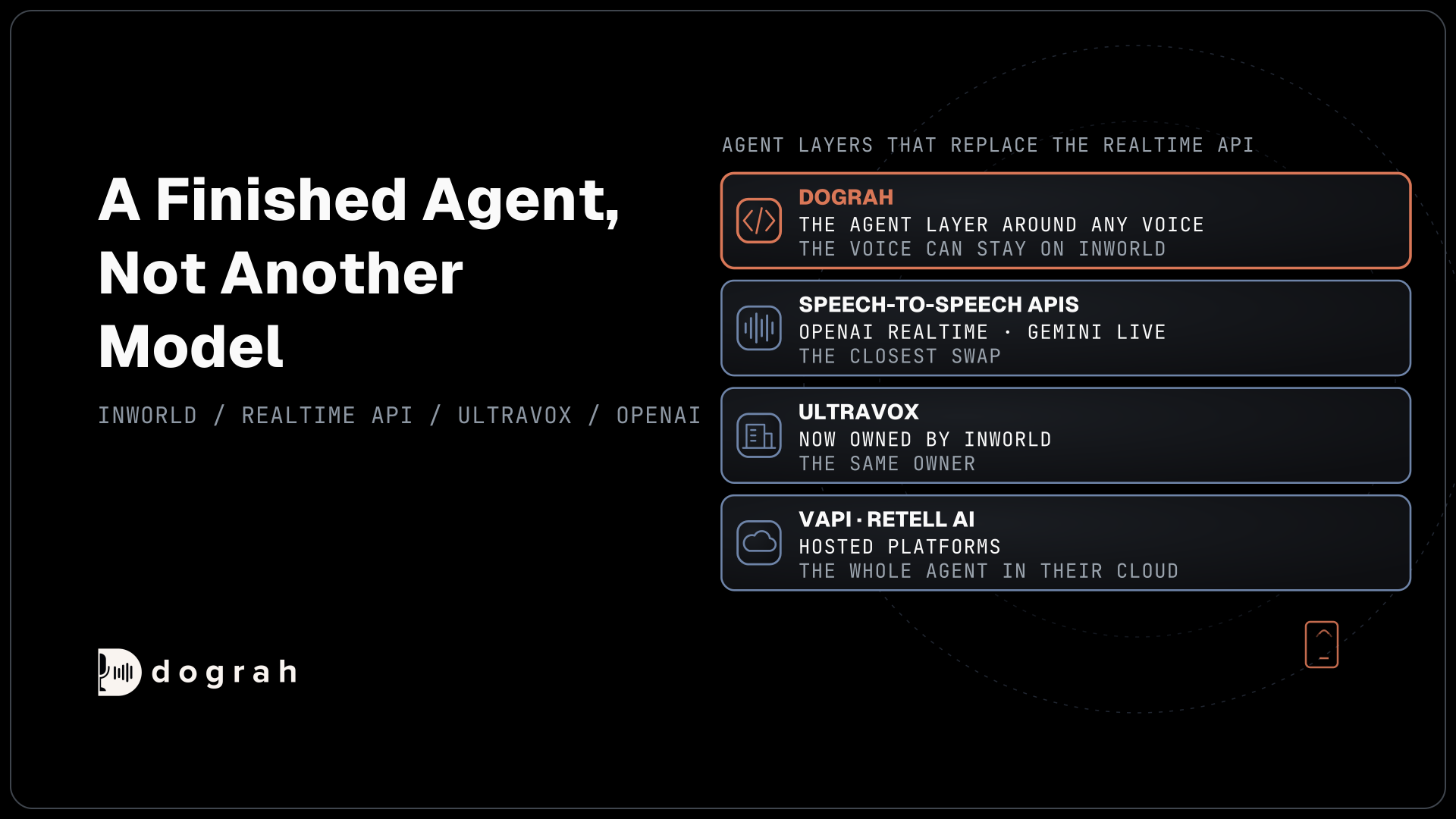
Ultravox ranks sixth because it is not on the independent board, so its tool and delay figures cannot be set beside the others. It is built for phone calls, with native Twilio, Telnyx, Plivo and Exotel support and its own SIP. Its v0.7 model is built on GLM with open MIT weights, and Ultravox is now owned by Inworld.
Ultravox pricing is $0.05 a minute after 30 free minutes, with up to 5 calls at once on pay as you go. The Pro plan at $100 a month removes the hard concurrency cap, and SIP adds 0.5 cents a minute. Test its tool calls on your own flow before ranking it higher.
Join the Dograh Community
Dograh is an OSS alternative to Vapi. Join our Slack community for queries, releases, best practices & community interactions.
7. Amazon Nova 2 Sonic (AWS)
Nova 2 Sonic ranks seventh because the board lists only its delay, and its price sits inside Amazon Bedrock's rates. Nova 2 Sonic reached first audio in 1.14 s, with no tool-task score. It streams over Bedrock, and one connection lasts up to 8 minutes, so longer calls need a reconnect.
For a team already on AWS, it keeps the model inside an account it controls, with Bedrock's own contracts. Check the Bedrock rate for your region before you compare its cost with the others.
A cascade instead of speech-to-speech
A cascade splits the call into speech-to-text, a language model and text-to-speech. AssemblyAI, which sells the speech-to-text half, argues that a cascade is safer for agents that must capture names, numbers and codes, because a transcript sits between every step and a misheard word can be found and fixed.
We agree on the hard cases. A cascade is stronger on reasoning, tool calling and voice cloning, so it suits complex calls, while a speech-to-speech model handles interruptions and tone more naturally. Some products sold as voice agent APIs, such as Deepgram's and AssemblyAI's, are cascades inside one connection. Our post on cascade vs speech-to-speech covers when each one wins.
Which of these run in Dograh
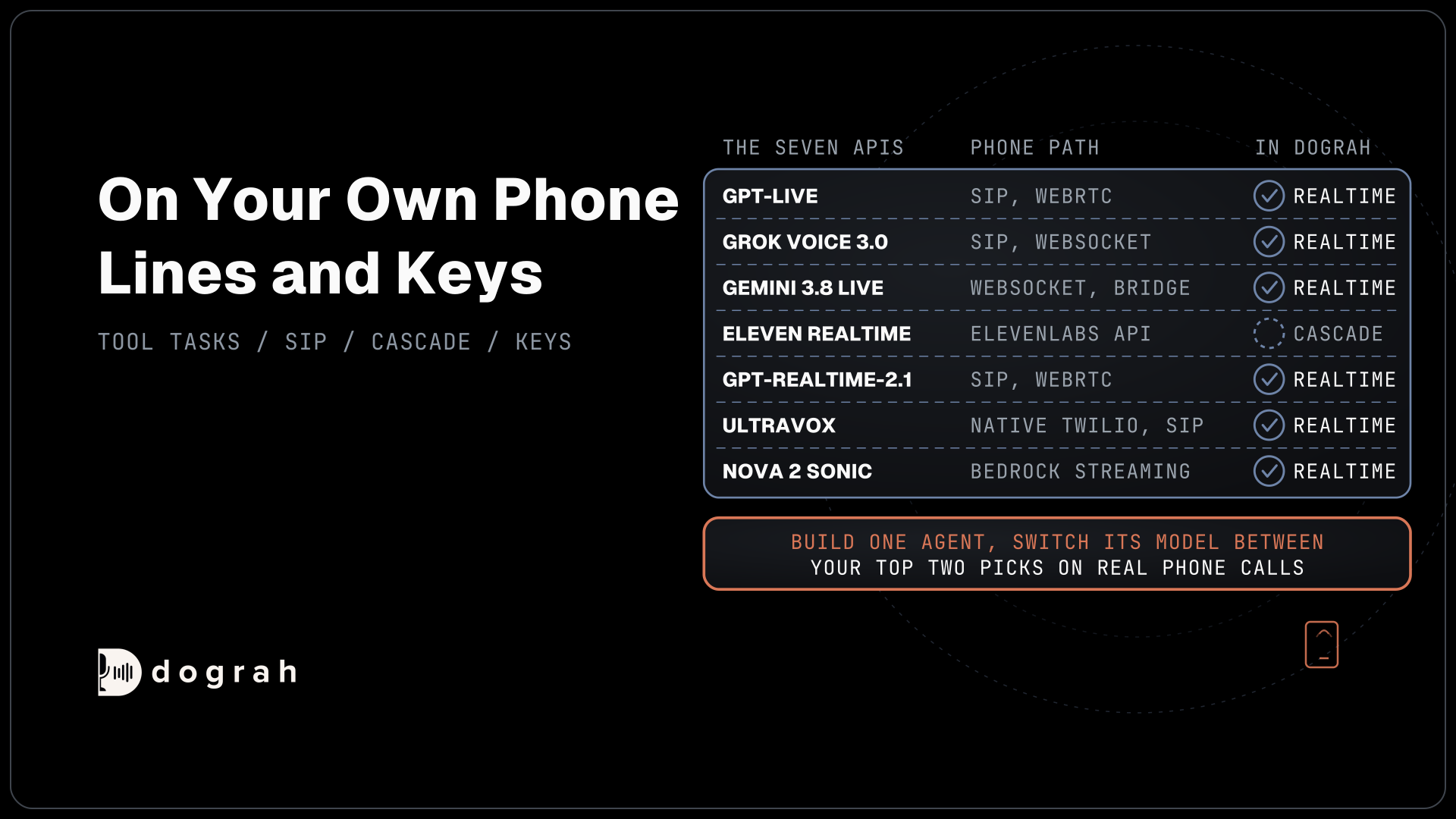
Dograh, the open-source AI voice agent platform, runs six of the seven as Realtime providers on your own keys. GPT-Live and gpt-realtime-2.1 run through OpenAI Realtime, Gemini 3.8 Live through Gemini on Google AI Studio, with a separate Vertex AI provider for EU or US processing, and Ultravox as its hosted API. Grok Voice and Nova 2 Sonic run too, the latter in four AWS regions. For Grok, type grok-voice-3.0 in the Model field. Azure OpenAI Realtime is also there for teams on Microsoft contracts.
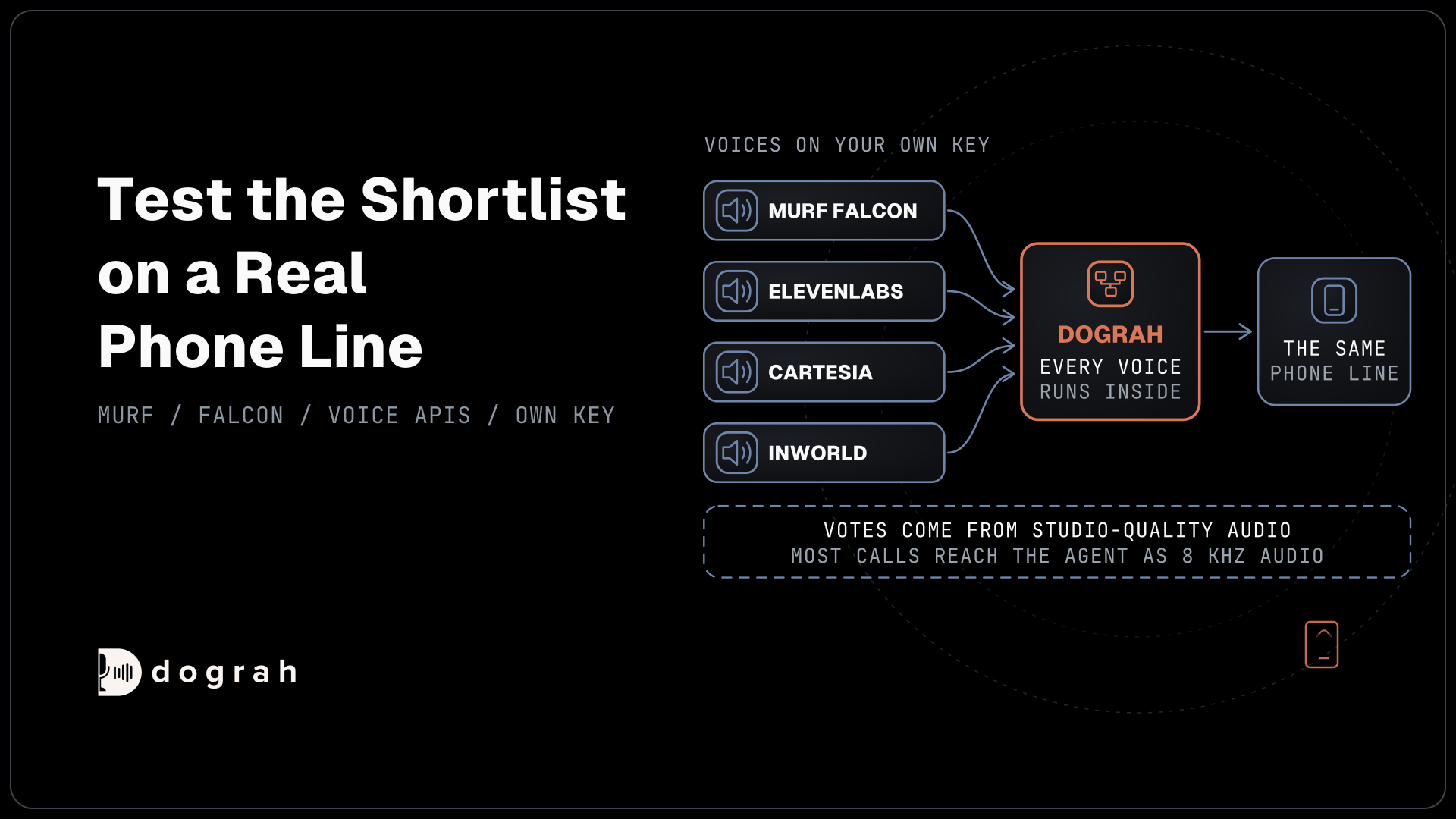
ElevenLabs runs in Dograh as voices and speech-to-text in a cascade, rather than as a Realtime provider. A fully self-hosted agent also runs as a cascade, through Local Models (Speaches), and our post on open-source speech-to-speech models covers where those models stand.
Setup is a Realtime configuration in Models, selected in the agent's Model tab. Under Models, click Add Configuration, choose Realtime, then pick the provider and model on the Realtime tab and a text model on the LLM tab, which fills variables and runs QA. The model configuration works the same for every provider. Typed transition lines do not play on speech-to-speech, so use a recording. Our guide to speech-to-speech voice AI covers the rest.
Each provider bills its own usage to your key. Hosting Dograh on your own servers adds no per-minute platform fee. Those servers, your model keys and the phone minutes are still yours to pay for, and your team looks after the database and every upgrade. Support runs through the open-source community, with custom SLAs on Enterprise, and Dograh Cloud hosts it for a 1¢-a-minute platform fee if you would rather not. Build one agent, switch its model between your top two picks and compare them on real phone calls.
Glossary
- Speech-to-speech API
- A model served by API that hears the caller's audio and answers in audio, with no separate speech-to-text or text-to-speech step.
- tau-Voice 2.0
- A benchmark of agent tasks done by voice, such as changing a booking through tools. Artificial Analysis reports each model's pass rate.
- Backend model
- The text model GPT-Live hands reasoning and tool calls to while it keeps the conversation going. Its usage is billed separately from the voice minutes.
- Burst pricing
- A higher per-minute rate for audio above a plan's concurrency limit. ElevenLabs charges $0.160 a minute for Eleven Realtime bursts.