
Yes, Kokoro is good for most phone agents. In our test of seven open voices, kokoro-82m read tricky text most accurately, scoring 0.61, and used about 18x less compute per clip than orpheus-3b. It is Apache-2.0 and the default local voice in Dograh, the open-source AI voice agent platform you can self-host or run on Dograh Cloud.
Key Takeaways
- kokoro-82m reads prices and acronyms well but got only one date in ten right.
- On an older CPU, Kokoro can take seconds to start speaking. Use a GPU.
- Kokoro has no reference-clip cloning, so a real person's voice needs another model.
This post is part of our guide to open-source TTS models, where Kokoro is the default voice for most phone agents. Below, we cover what it reads well and badly, its speed and sound on a call, its voices and license, then how it runs in Dograh.
Our verdict from the benchmark
Kokoro earns its place on accuracy and weight, two things a phone agent pays for on every call. In our TTS verbalization benchmark, seven open models read 1,080 sentences full of dates, prices, phone numbers and codes. Two independent speech recognizers transcribed what each model actually said, and both put kokoro-82m first.
Its score was 0.61, ahead of orpheus-3b at 0.54. The score is the share of tricky items read the way a person would say them, so this is a test of verbalization, turning written forms into spoken words. Kokoro needed 0.31 seconds of compute per clip against 5.50 for orpheus-3b, about 18x less, which leaves more room on one GPU for calls at the same time.
The test has limits. It covered English only, ran Kokoro as hosted on Replicate, and scores whether the right words come out, not how warm the voice sounds.
What Kokoro reads well and where it slips
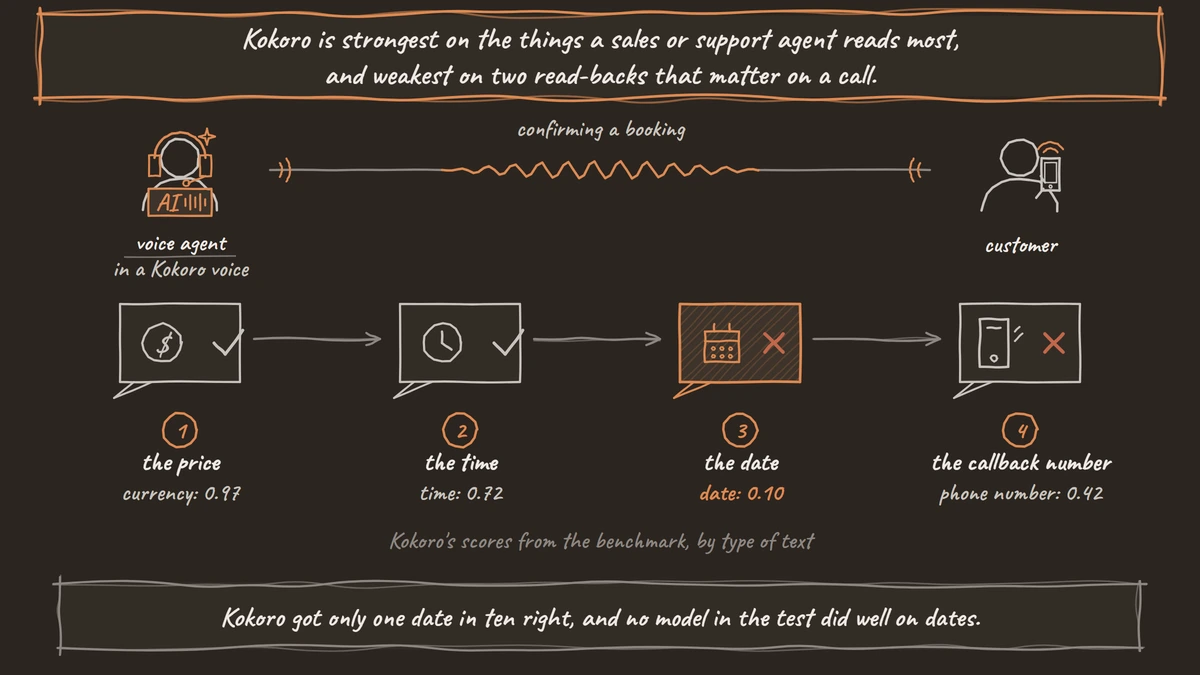
Kokoro is strongest on the things a sales or support agent reads most, and weakest on two read-backs that matter on a call. These are its scores from the benchmark, by type of text:
| Type of text | kokoro-82m | Best of the seven |
|---|---|---|
| Initialism or acronym | 1.00 | 1.00 (Kokoro) |
| Currency | 0.97 | 0.97 (Kokoro) |
| Decimal | 0.90 | 0.90 (Kokoro) |
| Time | 0.72 | 0.72 (Kokoro) |
| Address | 0.55 | 0.55 (Kokoro) |
| Phone number | 0.42 | 0.60 (orpheus-3b, chatterbox) |
| Date | 0.10 | 0.23 (chatterbox) |
Prices and acronyms come out right almost every time, and times about seven in ten. Dates and phone numbers do not, and those are the two things an agent reads back to confirm a booking or a callback number. Kokoro got only one date in ten right, and no model in the test did well on dates.
The fix is in the text, before the voice sees it. Tell the language model in the prompt to write dates, times and numbers as spoken words, such as "Tuesday, March fourth", and to read phone numbers digit by digit in small groups. Our post on how to reduce robotic TTS in voice agents has the full set of rules. For a line that never changes, record it once and Kokoro never has to read it.

Open Source Alternative to Vapi / Retell
Self-hosted voice agent platform — no per-minute fees
dograh-hq/dograh
Star on GitHub
Speed and sound on a phone call
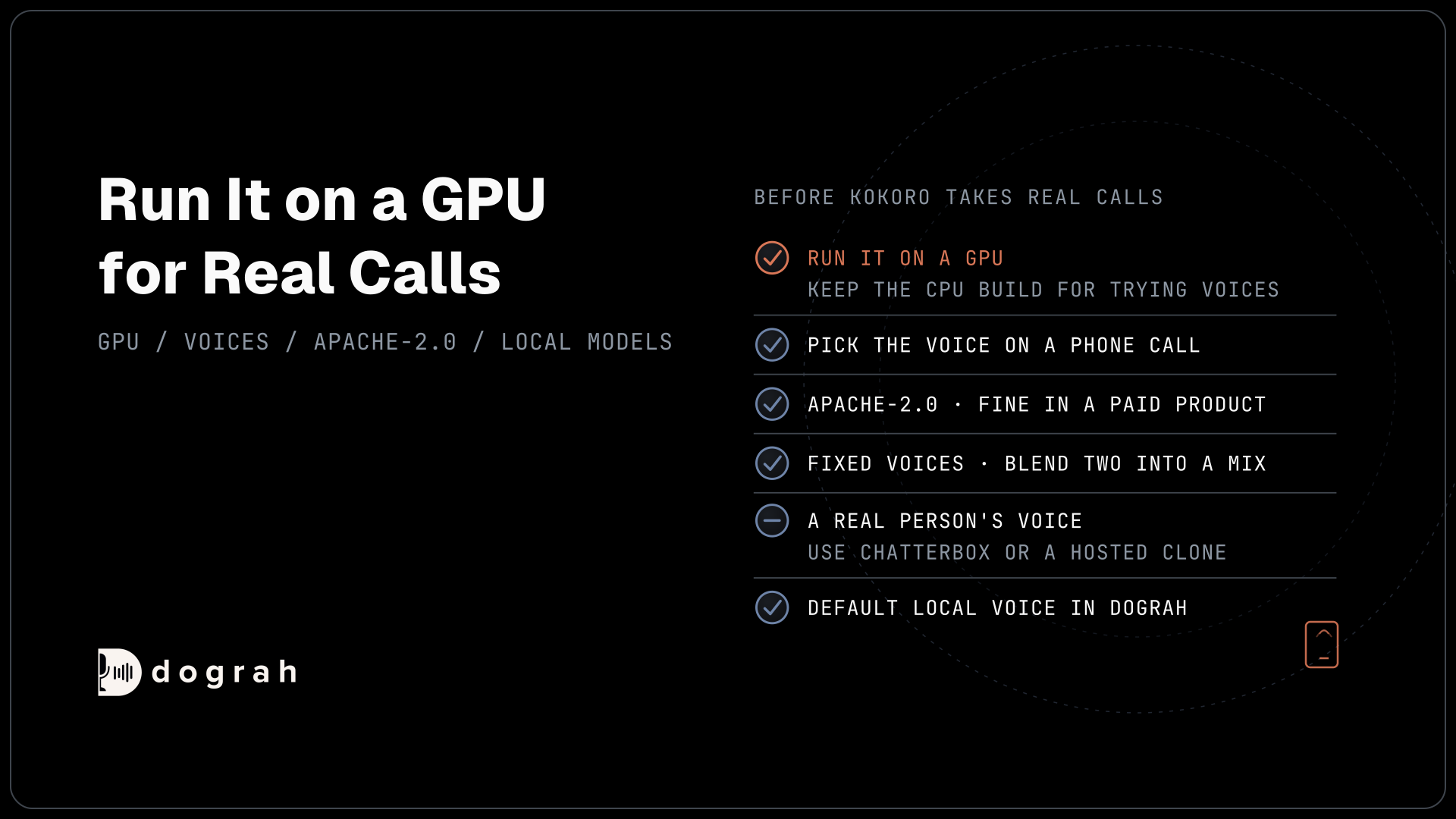
Kokoro is small, but small is not the same as fast everywhere. Kokoro-FastAPI, the open-source server most teams run it in, reports about 300 ms to first audio on a GPU and about 3.5 seconds on an older desktop CPU. A caller hears 3.5 seconds of silence as a dropped line, so run Kokoro on a GPU for real calls and keep the CPU build for trying voices.
Time to first audio is the number to watch, because a whole turn of speech-to-text, language model and voice needs to come back in under about 800 ms. Measure it on your own GPU with several calls running, since every call's sentences queue on the same card.
On sound, Kokoro is good but not top of the field. On the Artificial Analysis Speech Arena, where listeners vote blind between pairs of clips, Kokoro 82M v1.0 ranks 63rd of 103, with hosted voices at the top. Most phone calls still reach the agent as 8 kHz audio, which strips some of the detail listeners vote on, so pick your Kokoro voice on a real phone call.
Voices, languages and the license
Kokoro's model card lists 54 voices across 8 languages in v1.0, in a model of 82 million parameters. It is Apache-2.0, so you can use it in a paid product, and the card says it is already deployed in numerous projects and commercial APIs. The voice names carry their accent and gender, so af_heart is an American English female voice.
The one hard limit is cloning. Kokoro has no reference-clip cloning, so it cannot speak in your founder's or your best agent's voice. Kokoro-FastAPI can blend two voices into a new mix, written like af_bella+af_heart, but the mix copies no real person.
When the agent must sound like a real person, use Chatterbox, which is MIT and clones from a short clip, or a hosted cloned voice such as one from Cartesia or ElevenLabs. Our comparison of Kokoro vs Chatterbox vs Coqui XTTS covers the open options and their licenses.
Join the Dograh Community
Dograh is an OSS alternative to Vapi. Join our Slack community for queries, releases, best practices & community interactions.
Running Kokoro in Dograh
Dograh runs the call flow, tools and telephony as the orchestration layer, and the speech and language models sit in their own layer that you choose. That makes Kokoro one voice setting among many, picked per agent.
Kokoro is the default model behind Dograh's Local Models (Speaches) option in the voice settings. The defaults are the model kokoro, the voice af_heart and a speed you can set from 0.25 to 4.0, and Kokoro-FastAPI returns the raw 24 kHz audio this option plays. Our tutorial on how to run Kokoro TTS locally sets it up next to Dograh in Docker and makes the first test call.
If Kokoro's voices do not suit a campaign, switch that agent to a hosted voice with your own key and the flow stays as it is. Self-hosted Dograh has no per-minute platform fee, but servers, model keys and phone minutes still cost money. Dograh Cloud charges a 1¢-a-minute platform fee. Kokoro itself adds GPU time, with no per-character bill.
Self-hosting Dograh with Kokoro, plus open speech-to-text and language models, keeps call audio on your own servers. Kokoro's weak spots have a second fix here as well. Lines the agent says on every call, such as a date-heavy policy notice, can play as pre-recorded clips that skip the voice model entirely.
Glossary
- Verbalization
- Turning written forms such as $322.41, 2026-03-04 or #A7 into the words a person would say. Our benchmark scores how often a voice model gets this right on its own.
- Time to first audio
- The wait between sending text to the voice and hearing its first sound. For Kokoro it is about 300 ms on a GPU and about 3.5 seconds on an older desktop CPU, per Kokoro-FastAPI.
- Kokoro-FastAPI
- The open-source server most teams run Kokoro in. It returns the raw audio Dograh's local voice option plays, and it can blend two voices, such as af_bella+af_heart, into a new mix that copies no real person.
- Reference-clip cloning
- Making a voice from a short recording of a real person. Kokoro cannot do it, so a cloned voice needs a model such as Chatterbox or a hosted provider.