
Gladia alternatives are divided into hosted speech-to-text APIs, open models on your own GPU and voice agent platforms that run either one. For teams that want to own the phone agent, Dograh is the open-source AI voice agent platform, self-hosted or on Dograh Cloud. Deepgram, AssemblyAI, Soniox and Speechmatics are hosted APIs, and Parakeet and Whisper are open models.
Key Takeaways
- Gladia's live rate is 0.68 EUR an hour, on Solaria-1 only.
- Self-serve Gladia allows 30 real-time sessions, so 30 live calls at once.
- Dograh switches speech-to-text with one setting per agent and runs on your servers.
Gladia streams speech-to-text in 100 languages and switches between them mid-call, yet a phone agent needs more than a transcript. Below we compare the options in one table, show how Dograh switches speech-to-text per agent, then cover why teams leave, rival APIs, a priced month, staying and moving.
Gladia alternatives in one table
Gladia is the baseline row, and each other option is described on the same terms. Gladia's pricing page lists real-time transcription at 0.68 EUR an hour on Solaria-1, 30 real-time sessions on self-serve, and custom hosting with zero data retention on Enterprise.
| Option | Live rate | Calls at once | Open source | Where the audio goes |
|---|---|---|---|---|
| Gladia (baseline) | 0.68 EUR an hour (Solaria-1) | 30 real-time sessions on self-serve, unlimited on Enterprise | No | Gladia's cloud, custom hosting on Enterprise |
| Dograh | Runs any row below on your key, or its own models | 10 calls by default when self-hosted, raisable. Cloud includes 10 | Yes, BSD 2-Clause | Your servers or Dograh Cloud. Audio reaches the provider you pick |
| Deepgram | $0.0048 a minute (Nova-3, one language, current promotion). $0.0058 multilingual | 150 streams on pay as you go, 225 on Growth | No | Deepgram's cloud, containers on your hardware on Enterprise |
| AssemblyAI | $0.15 an hour (Universal-Streaming) to $0.45 (Universal-3.6 Pro Realtime) | 100 new streams a minute on pay as you go | No | AssemblyAI's cloud |
| Soniox | $0.12 an hour, plus token charges | 10 streams by default, raisable | No | Soniox's cloud |
| Speechmatics | $0.30 an hour (Linden 1, introductory) | 50 real-time sessions on self-serve | No | Its cloud, containers on Enterprise |
| ElevenLabs Scribe v2 Realtime | $0.22 an hour | Set by plan | No | ElevenLabs' cloud |
| Google Cloud Speech-to-Text | $0.016 a minute for the first 500,000 minutes | 300 streams per region | No | Google's cloud |
| Open models (Parakeet, Canary-Qwen, Whisper) | No hourly bill, a GPU instead | Whatever your GPU carries | Open weights | Your own GPU |
Every hosted row is closed code running in the provider's cloud, so the call audio leaves your network on each one. Only the open models keep it in, and only Dograh in the table is a full phone agent rather than a transcript.
Dograh: swap speech-to-text, choose where it runs
Gladia sells the layer that turns a caller's speech into text, and a phone agent needs everything around it. Dograh is an open-source AI voice agent platform under the BSD 2-Clause license that supplies the rest, from the phone line and turn-taking to the language model, the voice, tools and transfers to a person. Its speech-to-text setting lists Gladia beside Deepgram, AssemblyAI, Soniox, Speechmatics, ElevenLabs, Google, Azure, OpenAI, Cartesia, Sarvam, Smallest AI, Hugging Face and Dograh's own models, and local models such as Whisper connect through Speaches.
Changing provider is one setting per agent. You add the key under Providers, pick the provider on the STT tab of a model configuration under Models, and choose that configuration in the agent's Model tab, so two copies of one agent can take the same test calls through Gladia and a rival. Gladia runs there on Solaria-1 in the call language you pick, one language per agent. Words in the agent's Dictionary go as hints to Deepgram, AssemblyAI, Soniox, Speechmatics and the built-in model, which helps with brand names on those providers.
Dograh runs the call as the orchestration layer, and the speech and language models are a separate layer you choose. With your own key the contract is yours, but the audio still goes to that provider's cloud, which holds for Gladia and every hosted row above. Audio stays on your servers only when the models run there too, such as Parakeet or Whisper beside a self-hosted install.
You can self-host it with Docker Compose on a server with at least 8 GB of RAM and 4 vCPUs, or use the managed Dograh Cloud, and the Enterprise plan adds on-prem deployment. Self-hosted, there is no per-minute platform fee, but servers, model keys and phone minutes still cost money. Dograh Cloud charges a 1¢-a-minute platform fee, and your speech-to-text provider bills its own rate on your key either way. A self-hosted install runs 10 calls at once by default, a limit you can raise, and each provider field takes more than one API key to spread calls across accounts. The server, the database and upgrades are your team's job, with community support on the open-source edition and custom SLAs on Enterprise.

Open Source Alternative to Vapi / Retell
Self-hosted voice agent platform — no per-minute fees
dograh-hq/dograh
Star on GitHub
Why teams look for a Gladia alternative
Most teams that leave Gladia are reacting to how it fits a live phone line, not to its language list. Live audio runs only on Solaria-1 at 0.68 EUR an hour, and the bill comes in euros, so a team that budgets in dollars carries the exchange rate on every invoice. Solaria-3 lists 0.16 EUR an hour, but it works on recordings only and covers five languages.
The session cap is the second reason. Self-serve Gladia allows 30 real-time sessions, and each live call holds one session for as long as it runs, so a busy hour stops at 30. Unlimited concurrency sits on Enterprise. PII redaction is the third, since Gladia offers it on async jobs only, at 0.07 EUR an hour, and not on live streams.
Our post on Gladia pricing walks through the rate card, top-up bonuses and a 1,000-call month in detail. The point here is narrower. Each of these limits shows up only once the agent is on a real phone line.
Hosted APIs that bill live audio by the hour
Each of these runs in the provider's cloud as closed code, and each answers one of Gladia's limits differently. Deepgram bills per second, currently $0.0048 a minute for Nova-3 in one language and $0.0058 multilingual on a promotion, down from $0.0077 and $0.0092. It allows 150 streams on pay as you go and 225 on Growth, and Enterprise adds containers on your own NVIDIA hardware.
AssemblyAI charges $0.15 an hour for Universal-Streaming and $0.45 for Universal-3.6 Pro Realtime, billed on session time with idle seconds counted. Its limit is a start rate of 100 new streams a minute on pay as you go. Our guide to AssemblyAI alternatives compares the same providers from that side.
Soniox lists $0.12 an hour for live audio plus small token charges, 60 languages and 10 streams by default, which you raise in its Console. Our post on Soniox speech-to-text for voice agents covers its models and endpoint settings. Speechmatics charges $0.30 an hour for Linden 1 at an introductory rate, originally $0.40, with 50 real-time sessions on self-serve and containers on Enterprise.
ElevenLabs Scribe v2 Realtime costs $0.22 an hour. Google's standard models cost $0.016 a minute for the first 500,000 minutes a month, which works out to $0.96 an hour, with 300 streams per region.
Open models on your own GPU
Open models are the route that keeps call audio inside your network with no hourly bill. NVIDIA's Parakeet TDT 0.6B comes in v2 for English and v3 for 25 languages, and Canary-Qwen 2.5B trades size for accuracy. Both are CC-BY-4.0, which allows commercial use with attribution, and OpenAI's Whisper is MIT licensed.
Your team runs the GPU, the batching and the upgrades in exchange. Parakeet v2 needs roughly 2 GB of GPU memory, and our guide to open-source speech-to-text models covers which model fits which card and language.
What 30,000 live minutes cost
One month on every meter shows the spread. Take an example of 30,000 live minutes, or 500 hours of audio, and price only the speech-to-text line. Euros and dollars stay in their own currency, with no conversion.
| Option | Sum | Example month |
|---|---|---|
| Gladia real-time | 500 hours x 0.68 EUR | 340 EUR |
| Soniox real-time | 500 hours x $0.12 | $60, plus token charges |
| AssemblyAI Universal-Streaming | 500 hours x $0.15 | $75, plus any idle session time |
| AssemblyAI Universal-3.6 Pro Realtime | 500 hours x $0.45 | $225 |
| ElevenLabs Scribe v2 Realtime | 500 hours x $0.22 | $110 |
| Speechmatics Linden 1 | 500 hours x $0.30 | $150 |
| Deepgram Nova-3 multilingual | 30,000 minutes x $0.0058 | $174 at the promotion, $276 at $0.0092 |
| Google standard model | 30,000 minutes x $0.016 | $480 |
| Open model on your GPU | Server time | The GPU bill, whatever the minutes |
The speech-to-text line is small next to the rest of a phone agent's bill. The language model, the voice and the phone minutes for the same calls usually cost more than it does. Pick on accuracy with your callers and on the session limit you will hit, and use price as the tiebreaker.
Join the Dograh Community
Dograh is an OSS alternative to Vapi. Join our Slack community for queries, releases, best practices & community interactions.
Check accuracy on your own calls
Gladia does not appear in Pipecat's open streaming benchmark, so there is no like-for-like score for Solaria-1 on live audio. On that benchmark, which plays 1,000 conversational samples at real-time pace, Soniox stt-rt-v6 has the lowest pooled word error rate at 0.71%, with AssemblyAI's universal-3-6-pro close behind at 0.80%. Gaps under about a quarter of a point fall inside its confidence interval.
Those samples are not phone audio. Most phone calls still reach the agent as 8 kHz audio, while a browser demo runs at 16 kHz, and how much that hurts depends on the model and the phone path. Run Solaria-1 and two rivals on 30 or so recorded calls from your own line, with your product names in them, before you decide.
When staying on Gladia makes sense
Gladia is a sound choice when callers switch languages mid-sentence. Solaria-1 covers 100 languages, and 99 of them support code-switching. Solaria-3 at 0.16 EUR an hour is a good fit for re-running recordings after the call, and Enterprise adds unlimited sessions, zero data retention and custom hosting.
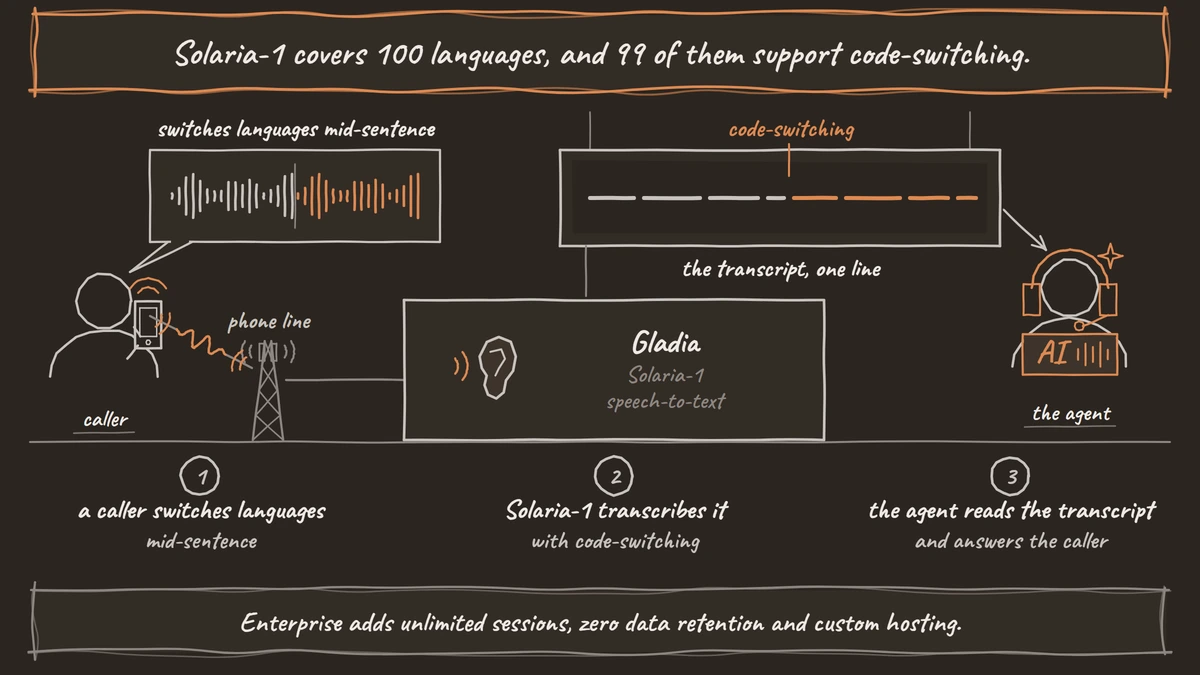
Inside Dograh, a bilingual line has two simple routes. Build one agent per language with Gladia set to that language, or pick a provider with auto-detect, such as Soniox with its Language set to multi. Either way the rest of the agent stays the same.
What moving off Gladia takes
Moving off Gladia means switching the speech-to-text provider, not rebuilding the agent. Add keys for two candidates under Providers, build one model configuration for each, and point the agent at the first for one batch of test calls and at the second for the next. Read the transcripts side by side, and check each candidate's limit against your busiest hour.
When a call goes wrong after the switch, each call's trace shows the speech-to-text, AI and voice time for every turn. That tells you whether the new provider is slower or simply mishearing your callers. Move one phone number first, and keep Gladia on the rest until the transcripts hold up.
Picking your Gladia alternative
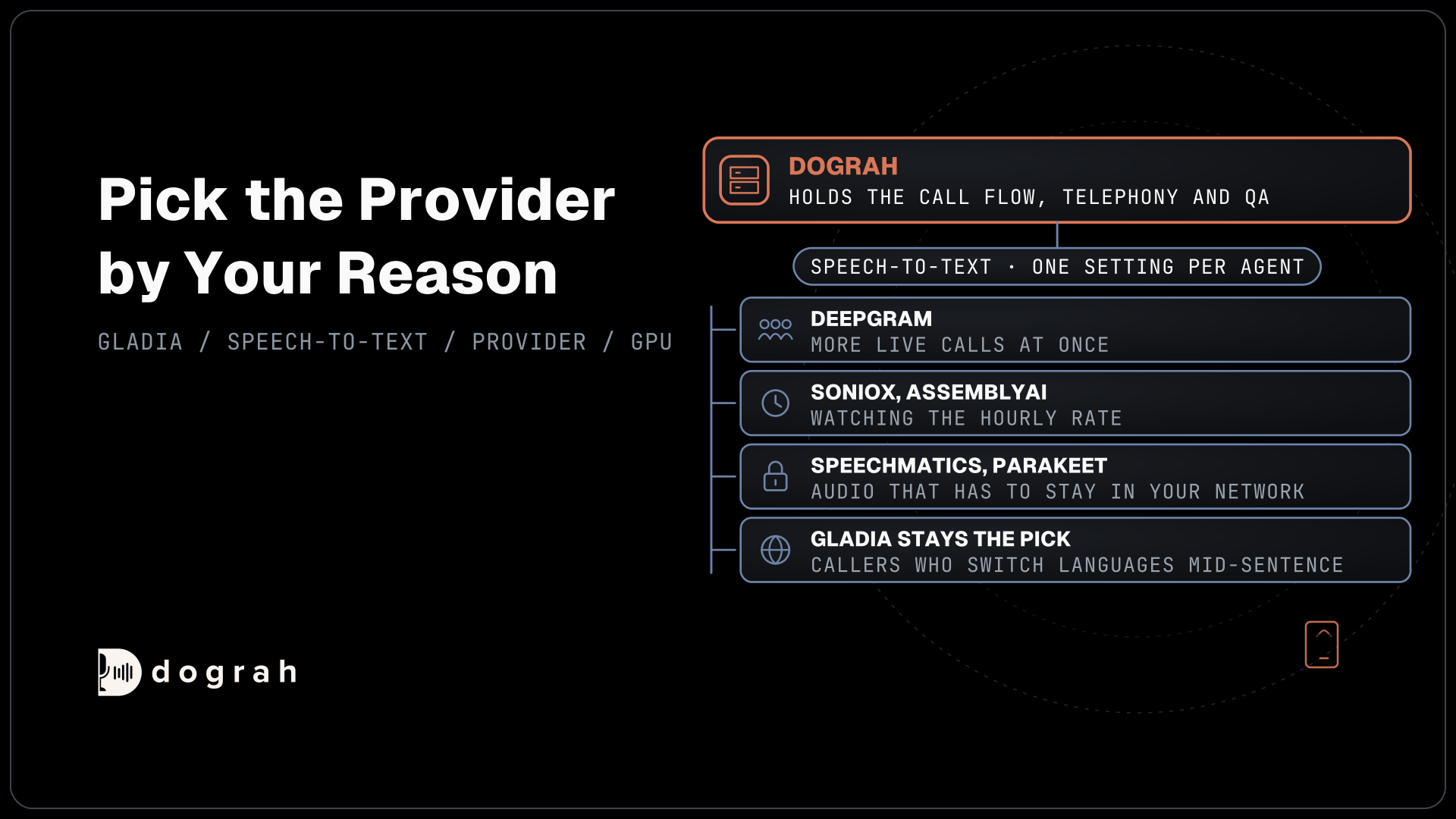
Start with where the agent runs. If you want open source, your own servers or on-prem inside your network, start with Dograh, which holds the call flow, telephony and QA while the speech-to-text provider stays one setting per agent. Then pick the provider by your reason for leaving. Deepgram suits teams that need more live calls at once, Soniox and AssemblyAI suit teams watching the hourly rate, Speechmatics and open models such as Parakeet suit audio that has to stay inside your network, and Gladia stays the pick for callers who switch languages mid-sentence. Prove the shortlist on your own recorded calls before a live number moves.
Glossary
- Code-switching
- A caller moving between languages inside one call or one sentence. Gladia's Solaria-1 supports it on 99 of its 100 languages, while most APIs expect one language per stream or auto-detect at the start.
- Concurrent session cap
- The number of live streams an account can hold open at once. A live call holds one for its whole length, so Gladia's 30 self-serve sessions mean 30 calls at once.
- Async transcription
- Speech-to-text on a finished recording rather than a live stream. Gladia's Solaria-3 and its PII redaction work this way, so they suit review after the call, not the call itself.
- Bring your own key (BYOK)
- Using a model provider through your own account in the platform. The contract and billing sit with you, while call audio is still sent to that provider.