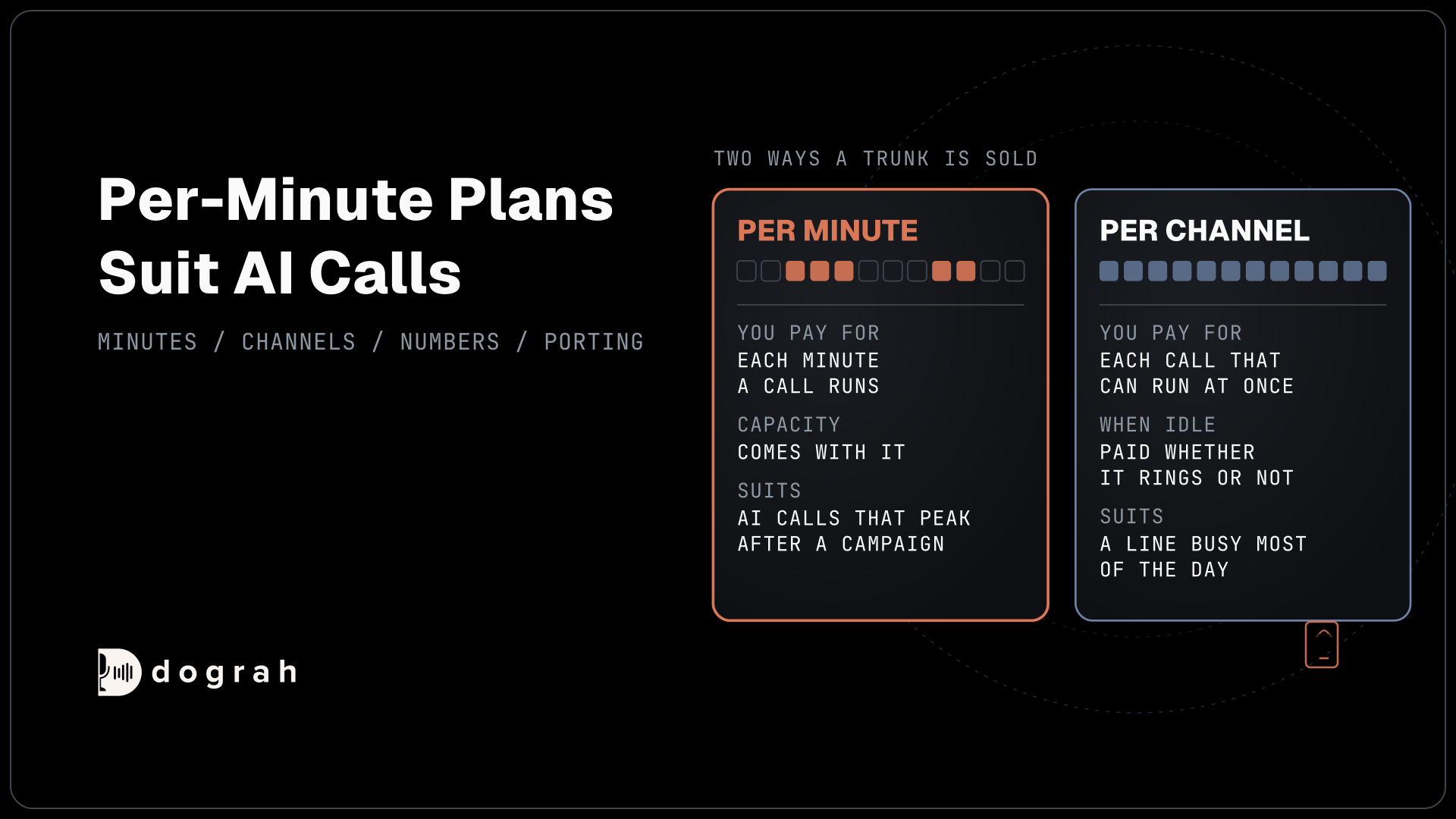

Gladia's self-serve real-time speech-to-text costs 0.68€ an hour, about 0.0113€ a minute, so a five-minute live call costs about 0.057€. Recorded audio is billed at lower batch rates from 0.16€ an hour. Dograh, the open-source AI voice agent platform we build, runs Gladia on your own key. You can self-host it or run it on Dograh Cloud.
Key Takeaways
- A live call pays 0.68€ an hour, over four times Solaria-3's batch rate.
- Self-serve allows 30 real-time sessions at once, one for each live call.
- PII redaction runs only on recordings, not on the live stream.
Gladia lists its prices per hour of audio, but a voice agent pays by the call. This post turns each Gladia line into cost per call minute, works through one labelled example, sets Gladia beside other streaming options and ends with running it in Dograh on your own key.
How Gladia prices live and recorded audio
Gladia sells two meters, and a live voice agent uses only one of them. One is real-time transcription, which returns words while the caller speaks, and the other is async transcription, which works on a finished recording. Prices are in euros per hour of audio, and self-serve accounts pay from a prepaid wallet with no subscription.
| Line | Per hour | Per minute | Works on a live call |
|---|---|---|---|
| Real-time, Solaria-1 | 0.68€ | 0.0113€ | Yes |
| Async, Solaria-1 | 0.27€ | 0.0045€ | No, recordings only |
| Async, Solaria-3 | 0.16€ | 0.0027€ | No, recordings only |
The live rate is the one to budget. Real-time runs on Solaria-1, the only model Gladia's live API accepts, and it covers more than 100 languages. Solaria-3 carries the lowest list rate, but it works only on recordings and covers 5 languages. So a live agent pays 0.68€ an hour, a little over four times the Solaria-3 rate.
Volume discounts apply to async only, down to 0.12€ an hour on Solaria-3 past 10,000 hours a month. Real-time has a single self-serve rate, and a larger top-up is the way to lower it. Gladia adds 10% of credit on a 1,000€ top-up, 15% on 2,500€ and 20% on 5,000€, and top-up credits do not expire. By our arithmetic, the 20% bonus brings the live rate down to about 0.57€ an hour.
Add-ons, limits and the free credit
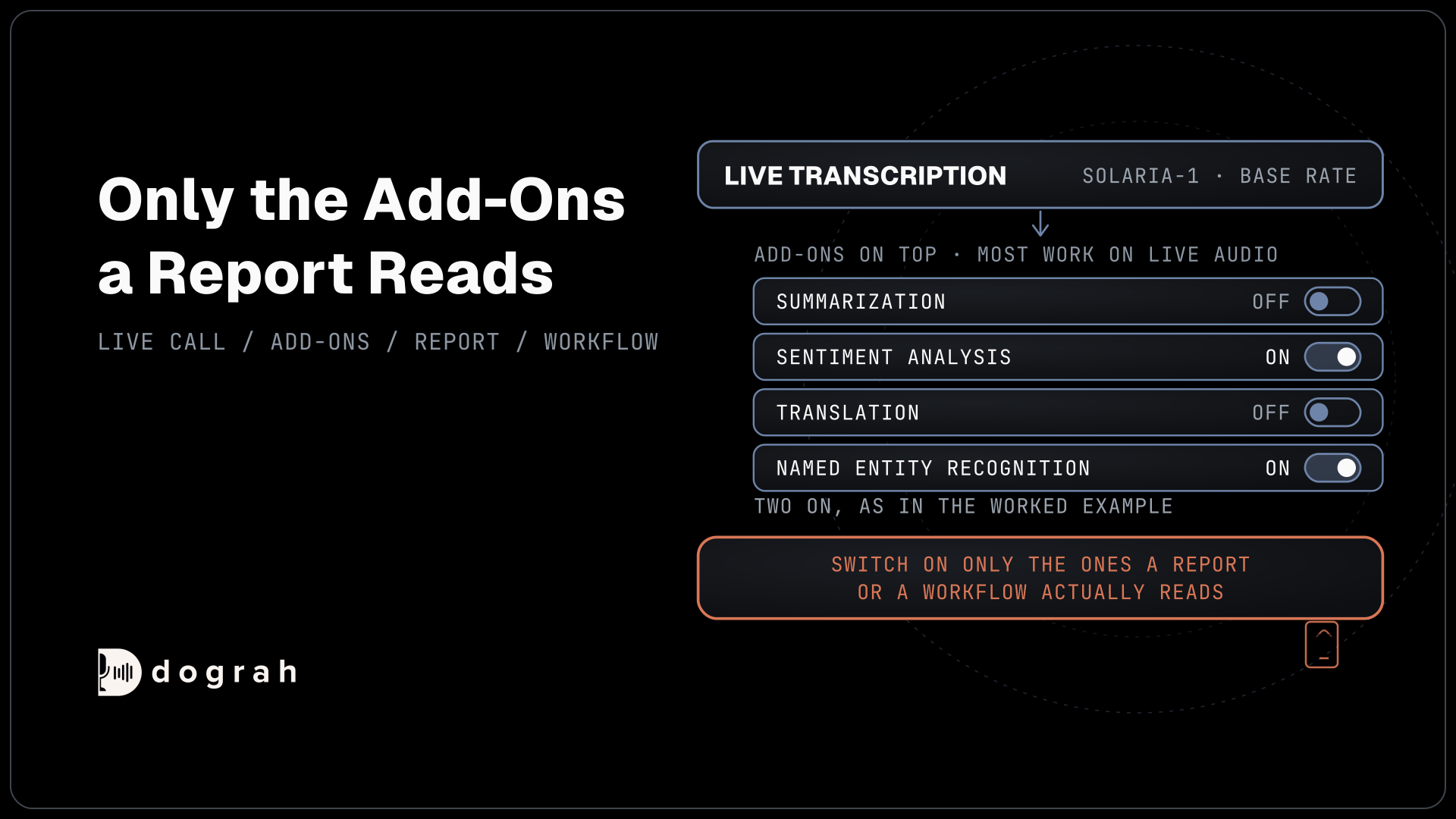
Add-ons are priced per hour on top of the base rate, and most of them work on live audio. Summarization costs 0.03€ an hour, sentiment analysis 0.02€, translation 0.05€ and named entity recognition 0.07€, on both real-time and async.
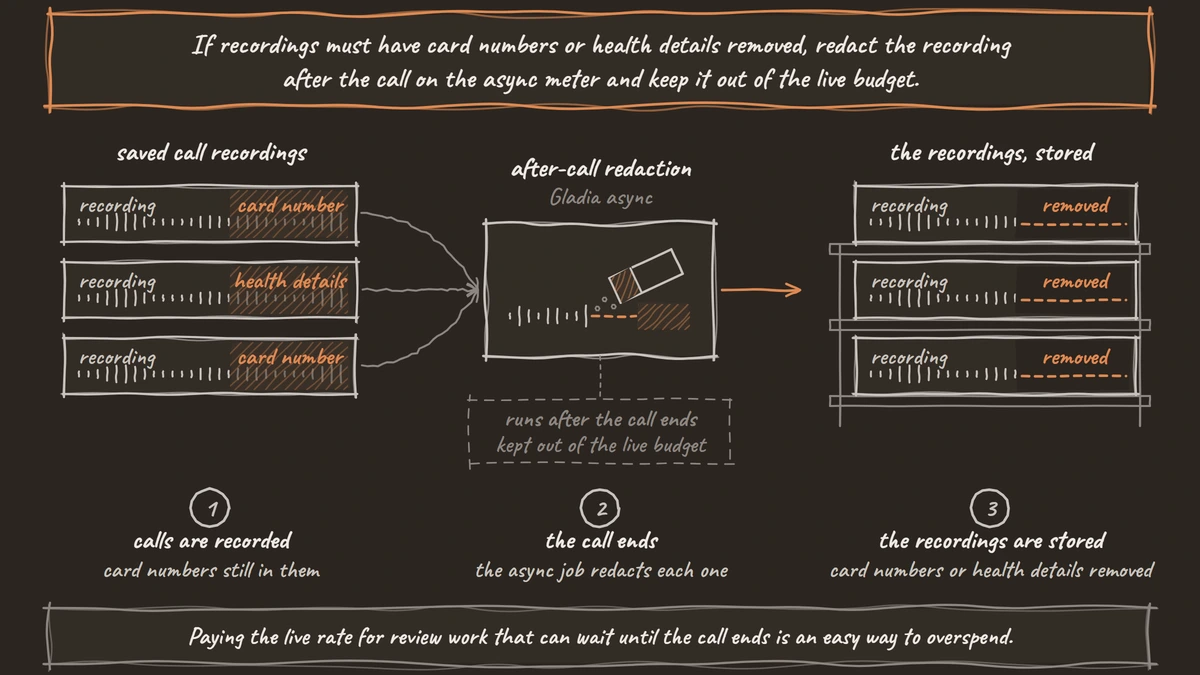
Redaction of personally identifiable information (PII) is the exception. It costs 0.07€ an hour and runs on async only, with real-time listed as unavailable. If recordings must have card numbers or health details removed, redact the recording after the call on the async meter and keep it out of the live budget.
The self-serve plan allows 30 real-time sessions and 25 async requests at once. A live call holds one real-time session for as long as it runs, so 30 is your ceiling on calls at once. Gladia answers requests over the limit with an HTTP 429 error, and on a call that means the agent cannot hear the caller. Enterprise is a custom annual plan with unlimited concurrency, zero data retention, custom hosting and no model training by default.
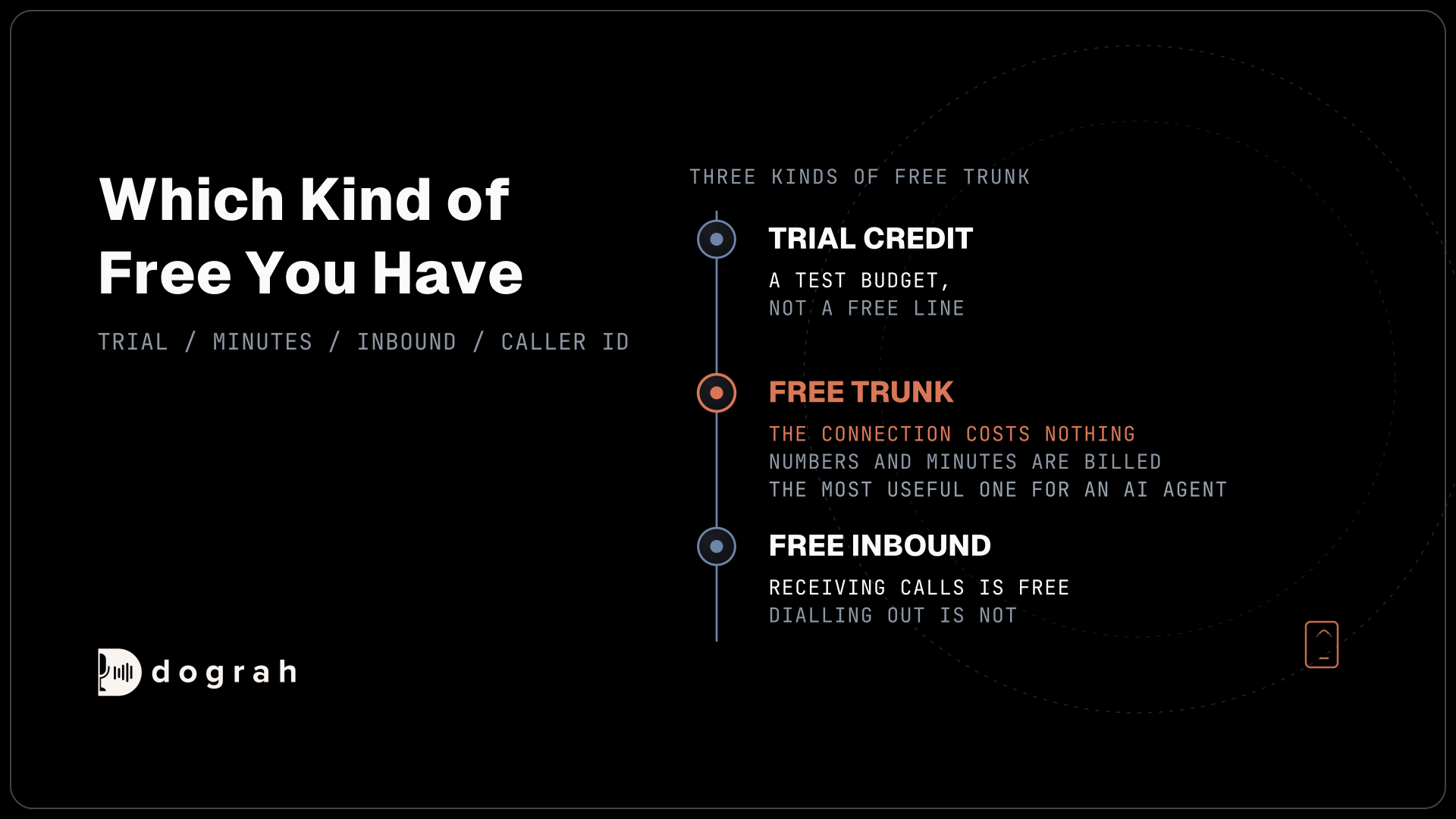
New accounts get 50€ of credit, valid for one year. Gladia puts that at about 73 hours of real-time transcription, roughly 875 five-minute calls, which is enough to run a pilot on real phone traffic before you top up.
One worked example: 1,000 five-minute calls
This is an example built only from Gladia's listed rates. An agent takes 1,000 calls in a month, each five minutes long, with Gladia transcribing the caller live. The example counts every minute the call is connected.
| Step | Arithmetic | Result |
|---|---|---|
| Live rate per minute | 0.68€ / 60 | 0.0113€ |
| One five-minute call | 0.0113€ x 5 | about 0.057€ |
| 1,000 calls | 5,000 minutes = 83.3 hours x 0.68€ | 56.67€ |
| With sentiment and entity recognition | 83.3 hours x (0.68€ + 0.02€ + 0.07€) | 64.17€ |
| Recordings re-run on Solaria-3 after the calls | 83.3 hours x 0.16€ | 13.33€ |
At this size, speech-to-text is a small line. 56.67€ for 1,000 calls is about 5.7 euro cents a call, before the language model, the voice and the phone minutes. The two add-ons raise it by about 13%, so switch on only the ones a report or a workflow actually reads.
The last row shows where batch fits. If you want a cleaner transcript for quality review, run each recording through Solaria-3 after the call, and the whole month of reviews costs 13.33€. Paying the live rate for review work that can wait until the call ends is an easy way to overspend.

Open Source Alternative to Vapi / Retell
Self-hosted voice agent platform — no per-minute fees
dograh-hq/dograh
Star on GitHub
Gladia next to other streaming options
Line up the live rates per call, and keep each one in its vendor's currency. Gladia prices in euros and the others in dollars, so the table does not convert them. Speechmatics charges $0.30 an hour for Linden 1 in real time.
| Live option | Listed rate | One five-minute call |
|---|---|---|
| Gladia Solaria-1 real-time | 0.68€ an hour | about 0.057€ |
| Deepgram Nova-3 streaming, one language | $0.0077 a minute | $0.0385 |
| AssemblyAI Universal-3.6 Pro Realtime | $0.45 an hour | $0.0375 |
| AssemblyAI Universal-Streaming | $0.15 an hour | $0.0125 |
| Speechmatics Linden 1 real-time | $0.30 an hour | $0.025 |
| Any of these in Dograh Cloud | The vendor's rate, on your own key | Plus the 1¢-a-minute platform fee, $0.05 |
| Self-hosted Dograh with a local model | No per-hour speech bill | Your servers' cost |
Gladia lists the highest live rate of the five. The meters differ too. Our Deepgram pricing breakdown shows that Deepgram bills per second of audio, and our AssemblyAI pricing post explains why AssemblyAI counts open session time, silence included.
Price is half the choice. On the Artificial Analysis speech-to-text index, AA-WER v2, a weighted mix of AA-AgentTalk, VoxPopuli and Earnings22 recordings, Gladia's Solaria-1 scores a 4.1% word error rate and Solaria-3 scores 3.2%, against 5.2% for Deepgram Nova-3. Those runs use recorded files, not live streams or phone audio, and the 3.2% belongs to the batch model a live call cannot use.
So treat both numbers as a shortlist, and run Solaria-1 on 20 to 30 of your own recorded calls before you choose. Our roundup of speech-to-text APIs for voice agents compares the rest of the field on price, caps and languages.
What Gladia needs from a phone call
Gladia's live API takes phone audio as it arrives. Gladia's live session settings accept mu-law and a-law encoding at an 8,000 Hz sample rate, the format most phone lines deliver, so the audio needs no conversion first.
On a call, Dograh streams the line's audio to Gladia at the rate it arrives, 8,000 Hz on Twilio. Most phone calls still reach the agent as 8 kHz audio, while a browser test call runs at 16 kHz, so judge Gladia's accuracy over a real phone line, not a web demo.
Join the Dograh Community
Dograh is an OSS alternative to Vapi. Join our Slack community for queries, releases, best practices & community interactions.
Running Gladia in Dograh
Gladia is built into Dograh as a speech-to-text provider you use with your own key, so Gladia bills you directly at the rates above. Add the key under Providers, then in Models create a configuration in BYOK mode and pick your Gladia connection on the STT tab, as the Model Configurations guide shows. The agent runs Solaria-1 in the call language you set there.
A connection can hold several Gladia keys, and one is picked at random for each call. That adds capacity only when each key sits on its own limit and you are entitled to use them together, as our post on STT and TTS concurrency limits explains. The platform has a limit of its own. A self-hosted install runs 10 concurrent calls by default, and Dograh Cloud's pay-as-you-go plan includes 10, with more on request.
Each call's trace shows the speech-to-text time for every turn. That tells you how much of each reply delay comes from Gladia before you commit more traffic to it.
If another provider hears your callers better, switching is a settings change, explained in the transcriber settings. The same agent can move to Deepgram, AssemblyAI or Speechmatics, or to a local open model on your own servers with no per-hour speech bill.
Self-hosted Dograh has no per-minute platform fee, but servers, model keys and phone minutes still cost money. Dograh Cloud charges a 1¢-a-minute platform fee. On the example's 5,000 minutes, the Cloud fee comes to $50.00, billed apart from Gladia's 56.67€.
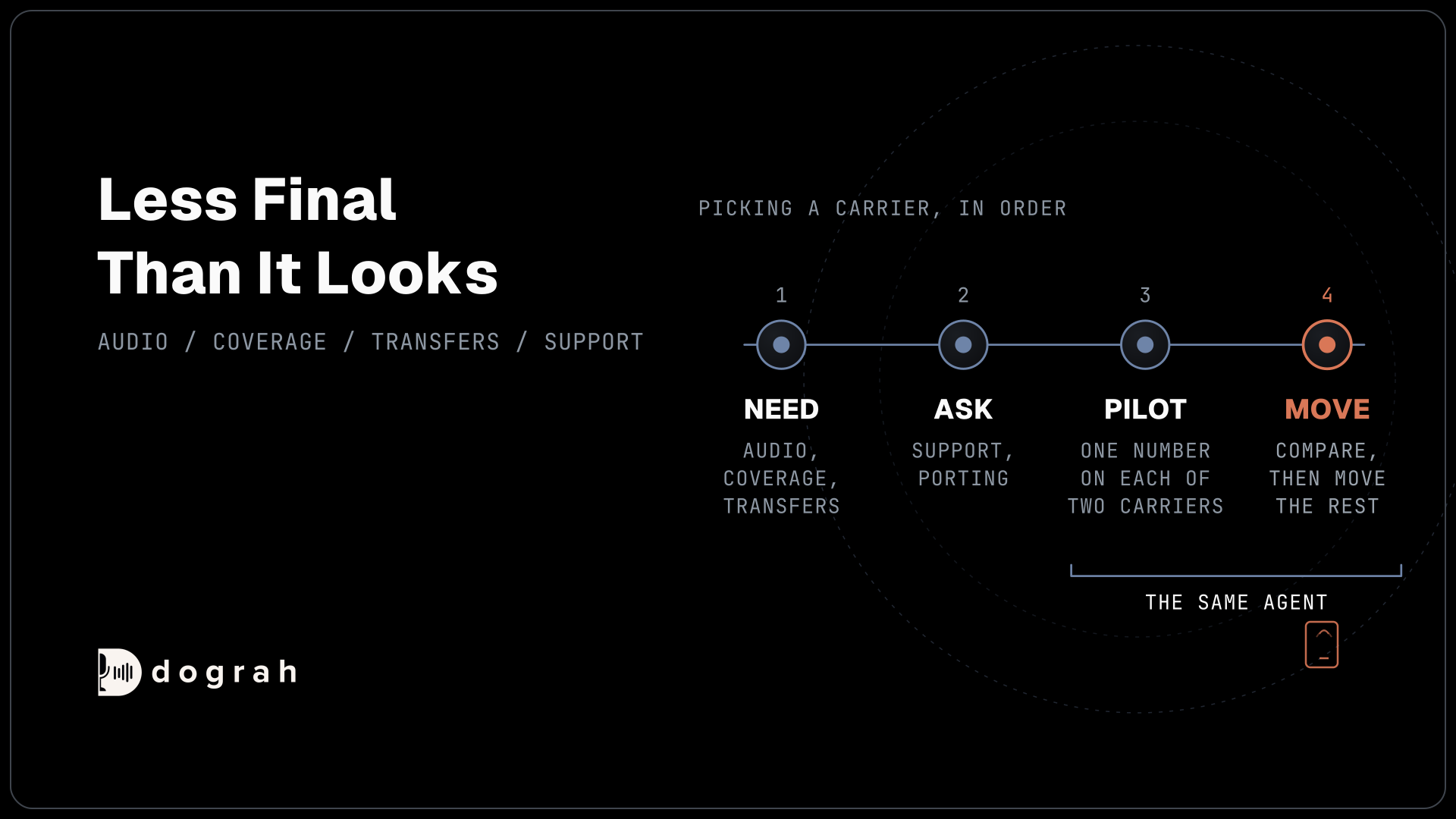
Start with the free credit. Put Gladia on one agent, run a few hundred real calls, and read its usage line next to your call traces before you move the rest of your traffic.
Glossary
- Real-time transcription
- Speech-to-text that returns words while the caller is still speaking. A live voice agent needs it, and on Gladia it runs on Solaria-1 at 0.68€ an hour.
- Async transcription
- Speech-to-text on a finished recording, after the call. Gladia prices it lower, from 0.16€ an hour on Solaria-3, and it suits quality review and redaction, not the live call.
- Concurrent sessions
- The number of real-time streams open at the same moment. Each live call holds one, so Gladia's self-serve cap of 30 is also a cap on calls at once.
- Top-up bonus
- Extra credit Gladia adds when you load a larger amount into the prepaid wallet: 10% on 1,000€, 15% on 2,500€ and 20% on 5,000€. It is the only lever on the self-serve live rate.